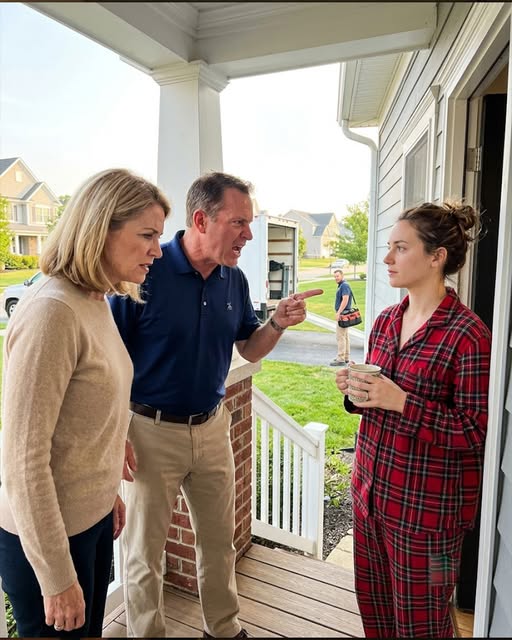
Mom brought a locksmith.
“Your sister needs this estate more.”
Dad snapped, “We co-signed!”
I just smiled as the sheriff stepped up.
“Sir, you only signed…” a lobby guestbook.
It was a Saturday morning, precisely 8:00. The air outside was still crisp, holding that quiet, untouched chill that only exists before the rest of the world wakes up and the noise of the city begins.
I was standing in the grand foyer of my home, wearing my oversized, comfortable flannel pajamas, holding a warm mug of black, unsweetened coffee.
For the past four days, I had barely slept. I had worked until 2:00 in the morning the night before finalizing a massive, highly sensitive quarterly contract compliance report for the International Medical Corporation I work for.
As a senior contract compliance director, my entire professional life revolves around finding microscopic loopholes, exposing fraudulent clauses hidden in hundreds of pages of legal jargon, and protecting millions of dollars in corporate assets from being siphoned away by bad actors.
My brain is fundamentally hardwired to look for discrepancies. I am paid quite literally to never let my guard down, to trust absolutely no one, and to verify every single claim with hard, undeniable documentation.
So, after a grueling 60-hour work week filled with intense negotiations and legal battles, all I wanted was a weekend of absolute, uninterrupted silence inside the sanctuary I had built for myself.
Instead, the aggressive, rhythmic, and incredibly violent pounding on my heavy oak front door completely shattered the peace of my morning.
It was not a polite knock. It was not the hesitant tap of a delivery driver dropping off a package. It was the kind of heavy demanding banging that expected immediate submission and access.
I did not even have time to set my coffee down and check the high-definition security camera feed on my phone before I pulled the heavy door open, expecting to find a deeply confused neighbor in some sort of an emergency.
What I found instead felt like a bizarre hallucination brought on by severe sleep deprivation.
My mother, Victoria, stood on my front porch. She was wearing her signature incredibly expensive beige cashmere sweater, her hair perfectly blown out and styled as if she were heading to a country club luncheon.
Rather than standing on my porch at the crack of dawn, she was looking at the facade of my house with the critical, hungry, calculating eyes of a real estate agent about to flip a foreclosure property.
Standing right behind her was my father, Arthur. He was wearing his pristine, neatly pressed golf attire, his arms crossed tightly over his broad chest, looking intensely annoyed that this little morning errand was cutting into his precious tee time.
And standing slightly to the side of them was a man holding a heavy canvas tool bag, wearing a faded work shirt with a local locksmith company logo stitched on the chest.
Further down my long, elegantly paved driveway, sitting right in front of my closed iron gates, was a massive white moving truck. Its heavy diesel engine was idling loudly, puffing small, dark clouds of exhaust into the cool morning air.
A crew of three large men leaned against the side of the truck, smoking cigarettes, and waiting for a signal.
My brain, trained to instantly analyze chaotic data and assess risk, tried to process the sheer, unadulterated absurdity of the scene unfolding on my property.
I tightened my grip around my warm coffee mug, feeling the heat seep into my cold fingers.
“What are you doing here?” I asked, keeping my voice entirely flat, devoid of any welcome, warmth, or surprise.
My mother did not even offer a basic polite greeting. She did not ask how I was doing. She just took a bold step forward, completely invading my personal space, and attempted to brush past me into the foyer as if she owned the place, and I was merely the hired help opening the door for her.
I immediately shifted my weight, planting my shoulder firmly against the door frame, physically and immovably blocking her path.
“Pack your bags, Maya,” she said breezily, offering a smile that was dripping with artificial sugary sweetness that did not reach her cold eyes. “You need to be out of here by noon.”
I stared at her, blinking slowly, letting the silence stretch for a moment to highlight her insanity.
“Excuse me.”
“Your sister Chloe and Trevor are getting married in two months,” my mother continued, her tone implying that this was the most natural, logical, and universally understood conversation in the world.
“They need a proper, sophisticated estate to start their new life together and to host their friends and colleagues. You are just one person, Maya. You are single. You do not need five bedrooms, a chef’s kitchen, and an entire acre of landscaped land.
It is incredibly selfish and entirely unreasonable of you to hoard all of this beautiful space when your sister is struggling so hard to find a nice venue for her wedding reception. So, your father and I are gifting this estate to her.
The movers are here to pack your things. You can find a nice, practical little apartment downtown by Monday.”
I stood completely firm in the doorway. I did not scream. I did not cry. Decades of dealing with this exact brand of emotional terrorism had burned all the panic and hysteria out of my system.
When you work in risk management, you do not throw tantrums when you spot a fraudster. You simply lock down the accounts.
I looked at the nervous locksmith who was shifting his weight uncomfortably from foot to foot and then back at my mother’s perfectly powdered face.
“I am sorry. Are you completely insane?” I asked, my voice remaining dangerously calm, low, and incredibly steady.
“You brought a locksmith and a heavy-duty moving crew to my house at 8:00 in the morning to illegally evict me from the $1,200,000 home that I bought with a $250,000 cash down payment, a home that is solely exclusively in my name.”
My father let out a loud, mocking scoff. He uncrossed his arms and puffed out his chest, stepping aggressively toward me.
He had always used his large physical size to intimidate people, a pathetic bullying tactic that used to terrify me into submission when I was a teenager, but now just looked desperate and sad.
“Do not be so dramatic and disrespectful, Maya,” Arthur snapped, his face turning a dark, dangerous shade of red.
“We are a family. Family wealth belongs to the family. We all share what we have. You have been living here like an absolute queen for 3 years while your poor sister struggles to make ends meet. It is time to let Chloe have her turn.
We are the ones who raised you. We made you who you are and you owe us. We make the decisions about family assets.”
He turned his attention away from me, completely dismissing my existence and gestured broadly to the man with the tool bag.
“Go ahead, Grady. Ignore her. Start with this front door. Drill out the deadbolt and then go around back and do the patio doors. The movers are charging us by the hour.”
Grady, the locksmith, stepped forward hesitantly, his eyes darting frantically between me, the calm homeowner standing in pajamas with a cup of coffee and my aggressive, well-dressed parents. He looked incredibly uncomfortable.
His professional instincts were clearly warning him that he was stepping directly into a massive legal liability.
“Ma’am,” Grady said, addressing my mother with a nervous clearing of his throat. “I really need to see some official proof of ownership before I start drilling out high security commercial-grade deadbolts on a luxury property. This does not feel right. I can lose my license for an illegal lockout.”
My mother waved her manicured hand in the air dismissively, acting as if the laws of the state were merely a minor inconvenience for people of her elevated social standing.
“I am her mother,” Victoria stated, raising her chin with absolute unearned arrogance. “We cosign the mortgage paperwork for her. She could never afford this place on her own. We have every legal right to authorize this work. I have the proof right here in my purse.”
She dug frantically into her designer bag and dramatically pulled out a crumpled piece of paper, shoving it aggressively toward Grady’s chest.
From where I stood, my trained auditor eyes instantly recognized the document. It was a photocopied page of a welcome brochure from a local title company. It was not a legal deed. It was not a legally binding contract. It was not a mortgage agreement.
It literally just featured a printed map to the title company’s corporate office and a bulleted list of their business hours and contact numbers.
Grady looked at the map, then looked up at my mother as if she had entirely lost her grip on reality.
“Ma’am, this is a map,” he said, his voice laced with pure, unfiltered confusion. “This does not prove you own the house. This is directions to an office.”
Before my father could start screaming at the locksmith again and escalating the situation to physical violence, I took a slow, deliberate sip of my coffee.
I looked directly into Grady’s eyes, projecting the full weight of my corporate authority.
“Do not even think about touching my door,” I said quietly, articulating every single syllable with razor sharp precision.
“If you put a drill to that lock, I will not just call the police. I will personally sue your business into bankruptcy for attempted property destruction, trespassing, and participating in an illegal eviction. I have four high-definition cameras recording you right now. My name is the only name on the deed of this property.”
Grady took a massive hurried step back immediately lowering his tool bag to the concrete porch. He held his hands up in a gesture of surrender. The tension in the air was so thick you could choke on it.
My father looked ready to break the door down with his bare hands, his jaw clenched so tight I could see the muscles jumping.
But as I stood there watching my parents completely unravel in front of strangers, I did not feel fear. I felt a cold, calculated sense of finality.
How do we get to a point where my own parents felt perfectly entitled to steal a million dollar estate from their eldest daughter?
To understand this absolute breathtaking delusion, you have to look back at the financial and emotional accounting of my life. You have to open the ledger.
If you looked at my family from the outside through the carefully curated lens of neighborhood barbecues and holiday greeting cards, you would think we were the absolute picture of upper middle class, suburban perfection.
My father was a golf playing executive at a logistics firm. My mother hosted charity luncheons and garden club meetings. And our perfectly manicured green lawn was the envy of the cul-de-sac.
But inside those freshly painted, immaculate walls, the reality was deeply toxic. I was not treated like a daughter. I was treated like a household utility, an appliance that existed solely to facilitate the smooth operation of the family without requiring any maintenance.
In the psychology of dysfunctional families, there is a specific heartbreaking term called the “glass child.” It refers to a sibling who is perfectly healthy, highly capable, independent, and low-maintenance. And precisely because of those positive traits, they become completely invisible to their parents.
The parents pour every ounce of their emotional, financial, and psychological resources into the more fragile, demanding, or problematic child, leaving the capable one to basically raise themselves.
I was the ultimate glass child. I was the eldest daughter, the responsible one, the one who learned very early on to never ask for help with homework, never ask for new clothes, and never ask for emotional support because I already knew the answer would be a resounding irritated no.
My younger sister, Chloe, on the other hand, was the golden child. She is 26 years old now, undeniably beautiful, highly charismatic, and completely fundamentally allergic to hard work, personal responsibility, or hearing the word no.
My parents treated her like she was made of spun glass that would shatter at the slightest breeze of adversity. She had a delicate, creative soul that needed to be fiercely protected from the harsh, demanding realities of the adult world.
The clearest, most painful visual representation of my non-existent worth to them was the grand sweeping staircase in my parents’ house.
If you walked through their custom front doors, you would immediately see a massive curving wall entirely covered in beautifully framed, expensive custom-matted photographs. It was a monument to their parenting, a shrine to their legacy.
One evening a few years ago, when I was home for a deeply tense holiday dinner, waiting for everyone to finish getting ready, I found myself standing alone in the hallway. My analytical mind took over, and I actually stood there and audited the photo wall.
I meticulously counted every single frame. There were exactly 52 pictures of Chloe.
There was Chloe as a radiant, smiling baby. Chloe at her middle school dance wearing a custom designer dress. Chloe posing dramatically on various expensive family vacations to Europe and the Caribbean. Chloe holding the grand opening sign for her short-lived aesthetic boutique that failed within months.
There were 14 pictures of my older brother, David. David was the silent peacemaker of the family, a man absolutely terrified of rocking the boat and drawing our parents’ wrath. So, he just went along with whatever they said.
And then there was me on a massive wall displaying nearly 70 photographs of our so-called loving family. I had exactly two pictures.
One was a crowded group shot from a family vacation to Hawaii that I had actually paid for out of my own pocket. And the other was my college graduation photo.
Even in that incredibly important graduation picture, the one day that was supposed to be about my academic achievement, I was standing in the back row, half hidden behind my father’s broad shoulder, and my eyes were closed.
They had picked the worst possible photo to print and frame. They did not display my achievements because my achievements were not meant to be celebrated. They were meant to be utilized.
I was nothing more than a financial safety net, a built-in backup plan, a quiet compliant ATM machine that they could comfortably withdraw from whenever the golden child inevitably ran into trouble.
And the relentless financial bleeding started the very moment I became a legal adult.
When I was 18 years old, I worked relentlessly, almost obsessively, to get out of that house. I studied late into the night, maintaining a perfect grade point average. I joined every extracurricular activity that did not require a registration fee and applied to the most rigorous top tier universities in the country.
When the thick heavy envelope arrived in the mail offering me acceptance into a highly competitive finance and corporate compliance program, I was absolutely ecstatic. For a brief, foolish, naive moment, I thought I had finally done something worthy of their praise. I thought they would finally look at me with pride.
I ran downstairs to the massive chef’s kitchen, waving the official acceptance letter in the air, a huge genuine smile stretching across my face.
My father barely looked up from his tablet. He slowly took the letter from my hand, scanned the estimated tuition costs printed on the second page, and immediately shook his head, sliding the expensive parchment paper back across the marble island.
“We cannot afford that, Maya,” Arthur said. His voice was entirely flat and dismissive. Not a single trace of regret in his tone.
“We need to save our liquid college funds for Chloe’s future. She has a very sensitive artistic disposition. She cannot handle the immense, crushing stress of student loans or working a dirty minimum wage job while studying like you can. You are tough. You are remarkably resilient. You will figure it out on your own. You always do.”
So, I figured it out. I had no other choice.
While my peers at the university were attending fraternity parties, joining sororities, and studying abroad in Paris and Rome, I was living in a constant, agonizing state of financial survival.
I took out terrifying, massive amounts of high-interest federal and private student loans. I worked three separate, exhausting jobs to keep myself afloat.
I serve tables at a busy, greasy diner until midnight, getting screamed at by angry, entitled customers over cold French fries and refilled sodas. I would go back to my cramped, noisy dorm room, sleep for exactly 4 hours, and wake up at 5 in the morning to mop the endless floors and scrub the toilets at the massive campus library before my morning classes even started.
On the weekends, I tutored wealthy, lazy freshmen in advanced calculus and corporate accounting, charging them an exorbitant hourly rate just so I could afford to buy my used textbooks and basic groceries.
I paid for every single credit hour, every overpriced meal plan, and every piece of clothing out of my own desperately depleted pocket.
I drove a dangerously rusty 1998 Honda Civic that perpetually smelled like wet dog and old carpet and violently rattled whenever the speedometer hit 40 mph. I tracked every single penny I spent in a small, worn out black notebook, absolutely terrified of triggering an overdraft fee that would cascade into financial ruin.
Meanwhile, my sister Chloe decided that attending the local, fully paid for community college was simply too stressful and stifling her boundless creativity after exactly one single semester. She dropped out without a backup plan, without a job, and without a care in the world.
Did my parents express disappointment? Did they cut off her generous weekly allowance? Did they demand she get a job to pay them back? Absolutely not.
To cheer her up and help her find her true, authentic path in life, my parents went to a luxury dealership and bought her a brand new silver Mercedes-Benz.
They completely, willfully ignored my grinding struggle while simultaneously funding her lavish vacations, her expensive designer clothes, and a string of failed aesthetic business ventures, like a luxury candle making business, and an organic dog treat bakery that always ended in total bankruptcy because Chloe refused to wake up before noon to actually run them.
I watched it all happen from the sidelines, swallowing the bitter, acidic resentment, telling myself that once I graduated and became successful, I would finally be free of them.
The absolute breaking point, the defining moment, the final frayed thread of familiar loyalty permanently snapped, happened four years ago.
I had just landed a highly coveted mid-level management position at the corporate hospital network. I was making decent money, aggressively paying down my mountain of student debt, and living in a modest, sensible apartment. I was carefully guarding my hard-earned savings, slowly building the foundation of my independence.
One rainy Tuesday evening, Chloe showed up unannounced at my apartment door. Her face was streaked with running mascara, her eyes red, and she was sobbing hysterically.
She sat on my cheap sofa and told a dramatic, heart-wrenching incredibly detailed story about how the engine in her car had completely seized up and broken down beyond repair. She claimed she was going to lose her new promising job at a boutique PR agency if she could not commute and that she was drowning in absolute despair and impending poverty.
Within an hour of her arrival, my phone began ringing off the hook. It was Victoria and Arthur launching a highly coordinated, relentless, high-pressure psychological guilt trip.
“She is your little sister, Maya,” my mother pleaded, her voice thick with fake, manipulative tears. “You make such incredibly good money now. You sit in a fancy air conditioned office while she is suffering.
Please help your family. We are a bit strapped for cash this month because of a bad investment your father made. If you just loan her the money to buy a reliable, safe used car, she promises to pay you back in regular monthly installments. She has changed. Maya, be the bigger person. Do not let her lose this job.”
Against all my professional instincts, against every single compliance and risk assessment alarm bell ringing deafeningly in my head, the deeply traumatized, approval seeking, desperate child still living inside me gave in.
I logged into my secure banking app, bypassed the warning prompts, and transferred exactly $18,500 directly into Chloe’s checking account. It was a massive sum. It was nearly half of my entire life savings, money I had bled for.
She hugged me, thanked me profusely, and promised on her life that I would see the first repayment installment by the first of next month.
Exactly two weeks later, I was sitting on my living room couch, eating a cheap salad and mindlessly scrolling through Instagram to unwind after a long day of audits. A picture popped up on my main feed. It was Chloe.
She was not standing proudly next to a reliable, sensible, used Toyota sedan in a corporate parking lot. She was standing on the pristine, gleaming white deck of a massive luxury yacht in Santorini, Greece.
She was wearing a custom designer swimsuit, holding a crystal glass of expensive vintage champagne with the brilliant, breathtaking blue Aegean stretching out endlessly behind her. The sunset was painting the sky in shades of gold and pink.
The caption below the photo read: “Living my absolute best life. Sometimes you just have to treat yourself, escape the toxic energy of the daily grind, and find your peace.”
I felt the blood rapidly drain from my face. My hands physically shook with rage as I took a screenshot of the photo documenting the fraud.
I immediately dialed my mother’s number, my voice trembling with a potent mixture of fury and profound betrayal. I demanded an explanation. I demanded every single cent of my money back immediately.
Victoria let out a long, dramatic, incredibly condescending sigh on the other end of the line.
“Maya, please do not be so vindictive, petty, and jealous,” she said, her tone instantly shifting from the pleading mother to a disappointed dictator.
“Chloe has been deeply depressed lately. You know, she struggles with her severe mental health anxiety. She needed a break to heal her spirit and find herself again. The money is gone, sweetheart. You are a smart, capable corporate girl. You can always make more money. You have a great salary. Just let it go. Do not ruin the peace and love of this family over pieces of paper.”
That phone call was the exact moment the good daughter died. It was a cold, quiet, clinical death.
I did not scream at my mother. I did not hurl insults. I did not leave angry, unhinged comments on Chloe’s vacation photos. I simply hung up the phone without saying another word and sat in the crushing silence of my apartment.
I realized with absolute terrifying mathematical clarity that my professional and personal success would never ever be celebrated in this family. It would only be evaluated for how efficiently it could be harvested, extracted, and handed over to fund the golden child’s endless delusions.
I was not a human being to them. I was a performing asset waiting to be liquidated.
The very next day, I booked a private appointment with a highly recommended, expensive therapist who specialized in recovering from narcissistic family abuse. I was completely exhausted from constantly trying to win a rigged game. Exhausted from the relentless, daily gaslighting that made me question my own memory and reality.
My therapist listened to my history and gave me a brilliant life-altering piece of advice that fundamentally changed how I operated in the world.
She told me to stop arguing with my family based on emotion because narcissists feed on emotional reactions. It gives them power. Instead, she told me to treat them the exact way I treat my corporate auditing job. She told me to start keeping a “ghost ledger.”
A ghost ledger is a physical, undeniable, timestamped record of every single time I was manipulated, undermined, verbally abused, lied to, or financially drained by my family. It was meant to keep me strictly grounded in objective, indisputable reality, so I would never again fall victim to their manipulation when they inevitably told me I was overreacting, being too sensitive, or remembering things wrong.
Being a senior compliance auditor, I naturally took this psychological advice to the absolute extreme. My ghost ledger was a highly encrypted, multi-tabbed Excel spreadsheet saved on a secure password protected external hard drive. It was formatted exactly like a forensic corporate accounting report. It had strict columns for dates, exact timestamps, precise dollar amounts, location data, and attached forensic evidence like screenshots and audio files.
It meticulously recorded the $18,500 stolen for the Greece trip, categorized strictly under fraudulent financial extraction. It recorded the 23 separate verified times I was conveniently forgotten or actively uninvited to extended family gatherings because my professional presence and independence made Chloe feel inadequate and stressed. It recorded the exact dimensions, counts, and descriptions of the photo wall in the staircase.
From that day forward, I completely ruthlessly cut off the financial pipeline. The Bank of Maya was permanently closed.
I stopped paying for expensive family dinners at steakhouses. I stopped buying extravagant designer birthday gifts to win their affection. I stopped answering the phone on weekends when I knew they wanted a favor or free labor.
I became what psychologists call a “gray rock”—boring, completely unresponsive, devoid of emotional reactions, and entirely useless to their parasitic agenda. All my energy, every single ounce of my brilliant, analytical mind went entirely into dominating my career and building my own empire.
My hyperfocus on my career paid off in ways my family could not even begin to comprehend. By the time I turned 26, I had ruthlessly, brilliantly negotiated my way up the steep corporate ladder. I was officially named senior finance and compliance director for my entire regional division, a role that came with immense stress, but extraordinary compensation.
I was earning a base salary of $210,000 a year, plus massive performance-based annual equity bonuses. I lived incredibly frugally, invested aggressively in diversified portfolios, and built an impenetrable financial fortress around myself.
And then I bought my dream home. It was not just a house. It was a physical, towering manifestation of my independence and survival. A stunning $1,200,000 estate tucked away securely in a quiet, heavily wooded, exclusive neighborhood.
It featured massive floor-to-ceiling windows that let in natural light, soaring 20-foot ceilings, an updated professional-grade chef’s kitchen with dark walnut cabinets and marble countertops, and a beautiful, sprawling landscaped backyard.
Because of my pristine credit and immense savings, I did not need a co-signer. I did not need a guarantor. I did not need my parents’ permission. I put down $250,000 in cold, hard, verified cash, and the bank happily handed me the heavy brass keys.
Against my better judgment, a tiny, lingering, pathetic part of that old childhood hope convinced me to invite my parents over for a celebratory dinner a few weeks after I moved in.
I thought perhaps seeing the undeniable, towering proof of my hard work, seeing this magnificent home that I bought entirely on my own would finally force them to respect me as an equal, successful adult.
I was completely, foolishly wrong. It only made them hungrier and significantly more bitter.
They walked through my custom double mahogany doors, their shoes clicking sharply against the pristine hardwood floors. They looked at the high ceilings, the expensive imported lighting fixtures, and the massive stone fireplace. There was absolutely no warmth in their eyes, no pride, no joy. There was only cold calculation and deep-seated envy.
My mother did not say congratulations. She did not say she was proud of the incredible woman I had become. She tightly crossed her arms over her chest, sighed heavily, and looked around my beautiful living room with a smear of pure disapproval.
“It is a bit flashy, do you not think, Maya?” Victoria said, her voice echoing harshly in the large open space. “It feels very cold, sterile, and unnecessarily large for a single woman. Honestly, I am deeply worried about how your sister Chloe is going to feel when she sees this place. You know, she is currently living in a cramped, depressing one-bedroom apartment with Trevor, struggling to pay rent.
She is going to feel so incredibly insecure, left behind and depressed. You really should have thought about your sister’s fragile feelings before buying something so extravagantly arrogant and showy. It just shows a complete lack of empathy and family solidarity.”
My father grunted loudly in agreement, aggressively inspecting a marble countertop as if desperately looking for flaws or cracks to criticize.
“Plus, the property taxes and maintenance on a massive place like this will bleed you dry within a year. You are in way over your head, girl. You do not know how to manage real wealth.”
I stood in my beautiful, perfect kitchen holding a crystal glass of expensive wine and felt absolutely nothing. No anger, no sadness, no desire to argue, just the final heavy metallic click of a vault door permanently locking shut.
I smiled politely, finished my wine in one long sip, and mentally logged the entire toxic interaction directly into the ghost ledger. That night was the absolute last time I willingly let them into my life or shared any personal details with them.
Over the next 3 years, I kept them at a strict, heavily guarded arms length. I was an island, a fortress of compliance and boundaries.
But narcissists do not like islands. They look at a secure, well-funded, peaceful fortress, and they do not see boundaries to respect. They see a challenge to overcome. They see an unexploited asset waiting to be conquered.
The event that finally pushed their entitlement into the realm of actual criminality, the event that pushed them to attempt the ultimate theft and the exact moment that gave me the perfect legal opportunity to destroy their delusions forever, happened exactly 3 days before they showed up on my porch with the moving truck.
It was a quiet Wednesday evening. The sprawling house was perfectly peaceful, filled only with the soft, soothing jazz playing from my integrated smart speakers. I was standing in my spacious kitchen, searing a beautiful, thick cut of wild caught salmon in a cast iron skillet and pouring myself a heavy glass of expensive dark red wine.
I was feeling incredibly victorious and deeply satisfied with my life. Earlier that afternoon, corporate headquarters had officially finalized my promotion to an even higher executive tier, securing my role and granting me an immediate $60,000 stock equity bonus. I was completely financially bulletproof at the absolute top of my professional game and deeply at peace in the sanctuary I had built.
Suddenly, my phone buzzed aggressively against the marble island, vibrating the heavy stone. The screen lit up with a notification from the family update group chat.
I usually kept this specific chat permanently muted and archived on my phone because it was mostly just Victoria sending endless, frantic, highly demanding updates about Chloe’s upcoming wedding planning or pictures of expensive floral arrangements that I neither cared about nor planned to pay for.
But this time, I saw an audio file attachment. It was a voice memo sent directly by Chloe.
Professional curiosity got the better of me. I wiped my hands clean on a dish towel, picked up the phone, and tapped the play button, expecting to hear her complaining about a caterer.
Immediately, Chloe’s shrill, overly excited, slightly nasal voice filled my quiet kitchen.
But within the first two seconds, it became terrifyingly clear that she was not talking to me or our parents. She was recording a frantic, gossipy message for her bridal party group chat, and in her usual careless rush, had accidentally clicked the wrong contact thread on her phone.
“Oh my god, girls, you will literally not believe it,” Chloe shrieked through the small phone speaker, completely out of breath with excitement.
“Trevor and I do not have to rent that depressing tiny little apartment anymore. Mom and dad just called me with the best news ever. They told me we are moving into Maya’s massive estate this weekend. They said she has been living there long enough playing house and it is time for a real family to use the property.
Mom is literally going over there on Saturday morning with a heavy-duty moving crew to kick that boring selfish spinster out onto the street. I am so excited I could scream. The first thing I am going to do is rip out her tacky dark wood kitchen cabinets and paint everything blush pink. We are going to have the most amazing aesthetic engagement party right by her pool.”
The voice memo ended with a high-pitched squeal of pure joy. The screen went dark. My kitchen was dead silent, save for the gentle sizzling of the salmon skin in the hot pan.
I did not drop my glass of wine in shock. I did not fall to my knees in tears. I did not immediately call my parents screaming in a blind emotional rage.
I just stood there completely motionless, letting the absolute freezing coldness wash over my entire body, starting from my chest and spreading to my fingertips.
They were not just having a fleeting jealous thought. They were actively, concretely, and methodically planning to steal my home. They were discussing it behind my back as if I were a mere squatter illegally occupying their royal property. They were calling moving companies and scheduling logistics.
They were treating my life’s biggest financial achievement as a hand-me-down toy they could just snatch out of my hands and give to the golden child simply because she threw a tantrum about her living situation.
I calmly walked over to the stove, turned off the gas burner, and picked up my phone again. I stared at the screen. I saw the three little gray typing dots appear at the bottom of the group chat. Chloe had obviously realized her catastrophic mistake.
A second later, a frantic text message from my mother rapidly popped up on the screen.
“Maya, do not listen to that audio message. Chloe is just confused, stressed about the wedding, and rambling. We were going to sit down and have a polite, loving family talk with you about the housing arrangement on Sunday over brunch. Please do not overreact or be dramatic. We love you. Call me immediately.”
I did not reply. I did not block their numbers. I did not type a single word of argument. I simply closed the messaging app, walked over to my home office, booted up my laptop, and opened the ghost ledger.
The time for setting polite emotional boundaries was officially over. My family was a high-risk liability, and they were attempting a hostile takeover of my assets. It was time to show them exactly what happens when you push a senior compliance auditor into a corner.
My mind shifted entirely into corporate defense mode. I needed to build an impenetrable wall of evidence. If I called them right now and yelled, they would simply deny their intentions, gaslight me, tell me it was a misunderstanding, and play the victim.
The classic DARVO technique: Deny, Attack, and Reverse Victim and Offender. I could not give them that opportunity. I needed them to commit to the crime. I needed them to show up with the moving truck so I could crush them with the full weight of the law.
I spent the next 2 hours compiling a pristine, undeniable portfolio of legal and financial documents. I printed out 36 months of certified bank statements showing every single mortgage payment exiting my personal checking account.
I printed the original loan documents proving I qualified based entirely on my own $210,000 income. I printed the wire transfer receipt for the $250,000 cash down payment. And finally, I printed a certified copy of the county deed, which listed exactly one name as the sole owner: Mine.
I placed all of these documents into a thick, bright red plastic folder.
But why did they think they had the right to take it? How could my father confidently tell a locksmith that he was a co-signer?
The answer lay in the deeply delusional, narcissistic rewriting of history.
Three years ago, on the day I closed on this house, my old car had a flat tire. I made the massive mistake of asking my parents for a ride to the title company office to sign the final escrow paperwork. They complained the entire car ride.
When we arrived, the receptionist at the front desk told them they could not enter the secure signing room. However, she told them that if they signed the visitor log guest book in the lobby, they could help themselves to the complimentary coffee and espresso machine while they waited.
My parents signed a guest book to get free coffee. I went into the back room and signed a million dollar mortgage.
In their incredibly warped, entitled narcissistic minds over the course of three years, the memory of signing a visitor log for a vanilla latte had morphed into the firm, absolute belief that they had signed legal documents to cosign and guarantee my mortgage. They truly believed that giving me a ride made them part owners of my estate.
It was a level of delusion so profound, it was almost impressive. But delusion does not hold up in court, and it certainly does not hold up against an auditor with a red folder full of receipts.
The trap was set. All I needed was a little bit of law enforcement backup to ensure the hammer fell with maximum impact.
The morning after I received that catastrophic voice memo from Chloe, I woke up before my alarm even had a chance to ring. My mind was completely clear, functioning with the cold, precise efficiency of a machine.
I skipped my usual morning workout, put on a sharp tailored corporate blazer, and grabbed my heavy leather tote bag containing the encrypted laptop and the bright red plastic folder. I had one very specific phone call to make and one very specific person to see.
I opened my contacts list and scrolled past the names of my corporate lawyers and compliance team members. I stopped on a name I had saved since I was 16 years old: Sheriff David.
I first met David at a youth leadership and community outreach camp when I was a deeply insecure, exhausted high school student desperately trying to build a resume for college scholarships so I could escape my house. He was a local police officer back then, volunteering his time as a mentor for at risk and struggling teens.
Over the years, he had quietly watched me grow up. He wrote my letters of recommendation for university. He attended my college graduation when my own parents claimed they were too busy dealing with Chloe’s minor fabricated crisis, and he knew exactly how much blood, sweat, and tears I had sacrificed to get to where I was.
He was now the deputy sheriff of our entire county, a man who commanded absolute unquestionable respect. I called his personal cell phone. He picked up on the second ring and within 5 minutes we had arranged a meeting.
I met him at a quiet, old-fashioned diner on the absolute edge of town on Thursday morning. It was the kind of place with faded vinyl booths, the lingering smell of bacon grease, and coffee that was always boiling hot.
I slid into the booth across from him, ordered a black coffee from the tired waitress, and waited until she walked away. Then, without a single word of dramatic preamble, I simply pushed my smartphone across the sticky table. I hit play on the voice memo.
Sheriff David sat in silence, his large hands wrapped around his ceramic coffee mug, listening to Chloe’s shrill, incredibly entitled voice echoing from the small speaker. He listened to her detailed plan to steal my house, rip out my kitchen, and throw a party on my dime.
As the memo ended, I watched his jaw physically tighten. The muscles in his neck strained.
He took a slow, deliberate sip of his coffee and looked at me with a complex mixture of profound anger and deep fatherly sympathy.
“What do you want to do about this, Maya?” he asked, his voice incredibly low and remarkably steady, though I could hear the dangerous edge of a protective law enforcement officer underneath it.
“I can go over to their house right this second and put the fear of God into them. I can knock on Arthur’s door and tell him that if he or your mother steps one single foot onto your property, I will personally arrest them for trespassing and harassment. I can shut this down today.”
I looked at him and slowly shook my head.
“No. If you warn them, my mother will simply pivot. She will immediately play the victim. She will cry fake tears, say it was all a terrible misunderstanding, and my brother will call me a monster for threatening our own parents with the police. They will aggressively spin the narrative, and I will be the bad guy, just like always.
They will never learn, and they will never stop trying to find a backdoor into my accounts.”
I leaned forward, resting my arms on the table, looking him dead in the eyes.
“I want them to feel exactly what I felt for 29 years. I want them to feel entirely powerless. I want them to show up. I want them to actively attempt the theft and then I want to completely crush them with undeniable, concrete legal reality in broad daylight.”
Sheriff David let out a slow, appreciative breath, a small, grim smile forming on his lips.
“Okay, you are the auditor. How do we build an airtight trap?”
I reached into my leather tote bag and pulled out the thick red plastic folder. I placed it squarely on the table and opened it. Inside was the meticulous, obsessive preparation of a senior finance director.
I walked him through the 36 months of bank statements, the original loan documents, and the certified county deed. I explained the absolutely delusional history of the title company visitor log and how my parents had convinced themselves that signing for free coffee made them mortgage guarantors.
Sheriff David reviewed the documents carefully, his eyes scanning the legal jargon.
“This is bulletproof,” he confirmed, closing the folder and sliding it back to me. “Your name is the only one on this deed. They do not have a single leg to stand on.”
So I asked, taking a sip of my coffee, “Will you be there on Saturday morning?”
“Just give me the signal, kid,” David said, his tone resolute. “I will park my cruiser two blocks away, out of sight. When they make their move, I will bring the hammer down.”
Friday evening arrived with a strange, heavy stillness. The weather forecast had predicted an unseasonably cold weekend, and I could feel the chill seeping through the glass of my massive living room windows.
I spent the entire evening conducting a thorough, methodical security sweep of my $1,200,000 property.
I checked the high-definition cameras mounted above the garage, the front porch, the back patio, and the side gates. I wiped the lenses clean, ensured the backup batteries were fully charged, and verified that the continuous cloud storage recording was active and functioning flawlessly. I was treating my home like a corporate vault and my family like a syndicate of hostile intruders.
Once the technical perimeter was secured, I went to my chef’s kitchen and poured myself a tall glass of sparkling water. I did not want alcohol tonight. I wanted my mind to be incredibly sharp, completely free of any chemical fog or emotional softening.
I walked through the quiet, spacious rooms of my house, running my hand along the cool marble countertops and the rich, dark wood of the dining table. This house was my sanctuary. It was the physical embodiment of every single tear I had shed, every humiliating shift I had worked at the diner, every floor I had mopped at 5 in the morning, and every ruthless corporate negotiation I had won. It was mine.
And the very people who were supposed to protect me, the people who were supposed to celebrate my victories, were currently sitting in their own house a few miles away, excitedly packing boxes and plotting to strip it all away from me.
I sat down on my expensive velvet sofa and opened my laptop. I pulled up the ghost ledger one final time before the main event.
I scrolled through the hundreds of meticulously documented entries. The stolen $18,500, the ruined holidays, the subtle insults about my weight, my career, my relationship status, the endless, suffocating demands to accommodate Chloe’s fragile ego.
I realized in that quiet moment that I was not just preparing for a legal confrontation. I was preparing for a funeral. Tomorrow morning, when the sun came up, the concept of my family would officially, legally, and permanently cease to exist.
There would be no more awkward Thanksgiving dinners. There would be no more passive, aggressive birthday cards. There would be no more hoping that one day they would wake up and realize my worth. That hope was a liability. And as a compliance director, I eliminate liabilities.
I felt a profound, overwhelming sense of grief, but it was not for the parents I had. It was for the parents I deserved, but never got.
I mourned the mother who should have been proud of my promotion instead of plotting to steal my bonus. I mourned the father who should have walked me down the aisle one day instead of trying to break down my front door.
I let myself feel that deep hollow sadness for exactly 10 minutes. I looked at the clock. At exactly 9:00, I closed the laptop, snapping the lid shut.
The grieving period was over. The audit was complete. The final report was written.
I went upstairs, took a long, hot shower, and put on my most comfortable oversized flannel pajamas. I climbed into my king-sized bed, pulled the heavy duvet over my shoulders, and fell into the deepest, most restful, and completely dreamless sleep I had experienced in over a decade.
I was entirely at peace because I knew the trap was set. The evidence was insurmountable, and the ending was already written in stone. I just had to wait for the sun to rise and let the thieves walk straight into the vault.
That brings us directly back to Saturday morning, standing on my cold concrete front porch. The trap was fully sprung, and the absolute chaos of the moment was freezing in midair.
I was standing firmly in my doorway, holding my coffee mug, watching my father’s face contort into a mask of pure, unadulterated rage. He had just threatened to break my door down with his bare hands if I did not step aside and let the movers into my house.
Grady, the completely terrified locksmith, had backed entirely away from the porch, refusing to commit a felony for a family he did not know. The three burly men from the moving crew were watching the escalating domestic dispute with wide eyes, looking incredibly reluctant to get involved in what was clearly turning into a massive legal nightmare.
“I swear to God, Maya,” Arthur roared, taking a heavy, aggressive step forward, raising his large hand and pointing a shaking, furious finger mere inches from my face. “You are nothing without us. We gave you everything. You will step aside right now or I will move you myself.”
He shifted his weight, physically preparing to shove me violently out of the doorway. My heart rate did not even spike. I did not flinch. I did not brace for impact.
Because right at that exact precise second before his hand could even make contact with my shoulder, the incredibly loud, piercing, unmistakable wail of a police siren sliced violently through the quiet suburban morning air.
Red and brilliant blue lights flashed intensely, reflecting off the large custom glass windows of my living room and painting the white sides of the moving truck in a strobe of emergency colors. A heavy dark black county police cruiser turned sharply and aggressively into my long driveway.
The heavy tires squealed against the asphalt as the vehicle positioned itself to completely block the massive moving truck from reversing or leaving the property.
The physical reaction of my parents was an absolute masterpiece of human panic. The aggressive violent color instantly and entirely drained from my father’s face, leaving him looking sickly and pale. He froze midstep, his raised hand awkwardly hovering in the cold air, his mouth slightly open.
My mother, Victoria, let out a sharp, genuine gasp of terror, her manicured hands flying up to cover her mouth.
The heavy armored doors of the police cruiser swung open with a solid thud, and Sheriff David stepped out into the crisp morning sunlight. He was wearing his full official county uniform. The silver badge pinned to his chest caught the morning light, gleaming with absolute unquestionable authority.
He adjusted his heavy-duty belt, resting his hand casually near his radio, and began a slow, deliberate, incredibly imposing walk up my paved driveway.
The sheer physical presence of a high-ranking law enforcement officer instantly and fundamentally changed the atmospheric pressure of the entire scene.
The heavy-duty moving crew, who had been leaning against their truck, waiting for the drama to unfold, suddenly stood up incredibly straight, tossed their cigarettes onto the driveway, and started slowly, carefully backing toward the cab of their vehicle. Absolutely no one wanted to be an accessory to a crime.
Grady, the locksmith, let out a massive, audible sigh of relief. He literally dropped his heavy canvas tool bag onto the concrete and took three massive steps away from my parents, holding his calloused hands up in the air slightly, as if to visually demonstrate to the approaching sheriff that he was completely unarmed, entirely uninvolved and highly cooperative.
I remained leaning against my door frame, taking another slow, perfectly timed sip of my coffee. I did not say a single word. I did not need to. The auditor had stepped back. The authorities had taken the floor.
My mother, however, reacted exactly the way she had trained herself to react over three decades of intense narcissistic psychological manipulation.
The unhinged, screaming, incredibly entitled woman from two seconds ago completely and entirely vanished into thin air. In her place, the fake, perfectly polished, deeply concerned suburban mother reappeared like a magic trick. It was terrifying how quickly she could switch masks.
She quickly smoothed down the front of her expensive cashmere sweater, forced a warm, slightly embarrassed, maternal smile onto her pale face, and confidently stepped forward to intercept Sheriff David before he could reach the porch steps.
“Good morning, officer,” Victoria said, her voice dripping with practiced velvety sweetness, attempting to establish a false sense of camaraderie.
“I am so incredibly sorry you were called out here this morning. This is really just a silly, emotional family misunderstanding. My eldest daughter, Maya, is throwing a bit of a tantrum because we are making some necessary changes to our family housing arrangement. You know how incredibly stressful wedding planning can be for young women and she is feeling a little left out and jealous of her younger sister.
We just need a few minutes to calm her down and talk sense into her and then we will be completely out of your hair. There is no need for police involvement. I assure you.”
Sheriff David did not smile back. He did not slow his deliberate pace. He walked right past her outstretched hand until he was standing directly between my parents and my front porch, effectively creating a massive physical and legal barrier protecting me and my home.
He looked down at my mother with eyes as cold and unforgiving as Arctic ice.
“It is Sheriff, ma’am,” he corrected her, his voice low, rumbling, and completely devoid of any polite warmth. “And I am absolutely not here for a silly family misunderstanding. I am responding directly to a reported property theft in progress as well as an organized attempted illegal eviction at a private residence.”
The fake maternal smile on my mother’s face violently twitched, fractured, and then slowly died.
“Property theft,” she repeated, her voice cracking slightly, the panic finally beginning to bleed through her polished exterior. “That is absolutely ridiculous. We are her parents. We are not stealing anything. We own this house. We are simply transferring the residence to our other daughter who needs it more.”
My father puffed out his chest, stepping up beside my mother to present a united front, trying to reclaim his lost alpha status.
“Now listen here, Sheriff,” Arthur boomed, trying to use his authoritative country club manager voice. The voice he used to intimidate waiters and golf caddies.
“I do not appreciate the accusation or your tone. We are upstanding law-abiding citizens of this community. We co-signed the financial paperwork for this estate 3 years ago. We have every legal right to be standing on this property, and we have the absolute right to change the locks on our own investment. My daughter is being completely unreasonable, highly disrespectful, and wasting valuable police resources.”
I stood leaning against my door frame, the warm ceramic mug in my hands. I watched the trap spring completely shut.
Sheriff David turned his head slowly to look at my father, his expression completely unreadable.
“You co-signed the paperwork?” he asked calmly, giving Arthur enough rope to hang himself.
“Yes, absolutely,” my father insisted, nodding his head aggressively, fully committing to the lie. “We were there at the title company. We signed the documents. We have massive financial equity in this home.”
Sheriff David nodded slowly, acting for a brief second as if he were taking my father entirely seriously. He then reached slowly into the breast pocket of his tailored uniform shirt.
“Well, sir,” Sheriff David said, his tone dangerously polite. “That is incredibly fascinating because I personally pulled the official legal county records for this specific address yesterday evening to verify your claims of equity.”
He unfolded a thick officially stamped document from his pocket. It was the certified deed from the county clerk’s office printed on heavy stock paper. He held it up so the bright morning sun illuminated the embossed state seal.
“According to the official legal records of this county,” Sheriff David began, his voice echoing loudly across my pristine front lawn, ensuring the moving crew and the locksmith heard every single word.
“This $1,200,000 estate has exactly one registered owner. Her name is Maya. There are absolutely no co-signers. There are no guarantors. There are no secondary parties listed anywhere in the entire financial history of this property.”
My father’s face turned a violent, explosive shade of crimson. The vein in his forehead pulsed.
“That is impossible,” he shouted, completely losing his professional composure. “The paperwork is wrong. The county made a mistake. We were there. We signed the papers.”
Sheriff David did not even blink at the outburst. He reached into his pocket again and pulled out a second piece of paper. This was the mortgage qualification summary I had given him at the diner. He looked at it, then looked directly, piercingly at my father.
“Sir, Maya qualified for this mortgage entirely on her own merit,” David stated, his voice ringing with undeniable authority. “Her verified base income as a senior finance director is $210,000 a year. She provided a direct wire transfer of $250,000 in cash for the down payment. The bank did not need your signature because quite frankly, she makes significantly more money than you do and her credit is flawless.”
The silence that followed was absolute breathtaking perfection. You could have heard a pin drop on the concrete driveway. My mother’s mouth was hanging wide open. She looked like a fish desperately gasping for air on dry land.
But the absolute best part, the crowning glorious jewel of my carefully orchestrated revenge was what Sheriff David said next.
“Furthermore,” David continued, a slight razor sharp edge of mockery finally creeping into his professional tone. “I had a detective contact the title company yesterday to legally verify your claims of co-signing. They pulled their archive security records for the day of the closing. Do you want to know what you actually signed, sir?”
My father stared at him completely speechless, the arrogant delusion slowly draining from his eyes, replaced by a dawning, horrifying realization.
“You signed the visitor log in the front lobby,” David stated flatly, delivering the knockout blow. “The receptionist required you to sign a guest book so you could drink the complimentary coffee while you waited in the seating area. You did not sign a legal contract. You signed a sign-in sheet for a free espresso. And based entirely on that delusion, you brought a locksmith to illegally break into a home you have zero legal claim to.”
I actually had to raise my coffee mug to cover my mouth to hide the massive genuine smile that was breaking across my face.
The sheer unadulterated public humiliation washing over my father’s face was an absolute masterpiece. He had spent three entire years holding this imaginary fabricated power over my head, acting like a generous, benevolent benefactor when in reality his only contribution to my massive estate was drinking a free cup of vanilla latte.
The psychological audit was complete and he was found utterly bankrupt.
Victoria completely panicked. The reality of the situation crashed down on her. She grabbed Arthur’s arm, her perfectly manicured nails digging painfully into his golf shirt.
“Arthur, tell him he is wrong,” she hissed desperately, her voice shrill and trembling. “Tell him we own it. Do something.”
But Arthur could not speak. The massive inflated balloon of his ego had been violently and publicly punctured by undeniable legal reality. He looked at the official deed in the sheriff’s hand, then looked at the terrified locksmith, and finally looked up at me standing safely on my porch.
For the first time in 29 years, I saw a genuine, profound fear in my father’s eyes. He finally realized he was not the king of the castle anymore. He was a pathetic trespasser standing on my land moments away from handcuffs.
“Ma’am,” Sheriff David said, turning his heavy attention to my mother. “Attempting to claim ownership of a property that does not belong to you and bringing unauthorized personnel to forcefully breach the security of that property constitutes attempted real estate fraud and illegal eviction. Those are serious felony charges.”
My mother physically stumbled backward as if she had been slapped across the face.
“Felony,” she stammered, tears suddenly welling in her eyes. But this time they were not the fake, manipulative tears she always used to get her way. These were real tears of absolute terror.
“No, no, she is my daughter. She would never press criminal charges against her own mother. We are family. Maya, please.”
I finally stepped out of the protective doorway. I walked slowly down the porch steps, the cold morning breeze blowing past my pajamas. I stopped right next to Sheriff David, looking directly into my mother’s crying, pathetic eyes.
“Family,” I repeated, letting the word hang in the cold air like a bad, tasteless joke.
“Family does not show up at 8:00 in the morning with a heavy-duty drill and a moving truck to leave their eldest daughter homeless. Family does not secretly plot behind my back to steal a $1,200,000 estate to hand it over to a spoiled 26-year-old who cannot even pay her own car loan. You stopped being my family the exact moment you decided my life was just a bank account for Chloe to drain.”
Before my parents could even attempt to formulate a response, Grady the locksmith had seen and heard more than enough. He zipped up his heavy canvas tool bag with terrifying frantic speed.
“Ma’am, sir,” he said, his voice loud and agitated. “I am out of here. I do not do illegal evictions, and I sure as hell do not mess with felony fraud. You can lose my business number.”
He practically ran to his van, threw his bag in the back, and peeled out of my driveway, the tires squeaking against the asphalt.
The foreman of the moving crew did not even bother saying goodbye or asking for his hourly rate. He just blew a loud whistle, waved aggressively to his guys, and within 30 seconds, the massive white moving truck was reversing out of my cul-de-sac, leaving a thick cloud of exhaust in its wake.
My parents were completely, utterly alone, stripped of their moving crew, stripped of their locksmith, and entirely stripped of their delusions of grandeur.
Sheriff David stepped forward, resting his hand casually on his duty belt.
“You heard the homeowner, folks. I am officially giving you a verbal trespass warning. If you do not vacate this property in the next 60 seconds, or if you ever step foot on this driveway again without explicit written permission, I will have you arrested, handcuffed, and booked into the county jail before lunch. Do we understand each other?”
My father grabbed my mother’s arm. He did not say another word. The total crushing defeat in his posture was the most beautiful thing I had ever witnessed.
They turned around, walked in absolute, humiliating silence to their luxury sedan, and got inside. I watched them drive away, the red brake lights flashing as they disappeared down the street.
I took a deep breath. The suffocating chain that had been wrapped around my neck for 29 years was finally permanently broken.
If you have ever dealt with deeply entrenched toxic narcissists, you know that they never simply accept defeat, apologize, and walk away to let you live happily ever after. The concept of self-reflection does not exist in their psychological makeup.
When narcissists lose total control over their primary victim, they immediately launch a vicious smear campaign to protect their own fragile ego and turn everyone else against you. The extinction burst of their rage was just beginning.
The next two weeks were an absolute masterclass in psychological warfare. My parents went into full frantic damage control mode, deploying their flying monkeys to try and break my boundaries.
By Tuesday, my phone was blowing up with furious text messages and voicemails from extended family members who only knew the twisted version of the story.
My aunt Marin left me a 5-minute voicemail calling me a cold, calculating, heartless monster.
“How could you call the police on your own mother?” she sobbed dramatically into the phone. “She is devastated. She had a panic attack. Chloe is crying every single day because you completely ruined her dream wedding. You are a selfish, greedy girl who cares more about bricks and mortar than her own flesh and blood.”
My older brother, David, sent me a massive wall of text, completely ignoring the fact that our parents tried to illegally steal my home and instead blamed me for the emotional fallout.
“Maya, you need to fix this right now. Dad is drinking too much and mom will not stop crying. Why did you have to embarrass them in front of the cops? Just let Chloe use the house for a year until she gets on her feet. Be the bigger person for once.”
I did not reply to Aunt Marin. I did not reply to David. I simply took a screenshot of the messages, saved the voicemails to my secure cloud drive, and added them to the ghost ledger. The silence drove them absolutely crazy.
But my mother, completely unable to accept that she had lost the war and been publicly humiliated, made one final catastrophic, spectacularly stupid mistake. She actually thought she could outsmart the law.
Exactly 18 days after the incident on my front porch, Victoria’s desperation peaked. Chloe’s apartment lease was officially up, and she had nowhere to go. The humiliation of the golden child potentially moving back into her childhood bedroom was too much for my mother’s ego to bear.
So, without telling my father, Victoria drove down to the county police precinct. She walked right up to the front desk, demanded to speak to a financial crimes detective, and filed a formal sworn police report against me.
Her story was completely fabricated from thin air. She officially claimed that I had committed elder financial abuse.
She told the police that she and my father had generously paid the $250,000 down payment for my estate in cash to help me avoid taxes, but that I had fraudulently altered the title documents behind their backs to remove their names. She demanded that the police arrest me for fraud and return the house to its rightful owners.
What my mother did not know and what her arrogant mind could never have anticipated was that the universe has an incredibly profound sense of ironic justice. The officer assigned to take her statement was Detective Ganon. And Detective Ganon just happened to be the young rookie that Sheriff David had personally trained 5 years ago.
Sheriff David had already briefed the entire precinct about my family’s attempted break-in. He had filed a highly detailed incident report complete with the True County records, my financial statements, and the hilarious note about the title company’s visitor log. My entire file was sitting directly in the precincts active database.
Detective Ganon let my mother talk for 45 uninterrupted minutes. He offered her a tissue when she fake cried. He nodded sympathetically as she spun her intricate web of lies.
And when she was completely finished and proudly signed her name at the bottom of the official legally binding sworn statement, Ganon closed the file folder and dropped the hammer.
“Ma’am,” Ganon said, leaning across the metal desk. “Do you have a single bank transfer receipt, an email, or a legal contract proving you paid the $250,000?”
My mother sniffled. “No, we paid it in cash. It was a verbal agreement, but I am her mother. You have to believe me.”
Detective Ganon stopped smiling. He pulled up Sheriff David’s incident report on his computer screen and turned the monitor so my mother could see it.
“I do not believe you, Victoria,” Ganon said, his voice dropping an octave.
“Because I have the verified bank wire transfer from Maya’s personal checking account. I have the certified deed and I have the report stating you attempted an illegal eviction based on a coffee shop visitor log. What you just did is sign a sworn legal statement containing verifiable lies to initiate a criminal investigation against an innocent party.
Filing a false police report of this magnitude is a felony. You are attempting to use this police department to commit real estate fraud.”
My mother started hyperventilating. She begged to tear the paper up, but Ganon refused.
He told her that as a favor to Sheriff David, he would not put her in handcuffs that day, but if she or anyone in her family ever contacted me again, he would personally drive to her house and arrest her. Victoria practically sprinted out of the police station in terror.
The ripple effects of my mother’s disastrous felony adjacent police visit were far from over. The gossip in our small interconnected suburban town travels faster than a raging wildfire.
Because my mother had caused a massive weeping scene in the public lobby of the police precinct before going into the interrogation room, people heard exactly what she was trying to do. And inevitably, that deeply embarrassing gossip reached Trevor, Chloe’s fiance.
Trevor was not a bad guy, but he came from a very pragmatic, realistic family, and he worked in the financial sector. When he heard credible rumors that his future mother-in-law was threatened with felony fraud charges over a bizarre house dispute, he started asking very uncomfortable, pointed questions.
He sat Chloe down and demanded total absolute financial transparency before they walked down the aisle. He asked to see her actual credit score and her real bank statements, not just the aesthetic Instagram version of her life.
Chloe, completely trapped and unable to emotionally manipulate her way out of hard undeniable financial data, finally broke down and confessed everything. The truth was absolutely horrifying.
Without my constant financial bailouts over the years, Chloe had been living entirely on massive amounts of credit. She had secretly accumulated over $90,000 in high-interest credit card debt.
She had been taking out new predatory credit cards just to pay the minimum monthly balances on the old ones, completely funding her lavish influencer lifestyle, her designer clothes, and her vacations with imaginary money.
She honestly thought she could hide it all by moving into my million-dollar estate, living completely rent-free, and letting Trevor slowly pay off her hidden debts once they were legally married.
When Trevor realized he was about to marry a financial black hole and that the beautiful, luxurious house she had promised him was actually a stolen criminal fantasy, he packed his bags that very same night.
He called off the wedding, completely broke the engagement, and moved to another state to take a new job.
Chloe was utterly devastated. Without Trevor’s income to support her, and without my house to steal, she had absolutely nowhere to go. She was forced to move all her expensive designer clothes, her luxury makeup, and her massive debt into our parents’ damp, unfinished basement.
To even begin paying off the minimum monthly payments on her $90,000 debt, she had to swallow her pride and take a job working the grueling opening morning shift at a local chain coffee shop.
The golden child was finally experiencing the harsh, unforgiving real world, and she hated every single second of it.
As for me, it has been 6 months since the morning they showed up on my porch with a moving truck.
I am sitting on my back patio right now. The sun is setting, painting the sky in brilliant, breathtaking shades of orange and purple. The $1,200,000 estate is completely beautifully silent, save for the gentle sound of the windchimes catching the evening breeze and the soft rhythmic breathing of a massive 90-pound rescue German Shepherd named Duke who is currently resting his heavy head on my lap.
I adopted him 3 months ago. He is fiercely loyal, incredibly warm, and he loves me unconditionally, something my family never figured out how to do.
People always say that DNA automatically makes you a family. They say you have to forgive and forget the abuse because blood is thicker than water.
But I learned the hard way that respect, honesty, and protecting your own hard-earned peace are worth infinitely more than a shared genetic code.
Letting go of the deeply ingrained guilt of being the good daughter was the hardest part of this entire journey. But keeping my house, the physical towering manifestation of my survival and hard work, was the greatest gift I ever gave myself.
My ghost ledger is permanently closed and my life is finally my own.