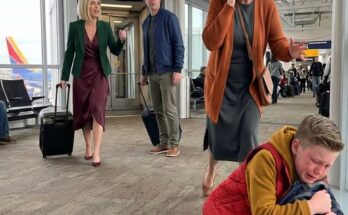
The text from my sister came while I was restocking paint rollers at Denny’s Hardware, and it was so bold I laughed before I realized she was serious.
Your cabin is ours this weekend. Don’t be cheap and leave the keys.
I stood in aisle four with a box cutter in one hand and my phone in the other, surrounded by the clean smell of lumber, metal shelving, and fresh sawdust tracked in from the back room. Outside the wide front windows, a June morning was brightening over the little town of Birch Falls, the kind of place where people still waved from pickup trucks and argued about dock stain like it was a local election.
I read the message twice.
Then a third time.
The cabin had been in my name for three years. Not almost mine. Not family-shared. Not emotionally complicated in a way that changed the county records. Mine. My grandfather, who everyone called Pop, had left it to me outright after he passed, with a deed, a notarized will, and a handwritten note in the lawyer’s folder that said, Victoria will know how to care for it.
My sister Eden had never forgiven that line.
I could understand the sting. I really could. We had both spent childhood summers at Silver Birch Lake, both eaten burnt hot dogs off paper plates on the porch, both slept under patchwork quilts while thunderstorms rolled across the water. The cabin was part of both our memories. But memory and ownership are not the same thing, and Pop had been very clear about that.
He did not leave me the cabin because he loved Eden less.
He left it to me because I showed up.
When the dock boards warped, I came out on Saturdays with a drill and a cooler of iced tea. When the gutters clogged, I climbed the ladder while Pop stood below pretending not to worry. When his knees got bad, I drove him to appointments and sat with him afterward on the porch, drinking coffee so strong it tasted like a dare. I listened to his old factory stories, his fishing stories, his stories about Grandma burning biscuits the first year they were married, even when he told them for the fourth or fifth time.
Eden came when it was pretty.
Fourth of July. Labor Day. Sometimes a long weekend if her calendar allowed. She posted pictures of the lake, called it “our happy place,” and left before the sheets made it into the washing machine.
Pop saw more than people thought he did.
That was why, when his lawyer called us to the office after the funeral, Eden sat in a navy dress with her sunglasses in her lap and a smile that looked pinned on. The office smelled like old paper and mint gum. Brett, her husband, kept checking his watch. I remember the lawyer sliding a manila folder across the conference table, clearing his throat, and reading Pop’s instructions in a voice soft enough to make the words hurt.
The cabin at Silver Birch Lake, including the land, dock, contents, and all associated rights, goes to my granddaughter Victoria Mae Sutton.
Eden’s face changed before she could stop it.
Just for a second.
Then she smoothed it over, leaned back in her chair, and said, “That makes sense. Victoria has more time.”
The way she said more time made my life sound like an empty room.
I worked part-time at Denny’s Hardware, four days a week, sometimes five if the seasonal rush got busy. It was not glamorous, but I liked knowing which neighbor needed a new latch, which summer family forgot propane every Friday, which old man would complain about the price of screws and then buy three boxes anyway. The job paid the property taxes and let me keep the cabin instead of selling it to someone who would tear it down and build a glass box with heated floors.
My life was quiet.
I had chosen that.
Eden had chosen something louder.
She and Brett lived outside Grand Rapids in one of those large subdivision houses with stone columns, a three-car garage, and a lawn service that came twice a week. She posted the kitchen island when it was installed, then the new patio furniture, then the anniversary flowers, then the girls’ brunches with women who all seemed to own the same beige hat. Brett sold commercial real estate and used phrases like “leveraging relationships” and “closing energy” in normal conversation, as if life were a conference room with appetizers.
I did not judge her for wanting that.
I only wished she would stop treating my quiet life like it was a supply closet for hers.
I typed back, What are you talking about?
The little typing dots appeared immediately.
I already booked it. Party company comes Thursday. It’s our anniversary weekend and I’m not doing it at some rental in town when we have a lake house in the family.
I stared at the screen until the words stopped making sense.
A customer turned into the aisle, holding a cracked paint tray.
“Victoria, you know if these come in bigger sizes?”
I blinked, slipped the phone into my apron pocket, and answered him automatically. That was the thing about small-town jobs. Your personal life could split open in your pocket, and you still had to know where the rollers were.
When the customer left, I took the phone out again.
It’s not in the family, Eden. It’s mine. Pop left it to me.
She answered in seconds.
Don’t start that again.
I felt a little coldness settle under my ribs.
That again.
As if the deed, the will, the tax bills with my name on them, the winters I drove through sleet to make sure the pipes had not burst, were all just a mood I kept bringing up to be difficult.
I did not answer right away. I finished my shift because I needed the time. I rang up deck screws, mixed a gallon of paint called Harbor Mist, helped Mrs. Landry find a new mailbox flag, and smiled through all of it while Eden’s message sat inside me like a pebble in a shoe.
After work, I drove the twenty minutes back to Silver Birch Lake. The road narrowed after the last gas station, winding through birch trees and maples, past mailboxes shaped like fish and cabins with names carved into driftwood signs. My cabin sat at the end of a gravel drive, gray cedar siding, blue shutters, a screened porch, and a dock that leaned just slightly to the left no matter how often I fixed it.
Pop’s wind chimes moved in the breeze.
I sat on the dock with a beer and watched the sunset turn the water orange. A loon called somewhere across the lake. I tried to think of a way to be firm without starting a family storm.
But some storms are already moving before you hear the thunder.
I finally texted, No. You can’t use the cabin this weekend. I have plans. And even if I didn’t, you should have asked before booking anything.
Her reply came so fast it felt rehearsed.
You’ll regret this.
I sat there looking at those four words while the dock cooled beneath my bare feet.
Eden had always been like that. As a child, if she wanted the last cookie and I had it, she would not ask. She would take it and dare me to make a scene. If I protested, she cried first and louder. By the time Mom walked in, Eden looked hurt and I looked mean. She learned early that confidence can outrun truth if it gets to the room first.
But we were not children anymore.
And this was not a cookie.
I put the phone face down on the dock and told myself she was being dramatic. Eden’s threats usually turned into cold silence at Thanksgiving, a vague social media quote, or a call from Mom asking why I could not “just try to keep peace with your sister.”
Still, I slept badly.
Wednesday passed without a word from Eden.
That worried me more than if she had kept texting.
Quiet Eden was plotting Eden.
By Thursday morning, I had nearly convinced myself I was overreacting. I opened the cabin windows, made coffee, watered the basil on the porch, and drove into town for my closing shift. Around noon, while I was labeling bins of drawer pulls, I called Colleen from two cabins down.
Colleen Baker was a retired schoolteacher who had basically adopted me after Pop died. She was in her seventies, sharp as a tack, and owned a floral housecoat for every season. She knew everything happening on that end of the lake before the rest of us had poured our second cup of coffee.
“Colleen,” I said, “can you do me a favor?”
“For you, honey, probably.”
“If you see any trucks or people at my place today, will you call me?”
There was a pause.
“That sounds specific.”
“It’s Eden.”
“Oh,” she said, and that one word carried three decades of understanding. “I’ll keep watch.”
At 3:47 that afternoon, my phone rang while I was ringing up a man buying deck screws and a new tape measure.
Colleen’s name lit the screen.
I answered with the phone tucked between my shoulder and ear. “Hey.”
“Victoria, honey,” she said, and I could hear wind rushing over the receiver. She was outside. “There’s a whole crew in your driveway.”
My hand froze over the register.
The customer looked at me.
I forced the last item across the scanner. Beep.
“What kind of crew?” I asked.
“Event crew. Big van says Lakeside Lux Events. They’ve got tables, a white tent, some kind of flower arch. Looks like a wedding, except nobody’s wearing uncomfortable shoes yet.”
My heart gave one hard thud.
“Tell them to stop,” I said. “Tell them they don’t have permission to be there.”
The customer quietly slid his card into the reader without making eye contact. Small-town people know when drama is family-shaped.
I heard Colleen call out, muffled but clear, “Excuse me, folks, the owner says you need to stop unloading.”
There was a pause. Voices in the background. A woman’s voice, professional and confused.
Colleen came back. “The lady in charge says she has a contract. Says Eden Sutton booked the venue and paid a deposit.”
I closed my eyes.
Venue.
My grandfather’s cabin had become a venue.
“Tell her I’m on my way.”
I handed the customer his receipt and apologized. He shook his head, kind-eyed.
“Family emergency?” he asked.
“Something like that.”
My manager, Rob, waved me off before I finished explaining. “Go. I’ll call Maddie to cover.”
The drive back to the lake felt endless. Every slow truck in the county seemed to appear in front of me. My palms were damp on the steering wheel. I kept seeing Pop’s cabin in my mind: the porch he built with cedar boards from a salvage yard, the birch trees he planted along the water, the dock where he taught me to tie a cleat hitch. Then I imagined strangers dragging rental tables across the grass, Eden laughing with champagne in her hand as if she had won.
When I turned onto the gravel drive, I actually said, “No,” out loud.
The cabin looked like a wedding magazine had been dropped onto it from a great height.
A white tent stood half-raised near the lake. String lights were looped between the birch trees Pop had planted. Round tables leaned on their sides in the grass. Two men carried a floral arch toward the dock while another unloaded boxes of linen from a truck. A woman in a black blazer stood near the driveway with a clipboard, directing traffic like she had done this a thousand times.
Colleen was on my porch with her arms folded.
She gave me a look that said, I didn’t touch anybody, but I thought about it.
I got out of my car and walked straight toward the woman with the clipboard.
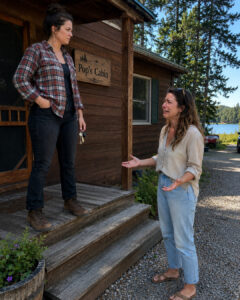
“Hi,” I said. “I’m Victoria Sutton. This is my property.”
She turned with a polite customer-service smile that faltered when she saw my face.
“Oh. You must be Eden’s sister.”
“I am. And I never approved this.”
Her eyebrows drew together. “I’m sorry?”
“This setup. The party. The tent. Any of it. I never spoke with your company, and Eden does not have permission to use this property.”
The woman glanced down at her clipboard, then back at me.
“I’m Maren. I’m the event coordinator. We were told you were aware.”
“I was not.”
“She said it was a family lake house.”
“It was. Now it’s mine.”
Maren’s expression shifted from confusion to caution. That was the look of a professional realizing the ground beneath a contract might not be as solid as advertised.
“She also said you were out of town,” Maren said slowly.
I let out a breath that might have been a laugh if I had been less furious.
“I work fifteen miles away.”
Maren pulled out her phone, scrolled through something, and turned the screen toward me.
There was a text thread.
Eden’s messages were bright blue, confident, and casual.
My sister’s fine with it. She’s just hard to pin down.
She’s out of town Thursday, but setup is approved.
Don’t worry about getting her signature. It’s a surprise for her too.
I read the words twice.
A surprise for her too.
The cold feeling in my chest spread.
Eden had not misunderstood. She had not assumed. She had lied strategically, with just enough detail to make other people act before I could stop them.
“That’s not true,” I said.
Maren’s face went pale.
“I need you to understand,” I continued, keeping my voice steady because if I let it shake, I might not stop. “I never authorized your company to come here. I did not sign anything. I did not approve a setup. I did not agree to host an anniversary party. Eden Sutton does not own this property.”
Maren looked back at the tent, then at her crew.
“Stop setup,” she called. “Everyone stop where you are.”
The men carrying the floral arch lowered it carefully into the grass.
Colleen came down from the porch and stood beside me.
Maren flipped through the clipboard, lips pressed thin. “I’m so sorry. We were given a signed venue confirmation.”
“By Eden?”
“Yes.”
“Not by me.”
“She represented that she had the authority to use the location.”
“She doesn’t.”
Maren looked like someone watching her afternoon turn into paperwork.
I felt bad for her. Truly. This was not her fault. She had a crew, trucks, supplies, labor hours already moving. Eden had used her too.
“Can I see the contract?” I asked.
Maren hesitated, then nodded.
She showed me the contract, careful not to hand over original paperwork until she knew what kind of mess she was in. I saw Eden’s name. Brett’s name listed as secondary contact. The date. The anniversary event. The deposit. The total package. The venue field: Sutton Family Lake House.
Sutton family.
I almost laughed again.
Not because it was funny.
Because sometimes people insult you with such confidence that your body does not know whether to cry or clap.
“This is my grandfather’s cabin,” I said. “My deed. My taxes. My insurance. Eden knows that.”
Maren looked tired now, and angry in the controlled way working women get angry when they are still on the clock.
“I’ll need to speak with her immediately.”
“You’ll get the chance,” Colleen said, looking down the driveway. “Because here she comes.”
Eden’s white SUV came fast up the gravel, dust billowing behind it like she was arriving at her own rescue. Brett sat in the passenger seat, shoulders tense, sunglasses on though the sun was behind him. Eden parked crookedly, jumped out, and started talking before the door had fully closed.
“Victoria, thank God. Okay, I know it looks like a lot, but wait until you see the tables set up by the water. It’s going to be gorgeous.”
“Stop.”
The word came out sharper than I expected.
She froze.
Everyone did.
I took one step toward her. “You told Lakeside Lux I approved this.”
Her eyes flicked to Maren, then to the tent, then to Colleen, then back to me.
“I was going to explain.”
“You said I was out of town. You said I was part of a surprise. You told them not to get my signature.”
Brett got out slowly on the other side of the SUV.
“Eden,” he said quietly.
She ignored him.
“I knew if I asked, you’d say no.”
“Yes,” I said. “That’s usually why people ask.”
Her face tightened. She was dressed for a party already: white linen pants, a soft pink blouse, gold sandals, hair blown smooth. She looked like a lifestyle ad standing in front of someone else’s violated boundary.
“This was important to me,” she said.
“So you lied.”
“It’s our anniversary.”
“It’s my property.”
“It was Pop’s.”
“And he left it to me.”
Her jaw clenched. “Because you made him feel guilty.”
That one landed.
Maren looked down at her clipboard. Colleen’s mouth tightened. Brett stared at the gravel.
I breathed in slowly. The lake wind moved through the birch leaves, carrying the smell of water and cut grass. Behind Eden, two more cars turned into the drive. Guests. Her guests. Women in summer dresses. Men in polos. A couple I recognized from her posts. They slowed when they saw the half-built tent and the circle of tense adults near the driveway.
Eden saw them too.
Panic moved over her face before pride covered it.
“Can we not do this right now?” she said, lowering her voice.
“You brought it here.”
“Victoria.”
“No.”
Maren stepped forward, professional again. “Mrs. Sutton, I need to clarify something. You represented in the signed agreement that you had authorization to use this property as the event location.”
Eden gave a little laugh that sounded like a glass cracking. “It’s a family property.”
“It is not in your name,” Maren said.
“Families share things.”
“Not without permission from the legal owner.”
Eden looked at me with pure frustration. “Are you really going to stand here and embarrass me in front of everyone?”
“You embarrassed yourself when you invited them to a place you didn’t have.”
More cars arrived.
A silver sedan. A black SUV. A couple carrying a gift bag. Someone paused near the driveway, clearly unsure whether to walk forward or reverse into the road and pretend they had gotten lost.
Brett finally spoke.
“Eden, we should talk to Maren.”
She turned on him. “Not now.”
“Yes,” he said, his voice low. “Now.”
That was when I noticed how gray he looked.
Not annoyed. Not merely embarrassed. Gray. His commission checks had been slow, Eden had said later. But in that moment, watching him look at the tent, the staff, the guests, and his wife’s trembling composure, I realized he had probably known money was tight long before the party was booked.
Maren turned the clipboard toward Eden.
“Because setup has already begun and the crew was dispatched based on the information you provided, cancellation terms apply. The remaining balance is still owed.”
Eden blinked.
“What?”
Maren’s voice stayed even. “The contract covers labor, rental delivery, custom florals, tenting, and food service coordination. Your deposit is nonrefundable, and because the event location was not legally secured, the cancellation falls under client breach.”
“That’s insane,” Eden said. “You can’t charge me for a party that isn’t happening.”
“I can charge you for resources reserved and deployed under a signed contract.”
Maren pointed to the page.
I saw the number before Eden did.
$6,400.
Eden stared at it.
Then she laughed.
Not because she found it funny. Because disbelief needed somewhere to go.
“No. Absolutely not. I’m not paying over six thousand dollars because my sister is being petty.”
Maren’s expression hardened. “Your sister did not sign this agreement.”
“My sister is doing this because she wants to punish me.”
I stepped closer.
“For what?”
Eden’s eyes flashed.
“For Pop. For the will. For everything.”
There it was, finally. Not the anniversary. Not the tent. Not the party. The wound underneath all of it.
I looked at my sister standing in Pop’s driveway, surrounded by strangers she had pulled into her version of reality. For a second, I saw us as children again, barefoot on this same gravel, Eden crying because Pop gave me the first turn in the rowboat and me feeling guilty enough to climb back out.
I had climbed out for her so many times.
This time, I stayed where I was.
“Pop made his choice,” I said quietly. “You don’t get to punish me because you didn’t like it.”
Her face crumpled, but anger rushed in before sadness could show.
“You always act like you’re better because you stayed,” she said.
“No. You act like showing up twice a year should count the same as taking care of something every week.”
The guests were fully gathered now, hovering near their cars, pretending not to listen and absolutely listening. A woman in a floral dress whispered to her husband. Another stared at Eden with sympathy that looked dangerously close to pity.
That was what broke her.
Not my refusal.
Not the contract.
The audience.
Eden had built a life around looking composed. Successful. Loved. Admired. This was not just a canceled party. This was a public correction.
Her voice rose, then cracked.
“I just wanted one weekend,” she said. “One nice weekend where people saw us the way they’re supposed to.”
Brett looked at her then, and something passed over his face that made me feel sad despite everything.
“What does that mean?” I asked.
She wiped under one eye quickly, furious at the tears.
“It means Brett’s deals have been slow. It means everyone thinks we’re doing amazing and we’re not. It means I wanted one thing to look easy.”
The lake went quiet behind her, or maybe I only noticed it then.
Maren lowered the clipboard slightly.
Colleen touched my elbow, not to stop me, just to remind me I was not alone.
I did not gloat. I want that understood. It would have been easy to. Eden had lied, pushed, manipulated, and walked into a trap of her own making. But watching my sister stand there with her perfect hair and shaking hands, unraveling in front of the very people she had hoped to impress, did not feel like victory.
It felt like grief wearing a different dress.
“Eden,” I said, “you could have called me.”
“I did.”
“No. You announced. That’s not the same thing.”
She looked down.
Maren cleared her throat gently. “We can discuss a payment arrangement. But the balance is owed. My crew has to be paid for the work already committed.”
I turned to Maren. “I’m sorry your team got dragged into this. I won’t be paying the bill, because I did not authorize the event. But I do hope you can work something out with Eden directly that doesn’t hurt your staff.”
Maren nodded. “We can set up installments.”
Eden stared at me like she expected me to rescue her anyway.
That was the old pattern.
She made the mess. I softened the landing. She took the relief and called it family.
Not today.
“I’m not covering it,” I said.
Brett closed his eyes briefly.
Eden whispered, “You’d let me stand here humiliated.”
“No,” I said. “You brought humiliation with you. I’m letting you carry it home.”
She turned away, pressing a hand over her mouth.
For the next hour, the party died slowly.
Maren spoke with Eden and Brett near the van, pen moving over revised paperwork. Guests quietly left in pairs. Some hugged Eden. Some gave me curious looks, as if trying to decide whether I was cruel or just tired. The crew began packing what could be packed. The floral arch never reached the dock. The tent came down before it had ever fully stood.
By sunset, the driveway was almost empty.
Colleen and I stayed outside, helping wind the string lights back into neat loops because the crew had done enough and because my hands needed something to do. The sky turned peach behind the trees. A loon called from the far side of the lake. The cabin settled back into itself, cedar and shadow and quiet.
Eden stood near her SUV, arms wrapped around herself.
Brett was inside the vehicle, staring straight ahead.
She walked over to me slowly.
For a moment, neither of us spoke.
The grass was flattened where the tent had been. There were little square marks in the dirt from the table legs. One white flower petal had fallen near my boot.
“I didn’t think you’d actually stop it,” she said.
“I know.”
Her eyes shone, but her voice was flat. “I thought once it was here, you’d just let it happen.”
“I know that too.”
That seemed to hurt her more than if I had raised my voice.
She looked toward the lake. “I miss him.”
“Pop?”
She nodded.
The answer softened something in me, but not enough to open the door she wanted.
“I do too.”
“He made me feel like a guest at the end.”
I looked at her.
For the first time that day, she sounded like my sister. Not the woman in white linen trying to turn my cabin into a backdrop. My sister. The girl who used to fall asleep on the porch swing with mosquito bites on her ankles and melted popsicle on her shirt.
“You became one,” I said gently.
She flinched.
“I’m not saying that to be cruel.”
“I know.”
“Pop noticed who came when there wasn’t a holiday. He noticed who called in February. He noticed who washed the windows and checked the pipes and sat with him when there was nothing pretty to post.”
Her face tightened, but she did not argue.
“I thought he loved you more,” she said.
“No,” I said. “He trusted me differently.”
The distinction hung between us.
She wiped her cheek. “That might be worse.”
“Maybe.”
Brett honked once, not impatiently, just reminding her the engine was still running.
Eden stepped back.
“I don’t know how to fix this.”
“The bill?”
She gave a bitter little laugh. “That too.”
I looked at the flattened grass, the packed trucks, the cabin that still stood behind me with Pop’s porch light glowing over the steps.
“You can start by asking next time,” I said.
She nodded, but she did not apologize.
Not then.
It took nearly a month.
For four weeks, we did not speak. The lake moved into summer without her. I worked my shifts, paid the property tax installment, sanded the porch rail, and replaced a warped dock board that had been bothering me since May. Colleen brought blueberry muffins and pretended she was not checking on me. Rob at the hardware store asked only once whether the “wedding tent situation” had calmed down, then wisely never mentioned it again.
On the Fourth of July, I sat on the dock alone while fireworks cracked over the far side of the lake. The cabin windows glowed behind me. Pop’s old radio played softly through the screen door. I felt the ache of memory then. Eden and I as kids with sparklers. Pop yelling not to run near the water. Grandma bringing out watermelon slices on a chipped blue plate.
Saying no had protected me.
It had not made me untouched.
That is the part people forget. Boundaries can be right and still hurt.
Eden called the next morning.
I let it ring twice before answering.
“Hey,” I said.
“Hey.”
Her voice sounded smaller than usual.
“I’ve been thinking,” she said.
I waited.
“I shouldn’t have told Maren you approved it.”
“No.”
“And I shouldn’t have booked anything without asking.”
“No.”
She breathed out. “I was embarrassed. About money. About Brett. About everything. And I wanted the weekend to look perfect.”
I sat at the kitchen table with my coffee. The morning light fell across Pop’s old mug, the one with a faded fish on it.
“Eden,” I said, “I’m sorry things are hard. I am. But you tried to solve that by using something that wasn’t yours.”
“I know.”
That was the first real thing she had said.
Not I was stressed. Not you made me. Not I thought you’d understand.
I know.
It did not fix everything.
But it opened a window.
“I’m on a payment plan,” she said. “Maren was nicer than she had to be.”
“She’s good people.”
“She said you asked about options for us.”
“I asked about options for her crew.”
Eden was quiet, then gave a small laugh. “Fair.”
We talked for sixteen minutes. Not warmly, exactly. Carefully. Like two people walking across ice they had both helped crack. She did not ask to use the cabin again. I did not offer. But before we hung up, she said, “I do miss that place.”
“I know.”
“Maybe someday I could come out. Just for coffee. No guests. No cameras. No surprise tent.”
I looked through the kitchen window at the dock, the birch leaves moving in the morning breeze.
“Someday,” I said. “If you ask.”
She paused.
“Okay.”
The cabin is still mine.
That sounds simple, but it feels like a sentence I had to grow strong enough to say without apologizing. It still smells like cedar and old coffee. The porch steps still complain in humid weather. The dock still leans slightly left. Every evening I can, I sit with my feet over the water and watch the sky change colors behind the tree line.
Sometimes I think about how close I came to handing over the keys.
Not because Eden was right.
Because saying yes would have been easier for one afternoon.
No confrontation. No guests staring. No clipboard. No bill. No sister crying near the driveway. Just one more little surrender dressed up as kindness.
But little surrenders become a life if you stack enough of them.
Pop understood that cabin better than any of us. He knew it was not just a lake house. It was a test of stewardship. Of showing up when no one claps for you. Of fixing the dock before it breaks. Of paying the tax bill before the county sends a reminder. Of cleaning the gutters when the leaves fall. Of loving something quietly enough to care for it even when there is no audience.
Eden loved the cabin as a memory.
I loved it as a responsibility.
That was why Pop left it to me.
And that was why, when my sister tried to turn it into a stage without asking, I finally learned that love does not always mean opening the door.
Sometimes love means standing on the porch with the deed in your name, the keys in your hand, and saying no before someone else makes their problem your home.
Disclaimer: This story is a work of fiction created for entertainment purposes. Any resemblance to real persons, events, or places is coincidental.