Part 1: The Glass at Easter Dinner
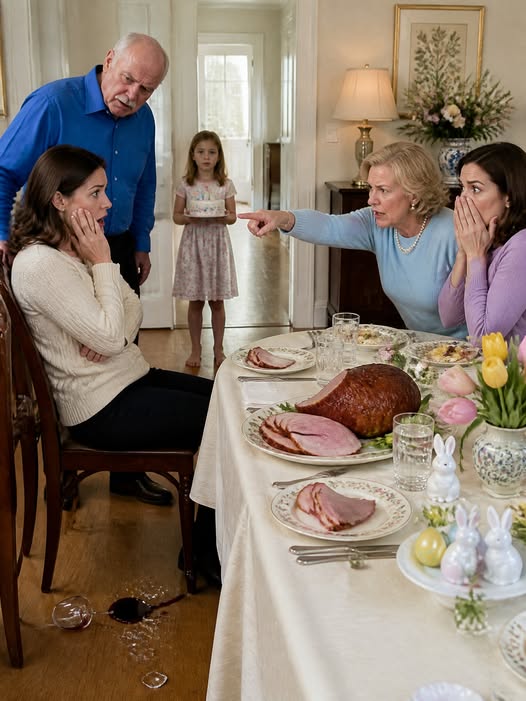
The glass hit me before I saw my father move.
One moment, I was sitting beneath my mother’s yellow dining room light while my sister, Caroline, explained why her two children “needed stability” in my guest rooms. The next, something struck my temple hard enough to turn the table white.
At first, I thought it was wine.
Then I tasted blood.
My nine-year-old niece, Lily, stood frozen in the doorway with a paper plate of cake. My nephew, Noah, was upstairs because Caroline had sent both children away once the conversation stopped sounding like Easter and started sounding like a takeover.
My mother, Elaine, did not rush to help me.
She planted her hands on the table and hissed, “You’re being selfish.”
My father, Martin, pointed at me like I had forced him to do it.
“You have empty bedrooms.”
Red wine ran down the wall. Blood ran down my cheek. And nobody at the table looked shocked enough.
Caroline looked frightened, but not because Dad had thrown the glass. She looked frightened because it had happened too soon. Her husband, Grant, stared at his plate as if silence could protect him.
For weeks, they had followed the same script.
Caroline’s landlord sold the rental. Caroline cried. Mom called me cold. Dad said family helps family. Then they stopped asking and started planning.
Which bedroom would Lily take?
Would Noah’s bunk bed fit upstairs?
Was the school near my street better?
They had already renamed my home.
The family house.
Not mine.
Not the house I had paid for alone for ten years. Not the house with the blue door I chose, the green office I painted myself, and the crooked lilac bush I refused to remove.
So I stopped arguing.
I started documenting.
I saved texts, voicemails, screenshots, and the message where Mom wrote, “One way or another, Caroline needs those rooms by Monday.” I sent everything to my attorney, Michael Grant, after I found a school flyer in my mailbox with my address written in Caroline’s handwriting.
That was when I understood this was no longer a family disagreement.
It was a campaign.
When I stood up from the table, Dad barked, “Where do you think you’re going?”
“To get this looked at,” I said.
Mom narrowed her eyes. “Don’t make this dramatic, Rachel.”
I lifted my phone with blood still on my fingers.
“Thank you,” I said quietly. “This was exactly what I needed.”
For one long second, the room understood I had not lost control of the night.
They had.

Part 2: The Move-In They Planned While I Bled
I drove to the emergency room without answering their calls.
At the first red light, I photographed my face.
At the second, I took another.
At the third, I zoomed in on the swelling near my eye.
Then I texted Michael.
Phase One is complete.
He replied immediately.
Go to the ER. Save everything. Do not answer family. Call me after triage.
Mom called six times.
Caroline texted, Please don’t do this in front of the kids.
Dad left a voicemail saying it had been “an accident caused by your attitude.”
At the hospital, a nurse cleaned my cut while my phone lit up again.
Mom: Come back so we can talk like adults.
Caroline: Grant is loading the car. Please don’t make this harder.
Dad: You are overreacting.
Then Mom sent the message that made me sit up.
We already told the children they’re staying with you tonight.
Not asked.
Told.
I opened my security app.
My foyer camera loaded.
Caroline was inside my house, holding Lily’s backpack. Noah’s blanket was over her shoulder. A black suitcase sat on my hardwood floor like it belonged there.
Grant stood behind her, reaching for the bowl where I used to keep my spare key.
But Michael had warned me they might try to force residency before I could stop them. He told me to change the alarm code, move the spare key, and keep cameras running.
I had done all three.
I called him from the triage chair.
He listened for eleven seconds, then said, “Stay where you are. I’m calling the police now.”
Twenty minutes later, two officers came to my ER bed. One held a clear evidence bag containing a brass key. The other carried a printed still from my foyer camera.
“Ms. Walker,” one officer said, “did your parents ever have permission to copy your key?”
I looked at the key.
It had the same faded blue tape I once wrapped around my spare.
“No,” I said. “They never had permission.”
Then the officer told me my mother had arrived at my house and claimed it was a family move-in. She had even produced a notarized occupancy agreement with my signature on it.
My signature.
A document I had never signed.

Part 3: The Paper Trail
While the nurse stitched my injury, I gave my statement.
My father had thrown the glass.
My mother had called me selfish while I bled.
My sister had pressured me for weeks to let her family move in.
No, I had never agreed.
No, I had never invited them.
No, I had never signed anything.
The officers photographed my injury and collected evidence. Patrol removed Caroline and Grant from my house. They had suitcases, children’s bags, and a plastic file box full of documents.
Thankfully, the children were still at my parents’ house with a neighbor.
Only their backpacks had been brought to my foyer.
Michael arrived with a leather folder and rain on his coat.
“Here’s where we are,” he said. “Your father assaulted you. Your mother and sister tried to establish unlawful occupancy while you were in the ER. They produced a forged document. This is no longer family drama. It is criminal and civil now.”
The next hour passed in signatures.
A statement for the assault.
A statement for the unlawful entry.
Authorization for police to remove anyone from my property and seize the fake agreement.
By midnight, Michael had sent formal no-trespass notices to my parents, Caroline, and Grant.
By one in the morning, he had filed for emergency protective orders.
When I finally returned home, my blue door looked normal from the street.
Inside, the house felt violated.
The entry rug was twisted. The umbrella stand had fallen. A trail of glitter from Caroline’s craft bag crossed my floorboards.
On the console table lay a photocopy of the occupancy agreement.
It claimed I had allowed Caroline, Grant, Lily, and Noah to live in my house indefinitely during a “family emergency.”
My signature was forged.
The notary stamp was smudged.
My mother’s name was misspelled on the witness line.
“Sloppy,” Michael said.
By breakfast, the family version had already begun circulating.
Aunt Diane texted about “peace after a dinner accident.”
A cousin said she could not believe I had called police over a misunderstanding.
Mom left a voicemail crying that strangers were ruining the family.
I saved every message and sent them to Michael.
Then I slept for three hours with every light in the house on.
Part 4: The Hearing
The hearing was set for the next afternoon.
I walked into court bruised, stitched, and angrier than I had ever been.
Mom wore pearls and soft beige, looking like a woman who delivered casseroles after funerals. Dad wore a pressed shirt that could not hide the mark on his knuckle. Caroline held a tissue but had no tears. Grant stood apart from them, pale and exhausted.
For one second, I wondered if they could still make me look unstable.
Then Michael handed me water and said, “Let them talk first.”
They did.
Mom said there had been a family disagreement about housing. Dad claimed the glass slipped. Caroline said she entered my house because she believed I had agreed and that the children had already been promised rooms.
It sounded polished.
Respectable.
If you ignored the blood.
If you ignored the copied key.
If you ignored the timing.
Then Michael stood.
He submitted the ER photographs, the officer’s report, the security footage, the spare key recovered from Caroline’s purse, and the forged agreement.
Then Grant asked to speak.