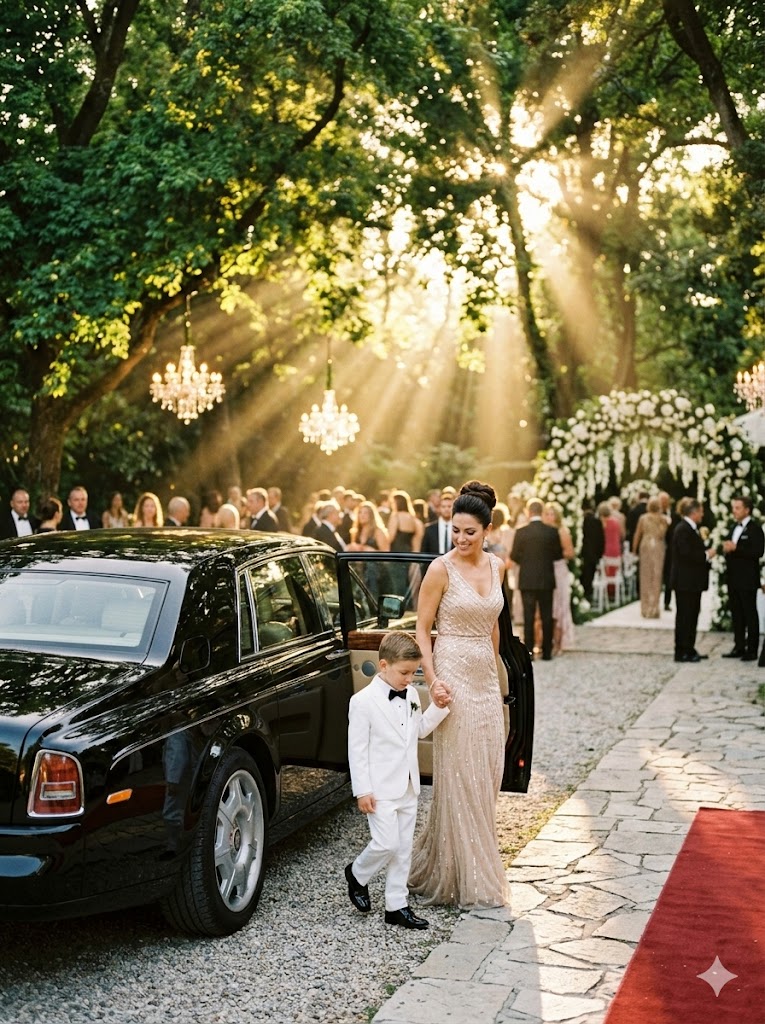
The garden hotel in Valle de Bravo looked like it had been stitched together from glossy magazines and rich people’s fantasies—white orchids spilling over gold vases, crystal chandeliers hung from temporary arches, and waiters moving like shadows with trays of champagne that cost more than my rent used to.
I arrived early.
Not because I was eager. Because I wanted to see everything clearly—the stage he’d built to make me small.
 I stood at the entrance for a moment and watched Marco in the distance. He looked… polished. Like someone had sanded away the rough edges and replaced them with expensive fabric. His hair was neatly styled, his tuxedo fit him like a promise, and he kept laughing too loudly—performing confidence for everyone who mattered.
Beside him was Tiffany.
She was tall and pale and glowing with the kind of effortless entitlement that came from never having to look at a price tag. Her dress was a waterfall of satin and pearls. Her smile was flawless, practiced, and sharp enough to cut.
When Marco spotted me, he didn’t walk toward me right away. He took his time. He made sure people saw him noticing me, like a king acknowledging a peasant.
Then he came, a champagne flute in his hand, with that familiar smirk I used to mistake for charm.
“Liza,” he said, loud enough for the women nearby to hear. “You actually came. I’m surprised.”
I smiled softly. Calmly. Like he hadn’t once watched me cry until my throat hurt.
“I’m here,” I said. “You invited me.”
“Oh, yes.” His eyes flicked down my dress—simple, black, elegant, fitted, nothing flashy. “I thought you might show up in something… less appropriate. But I guess you borrowed something decent.”
Borrowed.
He wanted to reduce me in one word.
“Thank you for thinking of me,” I said.
Marco leaned closer. “I even offered to pay for your bus ticket. Did you use it? I hope you weren’t too uncomfortable. These events… they’re not really your world, are they?”
The insult was wrapped like a gift.
I could feel eyes turning, ears sharpening. The guests around us smiled politely, hungry for gossip. They knew I mattered somehow—because he’d made sure they knew I was the ex-wife.
I didn’t flinch.
“No,” I said. “I wasn’t uncomfortable.”
He laughed. “Good. I just didn’t want you to feel out of place.”
Out of place.
That was the point. He wanted me to sit quietly in a corner and watch him rise into the life he’d always said he deserved.
He was still talking, enjoying himself, when Tiffany glided over.
“Marco,” she said, then looked at me like I was a stain she’d noticed on a white tablecloth. “And you must be… Liza.”
“That’s right,” I said.
Tiffany’s smile widened. “How… sweet of you to come.”
“It would have been rude not to,” I answered.
Marco chuckled, pleased at the tension. “Liza was always very… considerate. Even when she had nothing.”
Tiffany’s eyes flashed with amusement. “Well, I’m sure she’s happy for us. Right, Liza?”
I held her gaze without blinking. “Of course. Happiness looks different for everyone.”
For a second, something uncertain passed through her expression. Maybe she expected tears. Maybe she expected anger. Maybe she expected the broken woman Marco had left behind.
I gave her neither.
The wedding coordinator called for guests to take their seats. Music began to float over the garden—soft strings, romantic, expensive.
Marco gave me one last look, as if he’d just placed a bet he was confident he’d win.
“Enjoy the show,” he said.
I did not sit down.
Instead, I turned away from them and walked toward the entrance again.
Because the real moment wasn’t going to happen inside the garden.
It was going to happen at the gates.
I stepped outside into the driveway where guests arrived. A few security guards stood near the entrance, scanning invitations, greeting VIPs. The sun was bright, warming my skin, but my hands were cold.
Not from fear.
From the weight of what I was about to do.
For five years, I had rebuilt myself brick by brick. Not so I could come back and throw money in Marco’s face—but because I had promised myself, on the night I saw two lines on that pregnancy test, that my children would never feel unwanted.
That promise had turned me into something dangerous: a woman who could survive and succeed without needing anyone’s permission.
A quiet engine purred behind the gates.
Then another sound—deep, smooth, unmistakable—grew closer.
The guards straightened as a Rolls-Royce Phantom glided into view like a black swan sliding across water. The car looked impossibly polished, reflecting sunlight in crisp, luxurious edges.
The driveway went silent.
Even people who had been chatting turned their heads.
A Rolls-Royce at a wedding like this wasn’t unheard of—but it wasn’t common either. It announced power. It announced wealth that didn’t need to shout.
The car stopped in front of me.
The driver stepped out in a tailored suit and walked around to open the back door.
I took a slow breath.
And then I stepped forward.
The first thing guests saw was me.
The second thing they saw was what I brought with me.
Two small hands appeared from inside the car—one on either side—followed by two little faces that made the world shift.
My twins.
A boy and a girl.
They were four years old. They had Marco’s dark eyes and my cheekbones. They were dressed in matching outfits: my son in a tiny charcoal suit, my daughter in a cream dress with a bow in her hair.
They climbed out carefully, like they had practiced, each holding one of my hands.
Behind them stepped out a man.
Tall. Calm. Handsome in a way that didn’t need attention.
Adrián.
Not my husband. Not my savior. Just someone who had become family over the years—my business partner, my closest friend, the person who had offered support without ever asking for ownership of my life.
He wore a simple suit, no flashy watch, no desperate performance. But his posture alone carried authority.
And because people are trained to read symbols, the sight of him stepping out behind me with the twins made a statement louder than any words:
She didn’t arrive alone.
She arrived with a life.
A crowd had formed near the gate now, whispers buzzing like bees.
“Who is that?”
“Is she… arriving in that car?”
“Those children—are they hers?”
“Who’s the man?”
My twins looked up at me.
“Mommy,” my daughter whispered, “is this the place?”
“Yes, sweetheart,” I said. “This is the place.”
My son frowned. “Is he here?”
I knelt down so I could look them both in the eyes. Their little faces were serious, brave, trusting.
“Yes,” I said gently. “He’s here.”
They didn’t know the details. They only knew there was a man who had once been important, a man who didn’t know they existed, a man who had made choices.
I squeezed their hands.
“We’re going to walk in together,” I told them. “You stay close to me. You don’t have to say anything you don’t want to. Just… be yourselves.”
My daughter nodded solemnly.
My son straightened like a soldier.
Adrián leaned down beside me. “Are you sure?” he murmured quietly.
I stood. “I’ve never been more sure.”
He offered his arm—not possessive, not claiming. Just supportive.
I didn’t take it.
I didn’t need anyone to escort me.
I held both my children’s hands and walked forward.
The moment we stepped through the entrance into the garden, the entire wedding changed temperature.
Heads turned.
The string music faltered for a beat, the violinist’s bow slipping slightly, as if the musician felt the shift in the air.
Marco was at the front near the floral arch, talking to Tiffany’s father—a man with silver hair and an expression like a locked safe.
When Marco saw me, his first reaction was smug satisfaction.
Then he saw the twins.
His face drained so fast it was almost comical. The smile fell off him like a mask.
He stared.
Not at the Rolls. Not at Adrián.
At the children.
At their eyes.
At the tiny familiar shape of my son’s jaw.
At the dimple in my daughter’s cheek.
At the undeniable truth walking beside me.
His mouth moved, but no sound came out.
Tiffany followed his gaze and stiffened. She looked at me, then at the children, then back at Marco with confusion.
“What is this?” she whispered, but the microphone on the officiant’s stand picked it up and carried it into the garden.
The guests leaned forward.
The gossip hunger sharpened into shock.
Marco walked toward me slowly, like someone approaching a car crash they couldn’t stop watching.
“Liza…” he said, voice hoarse. “What… what is this?”
I stopped in the center aisle, still holding my twins’ hands.
“This,” I said calmly, “is your invitation coming to life.”
His eyes darted to the children again. “No… no, that’s not—”
“It is,” I interrupted, still quiet. I didn’t need volume. My control was louder than shouting.
The officiant, unsure what to do, froze in place. The music had stopped entirely now.
Tiffany stepped forward, face tight. “Marco, who are those children?”
Marco couldn’t answer.
Because if he answered, he would have to admit something about himself in front of everyone.
I looked at Tiffany—not with triumph, but with an odd kind of pity. She was marrying a man she thought was ambitious and charming. She didn’t yet understand that he was empty in the center.
“These are my children,” I said.
Tiffany blinked. “Your… children.”
Marco’s voice cracked. “Liza, you… you said you couldn’t—”
“I never said I couldn’t,” I replied. “You said it. You labeled me broken because I didn’t give you what you wanted on your timeline.”
He swallowed hard. “How old are they?”
“Four,” I said.
A murmur rolled through the guests like thunder.
Four years old.
Five years since he kicked me out.
The math landed like a slap.
Marco stumbled back half a step.
“No,” he whispered. “No, they can’t be—”
My son, brave little soul, looked up at him and asked, clear as a bell: “Are you Marco?”
The name sliced through the air.
Marco’s knees looked like they might give out.
Tiffany’s father stepped forward now, eyes narrowed. “Marco,” he said sharply. “Explain.”
Marco opened his mouth again, but nothing came.
Because there was no explanation that didn’t make him look like what he was.
I spoke for him.
“They’re twins,” I said. “A boy and a girl. Born a few months after you threw me out.”
Marco’s eyes flooded with horror and something else—panic, greed, regret, confusion. Like his brain was trying to calculate whether this was a disaster or an opportunity.
He took a step toward the children.
My son leaned closer to me instinctively.
My daughter’s grip tightened around my fingers.
Marco reached out—tentative, trembling—as if he wanted to touch them to confirm they were real.
I lifted my hand slightly.
“No,” I said.
The word was soft.
But it hit him like a door slammed shut.
His gaze snapped to me. “Liza… why didn’t you tell me?”
I laughed once—without joy. “Tell you? When you called me useless? When you said I was a burden? When you told me you’d find a rich woman to support you? You wanted a womb and a wallet, Marco. Not a wife.”
His face twisted. “That’s not—”
“It is,” I said. “And if you’re about to tell me you would have stayed if you knew I was pregnant, then you’re proving my point. Because you wouldn’t have stayed for me. You would have stayed for them.”
Tiffany’s lips parted. “Marco…” she whispered, voice shaking now. “Is it true?”
Marco looked at Tiffany like he’d forgotten she existed. Then he looked at the guests—the wealthy families, the businessmen, the socialites—and he realized they were all watching him collapse.
He reached for control.
“It’s—this is… this is some kind of trick,” he said loudly, forcing a laugh. “Liza wants attention. She always did.”
The lie was pathetic.
Adrián stepped forward calmly and held out a folder.
“Actually,” he said, voice even, “these are notarized birth certificates. And for anyone concerned about theatrics, we also have DNA documentation prepared and sealed by a certified clinic. Liza anticipated you might… question reality.”
Marco’s face went white.
Tiffany’s father took the folder with a stiff hand and flipped through it, his expression darkening with every page.
Tiffany’s eyes filled with tears—not romantic tears, not bridal tears, but humiliated betrayal.
“Marco,” she whispered again, “you said your ex-wife was nothing. You said she was desperate and poor.”
Marco’s gaze flicked to the Rolls-Royce parked outside, visible through the garden entrance.
He swallowed.
Tiffany’s father spoke, voice like ice. “You invited her here to humiliate her.”
Marco stammered. “Sir, I—”
“And instead,” the man continued, “you humiliated yourself.”
People murmured approval. The guests—especially those aligned with Tiffany’s father—began to shift away from Marco as if shame were contagious.
Marco turned to me desperately now.
“Liza,” he said, lowering his voice, stepping closer. “Please. We can talk privately. I didn’t know. I swear I didn’t know. If I had known, I would have—”
“Loved them?” I asked. “Or used them?”
His eyes flashed. “They’re my children!”
A hush fell.
My twins looked up again, confused by the tension, sensing the danger in his tone.
I crouched down beside them, smoothing my daughter’s hair and adjusting my son’s collar.
“Sweethearts,” I said, keeping my voice gentle, “go stand with Adrián for a moment, okay?”
They hesitated.
My son looked at Marco again. “Is he… bad?”
The question broke something in me.
I forced a smile. “He’s… complicated. But you’re safe.”
Adrián held out his hands, and my children went to him, still glancing back at me.
When I stood again, I faced Marco fully.
“You don’t get to claim them now,” I said quietly. “Not as a weapon. Not as an accessory. Not because it suddenly benefits you.”
Marco’s jaw clenched. “Benefits me? Liza, you’re acting like I’m some kind of monster.”
I didn’t raise my voice.
I didn’t need to.
“You kicked me out with nothing,” I said. “You didn’t care if I ate. You didn’t care if I had shelter. You didn’t care if I survived. You cared about what I could provide for you.”
Marco’s eyes darted around, realizing the crowd was listening. He tried to soften his expression.
“I made mistakes,” he said. “I was angry. I was under pressure.”
“And I was pregnant,” I said. “And alone.”
A few people gasped.
Tiffany’s face crumpled.
Her father closed the folder and handed it to a security guard as if it were evidence in a crime.
“Marco,” he said sharply, “this wedding is over.”
Tiffany whipped her head toward her father. “Papá—”
“No,” he said. “I will not have my daughter tied to a man who treats women like disposable objects. And a man who hides children is not a man. He is a liability.”
Marco’s face contorted with panic. “Sir, please—”
Tiffany stared at Marco, tears spilling now. “You told me she couldn’t give you children,” she whispered. “You told me you left her because she was barren.”
Marco tried to reach for her. “Tiffany, I didn’t know—”
“Stop saying that!” Tiffany snapped, voice cracking. “That doesn’t make you better. That makes you worse. You didn’t care enough to find out. You didn’t care enough to be decent.”
Then she looked at me—raw, broken.
“I’m sorry,” she whispered.
I nodded once. “I hope you find someone who deserves you.”
Tiffany pulled off her engagement ring, trembling, and shoved it into Marco’s hand.
The gasp from the crowd was loud enough to drown out the lake breeze.
Marco stared at the ring like it was a grenade.
And then he turned back to me, eyes wild.
“You did this,” he hissed. “You planned this.”
I tilted my head slightly. “No, Marco. You planned this. You invited me to be mocked.”
His voice rose. “You came here to destroy me!”
“I came,” I said, steady, “to introduce the truth into a room full of lies.”
Security guards approached now—Tiffany’s father had gestured subtly, and money makes people move quickly.
Marco backed away, furious, humiliated, cornered.
But then—because Marco was Marco—his expression shifted.
Greed crept in.
He glanced again at the Rolls-Royce. At Adrián. At the guests murmuring about me. About the confidence in my posture.
His eyes narrowed.
“You’re rich,” he said slowly, as if putting together the final piece. “You… you became rich.”
I didn’t confirm it.
I didn’t need to.
His smile returned, uglier than before. “Liza… then we can fix everything. For the children. We can—”
“No,” I said.
He blinked. “What do you mean no?”
“I mean no,” I repeated. “There is nothing to fix between us.”
His face hardened. “They’re my children. I have rights.”
I nodded, surprisingly calm. “You do. And the law will decide what role you’re entitled to.”
He sneered. “So you’ll fight me? You think you can keep them from me?”
I looked toward my twins standing with Adrián. My daughter was clinging to his jacket. My son was watching me like he was trying to memorize every expression.
“I’m not keeping them from you,” I said. “I’m keeping them from becoming like you.”
Marco’s eyes flashed with rage.
He took a step forward, voice low. “You can’t just show up and ruin my wedding and—”
“Marco,” Tiffany’s father cut in coldly, “if you don’t leave this property now, I will have you removed and ensure every boardroom in this city knows exactly why.”
That was the true power shift.
Marco looked around and realized the world he was trying to climb had just slammed the door in his face.
He was done.
Security escorted him out, and people parted like he carried disease.
The wedding guests began to disperse in an awkward wave—some pretending they had somewhere else to be, others lingering to stare at me like I was an unexpected headline.
The officiant quietly packed up his microphone.
The flowers remained, absurdly perfect, for a love story that had died before it began.
I walked to my children.
My son looked up at me. “Mommy… are we going?”
“Yes,” I said, smoothing his hair. “We’re going.”
My daughter’s eyes were wide. “Was that man… angry?”
“He was surprised,” I said softly. “And sometimes people act angry when they feel small.”
Adrián watched me carefully. “You okay?”
I exhaled slowly. “I am.”
And I meant it.
Because the moment I had feared for years—the moment of confrontation, of exposure—had not crushed me.
It had freed me.
We walked back toward the entrance together.
But before we reached the driveway, a voice called my name.
“Liza!”
I turned.
It was Tiffany.
She was no longer a bride. Her veil was gone, her bouquet abandoned. She looked like a woman waking from a dream she didn’t realize was a nightmare.
She approached slowly, eyes red. “I just wanted to say…” Her throat tightened. “Thank you.”
“Thank you?” I repeated gently.
She nodded, swallowing. “For showing me who he really is. Before it was too late.”
I studied her. I could have hated her. She had been the symbol of what Marco wanted—wealth, status, replacement.
But she wasn’t my enemy.
Marco was.
“You deserved honesty,” I said. “I’m sorry it happened this way.”
Tiffany looked at my children, and her expression softened. “They’re beautiful.”
“Thank you,” I said.
Her voice cracked. “He doesn’t deserve them.”
“No,” I agreed. “He doesn’t.”
Tiffany’s father appeared behind her, heavy with authority. He looked at me now—really looked.
“I owe you an apology,” he said stiffly. “I assumed you were… what Marco described.”
I lifted my chin slightly. “Marco describes whatever benefits him.”
The man nodded once, as if acknowledging an uncomfortable truth. “If there is anything my family can do—”
“I don’t need anything,” I said. “I came here for closure. And I have it.”
He studied me for a moment, then gave a small, respectful nod. “Then I wish you and your children well.”
I turned back to my twins.
As we stepped outside, the Rolls-Royce door was already open.
My children climbed in with practiced grace. Adrián followed. I slid in last, and the scent of leather and calm wrapped around me.
The driver closed the door, sealing us off from the garden, the whispers, the broken wedding.
The car began to move.
Through the tinted window, I saw Marco in the distance near the gate—being pushed out, shouting, gesturing wildly like a man drowning in public shame.
He looked smaller than I remembered.
Not because I was richer.
Because I was no longer afraid.
My daughter leaned against me. “Mommy,” she murmured, “are we going home now?”
I kissed the top of her head. “Yes, baby. We’re going home.”
My son looked up at me, serious again. “Mom… do I have a dad?”
The question pierced deep, not like a blade, but like a hand reaching into an old wound.
I held his face gently in my hands.
“You have me,” I said. “You have your sister. You have people who love you.”
He frowned. “But… like the other kids.”
I inhaled.
Then I spoke carefully, truthfully, with love.
“You have a father,” I said. “But a father is not just someone who helps make you. A father is someone who stays. Someone who protects you. Someone who chooses you every day.”
My son thought about that.
“Will he choose us?” he asked.
I looked out the window at the lake glittering in the sun, at the mountains in the distance, steady and ancient.
“I don’t know,” I admitted. “But you will never have to beg to be loved. Not from him. Not from anyone.”
My son nodded slowly, as if placing that promise somewhere safe inside himself.
Adrián sat quietly across from us, watching with gentle respect.
The Rolls-Royce glided down the road, away from the hotel, away from the garden of false wealth and borrowed love.
And for the first time in five years, I felt something I had almost forgotten existed:
Not rage.
Not revenge.
Peace.
Because I didn’t win by humiliating Marco.
I won by surviving him.
I built a life so full that his opinion no longer fit inside it.
And behind us, somewhere in the echo of a ruined ceremony, Marco learned the one lesson men like him never expect:
You can throw a woman out of your house.
But you cannot throw away the future she creates without you.