I stared. “So you sold my code?”
Mom laughed. “We sold our company.”
The buyer stood up.
My name is Lorie Kirk.
I am 41 years old. And on the worst morning of my life, my own parents fired me in front of a room full of strangers, sold the company I built from nothing, and handed every last penny to my younger brother, who had never written a single line of code in his entire life. I grew up in Cedar Falls, Iowa, in a modest two-story house on Tremont Street with chipped paint on the shutters and a garden that my mother, Darinda Kirk, maintained with almost religious devotion. My father, Gideon Kirk, was a mechanical engineer who worked at a manufacturing plant about 40 minutes outside of town. He was the kind of man who believed that hard work was its own reward and that complaining about anything was a sign of weakness.
He never told me he was proud of me. Not once. Not when I graduated valedictorian from Cedar Falls High School. Not when I earned a full ride to the University of Iowa. Not when I got accepted into the graduate program in computational biology at MIT.
The closest he ever came was a nod across the dinner table the night I told him about MIT. He looked at my mother, then back at me and said, “Well, do not waste it.”
My mother was different, but not in the way you might hope. Dorinda was warm and affectionate, but only to one person, and that person was not me. That person was my younger brother, Brent. Brent was born when I was 7 years old.
And from the moment he arrived, wrapped in a blue hospital blanket with a full head of dark hair, I became invisible. I do not say that for sympathy. I say it because it is simply what happened. Dorinda carried Brent everywhere. She sang to him.
She decorated his room with stars and planets. She baked his favorite cookies every Sunday. When Brent started school, she volunteered in his classroom. When I started school, she told me to walk myself home because she was too tired. I learned early that love in my family was not divided equally.
It was not divided at all. It was given entirely to Brent. And whatever was left over, which was usually nothing, floated somewhere in my direction like an afterthought. I taught myself to cook by the time I was 10. I did my own laundry by 11.
I forged my own permission slips for field trips because my parents forgot to sign them. None of this broke me. It made me quiet. It made me focused. It made me the kind of person who poured everything into things I could control.
And the thing I could control best was my mind. At MIT, I discovered something that changed the trajectory of my entire life. I found the intersection of biology and software. The place where code could simulate molecular behavior, predict protein folding, and accelerate drug discovery by years. I was not just good at it.
I was extraordinary. My thesis adviser, a woman named Dr. Priya Anand, told me during my second year that my work was unlike anything she had seen in two decades of teaching. She said I had the rare ability to think like a biologist and build like an engineer at the same time. By the time I finished my doctorate at 27, I had already written the foundational algorithms for a platform I called Helix Engine.
Helix Engine was a proprietary computational biology platform that could model complex biochemical interactions in a fraction of the time it took traditional methods. It could identify viable drug candidates in weeks instead of years. It could simulate clinical trial outcomes with startling accuracy. Pharmaceutical companies would eventually pay enormous sums just to run their research through it. But in those early days, it was just me in a tiny apartment in Cambridge, Massachusetts, writing code on a secondhand laptop until 3 in the morning, eating cereal for dinner, and believing that I was building something that mattered.
I made a mistake in 2013 that I would not fully understand for nearly 13 years. I moved back to Iowa. My father had been laid off from the manufacturing plant.
My mother called me and for the first time in my adult life, she sounded like she actually needed me. She said they were struggling. She said they might lose the house. She said, “Lorie, you are the smart one. You always have been. Can you come home and help us figure something out?”
Those words, “You are the smart one,” hit me harder than I expected. It was the closest thing to a compliment my mother had ever given me. And I held on to it like a drowning person holds onto a piece of driftwood. I packed up my apartment, said goodbye to Dr. Anand, and drove 14 hours back to Cedar Falls with Helix Engine on a hard drive in my backpack.
I sat my parents down at the kitchen table and explained what I had built. I told them it could be the foundation of a real company. I told them that the biotech industry was worth hundreds of billions of dollars and that the computational side was exploding. I showed them projections. I showed them early interest from two pharmaceutical firms in Boston.
My father stared at the screen for a long time. Then he looked up and said, “So, what do you need from us?”
I needed startup capital. I needed about $150,000 to get office space, hire two junior developers, and file provisional patents. My parents had some savings and my father had a small inheritance from his own mother that he had never touched. He agreed to invest it.
We incorporated the company in January of 2014 under the name Helixen Biotech. My father insisted on being listed as co-founder and president. My mother insisted on being listed as co-founder and chief financial officer. I was listed as co-founder and chief technology officer. At the time, I did not argue.
They were putting in the money. I was putting in the technology. It seemed fair enough.
But there was one thing I did that would later save everything. When we incorporated, I retained sole ownership of the underlying intellectual property. The Helix Engine source code, the algorithms, the computational models, every single line of it remained mine. I filed the patents in my name alone. I registered the copyrights in my name alone.
I signed an intellectual property licensing agreement with Helixen Biotech that granted the company the right to use Helix Engine. But the ownership never transferred. My father did not read the documents carefully. My mother did not read them at all. They were too focused on the title of president and the title of chief financial officer.
They saw the company as theirs. I let them believe that because I needed their investment and because some broken part of me still wanted them to see me as part of the family.
Brent, meanwhile, was 20 years old and had just dropped out of community college for the second time. He was living in the basement of the house on Tremont Street, playing video games and working part-time at a car wash. My parents never expressed an ounce of disappointment in him. When I dropped a fork at dinner one night, my father told me I was clumsy and careless. When Brent crashed the family car into a mailbox after drinking, my mother said, “Accidents happen, sweetheart.”
That was the world I lived in. Two sets of rules, two different children, one loved, one useful.
The first two years of Helixen Biotech were brutal, beautiful, and entirely dependent on me. I worked 16-hour days in a rented office space above a hardware store on Main Street in Cedar Falls. The office had no air conditioning, a leaking roof, and exactly three desks. I sat at one. The two junior developers I hired, a brilliant young woman named Tamson Okcoy and a quiet, intense guy named Declan Marsh, sat at the other two.
Together, the three of us built the commercial version of Helix Engine from the ground up. My father came into the office maybe twice a week. He would walk around, look at our screens without understanding a single thing on them, nod noncommittally, and then go to lunch. He spent most of his time calling himself the president of a biotech company to his friends at the Elks Lodge, and ordering business cards with embossed gold lettering. My mother came in once a month to review the books, which meant she looked at the bank balance, asked me how much money we were making, and then left to pick up Brent from wherever Brent needed to be picked up from.
Tamson and Declan were the only people in those early years who truly understood what we were building. Tamson had a background in bioinformatics from Howard University and a mind that moved at a speed I could barely keep up with. Declan had dropped out of a computer science program at Iowa State, but had taught himself more about machine learning than most professors knew. The three of us worked in a kind of silent, intense harmony. We finished each other’s thoughts.
We debugged each other’s code. We ate cold pizza at midnight and argued about algorithm efficiency until our voices were hoarse.
By the end of 2015, we had a working commercial product. Helix Engine version 2.0 could do things that no other platform on the market could do. It could take a target protein, model its interactions with thousands of candidate molecules simultaneously, and rank them by predicted efficacy, toxicity, and bioavailability, all within 72 hours. The same process done through traditional methods took pharmaceutical companies anywhere from 6 months to 2 years. We were not just faster.
We were a paradigm shift.
I flew to Boston in January of 2016 with a demo loaded on my laptop. I had secured a meeting with Ridley Pharmaceuticals, a midsize drug development company that had been struggling to bring a new cancer drug to market. I presented Helix Engine to a room of 12 executives. I showed them a simulation I had run on their publicly available research data. I showed them three candidate molecules that my platform had identified as having high potential for their specific target.
The room was silent for about 10 seconds after I finished. Then the chief science officer, a man named Dr. Harlon Foss, stood up and said, “How fast can we get started?”
That deal was worth $2 million in the first year. Ridley Pharmaceuticals became our anchor client. And within six months, three other firms had come knocking. By the end of 2016, Helixen Biotech had revenue of $7.4 million.
By the end of 2017, it was $23 million. By the end of 2018, it was $58 million.
We were growing at a rate that made venture capital firms in San Francisco and New York start calling my father’s phone. And my father, who still did not understand what Helix Engine actually did, loved every single one of those calls.
I should explain what my parents were doing during this time, because understanding their roles, or lack of them, is critical to everything that came later. My father, Gideon, handled what he called the business side. In practice, this meant he signed checks I told him to sign, approved hires I recommended, and attended industry conferences where he shook hands and collected business cards. He was charming in a rough Iowa-farmer kind of way, and people liked him. He told everyone he met that he had founded a biotech company, and he said it with such conviction that most people believed he was the brains behind it. He never once corrected that impression.
My mother, Dorinda, managed the finances with the help of an outside accounting firm I had insisted we hire. She approved expense reports, reviewed quarterly statements, and signed tax documents.
She was competent at this. I will give her that. But she also treated the company bank account like a personal fund. In 2017 alone, she spent $340,000 of company money on things that had nothing to do with the business. A new kitchen for the house on Tremont Street. A vacation to Hawaii for her and my father. A brand-new truck for Brent and a down payment on a condo in Des Moines, also for Brent.
When I confronted her about it, she looked at me like I had insulted her and said, “This is a family company, Lori. Family takes care of family.”
Brent, by this point, had been given a job at Helixen. My parents insisted. His title was director of operations, which was a term so absurdly inflated for what he actually did that Tamson once choked on her coffee when she saw it on the company directory. Brent came into the office around 10:30 most mornings, sat in a corner office my father had furnished with a leather chair and a 70-inch television, and watched sports. He answered no emails. He attended no meetings. He contributed nothing. He was paid a salary of $185,000 a year, plus bonuses that my mother approved without my knowledge.
I tolerated all of this because the company was growing, because the technology was working, and because some deep, quiet part of me still believed that if I just did enough, gave enough, built enough, my parents would finally see me. I thought success would earn me a place in the family. I thought if I made them rich, they would love me the way they loved Brent.
I was 35 years old and still chasing approval from people who had never given it and never intended to.
In 2019, something shifted.
A massive pharmaceutical conglomerate called Vidian Bio Group, headquartered in Cambridge, Massachusetts, reached out to us. Vidian was a giant. They had a market capitalization of over $40 billion and a drug pipeline that spanned oncology, neurology, and immunology. Their chief strategy officer, a woman named Margot Don, flew to Cedar Falls personally to meet with us. She sat in our conference room, which by then was in a proper office building we had leased downtown, and she told us that Vidian had been watching Helixen for two years. She said our technology was the most significant advancement in computational drug discovery she had ever seen. She said Vidian was interested in a partnership.
My father nearly fell out of his chair with excitement. He could barely contain himself during the meeting. He kept interrupting Margot to talk about his vision for the company, a vision that, as far as I could tell, he had invented approximately 90 seconds earlier.
After Margot left, he turned to me and said, “This is it, Lori. This is the big leagues.”
Over the next year, we worked with Vidian on a joint project. They gave us access to their clinical data for a neurodegenerative disease program that had been stalled for three years. I put Tamson and Declan on it full-time.
Within four months, Helix Engine identified two promising molecular candidates that had been missed by traditional screening. Vidian ran preliminary lab tests, and both candidates showed significant activity against the target. The results were so strong that Vidian fast-tracked the program into phase 1 clinical trials. That project alone was worth $15 million to Helixen.
But more importantly, it proved something that the entire pharmaceutical industry was starting to realize. Helix Engine was not just a tool. It was a revolution. And whoever owned it would control the future of drug development.
By 2021, Helixen Biotech had annual revenue of $140 million.
We had 87 employees. We had clients on four continents. We had been featured in Nature, Science, and Wired magazine. And my parents, who had contributed a combined $150,000 in startup money and approximately zero hours of technical work, sat at the top of the company as president and chief financial officer, collecting salaries of $2 million each per year.
I was the chief technology officer. My salary was $400,000.
I did not fight it. I never fought anything when it came to my parents. I just kept working, kept building, kept hoping that one day the scales would tip and they would finally look at me the way they looked at Brent.
The morning of March 14, 2027, started like any other. I drove to the office, parked in my usual spot on the third level of the garage, and took the elevator to the fourth floor. Helixen Biotech now occupied an entire building in downtown Cedar Falls, a gleaming glass-and-steel structure that I had personally helped design. The lobby had the Helixen logo etched into the floor, a double helix intertwined with a circuit pattern that I had sketched on a napkin back in 2013. Every time I walked across it, I felt a quiet surge of pride.
I was carrying two coffees, one for me and one for Tamson, who had been at the office since 5 in the morning working on an upgrade to the engine’s predictive modeling suite. Declan was already at his desk, headphones on, deep in a debugging session. These two had been with me from the beginning, and they were not just colleagues. They were the closest thing I had to family. Real family. The kind that showed up and stayed and actually cared.
I set the coffee on Tamson’s desk, and she looked up with a tired smile.
“You are early,” she said.
“You are earlier,” I replied.
She shrugged. “The new module is almost ready. I think we cracked the multi-target simulation problem.”
That was huge news. Multi-target drug simulation, the ability to model how a single compound interacts with multiple biological targets simultaneously, was the holy grail of computational pharmacology. If we had solved it, Helix Engine would be five years ahead of anything else on the planet.
I sat down to review the code with Tamson, but before I could pull up my terminal, my phone buzzed. It was a text from my father.
Conference room A. 9:00 a.m. Important meeting. Do not be late.
I checked the time. It was 8:47. I told Tamson I would be back and walked down the hall to conference room A.
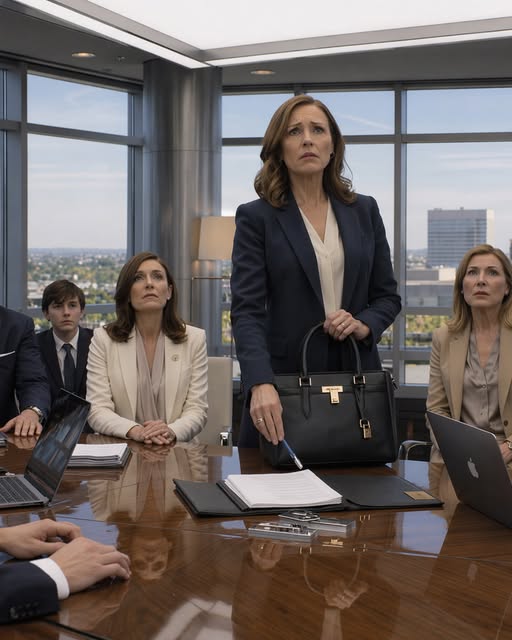
When I opened the door, I stopped.
The room was full.
My father sat at the head of the long oak table in a suit I had never seen before. Dark navy, perfectly tailored. My mother sat to his right in a cream-colored blazer with pearl earrings. Brent sat to the left of my father, also in a suit, also new, looking like a child playing dress-up at a corporate Halloween party. He was 34 years old and still had the same vacant, self-satisfied expression he had worn since childhood.
But it was the other people in the room who made my stomach drop.
There were six of them. Four men and two women, all in expensive business attire, all with leather portfolios open in front of them. I recognized one of them immediately. His name was Wendell Crane, and he was the CEO of Meridian Nexus Technologies, a sprawling tech conglomerate based in Austin, Texas.
Meridian Nexus had a market capitalization of over $90 billion and had been aggressively acquiring biotech and health-tech companies for the past three years. I had seen Wendell’s face in Bloomberg, Forbes, and on the panels at every major tech conference for the past decade.
Sitting beside Wendell was a woman I did not recognize. Tall, sharp-featured, with steel-gray hair pulled back in a tight bun. She had the posture and the eyes of a lawyer. Next to her were two younger men with matching silver laptops, clearly financial analysts or associates. The other two people were a man and a woman who looked like senior corporate attorneys.
My father gestured to an empty chair at the far end of the table. Not beside him. Not near the head. At the far end, like a guest at someone else’s dinner party.
“Sit down, Lorie,” he said.
His voice was different. It had a weight to it, a formality, like he had been rehearsing.
I sat.
I looked at my mother. She did not meet my eyes. I looked at Brent. He was smirking. A tiny, almost imperceptible curve at the corner of his mouth. I looked at the strangers. They looked at me with the neutral, practiced expressions of people who had done this kind of thing many times before.
“What is going on?” I asked.
My father straightened his tie. “Lori, this is Wendell Crane, CEO of Meridian Nexus Technologies. And this is his team. They are here because we have reached an agreement.”
“An agreement about what?” I said.
“The sale of Helixen Biotech,” my father said. “Meridian Nexus has agreed to acquire this company for $3 billion.”
The number hung in the air like a detonation.
Three billion dollars.
I stared at my father. I stared at my mother. I looked at Wendell Crane, who sat calmly with his hands folded on the table.
“You are selling the company,” I said.
It was not a question. It was me trying to make the words real in my mouth.
“We are,” my father said. “Effective immediately, pending final closing, which will occur within 60 days.”
“And you did not tell me,” I said. “You did not consult me. You did not bring me into a single conversation about this.”
My mother finally spoke. “Lori, this is a business decision. It was made by the leadership of the company.”
“I am the leadership of the company,” I said. “I am the chief technology officer. I built every piece of technology this company has ever produced.”
“You are an employee,” my father said.
And the way he said it, flat, final, without even a flicker of discomfort, told me everything I needed to know about how long he had been planning this.
“As part of the restructuring for the acquisition,” my father continued, “certain positions are being eliminated. Your position as chief technology officer is one of them. You are being terminated effective today.”
The air left the room. Or maybe it left my lungs. I could not tell.
I sat there looking at a man who had the same last name as me, who had lived in the same house as me for 18 years, who had watched me grow from a child into the person who had made him a multimillionaire.
And he was firing me in front of strangers in my own building, in a conference room I had paid for.
“You are firing me,” I said.
“We are restructuring,” my mother corrected. “The buyer has their own technology team. Your position is redundant.”
“And the proceeds from the sale?” I asked, my voice steady even as my hands trembled under the table.
My father looked at Brent. He looked at my mother. Then he looked at me and said the words that I will carry with me until the day I die.
“We are giving the billions to Brent. He is the future of this family. He will manage the family trust. He will decide how the money is allocated going forward.”
I did not cry.
I want you to understand that I did not cry in that conference room, because crying would have given them exactly what they expected. It would have confirmed the story they had been telling themselves about me for decades. That I was the difficult one, the sensitive one, the one who always made things complicated.
I refused to perform the role they had written for me.
Instead, I looked at my father with a stillness that seemed to unsettle him more than tears ever could have.
“So,” I said, my voice level, almost conversational, “you sold my code.”
My mother laughed. It was a sharp, dismissive sound.
“We sold our company, Lorie.”
“Our company?” I turned to look at her. “The one your father and I built.”
“You built it?” I repeated.
“Yes,” she said. “We invested the capital. We took the risk. We managed the business. You wrote some software. That is what employees do.”
Brent leaned back in his chair. “Come on, Lorie. Do not make this weird. It is a good deal for everyone. I will make sure you get something. Maybe a hundred thousand or something for old times.”
I stared at my brother.
One hundred thousand dollars.
He was offering me $100,000 out of $3 billion. The man who had never earned a single dollar from his own effort, who had been handed everything from the day he was born, was offering me table scraps from a feast I had cooked.
I turned back to my father.
“Did the lawyers review the intellectual property assignments?”
My father waved his hand. “Everything has been reviewed. The deal is done, Lori. I need you to accept this gracefully.”
I asked a specific question.
“Did the lawyers review the intellectual property ownership of the Helix Engine platform?”
For the first time, something flickered in my father’s eyes. It was brief, barely a shadow, but I caught it.
Uncertainty.
“The company owns the technology,” my mother said firmly. “We built it. We funded it. It belongs to Helixen.”
“Is that what you believe?” I asked.
“It is what we know,” my father said.
I turned to Wendell Crane. He had been silent through all of this, watching with the calm, predatory attention of a man who had acquired dozens of companies and had seen every kind of family drama play out across boardroom tables.
I addressed him directly.
“Mr. Crane, may I ask you something?”
He nodded. “Of course.”
“When your team conducted due diligence on this acquisition, did they examine the intellectual property ownership in detail? Specifically, did they verify who holds the patents and copyrights for the Helix Engine platform?”
The woman with the steel-gray hair, the one I had guessed was a lawyer, shifted in her seat. She opened one of the folders in front of her and began flipping through pages.
Wendell looked at her, then back at me.
“Our due diligence was thorough,” he said carefully. “We were provided with representations from the sellers that all core intellectual property was owned by the company.”
“Representations from the sellers,” I repeated. “Meaning my parents told you they owned it.”
“Lori, stop this,” my father said, his voice rising. “You’re embarrassing yourself.”
“No,” I said. “I am protecting myself for the first time in my life. I am protecting myself from you.”
I reached into the bag I had brought with me.
Inside was a folder I had been carrying every day for the past 13 years. I had started carrying it after the incident in 2017, when my mother spent $340,000 of company money on personal expenses and I realized for the first time that my parents did not see Helixen as my company. They saw it as their piggy bank. From that day forward, I kept copies of every critical document on my person at all times.
Call it paranoia. Call it self-preservation. Call it the instinct of a child who learned early that the people who were supposed to protect her were the people she most needed protection from.
I opened the folder and pulled out four documents. I laid them on the table one by one like a dealer laying down cards.
“Document one,” I said. “United States Patent No. 9,847,231. Computational method for multipathway biochemical interaction modeling. Filed April 2014. Inventor and sole owner: Lorie Elaine Kirk.”
My mother’s face changed.
“Document two. United States Patent No. 10,112,067. Predictive algorithm for molecular candidate efficacy ranking. Filed September 2015. Inventor and sole owner: Lorie Elaine Kirk.”
My father leaned forward.
“Document three. Copyright registrations for the Helix Engine source code, versions 1.0 through 6.4, all registered with the United States Copyright Office. All registered to Lorie Elaine Kirk. Not to Helixen Biotech. Not to Gideon Kirk. Not to Dorinda Kirk. To me.”
Brent’s smirk vanished.
“Document four. Intellectual property licensing agreement, executed January 2014, between Lorie Elaine Kirk and Helixen Biotech Incorporated. This agreement grants Helixen a non-exclusive, revocable license to use the Helix Engine platform.”
I tapped the page.
“Keyword: revocable. It can be terminated at any time by the licensor. The licensor is me.”
The room was silent.
I could hear the hum of the air conditioning. I could hear the faint tick of the clock on Wendell’s wrist. I could hear my own heartbeat, steady and strong, like a drum counting down to something inevitable.
Wendell Crane looked at the woman with the gray hair. She was reading the licensing agreement with rapid, precise attention. Her face, which had been professionally neutral all morning, was now showing the first signs of genuine alarm.
She looked up at Wendell and gave the smallest shake of her head.
“Mr. and Mrs. Kirk,” Wendell said slowly, “can you explain this?”
My father opened his mouth.
No words came out.
My mother stood up. “Those documents are old. They are outdated. The company owns everything. Tell him, Gideon.”
My father looked at the papers on the table. He looked at me, and I watched the realization crawl across his face like frost spreading across a window. He had never read the incorporation documents. He had never reviewed the IP assignments. He had been so busy playing president, so consumed with the title and the business cards and the handshakes, that he had never once checked who actually owned the thing that made his company worth $3 billion.
“This cannot be right,” he said quietly.
“It is right,” I said. “I have the originals. I have the registration certificates. I have the filing receipts. I have the licensing agreement with your signature on it. Dad, you signed it in January of 2014. You just did not read it.”
The next 45 minutes were the most surreal of my life.
Wendell Crane excused himself and his team to an adjacent conference room. Through the glass wall, I could see them in intense, animated discussion. The woman with the gray hair, who I later learned was named Petra Holmstead, the chief legal officer of Meridian Nexus, was on the phone within seconds. Two of the associates had their laptops open and were typing furiously. Wendell himself stood by the window with his arms crossed, staring out at the Cedar Falls skyline, which consisted mostly of grain elevators and church steeples, as if the view might offer him some kind of answer.
In conference room A, the atmosphere was toxic.
My father was pacing. My mother was sitting with her hands clasped so tightly that her knuckles were white. Brent was looking at his phone, scrolling through something as if the collapse of a $3 billion deal was an inconvenience roughly on par with a delayed pizza delivery.
“You planned this,” my mother said to me. Her voice was low and venomous. “You have been planning this sabotage for years.”
“I did not plan anything,” I said. “I simply did not give away what was mine. There is a difference.”
“That technology was developed on company time with company resources,” my father said. “Any lawyer will tell you it belongs to the company.”
“I developed the foundational code before the company existed,” I said. “The patents were filed in my name with full knowledge of the company. The licensing agreement was executed at the time of incorporation. Your own attorney at the time, Mr. Dale Apprentice, reviewed the documents and approved them. I have his correspondence on file.”
My father stopped pacing. “Dale Apprentice retired six years ago.”
“Yes,” I said. “But his emails did not retire with him.”
My mother turned to my father. “Fix this, Gideon. Call our lawyers. Call someone. She cannot do this.”
“She can,” said a voice from the doorway.
We all turned.
Wendell Crane was standing at the entrance to the conference room. Behind him was Petra Holmstead, holding a tablet and looking like someone who had just been asked to diffuse a bomb that had already started ticking.
Wendell walked back to his seat and sat down. He folded his hands on the table and looked directly at my parents.
“Mr. and Mrs. Kirk,” he said, “my team has done a preliminary review. The documents that your daughter has presented appear to be legitimate. The patents are registered with the United States Patent and Trademark Office in her name. The copyright registrations are on file with the Copyright Office. The licensing agreement you signed in 2014 is clear and unambiguous. The core intellectual property of Helixen Biotech, the Helix Engine platform, which is the sole reason we are offering $3 billion for this company, does not belong to the company. It belongs to Lorie Kirk.”
My mother made a sound. It was not a word. It was something between a gasp and a whimper.
“What this means,” Wendell continued, “is that the acquisition as currently structured cannot proceed. We are not paying $3 billion for a company that does not own its core technology. That would be like buying a car dealership and finding out they do not own any of the cars.”
“There must be some mistake,” my father said. His voice had lost all of its earlier authority. He sounded like a man who had just been told his house was built on someone else’s land.
“There is no mistake,” Petra Holmstead said. “We have confirmed the patent and copyright registrations independently. The licensing agreement is standard in structure but extraordinary in its terms. It grants the company a revocable non-exclusive license. The licensor, Miss Kirk, retains full ownership and can terminate the license at will. If she terminates, the company loses the right to use the Helix Engine platform entirely.”
“Which means,” Wendell said, “the company is worth essentially nothing without her.”
Silence filled the room.
I watched my parents process this. I watched my father’s face cycle through anger, confusion, disbelief, and then something I had never seen from him before.
Fear.
I watched my mother’s composure crumble like a wall of sand meeting the tide. I watched Brent look up from his phone for the first time in 20 minutes. His face twisted in sudden childlike panic.
“So the deal is off,” Brent said. “We do not get the money.”
It was such a perfectly distilled version of who my brother was. That sentence. Not what does this mean for the company, or how do we resolve this, or even are you okay, Lori. Just: we do not get the money.
Wendell looked at Brent for a long moment. Then he looked at me, and in that look I saw something shift. I saw a man who had built a $90 billion company by recognizing talent and opportunity, and who had just realized that the talent in this room was not sitting at the head of the table.
“The deal is off as currently structured,” Wendell said. “However, I would like to have a private conversation with Miss Kirk, if she is willing.”
“Absolutely not,” my father said. “This is my company. Any negotiations go through me.”
“With respect, Mr. Kirk,” Petra said, “the situation has changed materially. The asset we are acquiring, the technology, belongs to your daughter. Any path forward requires her participation and her consent.”
My father looked at me for one brief, searing moment. I saw something in his eyes that might have been regret, or it might have been calculation. With my father, I could never tell the difference.
“Fine,” he said. “Talk to her. But we are staying in this room.”
“No,” Wendell said. “You are not.”
The look on my father’s face was something I will never forget. It was the look of a man who had spent 13 years pretending to be in charge and had just been told plainly and publicly that he was not.

He opened his mouth. He closed it. He looked at my mother. She looked at the table.
“Gideon,” she whispered, “let us step out.”
My father’s jaw tightened. He pushed back his chair, stood up, and walked toward the door. At the threshold, he stopped and turned back to me.
“After everything we did for you,” he said. “After everything we sacrificed.”
“What did you sacrifice?” I asked.
It was a genuine question. I actually wanted to know.
He did not answer. He walked out. My mother followed. Brent trailed behind them like a shadow.
The door closed.
I was alone with Wendell Crane and his team.
Petra Holmstead pulled out a chair and sat down across from me. The two associates positioned themselves on either side. Wendell stayed at the head of the table, studying me with an expression I could not quite read.
“Well,” he said, “that was something.”
“I apologize for the theatrics,” I said. “I did not know about any of this until 40 minutes ago.”
“You did not know your parents were selling the company?”
“No.”
He nodded slowly. “And yet you had every critical document in a folder in your bag.”
I almost smiled. “I have been carrying that folder for 10 years. I hoped I would never need it.”
Wendell Crane was not what I expected. In the press, he was portrayed as a ruthless dealmaker, the kind of CEO who acquired companies the way other people collected stamps: methodically, relentlessly, and without sentiment. But sitting across from me in that conference room, with his team scribbling notes and Petra Holmstead running legal scenarios on her tablet, Wendell was something else entirely.
He was curious. He listened. He asked questions that showed he actually understood the technology. Not at my level, but at a level that told me he had done more than skim a briefing document on the flight to Iowa.
“Tell me about Helix Engine,” he said. “Not the marketing version. Not the investor pitch. Tell me what it really does, and what it could do if you had unlimited resources.”
So I told him.
I told him about the multi-target simulation breakthrough that Tamson and I had been working on that very morning. I told him about the potential applications in personalized medicine, where the platform could model drug interactions specific to an individual patient’s genetic profile. I told him about the predictive toxicology module that Declan had been developing, which could flag dangerous side effects before a drug ever entered human trials. I told him about my vision for a fully integrated computational biology ecosystem that could reduce the time from drug discovery to market approval from 12 years to three.
Wendell listened to all of this without interrupting.
When I finished, he leaned back in his chair and looked at Petra.
“What are our options?” he asked.
Petra outlined three scenarios. The first was to walk away entirely, abort the acquisition, and find another target. The second was to renegotiate the deal directly with me as the primary counterparty, since I controlled the core asset. The third was to pursue a separate licensing arrangement for Helix Engine independent of Helixen Biotech.
“There is a fourth option,” I said.
Everyone looked at me.
“You acquire the technology directly from me. Not the company. The technology. I will grant Meridian Nexus an exclusive license to Helix Engine, along with all future iterations, all patents, and full access to my development team. In exchange, you pay me directly. We structure it as a combination of upfront payment and long-term royalties tied to revenue generated by any product developed using the platform.”
Petra raised an eyebrow. “You are proposing that we bypass Helixen Biotech entirely.”
“I am proposing that you acquire what you actually came here to buy,” I said. “You did not fly to Cedar Falls for the office furniture or the company name. You came for Helix Engine. I own Helix Engine. Let us deal directly.”
Wendell smiled. It was a small, tight smile, the kind of smile a chess player gives when an opponent makes an unexpectedly brilliant move.
“And your parents?” he asked. “What happens to Helixen without the technology?”
“Helixen without Helix Engine is a shell,” I said. “It has clients, but those clients are there because of the platform. Without the platform, the contracts dissolve. The company is worth whatever the office equipment and the remaining cash on the balance sheet add up to. Maybe $2 or $3 million. Maybe less.”
“You understand what you are saying?” Wendell said. “You are effectively reducing your family’s company from a $3 billion asset to nothing.”
“They fired me,” I said. “They did not consult me on the sale. They planned to give every cent to my brother, who has never contributed a single meaningful day of work to this company. They tried to sell my intellectual property without my knowledge or consent. They did not reduce my value. They showed me theirs.”
The room was quiet. Petra looked at Wendell. The associates stopped typing.
“I need to make some calls,” Wendell said. “Can we reconvene in two hours?”
“Of course,” I said.
I left the conference room and walked down the hall to the technology wing. Tamson and Declan were at their desks. They both looked up when I walked in, and Tamson immediately stood.
“What happened?” she asked. “There are rumors flying everywhere. Someone said there was a buyer in the building. Someone else said your father sent a companywide email that your position has been eliminated.”
I sat down in my chair. I looked at the two people who had believed in my work from the very beginning, who had poured their talent and their time into a vision I had shared with them over cold pizza in a rented office above a hardware store.
“My parents sold the company for $3 billion,” I said. “They fired me. They gave everything to Brent.”
Tamson’s face went rigid with fury. Declan pulled off his headphones, his quiet eyes suddenly sharp.
“They forgot one thing,” I continued. “I own the code. I own the patents. I own the copyrights. The licensing agreement is revocable. I just told the buyer.”
Tamson sat back down slowly. “You are telling me that they tried to sell a company built on technology they do not own?”
“That is exactly what I am telling you.”
Declan spoke for the first time. He rarely spoke in situations like this. When he did, it meant something.
“What are you going to do?” he asked.
“I am going to make a deal directly with Meridian Nexus,” I said. “For the technology. Not the company, the technology. And I want both of you with me. Not as employees. As partners.”
Tamson and Declan looked at each other. Something passed between them. A silent conversation built on years of shared work and mutual trust.
“We are in,” Tamson said. “We have always been in.”
I spent the next two hours in my office preparing a detailed proposal. I outlined the terms of the licensing deal. I calculated royalty structures. I identified which employees would come with me and which would remain with the shell of Helixen. I drafted an organizational plan for a new entity, one that I would own and control, that would serve as the development and licensing arm for all Helix Engine technology.
At 1:15 in the afternoon, Wendell Crane called me back to the conference room. This time it was just him, Petra, and one associate. He looked energized. The cautious curiosity from the morning had been replaced by something more direct, more decisive.
“I spoke with my board,” he said. “We want to proceed. Not with the original acquisition. With your proposal. Meridian Nexus will enter into an exclusive licensing agreement with you for the Helix Engine platform. Here are our terms.”
Petra slid a single sheet of paper across the table.
I read it carefully.
The numbers were staggering.
An upfront payment of $1.2 billion. Annual royalties of 8% on all revenue generated by products developed using Helix Engine. A development budget of $200 million per year, fully funded by Meridian Nexus under my operational control. And a seat on the board of directors of Meridian Nexus Technologies for me, Lorie Kirk.
The news spread through the building like fire through dry grass.
By 3:00 that afternoon, everyone at Helixen knew that the original acquisition had collapsed and that I had struck a separate deal with Meridian Nexus. The reactions were split along a perfectly predictable line.
The engineers, the scientists, the developers, the people who had actually built and maintained Helix Engine, were cautiously hopeful. Many of them had worked under me for years and understood that the technology was mine. They also understood, without anyone needing to say it, that my parents had been decorative figures at best and active obstacles at worst.
The administrative staff, the people my parents had hired over the years to manage the business side, were panicked. Many of them owed their positions to my mother’s patronage. Dorinda had filled the company with friends, relatives of friends, and people from her church group. The head of human resources was her cousin. The office manager was a woman she played bridge with on Tuesdays. The director of marketing was the wife of one of my father’s friends from the Elks Lodge. None of these people had any relevant experience in biotech.
They had jobs because my mother gave them jobs, and now those jobs were about to evaporate.
I did not take pleasure in that. I am not a cruel person. But I also did not feel responsible for the consequences of decisions I had not made. My parents had built a patronage network inside my company, and that network had no foundation without the technology I had created.
That was their problem, not mine.
At 4:30, my father appeared at the door of my office.
He was alone.
The suit jacket was gone. His tie was loosened. He looked 10 years older than he had that morning.
“We need to talk,” he said.
“Sit down,” I said.
He sat in the chair across from my desk, the same desk where I had worked 18-hour days for over a decade. The same desk where I had solved problems that some of the brightest minds in pharmaceutical research had been unable to crack. My father had never once sat in that chair before. He had never visited my office voluntarily. He came to the fourth floor only for scheduled meetings, and even then he usually sent someone to fetch me to come to him.
“I know you are angry,” he began.
“I am not angry,” I said. “I was angry 10 years ago when Mom spent company money on a truck for Brent. I was angry seven years ago when you promoted Brent to vice president even though he could not name a single product we make. I was angry three years ago when you gave yourself a $2 million bonus while my team was working 60-hour weeks to deliver the Vidian contract.”
I looked at him.
“Today I am not angry. Today I am clear.”
My father rubbed his face with both hands.
“Your mother and I, we did what we thought was best for the family.”
“You did what was best for Brent,” I said. “That has always been the same thing to you.”
“That is not fair.”
“Is it not? Name one time you chose me over him. One time in 41 years.”
He was silent.
“You cannot,” I said, “because it never happened. I was the workhorse. I was the one you called when you were about to lose the house. I was the one who dropped everything and came home to save you. And the moment the company was worth something, the moment there was real money on the table, your first instinct was to fire me and hand everything to the child who has never done anything to earn any of it.”
“Brent is—he has his own strengths.”
“What strengths? Name them. What has Brent contributed to this company? What has he built? What has he sacrificed?”
Another silence. Longer this time.
“I came here to ask you to reconsider,” my father said quietly. “If you walk away with the technology, the company is worthless. Your mother and I will have nothing.”
“You will have the shell of the company,” I said. “The office building lease, the furniture, the client list, though the clients will leave once they learn the platform is gone. You will have whatever cash is in the operating accounts. And you will have each other, which is apparently what matters most to you.”
“Lori, please.”
I looked at my father. I looked at the man who had never told me he was proud of me. Who had never attended a single conference where I presented groundbreaking research. Who had never asked me how I was doing, how I was sleeping, whether I was happy. Who had taken my life’s work, stamped his name on it, and tried to sell it out from under me without even the courtesy of a conversation.
“The deal with Meridian Nexus is done,” I said. “I am signing tomorrow. I will be transferring the Helix Engine platform to a new company that I own. All employees with technical roles will be offered positions. Everyone else is the responsibility of Helixen, which is your company now. Entirely yours. Just like you always said it was.”
My father stood up. He walked to the door. He paused with his hand on the frame.
“Your mother is devastated,” he said.
“She was not devastated when she fired me this morning,” I replied. “She laughed.”
He flinched.
He did not deny it.
He walked out and closed the door behind him.
That evening, I sat in the parking garage for 30 minutes before starting my car. I was not sad. I was not triumphant. I was something in between. Something complicated and heavy and new. I was a person who had just drawn a line that could never be undrawn. And I was sitting with the weight of that choice in the silence of an empty parking garage in Cedar Falls, Iowa.
At 7:43 that evening, on the longest day of my life, my phone buzzed. It was a text from my brother.
You are making a huge mistake. Mom and Dad gave you everything. You are going to regret this.
I read it twice. Then I deleted it.
I started the car. I drove home. I made dinner. I ate alone, the way I had eaten alone for most of my adult life. And then I sat at my kitchen table with a glass of water and began planning the rest of my life with a clarity I had never felt before.
The next morning, March 15, I walked into the offices of Wendell Crane’s legal team at the Hilton in downtown Cedar Falls. The hotel had converted a conference suite into a temporary war room, with laptops, printers, and stacks of legal documents covering every surface.
Petra Holmstead was there. The two associates were there. A local attorney I had retained, a woman named Constance Almida, was there on my behalf. And Wendell Crane was there, drinking coffee from a paper cup and looking like a man who had slept well and was ready to close a deal.
The signing took three hours.
Every document was reviewed line by line. Every clause was discussed. Constance, who was one of the sharpest attorneys in the state and who specialized in intellectual property law, examined every provision with meticulous care.
By noon, it was done.
I, Lorie Elaine Kirk, had granted Meridian Nexus Technologies an exclusive license to the Helix Engine platform in exchange for a $1.2 billion upfront payment, ongoing royalties, a $200 million annual development budget, and a seat on the board.
The new entity I had formed, called Helix Meridian Labs, would serve as the technology development arm. I was the sole owner and CEO. Tamson was the chief science officer. Declan was the chief technology officer. We were bringing 23 engineers and scientists with us from Helixen.
When the last page was signed, Wendell Crane stood and extended his hand.
“Welcome to Meridian Nexus,” he said.
I shook his hand. “Thank you for seeing what my parents refused to see.”
He held my hand a moment longer than necessary and said, “I have been doing this for 25 years. I have never seen someone handle a situation like that with as much composure and intelligence as you did yesterday. Your parents did not just underestimate you. They never understood you at all.”
The fallout was immediate and devastating, but not for me.
Within 72 hours of my departure, four of the five largest clients of Helixen Biotech had requested meetings with my parents. These were not courtesy calls. They were exit interviews.
Ridley Pharmaceuticals, our very first client, the company that had taken a chance on us back in 2016, was the first to go. Dr. Harlon Foss, the same chief science officer who had stood up in that Boston conference room and asked, “How fast can we get started?” called my father personally and told him that without Helix Engine and without me, there was no reason to maintain the relationship. The contract was terminated with 30 days’ notice.
Vidian Bio Group followed within the week. Then Karr Therapeutics. Then Pinnacle Biomolecular.
One by one, the clients that had made Helixen a $40 million-a-year company walked out the door, taking their research contracts and their money with them.
By the end of April 2027, Helixen Biotech had lost 92% of its recurring revenue. The company that my parents had tried to sell for $3 billion was now struggling to make payroll.
My mother called me 17 times in the first two weeks.
I did not answer.
She left voicemails that ranged from pleading to accusatory to outright threatening. In one message, she told me I was destroying the family. In another, she said she had always known I was jealous of Brent. In a third, she cried so hard I could barely understand her words. But the gist was that my father was not sleeping, that he was having chest pains, and that I needed to come home and fix this.
I did not respond.
Not because I did not care about the health of my father. I did, despite everything. I did. But I had spent 41 years responding to every crisis, every demand, every guilt trip from that family. And every single time, the pattern was the same. They needed me when things were falling apart. And they dismissed me the moment things were stable.
I was the emergency service, not the family member.
I refused to play that role anymore.
Brent, surprisingly, was the one who showed up at my apartment.
He came on a Tuesday evening, about three weeks after the deal. He knocked on my door, and when I opened it, I was shocked by how he looked. He was pale. He had not shaved. His eyes were red-rimmed. He looked, for the first time in his life, like someone who understood that the safety net he had been bouncing on since birth had just been pulled away.
“Can I come in?” he asked.
I stepped aside.
He sat on my couch and stared at the floor.
“I did not know they were going to fire you,” he said. “Not until that morning. Dad told me the night before that the deal was happening and that I would be running the family trust. But I did not know they were cutting you out completely. I thought you would get a share.”
“Would you have said something if you had known?” I asked.
He did not answer immediately. Then he said, “I do not know. Probably not. And I hate myself for that.”
It was the most honest thing my brother had ever said to me.
We sat in silence for a while.
“I never understood what you did,” Brent said. “Not really. I knew you were smart. I knew the company was because of you. But I never had to face that, because Mom and Dad never made me face it. They always told me I was special. That I deserved things. That the world owed me something because I was their son. And I believed them. I believed them because it was easy to believe.”
“It was easy because they made it easy,” I said.
“Yeah.” He rubbed his eyes. “Dad is talking about suing you. Mom is calling lawyers. They think they can prove the IP should belong to the company because you developed it on company time.”
“They can try,” I said. “The patents predate the company. The copyright registrations are in my name. The licensing agreement is clear. Any lawyer worth anything will tell them they have no case.”
“I told them that,” Brent said. “The attorney they consulted last week said the same thing. Mom fired the attorney.”
I almost laughed.
Almost.
“What are you going to do?” I asked him.
“I do not know. I have no skills. I have no education. I have a job title that does not mean anything at a company that is about to go under. I am 34 years old and I have never actually worked a real day in my life.”
“That is not entirely your fault,” I said. “You were raised to believe you did not have to.”
“But I am an adult. I should have figured it out.”
“Yes,” I said. “You should have.”
He looked at me. “Are you going to help me?”
“Not the way you are hoping,” I said. “I am not going to give you money. I am not going to give you a job. But if you decide you want to actually build something, learn something, become someone other than the golden child of Gideon and Dorinda Kirk, then I will be here. I will answer the phone. I will give you advice. But you have to do the work.”
He nodded slowly.
He stood up. He walked to the door. And then he turned back and said something that stunned me.
“I am sorry, Lorie. For all of it. For every year that I took what should have been yours and never said thank you. I am sorry.”
He left.
I stood in my apartment and stared at the closed door for a long time.
It was not forgiveness, that moment. It was not reconciliation. But it was the first time in my life that my brother had seen me, truly seen me, and it cracked something open in my chest that I had not even known was sealed shut.
My parents filed a lawsuit in June of 2027. They claimed that the intellectual property of Helix Engine was developed using company resources and should therefore be classified as a work for hire under the company’s employment agreements. It was a desperate, flimsy argument, and their own attorney, a man named Curtis Langghorn, whom they had hired after firing the first one, seemed to know it.
The case was assigned to a federal judge in Des Moines.
Constance Almida, my attorney, was magnificent.
She filed a motion to dismiss that was 47 pages of surgical precision. She demonstrated that the foundational code predated the company by two years. She presented the patent and copyright filings with their timestamps. She submitted the licensing agreement with my father’s signature. She included email correspondence from 2014 in which my father explicitly acknowledged that the technology belonged to me and that the company was licensing it.
That email, which my father had apparently forgotten he ever wrote, was the final nail.
The judge granted the motion to dismiss in September of 2027. The case was thrown out. My parents were ordered to pay my legal fees, which amounted to $340,000.
The years after the lawsuit were the most productive and fulfilling of my career.
Helix Meridian Labs, the company I built from the ashes of Helixen, became something I had always dreamed it could be, but had never been able to fully realize under the shadow of my parents. With the $200 million annual development budget from Meridian Nexus, I hired the best computational biologists, software engineers, and data scientists in the world. We opened a research campus outside of Boston, a beautiful facility with state-of-the-art labs, open floor plans for collaborative work, and a cafeteria that served actual good food because I had spent too many years eating cold pizza and vending-machine snacks to inflict that on anyone else. We also maintained a smaller satellite office in Cedar Falls, partly for practical reasons and partly because I wanted the town where everything started to share in what the technology had become.
Helix Engine version 8.0, released in early 2028, was the breakthrough I had been chasing for years. The multi-target simulation capability that Tamson and I had cracked on the morning of March 14 was fully integrated, refined, and validated against real-world clinical data. The platform could now model how a drug candidate would interact with up to 12 biological targets simultaneously, predicting not just efficacy, but secondary effects, metabolic pathways, and patient-specific responses based on genetic markers.
Two major pharmaceutical companies used the platform to identify lead candidates for neurodegenerative disease treatments that had eluded researchers for decades. One of those candidates entered phase 2 clinical trials within 18 months of discovery, a timeline that was previously unheard of.
The royalties from Meridian Nexus began flowing in substantial volume by 2029.
In the first full year, the Helix Engine platform generated $1.8 billion in licensing revenue across Meridian Nexus and its partners. My 8% royalty amounted to $44 million for that year alone. Combined with the original $1.2 billion upfront payment, my personal wealth had grown to a level that I still sometimes struggled to comprehend.
But the money was never the point.
The point was the work. The point was watching Tamson present her research at the International Conference on Computational Biology in Zurich and receive a standing ovation. The point was watching Declan, the quiet dropout from Iowa State who had taught himself machine learning in his childhood bedroom, become one of the most respected software architects in the biotech industry. The point was knowing that somewhere in a lab in Tokyo or London or São Paulo, a researcher was using my platform to find a cure for a disease that had been stealing lives for generations.
In 2029, I was named to the Forbes list of the 100 most powerful women in business. Time magazine featured me in a profile titled The Woman Who Rewrote Drug Discovery. I was invited to speak at Davos. I was offered honorary doctorates from three universities.
Dr. Priya Anand, my thesis adviser from MIT, sent me an email after the Time article that said simply, “I always knew. I am so proud of you.”
I printed that email and framed it. It hangs in my office to this day. It is the closest thing to a parental expression of pride that I have ever received. And it did not even come from a parent.
My parents, meanwhile, were facing a reality they had never imagined.
Helixen Biotech limped along through 2027 and into early 2028. But without Helix Engine, there was nothing to sell. The remaining clients all left. The employees who had not come with me were gradually laid off. My mother’s network of friends and relatives lost their jobs one by one. The office building lease became too expensive. They downsized to a small office suite in a strip mall. Then they closed that too.
By mid-2028, Helixen Biotech was formally dissolved.
My father filed the paperwork himself.
My mother told people at their church that they had decided to retire, which was a creative interpretation of what had actually happened, but I did not begrudge her the face-saving. The house on Tremont Street was still theirs. They still had some savings, though much of it had been spent on the failed lawsuit and the extravagant lifestyle they had been living on company money.
They were not destitute.
They were diminished.
I learned through acquaintances that my father’s health had declined. The chest pains that my mother had mentioned in her voicemails turned out to be stress-related cardiac issues. He was put on medication. He stopped going to the Elks Lodge. He stopped telling people he had founded a biotech company. He became, by all accounts, very quiet.
Brent, to my genuine surprise, began to change.
After that evening at my apartment, he enrolled in community college for the third time. But this time, he actually went to class. He completed an associate degree in business administration.
In 2029, he got a job at a small logistics company in Des Moines. It was entry-level work, answering phones and processing shipping orders. And it paid $38,000 a year. But he earned it. He showed up. He did the work.
He called me every few weeks to tell me about something he had learned or a challenge he had faced. And I listened, and I gave him advice. And I watched my brother slowly, painfully, beautifully become a person rather than a projection of the wishes of our parents.
In September of 2029, Brent called me and told me that he had been promoted to a shift supervisor.
His voice on the phone was different than I had ever heard it. It was lighter. It was steady. It was the voice of someone who had discovered, perhaps for the first time, that the feeling of earning something is fundamentally different from the feeling of being given it.
“I understand now,” he said. “What you went through. Why you were the way you were. You had to fight for every single thing, and nobody ever gave you credit. I am sorry I was part of that.”
“You are building something now,” I said. “That is what matters.”
My parents reached out to me in early 2030.
It was not through a phone call or a visit. It was through a letter. A physical letter, handwritten on plain white paper, delivered to my office in Boston by regular mail. It was written by my mother.
The letter was three pages long.
It was not elegant. It was not poetic. It was raw and clumsy and full of crossed-out words and sentences that started and stopped and started again.
My mother wrote that she knew she had failed me. She wrote that the favoritism toward Brent was something she had always been aware of but had never been willing to examine. She wrote that she had grown up in a family where sons were valued and daughters were expected to serve, and that she had carried that pattern into her own family without questioning it. She wrote that losing the company and the money had forced her and my father to confront things they had spent decades avoiding. She wrote that she was not asking for forgiveness because she did not feel she had earned it.
She was asking for the chance to try.
I read that letter four times. Then I put it in a drawer.
I did not respond for three months.
I was not being cruel. I was being careful.
I had spent a lifetime running toward people who kept pushing me away. And I was not going to do it again until I was sure that this time was different.
I finally called my mother on a Sunday afternoon in April of 2030. I was sitting on the back porch of a house I had purchased in Brookline, Massachusetts, a quiet Colonial with a garden that I maintained with the same dedication my mother had once given to hers. The irony of that was not lost on me.
She answered on the first ring.
“Lori.”
Her voice was tentative, fragile. It sounded like the voice of someone who had been waiting by the phone for three months.
“I got your letter,” I said.
There was a long silence. I could hear her breathing. I could hear the faint sound of a television in the background. Probably my father watching something in the other room.
“Thank you for reading it,” she said.
“I want to believe you,” I said. “But I need you to understand something. I am not coming back to the way things were. I am never going to be the person who drops everything and runs home to fix your problems. I am never going to pretend that what happened in that conference room was acceptable. I am never going to act like the first 41 years of my life did not happen.”
“I know,” she said. “I know all of that.”
“If we rebuild this, it will be slow. It will be on my terms. And there will be boundaries that you and Dad will need to respect.”
“Whatever you need,” she said. “Whatever it takes.”
We talked for 40 minutes.
It was not a warm conversation. It was not a reunion scene from a movie. It was two women, mother and daughter, trying to find a language they had never shared, a way of talking to each other that was honest instead of performative.
My mother told me that my father was in therapy. She told me that she had started seeing a counselor, too. She told me that they had both read about narcissistic family dynamics and that some of what they read had been painful to recognize in themselves. She told me that they had sold the house on Tremont Street and moved to a smaller place. She told me they were living modestly on savings and my father’s Social Security.
I did not offer money. She did not ask.
That, more than anything, told me that something might have actually changed.
Over the next year, I saw my parents four times. Each visit was brief, each one slightly less awkward than the last.
My father, who had once been unable to say he was proud of me, sat across from me at a restaurant in Des Moines in the fall of 2030 and said, “I wasted decades not seeing what was right in front of me. You are the most remarkable person I have ever known, and I spent your whole life treating you like you did not matter. I am ashamed of that.”
I did not cry. But I wanted to.
For the first time in a very long time, I wanted to let myself feel the full weight of what I had been carrying. The years of invisibility. The years of working myself to the point of exhaustion for people who would not acknowledge it. The years of watching my brother receive the love I had earned ten times over.
I wanted to cry, but I did not, because I had learned something important in the years since that conference room.
I had learned that validation from the people who hurt you is meaningful, but it is not necessary.
I had already validated myself. I had already proven my worth. The words of my father were welcome. They were healing. But they were not the foundation of my self-worth.
I had built that foundation myself.
One line of code at a time. One sleepless night at a time. One boundary at a time.
By 2031, Helix Meridian Labs had grown to over 300 employees. We had research partnerships with universities on every continent. The Helix Engine platform had contributed to the development of four drugs that were in late-stage clinical trials, including a breakthrough treatment for early-onset dementia that showed a 40% reduction in cognitive decline.
My royalties from Meridian Nexus continued to grow. My net worth, according to Forbes, was approximately $23 billion.
I had donated over $100 million to scholarships for women in computational science at underfunded research institutions and to a foundation I had established in the name of Dr. Priya Anand to support first-generation graduate students in STEM fields.
Tamson married Declan in the summer of 2031 in a ceremony I attended as the maid of honor. The wedding was held in a garden in Cape Cod. And when the officiant asked if anyone had anything to say, I stood up and told the guests that these two people had been the first to believe in me, the first to stay, and the first to prove that loyalty does not require a blood connection.
I told them that family is not defined by DNA.
Family is defined by who shows up when everything falls apart and who stays when there is nothing to gain.
Brent continued to grow.
By 2032, he had worked his way up to regional operations manager at the logistics company. He was engaged to a woman named Iris, a nurse he had met at a community event. He called me to tell me about the engagement, and he asked if I would come to the wedding.
I said I would.
When I arrived at the small ceremony in Des Moines, my parents were there. My father was thinner than I remembered. My mother was grayer. But they were there. And when they saw me, something passed across both of their faces that I can only describe as gratitude.
Not the old kind.
Not the kind that meant, Thank you for doing something useful for us.
A new kind.
The kind that meant, Thank you for giving us another chance we did not deserve.
I gave a toast at Brent’s wedding. I kept it short.
I said, “My brother and I grew up in the same house, but lived in different worlds. For most of our lives, we did not know each other. But I have watched Brent build himself from the ground up over the past five years. And I want him to know that I see him now the way I always wished our parents had seen me. I see someone who chose to change. I see someone who earned what he has. And I am proud of him.”
Brent cried. My mother cried. My father put his hand over his eyes and sat very still.
It was the most honest moment our family had ever shared.
I am 41 years old. I run a company that is changing the future of medicine. I have a relationship with my family that is imperfect and fragile and constantly under construction, but it is real in a way it has never been before. I have friends who are more like siblings to me than my actual sibling was for most of my life. I have work that matters. I have a home that is mine. I have a life that I built with my own hands, from my own mind, on my own terms.
If you are reading this and you are the one in your family who gives everything and gets nothing in return, I want you to hear me.
Your worth is not determined by the people who refuse to see it.
Your value is not measured by the love you do not receive.
You do not have to light yourself on fire to keep other people warm.
The code of your life, the unique, brilliant, irreplaceable thing that only you can create, belongs to you.
Do not let anyone sell it out from under you.
Do not let anyone convince you that what you built is theirs.
Protect what is yours. Set your boundaries.
And if the people who are supposed to love you choose not to, then build a family from the people who do.
That is my story.
That is how my parents sold a $3 billion company and forgot that I owned the thing that made it worth $3 billion.
That is how I lost my family and found myself.
And that is how I learned that the most important intellectual property you will ever own is your own self-respect.