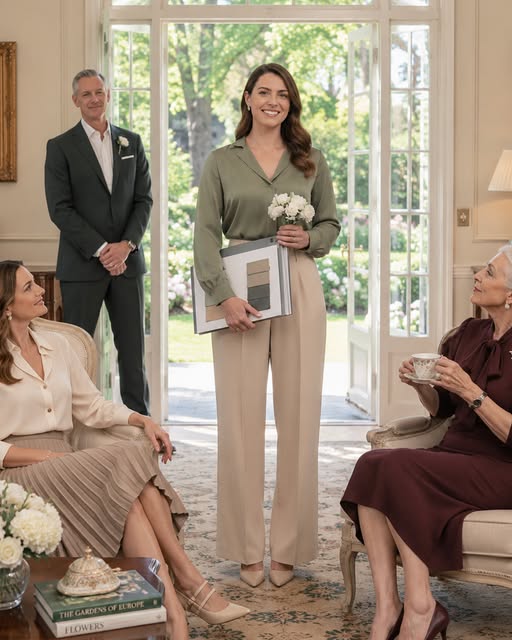
My name is Olivia Reed.
My mother’s words cut sharper than glass. I was standing in her living room, a space of cold marble floors and pristine furniture no one was ever allowed to sit on. Clutched tightly in my hands was my wedding binder.
That book was heavy with three years of my stolen dreams, carefully chosen fabric swatches, and magazine cutouts of smiling couples. I was twenty-six years old, and I was weeks away from marrying Ethan, the only man I had ever truly loved.

I had just walked out of a final meeting with our wedding caterer, the pure excitement still buzzing warmly under my skin. Ethan had already left for his shifts as a counselor at the local high school, so I stopped by my parents’ house alone, eager to share the final details.
My mother, Veronica Reed, sat rigidly in her favorite wingback chair facing the perfectly manicured garden. She held a cup of chamomile tea, her posture as flawless and frozen as the porcelain in her hands.
Without even glancing up at me, she kept her eyes fixed on the outside world—a world she had spend decades arranging to her absolute liking.
“We’re not funding this circus,” she said.
The words were uttered so quietly, so entirely devoid of emotion, that I genuinely thought I had misheard her. In the sudden silence, the heavy ticking of the grandfather clock in the hall sounded deafening. The air in the room, strictly maintained at 68 degrees, felt like it had instantly dropped to freezing.
Sitting on the arm of the sofa like a porcelain doll, my older sister Grace looked up from her phone. A slow, deeply satisfied smirk spread across her face.
It was a look I had been forced to witness my entire life, always right before my world was stripped away a little bit more.
“Maybe next time you’ll choose someone appropriate,” Grace chimed in, her voice dripping with artificial sympathy.
My eyes darted from my sister’s triumphant grin to my mother’s rigid, unmoving back. I looked down at the wedding binder in my hands, a book filled with all my simple, happy plans for the future.
A circus.
That was how they viewed my love, my fiancé, and my future happiness. An embarrassing, low-rent sideshow.
Right then, a fragile part of me that had spent twenty-six years begging for their approval finally snapped. But it didn’t dissolve into tears; it shattered and reformed into something hard, clear, and dangerous.
I didn’t argue, I didn’t raise my voice, and I refused to give them the satisfaction of a single tear.
Instead, I closed the binder with a soft, deliberate click, looked directly at the back of my mother’s head, and uttered a single word.
“Understood.”
That was the exact second everything shifted.
They genuinely believed they had humiliated me, broken my spirit, and forced me back into my place. They expected me to come crawling back on my knees, begging for their forgiveness and their money.
But they fatally miscalculated my silence; it wasn’t an act of surrender. It was the quiet beginning of a war they didn’t even realize I had just declared.
Three weeks later, that very silence would become the one weapon they never saw coming.
Growing up under the Reed roof was equivalent to living inside a cold museum. Every single object was breathtakingly beautiful, highly valuable, and strictly meant for display.
In our household, affection always came with fine print and a hidden price tag. Love wasn’t a genuine emotion; it was a marketable asset to be polished, paraded at high-society parties, and appreciated in value when paired with the right family name or bank account.
My mother was the ruthless curator of this museum, running our estate on King Street in Charleston like an exclusive, frosty country club built entirely on reputation.
She saved her warmth exclusively for the high-profile guests she wanted to impress. Toward my father and me, she was merely efficient, cold, and demanding.
She never had to raise her voice because her quiet disapproval was a suffocating force that could instantly drain the oxygen from a room. A single arched eyebrow or a tight, thin smile was more than enough to signal that you had failed her.
My father, Charles, was simply one of her most prized exhibits. He was a highly successful architect who designed stunning, empty buildings that won prestigious awards, and at home, he was just as vacant.
He existed as a well-tailored ghost who rarely spoke unless it was to blindly echo my mother’s demands. As a child, I thought he was just quiet, but growing up forced me to realize the truth: his silence was active complicity.
He stood by and watched as my mother rationed out her affection in microscopic teaspoons, consistently saving the largest portion for my older sister.
Grace was their undisputed masterpiece.
Being two years older, she was deemed prettier, smarter, and far more ambitious than me. She was the exact carbon copy my mother had always desired in a daughter.
Grace understood the family business perfectly: appearances override reality. She attended the right schools, joined the elite sorority, and dated men with inheritance, acting as a flawless mirror reflecting my mother’s ambitions.
I, on the other hand, was a window my mother preferred to keep heavily curtained.
I vividly remember a Christmas when I was ten years old, after spending weeks crafting a handmade jewelry box for my mother. I used my entire allowance to buy the wooden box and painstakingly painted tiny sea turtles on the lid because she had once casually mentioned liking them.
On Christmas morning, my heart pounded with desperate hope as she unwrapped it. She stared at the painted turtles, offered a thin, mechanical smile, and muttered, “How quaint, Olivia,” before tossing it aside to open Grace’s present.
Grace had used our father’s credit card to buy a designer silk scarf from a luxury boutique, and my mother wore that scarf proudly for the rest of the day while my little box was thrown into a dark drawer, never to be seen again.
That unmoving pattern defined my entire existence.
My deepest efforts were labeled quaint, while Grace’s superficial actions were deemed deeply impressive.
When Grace married a man whose family commanded a massive shipping empire, my mother was ecstatic, threw a lavish garden wedding featured in the local society pages, and spent a year obsessing over every detail from the imported French lace to the string quartet.
It wasn’t a celebration of a wedding; it was a royal coronation, and my mother basked in the spotlight as the proud queen mother.
My upcoming wedding was never going to fit into her exhibit.
I wasn’t marrying for social leverage or a magazine feature; I was marrying Ethan.
We met in college, and he didn’t possess a prestigious lineage—his father worked as a mechanic and his mother was a registered nurse. He had zero desire to climb corporate ladders as a banker or lawyer because his true calling was helping people.
Now, he worked tirelessly as a high school counselor for troubled youth, guiding them, listening to them, and remaining fiercely steady, kind, and patient.
In his presence, I could finally breathe without a script. He never viewed me as a project to be corrected or a tool to boost his own ambition; he simply saw me for who I was.
He loved me, and that was the only thing I had ever craved.
To my family, however, his genuine kindness was viewed as a financial liability and a pathetic weakness.
The moment I brought him home for dinner, the polite but lethal interrogation commenced. My mother demanded to know his five-year financial plan, my father questioned his investment portfolio, and Grace asked if counseling was emotionally draining, her sneering tone heavily implying it was also financially bankrupt.
Ethan handled every single barb with calm, unshakeable sincerity, refusing to be ashamed of his profession or his background.
The moment he left that evening, my mother cornered me in the kitchen, her voice low and frantic.
“Olivia, you cannot be serious about this man. He has absolutely no drive. He is a mere public servant. Think about what this does to our reputation.”
“I love him, Mom,” I replied, my voice barely audible.
She let out a long, exhausted sigh, as though my personal happiness was an unbearable burden she was forced to carry.
“Love doesn’t pay mortgages, darling. In our circle, marrying for pure love is considered a public scandal.”
I should have walked away right then. I should have recognized that this dynamic would never yield a happy ending. But a buried part of me—the little ten-year-old girl who had painted sea turtles on a wooden box—still foolishly believed that she might finally see me one day.
That desperate hope was a lethal trap.
When my mother suddenly broke months of icy silence to offer financial help with the wedding planning, I experienced a naive surge of immense relief.
I foolishly thought she had finally accepted Ethan, saw how happy he made me, and wanted to genuinely be a part of my milestone.
We sat in the exact same sitting room where she would later shatter my life, and she produced a heavy folder filled with glossy brochures for luxury venues that were astronomical for our budget.
“I know you and Ethan are trying to fund this alone, and I truly admire your independence,” she began, her tone uncharacteristically soft. “But managing a wedding is overwhelming with endless deposits. Why don’t you let me handle the financial logistics from a family account to simplify the paperwork, and you can focus entirely on the creative details? My treat, darling.”
She packaged it beautifully as an act of pure maternal generosity, promising to handle vendor contracts directly.
Desperate for peace and her approval, I agreed, thanking her as a rare warmth spread through my chest.
I viewed it as an olive branch; I had no idea it was a loaded weapon.
For the next few weeks, the facade was flawless as my mother called regularly with cheerful updates about deposits being paid to the venue and florists being locked in. I completely bought into the fantasy that we were a normal mother and daughter happily planning a wedding.
The first devastating crack appeared exactly one month before the wedding date.
On a Tuesday afternoon, while I was sitting in my apartment addressing invitations, my phone rang. It was Sarah, the events coordinator from Ivy Oaks Garden, our absolute dream venue.
“Hi, Olivia,” she said, her voice dripping with deep confusion. “I’m calling to finalize your cancellation. We have another couple ready to snap up your date, so I just wanted to confirm you won’t be needing the space.”
The pen slipped from my numb fingers.
“Cancellation? I haven’t cancelled a single thing.”
A heavy pause hung over the line.
“Oh. Well, we received an official email and a formal cancellation document last week stating that due to unforeseen family emergencies, the wedding was called off. Your signature was right there at the bottom.”
My blood instantly turned to ice.
“Can you email me a copy of that notice immediately?” I asked, my voice trembling violently.
A minute later, the notification popped up in my inbox, and I opened the PDF attachment. There it was: the official cancellation form for Ivy Oaks Garden.
And at the bottom, written in perfect, flowing script, was my exact signature.
Except I had never laid eyes on that piece of paper.
I stared blankly at the screen, my heart hammering violently against my ribs. It was a flawless, terrifying imitation of my handwriting—the exact kind of forgery someone could only execute if they had spent years practicing on your school forms and birthday cards.
Before my brain could even process the violation, my phone buzzed repeatedly. It was our florist, followed by the caterer, and then the photographer.
One by one, they delivered the exact same news: they had all received formal cancellation notices bearing my forged signature, believing I was the one dismantling my own wedding piece by piece.
My dream was being systematically murdered by an invisible hand, but I knew exactly whose hand held the blade.
Blindsided and in a complete daze, I drove straight to my parents’ estate, bypassed intercoms, used my old key, and marched into the living room to find my mother calmly arranging fresh roses in a crystal vase.
She looked up with a placid, questioning smile as I thrust my phone forward, displaying the forged documents.
“Why?” I demanded, my voice tight and completely strained. “Why would you do this to me?”
She didn’t deny it, she didn’t flinch, and she didn’t lose her composure. She simply took a long stem, clipped the end with silver scissors, and placed it perfectly into the arrangement.
Her utter calmness was far more terrifying than any scream.
“It’s for your own good, Olivia,” she said, finally locking her cold, ice-like eyes with mine. “You are marrying far beneath your station, and I refuse to sit back and watch you ruin your life. This is a harsh lesson, but you will thank me in the future.”
Grace suddenly materialized in the doorway, drawn by the conflict, and leaned against the frame with crossed arms and a smug expression.
“She’s right, you know. We are simply intervening to protect you from your own horrific decisions.”
I stood there, completely ambushed.
This wasn’t just a simple cancellation; it was a calculated, coordinated attack that they had planned, discussed, and executed together behind my back.
The betrayal was so total, so absolute, that it threatened to swallow me alive.
I walked out of that house shaking to my core, but I refused to let a single tear fall. Tears equaled weakness, and I could no longer afford to be weak.
The crushing weight of the hurt felt like a physical blow to my chest, but deep beneath the pain, a cold, unyielding resolve began to take root.
I drove back to my apartment, my knuckles stark white against the steering wheel, walked right past the useless stacks of wedding invitations, sat down at my laptop, and typed a single heading at the top of a new document:
Evidence.
I began compiling a meticulous list of every single contract she had touched and everything I was about to claw back.
When Ethan came home that evening, the apartment was completely dark except for the harsh blue glow of my laptop screen illuminating my face.
He took one look at me and knew something catastrophic had occurred, so I laid out the entire timeline: the calls, the forged signatures, and the chilling confrontation with my mother and sister.
As the reality set in, his face shifted from confusion to disbelief, finally morphing into a terrifying, slow-burning fury I had never witnessed in him before. Ethan, the gentlest soul I knew, looked ready to burn their entire world to the ground.
“That’s it,” he growled, reaching for his phone. “We’re hiring a lawyer immediately. We will sue them for forgery, breach of contract, and emotional distress. We are going to legally destroy them.”
A part of me loved him more than ever for wanting to shield me, but a colder, far more calculating side of my brain reached out and placed a firm hand on his arm.
“No,” I said, my voice eerily steady. “Not yet.”
He looked at me, completely baffled.
“What do you mean, not yet? They forged your name and sabotaged our future. They cannot walk away from this.”
“I know,” I replied, staring at the list glowing on my screen. “But revenge doesn’t require blind rage, Ethan. It requires absolute precision.”
They expected me to be a hysterical, emotional wreck who would scream, cry, and eventually collapse in defeat. We were not going to give them what they expected.
I needed to unearth the entire truth.
My mother’s cruelty had always felt purely emotional—a twisted psychological tool to control my actions. But this operation was different; it was methodical, criminal, and calculated. There had to be a deeper motive than just her snobbish disapproval of Ethan.
Over the next few days, I channeled my grief into a singular, razor-sharp focus: finding out the real why.
I started tracking the payments my mother claimed to have made, cross-referencing the original vendor contracts and deposit amounts. Since she claimed she was drawing from a family account, I needed to identify the exact one.
I dug through old financial folders my parents had handed over to me years ago for tax purposes—documents I had filed away and completely forgotten about. Most were standard checking statements.
But then, tucked away at the very back of the filing cabinet, I discovered a thin, overlooked folder containing a few outdated papers.
The title on the account made me freeze: Olivia Reed Custodial Account.
I barely remembered its existence. My parents had casually told me it was a minor savings fund my grandfather had set up for my college tuition, and that the balance had been entirely drained by my graduation.
The final statement in that folder was from over five years ago.
Following a sudden intuition, I looked at the routing and account numbers, then pulled up the initial vendor deposit receipts my mother had forwarded to me weeks prior as proof of payment.
I lined up the numbers. They were an identical match.
My heart began beating a frantic, erratic rhythm against my ribs.
The funds she used to pay the wedding vendors—the very money she used to seize total control of my wedding—hadn’t come from her wealth at all. They had been drawn from an account that belonged exclusively to me.
Why would she risk using that specific account? It made absolutely no logical sense.
There was only one human being alive who could provide the missing answers.
Our family had utilized the same prestigious law firm for generations, and the senior partner, Ms. Eleanor Carter, was a sharp, fiercely discreet woman who had been my late grandfather’s closest confidante and personal attorney. She was one of the few people on earth my mother could never intimidate.
I dialed her private office line, and her assistant patched me through without hesitation.
“Olivia, dear,” Ms. Carter’s voice was professional yet warm. “It’s been far too long. How are you holding up?”
“I’m not entirely sure, Ms. Carter,” I said, forcing my voice to remain stable. “I have a strange question regarding an old custodial account my grandfather established in my name. My mother has been using it to fund wedding deposits, and I don’t understand the legal mechanics behind it.”
As I detailed the situation, a profound, heavy silence stretched over the phone line. It lasted so long I feared the call had dropped.
When she finally spoke, all the warmth had completely vanished from her tone, replaced by a devastating gravity that terrified me.
“Olivia,” she said slowly, measuring every syllable. “You have absolutely no idea what has been happening with that money, do you?”
Later that evening, I met Ms. Carter at her dark, wood-paneled downtown office. The building was completely deserted, save for the single beam of light spilling from her open doorway into the corridor.
A thick, leather-bound folder bearing my name sat squarely on her mahogany desk, and the air felt heavy, like the exact second before a massive storm breaks.
“Your grandfather was an incredibly perceptive man, Olivia,” she began, her sharp eyes scanning my face. “He loved your mother, but he was never blind to her volatile temper or your father’s total passivity.”
She opened the file and slid the first document across the polished wood. The bold header read: Irrevocable Trust Agreement.
“Your grandfather didn’t set up a simple college savings account,” she explained gently. “He established a massive trust fund. He wanted to guarantee you possessed a significant piece of the family legacy that your mother could never touch or manipulate.”
My eyes raced down the legal text, and my hands began to tremble violently. The number printed in the formal clause seemed to leap off the page.
$275,000.
I physically couldn’t breathe.
“Two hundred and seventy-five thousand dollars?” I whispered, the words feeling entirely foreign. “I don’t understand. My parents explicitly told me this fund was entirely drained to pay for my university tuition.”
Ms. Carter let out a weary, deeply sorrowful sigh.
“That was their very first lie. The trust terms dictated that while your parents were named as trustees to manage the funds, the money was for your benefit and your benefit alone. And most importantly,” she added, tapping a specific legal clause with her pen, “the entire remaining balance was legally mandated to be released into your sole, unrestricted control upon one of two conditions: your thirtieth birthday, or the exact date of your legal marriage.”
The entire room began to spin violently as the word marriage echoed repeatedly in my skull.
The legal trigger.
“The account my mother has been using…” I stammered, the horrifying reality finally breaking through my denial.
“Was your trust account,” Ms. Carter confirmed flatly. “The exact fund she was legally bound to protect for your future. Instead, she and your father have spent the last decade treating it as their personal, unrestricted slush fund.”
She then laid out the full financial audit—page after page of unauthorized withdrawals, hidden transfers, and personal payments stretching back over ten years. It was a flawless, irrefutable record of their betrayal.
I spotted a $25,000 withdrawal from three years ago, the memo line reading: Kitchen remodel. Our family kitchen had been completely renovated that exact year.
Next was a massive transfer of $50,000 with the memo: Seed funding, Reed Designs. That was the exact capital they claimed to have proudly gifted Grace to launch her failing fashion boutique.
They hadn’t gifted her a dime; they had stolen the money directly from my inheritance and presented it to her as a grand gesture.
There were endless charges for elite country club dues, my father’s luxury sedan, and my parents’ anniversary trips to Europe—the very vacations they sent postcards from, patronizingly telling me to work hard so that I could travel like them one day.
Every single luxury, every unfair advantage handed to Grace, and every facet of the perfect lifestyle they paraded in front of Charleston high society had been entirely funded by me, using the money my grandfather had locked away to secure my life.
They had been quietly bleeding the account dry for a decade, embezzling over $150,000.
The final, sick piece of the puzzle locked into place with absolute clarity.
“If I had actually gone through with the wedding…” I whispered, looking up at Ms. Carter with burning, completely dry eyes.
“The trust would have automatically dissolved,” she confirmed. “The total remaining balance would have been transferred directly to your private bank account, which would have triggered a mandatory legal audit to close out the trust. The corporate lawyers would have requested a full, itemized accounting of every single expenditure over the last decade.”
“They would have been exposed instantly,” I realized.
“Precisely. Forgery, embezzlement, and grand fraud. They would have been utterly ruined, both socially and criminally.”
Cancelling my wedding had absolutely nothing to do with their embarrassment over Ethan’s middle-class background, nor was it about my personal happiness or choice of husband.
It was an act of pure criminal self-preservation to hide their theft.
They hadn’t sabotaged my future out of elitist snobbery; they did it to stay out of a federal prison. They were protecting their own freedom, not my well-being.
I sat there staring at the physical proof of a decade of deception, realizing that the emotional neglect I had endured my entire life suddenly possessed an exact price tag.
The blatant favoritism, the systematic dismissals, and the constant narrative that I was inferior were all part of a deliberate psychological strategy to keep me compliant, insecure, and too afraid to ever ask questions about my money.
I slowly stacked the papers into a neat, perfect pile. The shaking in my hands completely ceased.
The raging hurricane of pain inside me suddenly settled into a dead, calm eye, and a chilling, unshakeable clarity washed over my entire being. This situation was vastly larger than a canceled wedding ceremony.
I looked up at Ms. Carter, the one woman my grandfather trusted to protect me.
“They didn’t just cancel my wedding,” I whispered, my words sounding like sharp chips of ice. “They just canceled their own peace.”
The days that followed that meeting were unnervingly quiet. The legal storm was gathering strength behind the scenes, but on the surface, my daily routine remained completely frozen.
I went to my job, shared quiet dinners with Ethan, and mapped out a future that felt simultaneously more real and vastly more terrifying than anything I had ever imagined.
Ethan, now fully grasping the immense scale of the financial crimes committed against me, had moved past his initial explosion of anger to become my absolute anchor.
He refused to push, pressure, or dictate my choices. He simply sat beside me every evening, holding my hand while I stared at the bank audits, the numbers blurring into a grim testament of my entire childhood.
He would quietly place a cup of tea in front of me and say, “Whatever path you choose to take, I am standing right next to you.”
Making the final decision was the hardest hurdle. Filing a formal lawsuit wasn’t merely a legal maneuver; it was a total declaration of war.
It meant taking a family dynamic that was already severely fractured and completely pulverizing it into microscopic dust. It meant consciously choosing to become an orphan.
There were agonizing moments late at night when the neglected little girl inside me would desperately whisper, “But she’s still your mother.”
I had to brutally remind that little girl that a real mother does not systematically rob her own child, nor does she murder her daughter’s happiness to cover up her own financial crimes.
After a solid week of entirely sleepless nights, I dialed Ms. Carter’s number.
“File it,” I commanded, my voice completely clear and steady. “File every single charge.”
The initial legal process was executed with absolute quiet, exactly as I had requested. There were no dramatic, screaming phone calls or theatrical confrontations—only the silent, clinical delivery of an official court summons by a process server.
I spent hours imagining the exact second the courier arrived at their pristine front door on King Street. I pictured my mother’s manicured hand taking the heavy envelope, her brow furrowing in irritation at the unannounced interruption.
I envisioned her slicing the paper open with her custom silver letter opener, her elegant expression morphing from confusion into a cold, reptilian fury. I imagined my father’s face turning entirely translucent as his eyes scanned the text: Olivia Reed versus Veronica and Charles Reed.
Those specific words were an undeniable act of war.
Naturally, they launched a counter-attack.
Their high-priced attorney, a man who smelled heavily of expensive cologne and completely bankrupt ethics, fired back a legal response filled with aggressive denials and vicious accusations. They claimed the trust funds had been entirely utilized for my upscale upbringing and elite private schooling, arguing that every single withdrawal directly benefited my life.
They painted a narrative for the courts where I was an ungrateful, malicious daughter who was being heavily manipulated by a greedy fiancé, throwing a massive tantrum simply because her wedding had been postponed.
They were carefully constructing a public lie—the exact story they intended to whisper to their affluent friends at the country club to ensure I became the ultimate villain of the narrative.
But Ms. Carter remained entirely unfazed by their smoke and mirrors.
“Fabrications look incredibly flimsy on legal paper, Olivia,” she reassured me over the phone. “And they look even flimsier when subjected to cross-examination under oath.”
The official court date arrived on a crisp, cloudless autumn morning, the sky a brilliant shade of blue that felt like a mockery of the destruction about to occur.
Ethan gripped my hand tightly as we marched up the towering stone steps of the Charleston County Courthouse, his jaw set in a rigid, fiercely protective line beneath his best suit.
I wore a simple, structured navy-blue dress with my hair pulled back tightly, wanting to project an image of absolute calm, seriousness, and unyielding strength.
The moment we entered the grand, echoing hall, we spotted them across the room. My mother, my father, and Grace.
They stood shoulder-to-shoulder, a united front of absolute denial. My mother was decked out in a vintage Chanel suit, her signature pearls glowing against her throat, looking as though she were attending an elite charity luncheon rather than a fraud hearing.
But for the very first time in my life, I could see the visible cracks in her polished facade. There was a desperate tightness pinning her mouth, and a faint, uncontrollable tremor shook her hand as she clutched her luxury handbag.
My father hovered slightly behind her shoulder, his face resembling a gray, lifeless mask.
And Grace—Grace glared across the room at me with an expression of pure, unadulterated hatred, her eyes narrowed into lethal slits.
She whispered something venomous into my mother’s ear, prompting Veronica to turn her head and look directly into my eyes. Her expression wasn’t one of rage or sorrow; it was an look of utter, deep bewilderment, as if she were staring at a dangerous stranger who had committed an unspeakable crime against her.
She looked at me as if I was the one who had betrayed her.
Inside the courtroom, the air was suffocatingly thick with tension as the proceedings commenced, and Ms. Carter began dismantling their lives with cold, surgical precision.
She started with the wedding sabotage, projecting the forged cancellation documents onto a massive screen alongside an official report from a certified handwriting expert, confirming the signatures were a direct match to my mother’s handwriting.
My mother watched the screen, her expression frozen and unchanging, treating the evidence as a minor social inconvenience.
Then, Ms. Carter shifted her focus to the trust fund.
Line by line, item by item, she walked the judge through an entire decade of systematic theft, splashing the bank audits across the screen for the entire courtroom to witness.
“A withdrawal of $25,000 on April 12th was claimed by the defendants to be mandatory home maintenance. In reality, it funded a custom imported marble island for their private kitchen,” Ms. Carter stated, her voice echoing off the high ceilings.
She hammered the point home by presenting the direct receipt from the kitchen contractor.
“A transfer of $50,000 on June 3rd was used to fund a boutique for their other daughter, Grace Davenport,” she continued relentlessly.
Audible gasps rippled violently through the public gallery, where several local society reporters were now scribbling frantically into their notebooks.
She refused to stop, laying bare the luxury vacations to Italy, the brand-new sedan for my father, the season tickets to the symphony, and the annual country club membership fees.
With every single piece of irrefutable evidence, my mother’s aristocratic composure began to visibly fray as the color completely drained from her skin, while my father seemed to physically shrink down into his leather chair.
Grace simply stared at the glowing screen, her mouth slightly open in shock, as if she were seeing the true, horrific scale of the deception for the very first time.
When it was finally my mother’s turn to take the witness stand, she attempted to summon her usual air of upper-class grace, speaking softly of her immense maternal love for me and her deep anxiety regarding my future.
“I was only ever acting to protect my daughter,” she claimed, dabbing at a completely tearless eye with a silk handkerchief. “The capital was utilized for her long-term benefit. A stable, beautiful home environment is a benefit. A successful sister with an established business is a benefit. It was a family fund meant to support the family unit.”
Ms. Carter slowly approached the witness stand, her voice dropping to a dangerously soft tone.
“Mrs. Reed, did you ever, at any point in time, explicitly inform your daughter Olivia that you were withdrawing funds from the trust left by her grandfather to pay for your luxury kitchen renovations?”
My mother hesitated, her eyes darting across the room.
“It was a holistic family decision.”
“That is not what I asked you,” Ms. Carter pressed, her voice cutting through the excuse. “Did you tell Olivia you were taking her money?”
“I am her mother. It was my fiduciary duty to manage her finances as I saw fit.”
“So the answer is no, you did not tell her,” Ms. Carter concluded flatly. “And did you inform her when you forged her legal name on the wedding cancellation documents?”
“That was a drastic, necessary measure executed out of pure love to prevent her from making a catastrophic mistake!” my mother snapped, her voice piercing the room as her icy control finally shattered to pieces.
The judge, a man with a stern, exhausted face, had heard more than enough and held up a commanding hand to silence her outbursts.
He stared down at the mountain of evidence, glanced at the bank audits still glowing on the screen, and then looked directly at my mother with a voice colder than death.
“Maternal love is not a legal defense for fraud, Mrs. Reed. Nor is parental concern a defense for grand theft.”
He delivered his final judgment swiftly and without mercy, finding them guilty on every single count: misappropriation of trust funds, forgery, and the intentional infliction of emotional distress.
“This court rules entirely in favor of the plaintiff, Ms. Olivia Reed,” the judge announced, his voice booming through the silent room. “All misappropriated funds totaling $152,000 are ordered to be returned in full to the trust account immediately. Furthermore, additional punitive damages for fraud are awarded to the plaintiff in the amount of $75,000.”
My mother’s hand instantly flew to her throat, clutching her pearls as her mouth opened in silent horror. She looked entirely, irrevocably broken.
Grace violently turned her head away, burying her face in her hands, crying not out of guilt, but from the brutal, public shame of their exposure.
For the first time in my twenty-six years of life, I had won.
Yet, it didn’t feel like a triumphant victory; it felt like a massive, final ending.
The loud crack of the judge’s gavel striking the wooden block felt deafening—a sound of absolute finality that signaled a world fracturing in two.
In the stunned silence of the room, I sat completely frozen in my chair until Ethan’s warm hand found mine, grounding me back to reality.
Behind us, I could hear the society reporters rushing for the exit doors, desperate to be the first to publish the story of the Reed family’s catastrophic public implosion, while whispers began to spread through the room like thick smoke.
Ms. Carter offered me a small, reassuring nod before packing her legal briefs into her briefcase with crisp, professional movements.
The legal war was over, and now I had to walk through the smoldering wreckage.
We waited patiently for the courtroom to completely empty out. My father, looking incredibly old, frail, and defeated, guided my mother out through a private side exit, shielding her from the glaring eyes of the public.
Grace followed closely behind them, her face heavily streaked with black mascara, completely refusing to glance in my direction. They existed as a moving portrait of complete ruin, stripped entirely of their dignity and their carefully constructed lies.
The moment we stepped out into the grand main hall, the afternoon sun poured through the massive arched windows, illuminating the dust motes dancing in the air.
And then, the voice cut through the space.
“Olivia.”
I stopped dead in my tracks and turned around slowly.
My mother had broken away from my father’s grip and was walking directly toward me. Every ounce of her perfect poise was gone; her hair was disheveled, and her eyes were red-rimmed and utterly desperate.
She looked drastically smaller and fragile. Stopping a few feet away, she searched my face, desperately hunting for an emotion I no longer possessed.
“Olivia, we need to speak,” she rasped, her voice cracking. “This entire situation has been a terrible misunderstanding. We can fix this legally. We are still family.”
That specific word hung heavily in the air between us.
Family.
It was the exact word she had weaponized my entire life as both a shield and a blade—a word that demanded unconditional loyalty, but strictly on her terms. It dictated endless obligation from me, but zero accountability from her.
It defined a version of love that was meant to be performatively displayed, never genuinely felt.
I looked at her, really looked at her, and for the first time in my life, the terrifying, all-powerful matriarch who had dictated my reality completely vanished.
In her place stood a terrified, insecure woman who had spent her entire existence so deeply afraid of not possessing enough status, money, and control that she had literally devoured her own daughter’s future to feed her ego.
Her life had never been constructed on a foundation of integrity or love; it was built on a fragile, hollow scaffolding of keeping up appearances, and I had just kicked the entire structure out from under her feet.
Ethan gave my hand a supportive squeeze but remained entirely silent, knowing this specific moment belonged to me alone.
“No,” I said.
My voice was soft, barely a whisper, but it carried across the marble floor with absolute, lethal finality.
“We were a family a very long time ago. But you cancelled that contract, too.”
She flinched violently, a sharp intake of breath throwing her shoulders back.
It was the exact, identical way I had flinched in her living room three weeks prior when she had labeled my love a circus. The poetic symmetry of the moment was both deeply tragic and incredibly liberating.
She finally understood exactly how it felt to have something precious declared completely worthless.
I held her desperate gaze for one final beat, long enough for the reality of my words to sink into her soul, realizing there was nothing left to say, no arguments to be made, and no forgiveness to be begged for.
We were past the point of no return; we were officially strangers connected only by a history of trauma and a court mandate.
I turned my back on her, stepped toward the courthouse doors, and walked away into the bright, open world outside without looking back a single time.
With every single step I took away from her, I felt an invisible, lifetime weight lifting off my shoulders—the suffocating pressure of trying to be good enough, of hoping for a single crumb of validation from a woman who possessed a stone for a heart.
The weeks that followed were profoundly quiet.
The story naturally made the local papers—a clinical, damning article on page three detailing the fraud lawsuit and the judgment, and Charleston high society proved to be entirely ruthless. Scandal was their primary source of entertainment, and the disgraced Reed family was the hottest new show in town.
I methodically cut the final cords connecting me to that past, changing my phone number, deleting and blocking their contacts, their emails, and their social media profiles.
It was a strange, clinical process that felt like cleaning out an estate after a sudden death, where every single click of the block button acted as a mini-funeral for a piece of my childhood.
Ethan was my absolute rock, understanding that this wasn’t a simple, celebratory victory, but a complex grieving process mixed with intense relief.
He allowed me to sink into silence when I needed it, and he held me tightly when, on a random Tuesday night while washing the dinner dishes, a massive wave of sudden grief washed over me and I finally broke down and sobbed.
I wasn’t crying for the mother I had; I was mourning the mother I had deserved but was never given.
“It’s okay to grieve, Liv,” he whispered against my hair, pulling me into his chest. “You’re mourning what should have been, and this is the final step of letting go completely.”
He was entirely right.
The lawsuit had severed the financial ties, and the courthouse confrontation had broken the spoken ones, but in the safety of Ethan’s arms, I severed the final invisible cord binding my heart to a ghost of hope.
The foolish hope that they would love me for who I was. I was finally, completely free.
And in the beautiful silence they left behind, I could finally begin to hear the sound of my own voice.
Six full months passed by as the chill of autumn melted into the quiet dark of winter, eventually giving way to the vibrant, blooming warmth of a Charleston spring.
The world kept turning, and I transformed right along with it.
The legal scandal faded entirely from the society pages, replaced by fresh gossip and newer downfalls, while the embezzled funds and damages were officially transferred into a brand-new account under my sole name—a space my parents could never touch.
The money sat there, a quiet symbol of my absolute independence, but the true prize of the lawsuit was never the wealth; it was the unshakeable peace.
During those months of healing, Ethan and I chose to start completely over, deciding we still wanted to hold our wedding at Ivy Oaks Garden because it was our dream, and I refused to let my mother’s crimes taint our memories.
Reclaiming that venue felt profoundly important, like replanting a beautiful garden that had been violently trampled by malicious hands.
This time around, the planning process looked entirely different.
There were no massive binders filled with magazine clippings meant to impress high-society judges, nor were there any passive-aggressive phone calls or suffocating meetings.
Instead, it was just Ethan and me sitting cross-legged on our living room floor with cheap takeout and a laptop, making decisions together and laughing until our ribs ached.
We chose a simple, elegant aesthetic, curated a menu of comfort food we actually loved eating, and built a playlist of our favorite indie rock and old soul tracks that would have made my mother absolutely cringe.
Every single choice belonged to us, and every minor detail reflected our genuine love story. The entire process was light, joyful, and completely effortless—the exact way a wedding was always meant to feel.
I even designed my own wedding gown—a clean, minimalist A-line dress crafted from soft, flowing crepe, spending hours sketching the lines before hiring a local seamstress to bring it to life.
The physical act of designing it felt as though I were stitching my new existence together, thread by perfect thread.
Our wedding day finally arrived on a flawless Saturday in May, with a radiant sun warming the property and a gentle breeze rustling the leaves of the ancient oak trees.
The gardens were trapped in a full, spectacular bloom, throwing a riot of white roses, lavender, and heavy hydrangeas into the sweet spring air.
Our guest list was kept intentionally small—just fifty people, a far cry from the massive three-hundred-person corporate gala my mother had tried to force upon us.
There were zero business associates of my father, and absolutely no high-society friends of my mother present.
The space was filled exclusively with Ethan’s loud, incredibly warm, and deeply loving family, who had embraced me as a daughter from day one, alongside my absolute closest friends who had watched me weep and cheered me on as I fought my way back to the light.
It was a celebration built on a foundation of genuine love, not strategic social connections.
As I pinned my veil in the bridal suite with my two best friends, a sudden pocket of quiet settled over the room, and Sarah, my maid of honor, looked at me with misty eyes.
“Are you thinking about them right now?” she asked softly.
I knew exactly who she meant.
I turned and stared at my reflection in the full-length mirror, seeing a woman who was entirely calm, incandescently happy, and completely whole.
The toxic ghosts of my family were nowhere near the room because I had denied them an invitation.
“No,” I replied, and a wave of pure surprise washed over me as I realized it was the absolute, unyielding truth. “I’m really not.”
There was no prestigious father present to walk me down the aisle, and no elegant mother to fix the placement of my veil.
That realization, which once would have completely devastated my spirit, now felt like a towering testament of my own strength.
I didn’t require a single soul to give me away to another human being; I was walking out there to freely, consciously hand myself over to the man who loved me.
I walked myself down that aisle.
I moved slowly, deliberately, my eyes locked entirely on Ethan, who stood waiting for me beneath a massive archway of blooming white roses, a radiant smile splitting his face as his eyes shone with happy tears.
In that exact microsecond, he was the only living soul in the entire universe.
He was my partner, my ultimate champion, and my true home—everything they had sneered was not enough for our social circle.
And I knew with a bone-deep certainty that he was vastly more than enough; he was my entire world.
Every single step I took down that grassy path was a piece of my life I was actively reclaiming, and every smiling face I passed stood as a testament to the real, chosen family I had built from the ground up.
This gathering was not a high-society circus; it was a sacred sanctuary.
We wrote our own vows, and Ethan spoke eloquently of my inner strength, my courage, and the profound way I had taught him the true meaning of unconditional love.
When it was finally my turn, I looked directly into his steady, kind eyes and let the words pour directly from my soul.
“You saw me clearly when I felt completely invisible to the world,” I said, my voice thick with raw emotion but entirely steady. “You loved me when I had no idea how to love myself. You are my quiet sanctuary in a deafeningly loud world. Today, in this exact garden we fought a war to stand in, I don’t just choose you as my husband. I choose us. I choose this joy, I choose this absolute peace, and I promise to actively choose it with you every single day for the rest of our lives.”
The moment the ceremony concluded and the officiant officially pronounced us husband and wife, Ethan pulled me into his arms.
The crowd erupted into cheers, but the only sound that registered in my brain was the steady, rhythmic beating of my own heart against his chest as he kissed me, signaling the first official day of the rest of my life.
As we walked back up the aisle hand in hand, he leaned his head down and whispered, “Are you okay?”
I looked up at my husband, a genuine, radiant smile blooming across my face.
The crushing weight was entirely gone, the ghosts of my past were permanently banished, and I was standing squarely in the center of my own happiness—a happiness I had fought a bloody war for and won on my own terms.
“Better than ever,” I said, meaning it with every fiber of my being.
In the beautiful months that followed our wedding day, Ethan and I settled into a lifestyle that was blissfully, beautifully normal.
We purchased a charming small home featuring a massive fenced yard for a golden retriever we planned to rescue, spending our weekends getting our hands dirty in the garden and exploring the coastline. My life became filled with tiny, quiet joys that slowly stacked up to form an impenetrable fortress of happiness.
The chaotic drama of the prior year quickly began to feel like a distant fiction story that had happened to an entirely different person.
I never actively sought out updates regarding my biological family, but in a city as tightly wound and small as Charleston, news always finds a way to travel through the grapevine. It trickled down to me through mutual high-society acquaintances who would awkwardly bring up rumors, or through random local headlines I’d stumble across online.
The very first domino to collapse was Grace’s upscale fashion boutique.
Her business had been artificially propped up by my stolen trust fund capital from day one, and the second that illegal line of credit was permanently severed—and the court mandate forced my parents to rapidly liquidate assets to pay me back every dime—there was absolutely nothing left to keep her afloat.
The storefront, Reed Designs, held a desperate, massive going-out-of-business liquidation sale, and a friend text me a photo of the building, its luxury display windows plastered with cheap, bright yellow clearance signs.
I experienced a fleeting, distant pang of something resembling pity, but the emotion evaporated before it could take root.
Grace had stood by idly and watched my mother forge my identity, smirking maliciously while my world was dismantled, so her failure wasn’t my personal revenge; it was simply the natural consequence of her actions.
Next came the total social fallout.
The public details of the fraud lawsuit, with its sordid evidence of grand theft and forgery, became a permanent, toxic stain on the prestigious Reed family name.
My mother, a woman who had literally lived and died by her elite social reputation, was instantly transformed into a total pariah. The invitations to high-profile charity galas completely ceased, and her closest friends stopped returning her phone calls.
I eventually learned she had been forced to resign from her position as chair of the historical society—a board she had commanded with an iron fist for over a decade.
She had constructed her entire identity on being a revered pillar of Charleston’s elite upper class, and without that hollow title, I truly couldn’t comprehend who she was as a person.
My father’s professional architectural career suffered a devastating blow as well, since he was a man whose entire business model relied on a sterling reputation of corporate integrity to secure contracts with billionaire clients.
The word fraud is an absolute death sentence for business.
His long-term clients became instantly distant, and securing fresh contracts proved entirely impossible, forcing his firm—once a proud titan of the Charleston architectural scene—to violently struggle for survival.
They were forced to downsize drastically, firing dedicated staff members they had proudly employed for decades.
Their entire hollow universe, built on a foundation of my stolen inheritance and their elaborate lies, was crumbling to pieces brick by brick, and my only contribution to their absolute demolition was my total absence.
Then, the desperate phone calls commenced.
They didn’t call my private cell phone, which they didn’t possess, but began targeting my office line at the interior design firm where I worked.
The very first time the receptionist informed me that Veronica Reed was on the line, a sudden jolt of pure ice raced through my veins.
“Inform her that I am permanently unavailable,” I commanded, my voice flat and completely devoid of emotion.
She called again the following afternoon, and the day after that, until I finally instructed management to officially tell her to cease all communications.
Inevitably, the direct calls were replaced by endless voicemails left on the company’s general inbox, which my boss—a fiercely compassionate woman who fully understood my trauma—would quietly forward to my email as audio files, leaving the choice to listen entirely up to me.
For weeks, I deleted the files instantly without listening, but one afternoon, a flash of morbid curiosity overrode my defense mechanisms.
I clicked play on the latest recording.
My mother’s voice flooded my headphones, but it was a voice I could barely recognize as her own; the sharp, authoritative, aristocratic tone was completely gone, replaced by something thin, hollow, and deeply pleading.
“Olivia… Olivia, if you are listening to this, please, just call your mother back. Your father is incredibly unwell, the stress of this entire situation is… he’s just… please call us. We simply want to talk to you. This punishment has gone on far too long. We genuinely miss you.”
The psychological manipulation was so blindingly transparent it was almost pathetic.
She didn’t offer a single apology, nor did she take an ounce of personal responsibility for their crimes; she was merely trying to weaponize my father’s declining health as a crowbar to pry open a door I had permanently bolted shut.
I deleted the file.
A week later, a fresh voicemail landed, but this time it was Grace, her voice sharp, furious, and dripping with absolute desperation.
“You did this to us, Olivia!” she spat into the phone. “Are you incredibly happy with yourself now? Our entire lives are completely ruined because of your selfishness! Mom does nothing but cry, and Dad refuses to leave the house. You stripped everything away from us because you couldn’t handle a little bit of criticism regarding your loser husband! I hope you are thrilled with what you’ve accomplished.”
I listened to the entire toxic tirade from start to finish without experiencing a single flicker of internal emotion.
The raging Grace on that voicemail was the exact same girl who had smirked at me in the living room, still fundamentally believing that they were the true victims of the narrative and that I was entirely to blame for their downfall.
They had learned absolutely nothing from their judgment.
I never picked up the receiver, I never fired back an angry email, and I felt zero need to scream or remind them of how deeply they had wounded my soul.
I no longer required active revenge.
My ultimate revenge was my absolute silence, my unshakeable happiness, and the stunningly peaceful life I was actively constructing alongside Ethan—a life that possessed zero real estate for their toxicity.
They had built their entire empire on a foundation of lies, and the quiet, crushing weight of the absolute truth had done all the heavy lifting for me.
They weren’t being actively punished by my hand; they were simply forced to inhabit the psychological prison they had spent a lifetime building for themselves.
And I was completely free.
Two full years have passed since that day.
Ethan and I finally rescued that dog—a goofy, loving golden retriever named Gus who fills our home with an abundance of shedding fur and pure joy.
My daily existence looks absolutely nothing like the rigid blueprint my mother had mapped out for me, and I find myself profoundly grateful for that fact every single morning.
After working at the design firm for another year, I decided to take a massive leap of faith, utilizing a portion of the trust fund money—my grandfather’s gift finally being used for its true, intended purpose—to launch my own independent venture.
Today, I proudly own and operate my private bridal design studio out of a gorgeous, sunlit boutique located squarely in the historic district.
The exact artistic dream my mother had once casually thrown into a trash bin alongside my childhood sketches is now my living, breathing reality, and every single gown I sketch, every single bride I assist, feels like an act of quiet, beautiful rebellion.
It feels like absolute freedom stitched directly into the luxury fabric.
I spend my days helping women curate the absolute happiest moment of their lives strictly on their own terms, completely insulated from the toxic judgment and expectations of outside forces. In a beautiful way, I am handing them the exact gift I was forced to fight a war to win for myself.
People who are familiar with the timeline of my journey often label the outcome as poetic justice.
I don’t look at it through that lens.
I simply call it peace.
I have learned that the most lethal, powerful response to individuals who are desperately trying to break your spirit is not to shatter into pieces, but to build something magnificent. You build an existence so vibrantly full of light and love that their darkness cannot locate a single shadow to hide inside.
Sometimes, choosing to turn your back and walk away is the loudest, most devastating revenge you can ever inflict. It is a profound statement that you value your own internal peace vastly more than you value their hollow drama. It is a total refusal to play their twisted game ever again.
My biological family still resides in Charleston, existing day-to-day inside the smoking ruins of the life they constructed.
I don’t harbor a shred of active hatred toward them, nor do I waste energy wishing them ill fortune.
I simply do not think about them at all.
They exist merely as a closed chapter in a book that I have already finished reading.
If you have ever been told by the world that you are not enough, that your deepest passions are nothing but a circus, or that the love of your life is entirely inappropriate, please look at me and listen.
Your inherent worth is never up for negotiation, and your happiness does not require their approval.
Prove them wrong in absolute silence. Build your own universe. Stitch your own freedom.