When I came back from a business trip, I found my daughter unconscious near the front door.
My wife barely reacted, saying she had “just disciplined her.” I called for an ambulance—but the moment the paramedic saw my wife, his face drained of color. “Sir… are you sure that’s your wife? Because…”
The first thing that struck me when I stepped inside wasn’t the sight—it was the silence.
Not the calm, end-of-week quiet I had expected after days away. This silence felt heavy, unnatural, like the house itself was holding its breath.
My suitcase rolled in behind me as I called out, “Lily? Jen? I’m home!”
No answer. No footsteps. No laughter.
Then I saw her.
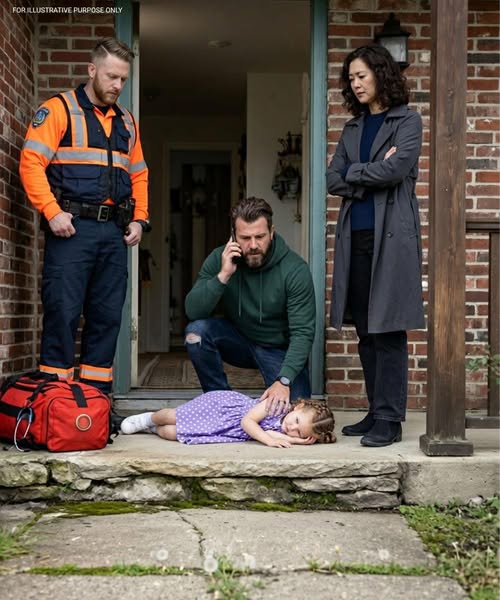
Lily lay crumpled by the door, as if she had collapsed mid-step and no one had bothered to help her. One arm was pinned beneath her, the other stretched out near the mat. Her skin looked pale, her lips slightly gray.
For a split second, my mind refused to accept what I was seeing.
Then reality hit.
“Lily!” I dropped to my knees, hands shaking as I reached for her. Her skin felt wrong—cool, lifeless in a way that made my chest tighten. I checked her pulse. It was there, but weak and uneven.
Her breathing was shallow. A faint sound escaped her lips, but she didn’t wake.
A dark bruise spread across her cheek—too harsh to be an accident.
Panic flooded me. I grabbed my phone—then stopped when I heard footsteps.
Jennifer appeared in the doorway, calm, almost indifferent, holding a dish towel as if nothing was wrong.
“Oh,” she said casually. “You’re home early.”
“What happened?” I demanded. “What did you do?”
She shrugged.
“She was acting out. I disciplined her. She’ll be fine.”
I stared at her, waiting for any sign of concern.
There was none.
“What did you do?” I asked again, my voice tight.
“She was throwing a tantrum,” Jennifer said, annoyed. “So I gave her some Benadryl to calm her down.”
The world seemed to narrow around those words.
“How much?” I asked.
She hesitated. “A few pills.”
“She’s six!” I shouted, my voice breaking.
Jennifer rolled her eyes, acting like I was overreacting.
That’s when I stopped arguing.
I called 911.
“My daughter is unconscious,” I told the operator. “I think she’s been drugged.”
I held Lily’s hand, trying to keep her with me, whispering desperately as I waited.
Jennifer leaned against the wall, arms crossed, watching like this was nothing.
The paramedics arrived quickly. The lead one—Martinez—knelt beside Lily, checking her vitals with focused urgency.
“How long has she been like this?” he asked.
“I just found her,” I said. “Maybe ten minutes.”
Then his eyes shifted to Jennifer.
And everything changed.
His expression went from professional to something else—recognition, then alarm.
He stood slowly, staring at her.
“Sir… is that really your wife?” he asked quietly.
My stomach dropped.
“Yes,” I said—but suddenly, I wasn’t sure of anything.
Martinez swallowed. “Because she matches the description of someone we’ve been warned about. Multiple cases. Children. Sedatives.”
I felt the ground slip beneath me.
Lily was rushed onto a stretcher, oxygen mask secured as machines beeped around her.
Martinez stopped me briefly, his voice low and serious. “Stay with your daughter. And don’t let her out of your sight.”
Behind him, Jennifer laughed—soft, almost amused.
“This is ridiculous,” she said. “You’re acting like I’m a criminal.”
But there was something off in her eyes.
Not fear.
Control.
At the hospital, everything moved fast. Doctors worked to stabilize Lily while I waited, barely able to breathe.
Then Martinez returned—with a police officer.
“She’s in custody,” he said.
The words felt unreal.
The officer explained they had been tracking a pattern—children becoming unusually drowsy, suspicious “discipline,” cases that never quite stuck.
Until now.
“Your call saved your daughter,” he said.
Saved.
The word hit me all at once.
I broke down, the weight of everything crashing over me—fear, anger, guilt, relief.
Then a doctor approached.
“She’s going to be okay.”
Everything inside me stopped—and then came rushing back.
Later, I sat beside Lily as she lay in the hospital bed, machines humming steadily around her.
Her eyes slowly opened.
“Daddy?” she whispered.
“I’m here,” I said, gripping her hand.
Her fingers curled weakly around mine. “I tried to stay awake… she said not to tell you.”
Something inside me shattered completely.
“You don’t have to be strong anymore,” I told her softly. “I’ve got you now.”
Outside that room, my life was falling apart.
But inside it, one truth remained.
She was alive.