One second I was half asleep, dragged upward out of a shallow, uneasy dream by the sound of my daughter crying, and the next there was that sharp crack cutting through the dark, clean and hard and unmistakable. It was the kind of sound that makes your body understand something terrible before your mind catches up.
Then my stepmother-in-law’s voice followed it.“Stop the drama, Eva.”
I was already moving by then, my bare feet cold against the wood floor, my heart pounding so hard it felt too large for my chest. Our hallway was narrow, and at two in the morning it held onto darkness in a way that made every doorway feel like a mouth. The only light came from the yellow nightlight we kept near the bathroom so Eva wouldn’t trip if she woke from a bad dream.
That soft light showed me everything.
Eva stood in the middle of the hall in pink pajama shorts and a faded T-shirt with a cartoon moon on it. Her hair was tangled from sleep. One hand was pressed to her cheek, and a red mark was already brightening across the left side of her face. Tears spilled down both cheeks faster than she could wipe them away. She looked so small in that moment that something inside me seemed to tear.
Facing her was Marlene—my husband Jack’s stepmother, though Eva called her Grandma because children are generous with titles adults have not earned. Marlene still wore her satin robe, one hand on her hip, the other dropping lazily back to her side after the slap as if she had merely swatted at a fly. Her expression was not angry in the way I might have understood, not explosive or wild. It was worse. It was irritated. Offended that an eight-year-old had disturbed her.
“I just wanted to tell you something,” Eva said through hiccupping sobs.
“Then tell me in the morning,” Marlene snapped. “You do not wake people up in the middle of the night over nonsense.”
I think I said her name before I knew I had opened my mouth.
“Marlene.”
She turned. For a fraction of a second, surprise crossed her face. Then she recovered and gave me the same look she always did when she thought I was overreacting to something she had already decided didn’t matter.
“Oh,” she said. “You’re awake.”
I didn’t answer. I crossed the hall in two strides and dropped to my knees in front of Eva. Her body pitched toward me so fast it almost knocked me backward. She was shaking all over, those little fine tremors that run through a child when fear has gone beyond crying and settled into the nervous system.
I gathered her against my chest and looked up at Marlene.
“You hit her.”
My voice sounded colder than I felt. Inside, I was all heat and panic and disbelief.
Marlene gave the smallest shrug in the world.
“Kids need discipline.”
By then Jack had come downstairs, heavy with sleep and confusion, one hand braced against the railing, his hair sticking up on one side. “What’s going on?”
I pointed at Eva’s face.
“Your stepmother hit her.”
Jack looked from me to Marlene to Eva’s cheek, which was reddening by the second. The sleep left his face. “Marlene, did you slap her?”
Marlene rolled her eyes. “Oh, for heaven’s sake. It was one slap. She was carrying on in the middle of the night like the house was on fire.”
I opened my mouth to answer her, but before I could, Eva sagged in my arms.
Not dramatically. Not all at once. It was more frightening than that. She just seemed to soften, her bones giving way under her skin as if someone had quietly cut the strings holding her upright.
“Eva?”
Her head tipped back against my shoulder.
Then I saw the foam at the corner of her mouth.
Everything inside me went white.
“Jack.”
The word came out wrong. Too thin. I shook her gently, then harder. “Eva, baby. Eva, look at me.”
Her eyelids fluttered but did not open.
Jack was beside me instantly. “What happened?”
“I don’t know.” My own voice didn’t sound like mine anymore. “I don’t know. Something’s wrong.”
I had worked as a nursing assistant for six years before the clinic where I was employed cut staff after a round of budget reductions. I knew enough medicine to recognize danger when it stared me in the face. The foam. The limpness. The strange slackness around her mouth. Whatever this was, it was not the aftereffect of a slap.
I scooped her up before anyone could argue.The next ten minutes are broken pieces in my memory.
Jack grabbing his keys with hands that suddenly looked too large and clumsy. Me cradling Eva in the back seat because I couldn’t bear to strap her in alone. Marlene calling after us from the front door that we were overreacting, then hurrying after us anyway because people like her never want events to move beyond the boundaries of their own control.
The road to the hospital blurring under streetlights.
Jack running a red at the corner of Main and 7th because no one else was coming and our daughter’s breathing sounded wrong.
My own fingers pressed to the side of Eva’s neck, counting her pulse, counting my own, whispering nonsense into her hair because mothers say meaningless things when meaning itself is too frightening to touch.
“It’s okay. Mama’s here. Stay with me. Stay with me.”
The emergency room in our town was small, underfunded, too brightly lit, and familiar to me in the worst possible way. I had worked down the hall from triage three years earlier before the layoffs. The same vending machine stood near the waiting room entrance, still half broken. The same faded poster about flu shots hung crooked over the registration desk. The same overworked smell of antiseptic, old coffee, and panic lived in the walls.
The nurse at triage looked up, saw Eva in my arms, and called for a stretcher before I reached the desk.
That was Nurse Aisha Patel.
I knew her slightly from my clinic days—compact, efficient, warm when she had time for warmth and made of steel when she didn’t. She took one look at Eva’s face and another at the foam around her mouth and said, “Resus room two, now.”
They moved so fast after that that I barely kept up.
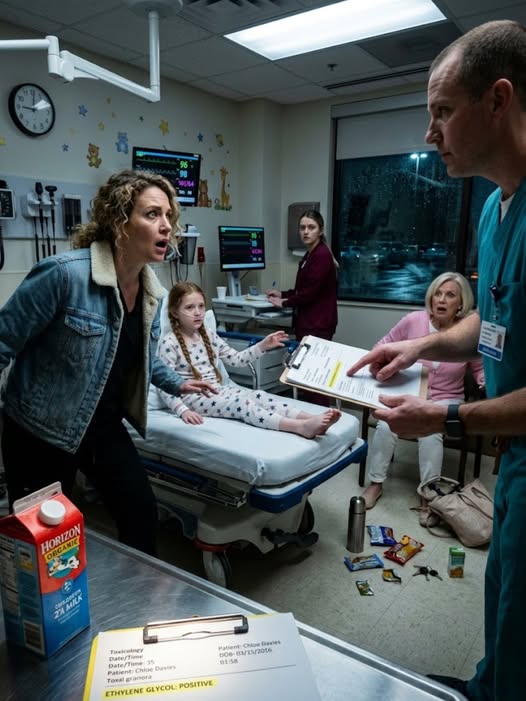
A resident cut off Eva’s shirt. Someone else attached monitors. Dr. Harper, the ER physician on duty, came in with his sleeves already rolled and started firing questions in quick succession.
“How old?”
“Eight.”
“Any history of seizures?”
“No.”
“Any meds at home?”
“Nothing regularly.”
“Head injury?”
“No.”
“Any chance she ingested something?”
I hesitated.
Because in that moment I didn’t know.
But I did know one thing.
“She was asleep,” I said. “She woke up crying. She said she needed to tell—”
I stopped myself because my throat closed around the rest.
Dr. Harper didn’t press yet. He was already listening to Eva’s chest while a nurse checked her pupils. A tech drew blood. Another started an IV. Her eyelids fluttered again, but she didn’t wake properly. The monitor beeped in sharp green bursts above her bed.
Jack stood to one side, pale and silent. Marlene hovered in the doorway, arms folded as if this were all terribly inconvenient.
“Wait outside,” Dr. Harper said finally. “We need room.”
I didn’t want to leave, but he gave me the kind of look that says staying would not help your child, and so I kissed Eva’s damp forehead and stepped backward into the hall.
The waiting area outside emergency treatment rooms is designed, I think, by people who hate human vulnerability. Plastic chairs too hard for your body to forget itself in. A television mounted too high on the wall, muted and irrelevant. Clocks that tick louder when you are desperate. Air too cold in one corner and too stale in the other. The whole place encourages helplessness.
I sat because my knees didn’t give me another choice.
Jack remained standing at first, then leaned against the wall with both hands braced flat behind him, head lowered. Marlene took the chair farthest from me and sighed once as if she had been dragged into someone else’s melodrama.
I watched the second hand on the clock make one full turn. Then another. Then another.
Fifteen minutes passed.
Then Dr. Harper came back.
He was holding a printout in one hand and wearing an expression that turned the cold waiting room air into something much heavier.
For a moment he said nothing.
He just looked at us.
Not in uncertainty. In that terrible professional way that means the next sentence is going to change the shape of everyone’s life.
Finally he asked, very quietly, “How did this happen?”
Jack pushed off the wall. “What do you mean?”
Dr. Harper looked down at the paper, then at us again.
“Your daughter has a dangerously high level of a toxic sedative in her system.”
The room went silent in a way I have never heard silence before or since. Not just quiet. Full. Dense. Like all the air had thickened at once.
“What?” Jack said.
Dr. Harper didn’t look away.
“The lab results show a significant concentration of sedating antihistamine compounds and an additional over-the-counter sleep agent. This is not consistent with one accidental exposure. It appears the substance has been entering her system repeatedly over a period of days.”
I stared at him.
My ears were still working, but the words took a second to reach meaning.
Repeatedly.
Days.
Substance entering her system.
And then, with the horrible speed memory sometimes has when it’s been waiting for permission, a dozen moments from the last week came back all at once.
Eva pushing away her bedtime mug.
The milk tastes weird.
Marlene standing at the stove saying, “I’ll warm it. Children sleep better with warm milk.”
Eva falling asleep at the table two nights ago before she finished her homework.Waking her for school and having her blink at me as though she had surfaced from the bottom of a lake.
Her teacher’s email about trouble concentrating.
The way she’d clung to me on Sunday and said, “Can I sleep in your room?” and Marlene had answered from the kitchen, “Don’t start that nonsense.”
I had thought she was stalling bedtime.
I had thought she was going through a phase.
I had thought a hundred ordinary, harmless things because the alternative had not occurred to me.
Beside me, Marlene said, with astonishing coolness, “That’s ridiculous. Children always exaggerate.”
Dr. Harper turned to her so sharply that even Jack flinched.
“This is not exaggeration, ma’am,” he said. “This could become a criminal matter.”
Something in me locked onto the memory of the milk and would not let go.
I looked at Jack.
“The milk.”
He stared back. For one blank second he didn’t understand me. Then I watched understanding arrive.
Two nights earlier, Marlene had stood in our kitchen in her house slippers, holding Eva’s little purple mug and saying in that falsely kindly voice she used whenever she wanted credit for doing something no one had asked her to do, “I’ll take care of bedtime tonight. Warm milk helps children settle.”
Jack’s face changed.
Slowly, he turned toward her.
“What did you put in her milk?”
Marlene’s expression hardened immediately. “Nothing.”
“Mom—”
“I said nothing.” Her voice rose. “Are you both insane?”
Dr. Harper lifted the report in his hand.
“The toxicology screen does not support that statement,” he said. “The levels we found are high enough to be dangerous in a child her size. Repeated administration could have caused respiratory depression, cardiac complications, neurological effects. If this had gone on longer—”
He didn’t finish.
He didn’t need to.
Marlene’s mouth trembled once.
Not with remorse.
With frustration.
“I just wanted her to settle down,” she snapped suddenly, as if we were all being unreasonable. “That child never stopped. Always talking, always crying, always wanting something. The house was never quiet.”
The sheer wrongness of that sentence left me unable to respond for a second.
Jack stepped backward as though something had struck him physically.
“Mom,” he said. “What have you done?”
But Marlene was talking over him now, louder, unraveling in real time because people like her mistake confession for self-defense when pressure breaks the wrong place.
“I didn’t poison her,” she shouted. “I just wanted peace. You both work all the time, nobody ever listened, that girl was impossible to settle—”
A police officer walked into the waiting area just then.
I never learned who called first—the hospital administration, the doctor, or some internal protocol triggered automatically by the tox screen. All I know is that the officer arrived before the echo of her own words had finished leaving the walls.
Dr. Harper handed him the lab report without a word.
That was enough.
The questions came fast after that.
What exactly had she given Eva?
How often?
Where were the medications stored?
Had anyone else seen her prepare the drinks?
Marlene tried first to minimize, then to deny, then to cry, and when none of those worked, to claim she had only been “helping” because modern parents had no discipline. But the evidence moved faster than her excuses. A nurse had already gone to collect the mug from our kitchen after I told them about the milk. The residue in it would later confirm the same compounds.
When the officer stepped behind Marlene and put handcuffs on her wrists, she looked less frightened than offended. Outraged, almost, that events had slipped beyond the range of her own explanation.
“This is absurd,” she said. “I’m her grandmother.”
Step-grandmother, technically. Jack’s father had married her when Jack was fourteen, after his biological mother died. But Eva had never cared about technicalities. To a child, anyone in the house who sits at holidays and receives handmade cards can be a grandmother if the adults allow it. Marlene had taken the title. She had not earned what came with it.
I walked into Eva’s room after they took Marlene away.
The monitors were steadier then. A soft blanket had been pulled up over her. A nurse had cleaned the dried foam from the side of her mouth and pushed her hair gently away from her forehead. She looked smaller in a hospital bed than I had ever seen her look anywhere else.
I sat in the chair beside her and took her hand in mine.
After a while, her eyelids opened.
“Mama?”
I bent over her so quickly the chair legs scraped.
“I’m here, baby.”
Her voice was no more than a whisper. “I wanted to tell Grandma…”
The rest broke apart in her throat.
I swallowed hard enough it hurt.
“What did you want to tell her?”
She blinked at me slowly, like every word had to climb through fog.“That the milk makes me feel sick.”
I closed my eyes.
There are guilt feelings so sharp they almost resemble physical injury. That was one. Not because I had done it, obviously. Not because a mother can watch every second and prevent all harm. But because she had tried to tell us in the language she had, and the adults around her had been too tired, too rushed, too trusting, too used to ordinary explanations to hear the alarm hidden inside her complaint.
She had reached out.
And instead of being believed, she had been slapped.
I kissed her forehead and told her, “You do not have to tell her anything ever again.”
Then I sat there while the machines beeped steadily and wondered how many warnings I had mistaken for bedtime resistance.
Jack came in sometime later and stood by the bed without speaking.
He looked wrecked already. Not just frightened. Hollowed out. The sort of devastation that comes from realizing the danger entered your child’s life through someone you vouched for.
Marlene had moved in fourteen months earlier.
At the time it had seemed like the practical answer to three separate problems. Jack’s father had died the previous winter after a long ugly decline that left bills and bitterness behind. Marlene said she couldn’t afford the mortgage on the little ranch house she’d shared with him. Around the same time, the clinic where I worked announced cuts, and because I was lower on the seniority chain than women I’d trained myself, I lost my job in a fifteen-minute meeting with a manager who cried more than I did. Jack’s hours at the warehouse grew longer, not shorter. Money thinned. Stress thickened. Eva needed someone home after school. Marlene offered to contribute part of her pension and help with the child.
“It will only be until things stabilize,” Jack said.
We believed her when she promised she wanted to be useful.
At first, she was.
She folded laundry without being asked. She made casseroles. She picked Eva up from school twice a week. She said things like, “Families help each other,” and because we were drowning in bills and exhaustion and grief, it sounded like grace.
Then, slowly, the edges showed.
She hated noise.
She hated clutter.
She hated cartoons, messy art projects, dripping bath toys, the way children repeat a story four times because the first three times they were still thinking through it.
If Eva laughed too loudly in the living room, Marlene would flinch.
If she forgot to put her shoes away, Marlene would mutter about sloppiness.
If she cried over a scraped knee or a bad dream, Marlene would say, “There’s no prize for theatrics.”
I noticed it. Of course I noticed it. But I noticed it the way tired mothers notice a hundred things at once and rank them against the day’s current emergencies. I told myself Marlene was old-fashioned. Strict. Too blunt. Not maternal. I told myself Eva needed to learn resilience. I told myself, most shamefully, that any help was better than none while we tried to steady ourselves financially.
I was wrong.
Not in letting someone else help with a child. People need help. Families need help. Communities exist for that reason. I was wrong in confusing availability with trustworthiness. Wrong in thinking a woman who resented a child’s ordinary needs would stop at irritation. Wrong in assuming that because harm had not become dramatic, it had not already begun.
None of this excuses what Marlene did.
But understanding the path matters because that is how these things happen—not always with monsters who announce themselves. Sometimes with a tired house, a child who complains in small ways, adults under strain, and one person who decides their need for quiet is more important than a child’s right to feel safe.
The next weeks were consumed by systems.
Doctors. Caseworkers. Police interviews. Lab reports. Follow-up appointments.
Marlene was charged with child endangerment first, then with intentional poisoning after the toxicology results and the mug residue came back. There were more technical charges too—reckless administration of a harmful substance to a minor, neglect-related endangerment. Words that looked flat on paper and still failed to capture the obscenity of what she had done in our kitchen with a spoon and a child’s bedtime routine.
The police found two half-empty bottles in her room. One children’s nighttime antihistamine. One adult sleep aid. There was also a measuring syringe tucked into a cosmetic bag in her dresser drawer and, on the nightstand, a notebook where she had been making little marks on certain evenings. Nothing descriptive. Just dates, almost all of them on the nights Jack worked late.
The pattern lined up too perfectly.
When the detective showed us the photocopies of those pages, I felt sick in a way that had nothing to do with hospitals.
“She tracked it,” Jack said.
He sounded less angry than stunned.
Like some part of him still couldn’t accept that this had not been thoughtless, not exactly. It had been systematic in the lazy, domestic way terrible things often are. The management of a child. The scheduling of sedation. Quiet purchased in teaspoons.
Jack barely spoke to anyone those first two weeks except police, lawyers, and doctors.
At home—if you can call a house home after a thing like that—it was worse. Every corner held memory differently now. The kitchen was unbearable. I could not look at the saucepan Marlene had used for warm milk without my stomach turning. Eva didn’t want to sleep in her room because the hallway passed Marlene’s door. I started making a nest for us on the couch, then on the living room floor, then on a mattress pulled into my bedroom. Jack slept badly in all of those arrangements, waking every time Eva shifted.He blamed himself.
I blamed myself.
We said that to each other a few times, quietly, usually in the kitchen after Eva was asleep.
“I should have seen it.”
“So should I.”
Neither sentence helped.
On the twelfth day after the hospital, Eva had a nightmare so violent she woke screaming and tried to crawl behind the headboard because she thought someone was making her drink the milk again.
That morning, over coffee gone cold, Jack stared at the wall and said, “We can’t stay here.”
He was right.
Sometimes a house becomes a container for too much memory. It stops being shelter and starts being an instrument of repetition.
We sold it three months later for less than we might have gotten in a calmer year. I didn’t care. Neither did Jack. We packed what mattered and moved into a small apartment on the other side of town above a hardware store with floors that slanted slightly in the kitchen and a view of a parking lot instead of a yard. It was not beautiful.
It was peaceful.
Peace, I learned, has a value that doesn’t show up in property listings.
I found work again at a nearby clinic, part-time at first, then closer to full-time once someone went on maternity leave and didn’t return. The pay was less than before. The bills still stacked up on the counter for a while. There were nights when I sat at the little apartment table with a calculator and felt the old fear of not enough pressing at the edges of everything.
But one thing had changed in me so completely that the financial strain never quite reached the same power it once had.
I no longer ignored silence.
If Eva hesitated, I noticed.
If she said, “Mom, can I tell you something?” I stopped what I was doing.
If she pushed away a cup, a plate, a question, I did not tell myself she was being difficult or tired or dramatic. I listened first. Sorted later.
Trauma rearranges your senses like that. It teaches you that ordinary life is full of alarms disguised as small talk.
Eva recovered slowly.
Physically, she was lucky. Dr. Harper told us that more than once, and each time I heard it, the word lucky sounded both accurate and insufficient. If the sedative had continued building in her system, he said, the damage could have been severe. Respiratory suppression. Organ stress. Long-term complications. The body of an eight-year-old is not large enough to negotiate those risks for very long.
Emotionally, the healing was slower.
She became wary of drinks she hadn’t watched being poured.
She asked, repeatedly at first and then less often, “You made this?”
If I left the room while she was drinking something, she would call after me until I came back.
She had nightmares. She startled easily. Loud voices made her go very quiet.
But children are strange and extraordinary creatures. They continue becoming themselves even while carrying things that should have flattened them.Within a month she was drawing again.
Within two, she was arguing with me about socks.
Within three, she had informed us that the apartment’s parking-lot view was “boring but not the worst” and that if we put yellow curtains in her room, it might feel less temporary.
So I bought yellow curtains.
The trial began just after New Year’s.
Marlene wore navy to court, as if she too understood the language of respectable suffering. Her lawyer argued first that the doses had been accidental, then that she had only been trying to soothe an anxious child, then that her age and stress should be considered. He used words like misguided and overwhelmed.
The prosecutor used different words.
Repeated.
Measured.
Concealed.
I sat in the second row beside Jack with my hands folded in my lap so tightly my fingernails left marks in my skin. Eva did not come. She stayed with a friend of mine from the clinic who understood instinctively that some children do not need to see accountability to benefit from it.
When the toxicologist testified, the courtroom became very quiet.
When Dr. Harper described the levels in Eva’s blood, quieter still.
When the prosecutor asked Marlene, on cross, whether she had once told a neighbor that “the child finally sleeps when I need her to,” Marlene’s face changed in a way I will never forget. Not into remorse. Into fury at being made legible.
The plea agreement came before the trial could run its full course.
Marlene pleaded guilty to one count of child endangerment involving toxic administration and one count of intentional poisoning of a minor with mitigating medical outcome. The sentence was not as heavy as I wanted. It never could have been. Suspended prison time. Probation. Mandatory psychiatric treatment. Permanent restriction from unsupervised contact with Eva. Court review for any future visitation. A criminal record that would follow her longer than most people in our town would admit when talking about “family matters.”
It did not feel like enough.
Jack said that aloud in the car afterward.
“It isn’t enough.”
“No,” I said. “It isn’t.”
Then we drove home to our apartment above the hardware store and made dinner because Eva was expecting macaroni and because sometimes the only moral action available after an imperfect justice is to keep the child’s evening intact.
In February, the pediatric specialist ran a full developmental and neurological follow-up to see whether the repeated sedation had left any lasting effects.
I sat on one side of his desk. Jack sat on the other. Eva was in the waiting room coloring a dog purple because, she said, “Dogs don’t care what color they are.”
The specialist, a silver-haired man with calm hands and a quieter voice than most, went through the results carefully. Cognitive function within expected range. Memory slightly affected in the short term but improving. Attention mildly disrupted, likely from the cumulative sedation and stress, but nothing he considered unrepairable.
“The most important things now are stability, safety, routine, and responsive caregiving,” he said.
That sentence filled me with such fierce, unexpected gratitude I nearly cried in his office.
Stability, safety, routine, responsive caregiving.
It sounded so simple when he said it. Like a checklist any decent house should meet by default. And yet for months those had been the precise things under attack.
“Will she be all right?” Jack asked.
The specialist didn’t overpromise. I appreciated that.
“I can’t give guarantees,” he said. “But children are often more resilient than adults deserve.”
That sentence stayed with me too.
More resilient than adults deserve.
Eva got stronger in ordinary ways after that.
She laughed more.
She started sleeping with the light off again.
She joined the school art club and came home furious one day because another child had smudged her drawing and that, more than anything, reassured me. Outrage over ordinary injustice is one of childhood’s healthiest signs.
In April, Jack found a small house to rent in Westerville.
Two bedrooms, one bathroom, old hardwood under cheap carpet, and a yard with a huge oak tree in the back. Eva saw the tree and declared immediately that it was perfect for a tire swing. Jack promised her one by summer.
He kept that promise.
We moved in with mismatched furniture, cautious hope, and exactly enough money left in savings to make me slightly sick if I thought about it too long. But the first night in that house, when Eva fell asleep without waking screaming, I stood in the doorway of her room and understood that this was the first place she had slept in months where no memory of threat lived in the walls.
That mattered more than square footage or updated appliances or whether the bathroom tile was ugly.
By May we got her a dog.
Not because it was practical. Nothing about a puppy is practical. But because she had started asking for one in that careful way children do when they want more than the object itself. A dog meant companionship, yes. But it also meant permanence. A future assumption. Something that belonged to the life after.
She named him Chester.He was all paws and ears and unearned confidence. He chewed one shoe, stole half a sandwich, knocked over a lamp, and decided almost immediately that his personal mission in life was to follow Eva from room to room as if she were the gravity around which the world ought to arrange itself.
He slept at the foot of her bed.
The first time I saw him there, chin on his paws, keeping his own ridiculous vigil, I had to turn away because I suddenly could not trust my face.
There are some kindnesses the world gives back to children all on its own.
I work four days a week now at the clinic and pick up extra Saturdays when they need coverage. The pay still isn’t great. The kitchen counter still collects envelopes I do not enjoy opening. Life did not transform into some shining reward after the truth came out.
But our home is quiet in the right way now.
Not the suffocating silence of fear.
The peaceful kind.
The kind where a child pads into your room at midnight and says, “Mama, can I tell you something?” and your body does not brace before you’ve even heard the words.
Now, when Eva says that, I turn on the light.
I sit up.
I make space.
The first time I did it, maybe a month after we moved, she stood in the doorway in socks too big for her and whispered, “I had a dream and I don’t know if it was a real memory.”
I moved over in the bed. “Tell me.”
So she did.
Not because I had become perfect. Not because I had earned some kind of redemption from missing the earlier signs. But because from that night forward, I was never again going to confuse inconvenience with overreaction where my daughter was concerned.
A few weeks ago, she asked me a question while we were folding laundry.
“Why didn’t Grandma listen?”
Children always circle back.
I set down the towel I was holding.
“Because some adults care more about being comfortable than being good,” I said.
She thought about that.
“That’s bad.”
“Yes,” I said. “It is.”
Then she folded a washcloth into a triangle and told Chester he was not allowed to eat socks anymore.
That is how healing looks most days. Not speeches. Not closure. A hard question, an honest answer, then a dog trying to steal a washcloth.
Sometimes I still wake up hearing that slap.
Not as memory exactly. More as sensation. I’ll open my eyes and be back in that dark hallway for one split second, my daughter’s face turned up in the yellow nightlight, Marlene’s hand dropping back to her side.
On those nights, I get up.
I walk to Eva’s room.
I stand there and listen to her breathing until my own body remembers where we are now.
Westerville.
Yellow curtains.
Oak tree in the yard.
Chester sprawled across the foot of the bed like an overgrown stuffed animal with opinions.
Safe.
That is not a small word.
Not anymore.
People tell me sometimes that I was strong through all of it. I never know how to answer that. I did what mothers do when there is no other morally acceptable option. I kept moving. I made the next necessary choice. I sat in hospitals, answered questions, filled out forms, signed leases, packed boxes, changed routines, made dinners, listened harder, loved harder, learned what I should have known earlier, and kept going.
That isn’t heroism.
It’s duty sharpened by fear.
But there is one thing I know now in a way I did not know before, and if I could put it in the hands of every tired parent who has ever dismissed a child’s odd complaint because life was loud and bills were due and the dinner was burning, I would.
Children are almost always telling the truth.
Not always in adult language.
Not always in neat chronological sentences.But they tell it in the only way they can.
The milk tastes weird.
I don’t want Grandma to tuck me in.
Can you stay while I drink this?
I had a bad dream again.
I need to tell you something.
Those are not interruptions.
Sometimes they are the whole alarm system.
That night, my daughter tried to tell someone her secret while crying in the hallway.
What she got back was a slap.
If I carry guilt now, it lives there. In the fact that she had been trying to hand us the truth and had not yet found the right adult to place it with.
But she found me in time.
That matters too.
And because she did, she is here.
Eight years old and growing taller every week.
Still opinionated about curtain colors.
Still suspicious of milk she hasn’t watched being poured.
Still sometimes waking from dreams she can’t explain.
Still brave enough, after everything, to come to my room in the dark and say, “Mama, I need to tell you something.”
Every time she does, I listen.
Immediately.
Completely.
No matter how tired I am.
No matter what’s waiting in the sink or on my phone or in the morning.
Because now I understand something with my whole body, not just my mind:
Sometimes the smallest secret a child tries to share is the thing that saves her life.
And if she is brave enough to say it, then I had better be brave enough to hear it.