The first time my daughter called her “Mommy Sarah,” I thought I had misheard her.
We were standing in my driveway on a Sunday afternoon, and the kids had just returned from their father’s house.
My six-year-old daughter, Lily, climbed out of the car holding a pink backpack. Her younger brother, Noah, followed behind her, carrying a stuffed dinosaur Sarah had bought him.
“Mommy Sarah said we can keep these here,” Lily said cheerfully.
I froze.
“Who?”
She looked at me as if I had asked the strangest question in the world.
“Mommy Sarah.”
I forced a smile.
“Oh. You mean Sarah?”
Lily’s smile disappeared.
She looked toward the car.
Then she lowered her voice.
“We’re supposed to call her Mommy Sarah now.”
I felt something tighten in my chest.
“Who said that?”
Lily didn’t answer.
Noah suddenly became very interested in the zipper on his backpack.
I looked at both of them.
“Kids, you can call Sarah whatever feels comfortable to you. You don’t have to call anyone Mommy if you don’t want to.”
Lily looked frightened.
“But she gets mad.”
Those four words stayed with me for the rest of the day.
At first, I tried to convince myself that it was a misunderstanding.
My ex-husband, Daniel, had remarried Sarah about eight months after our divorce. I had never expected to become friends with her, but I had tried to be civil.
For the children’s sake, I had told myself that we didn’t need to like each other.
We only needed to respect each other.
I never wanted my children to feel as though they had to choose between their parents.
I had even told them that it was okay to love Sarah.
“She is part of Dad’s life,” I had said.
“You can care about her without loving me any less.”
I meant every word.
Apparently, Sarah didn’t feel the same way.
Over the next few weeks, little things started happening.
Lily began correcting herself whenever she mentioned Sarah.
One afternoon she said, “Mommy—”
Then stopped.
Her eyes widened.
“Sarah,” she whispered.
I asked why she had changed what she was going to say.
She shrugged.
“I forgot.”
Another time, Noah was telling me about a trip to the zoo.
“Mommy Sarah bought me ice cream.”
I gently asked, “You mean Sarah?”
He nodded quickly.
“Yeah.”
Then he added, “Don’t tell her I called her Sarah.”
That was when I knew this wasn’t innocent.
The children weren’t choosing the name.
They were afraid of getting it wrong.
One night, Lily stayed awake long after bedtime.
I found her sitting beneath her blanket, clutching her stuffed rabbit.
“What’s wrong, sweetheart?”
She shook her head.
“Nothing.”
I sat beside her.
“You can tell me anything.”
Her lower lip trembled.
Then she whispered,
“She yells if we don’t.”
My heart stopped.
“What does she yell?”
Lily stared at her blanket.
“She says we’re being disrespectful.”
“To whom?”
“To Mommy Sarah.”
I didn’t know what to say.
I wanted to storm into Sarah’s house.
I wanted to call Daniel.
I wanted to demand an explanation immediately.
But I knew my daughter was watching me.
So I took a breath.
“You are never in trouble for calling someone by their name.”
Lily looked at me.
“Really?”
“Really.”
She wrapped her arms around me.
“But she says you’re not our real family anymore.”
I felt the words like a slap.
“Who said that?”
“Sarah.”
I stayed with Lily until she fell asleep.
Then I walked downstairs, picked up my phone, and called Daniel.
He didn’t answer.
I called again.
Nothing.
The next morning, I sent him a message asking him to meet me.
He agreed.
Sarah came with him.
That surprised me.
We met at a quiet café near the children’s school.
I didn’t want to argue in front of the kids, so I had arranged for them to stay with my sister.
The moment Sarah sat down, I knew she wasn’t there to apologize.
She crossed her arms.
“So,” she said, “what exactly is the problem?”
I looked at Daniel.
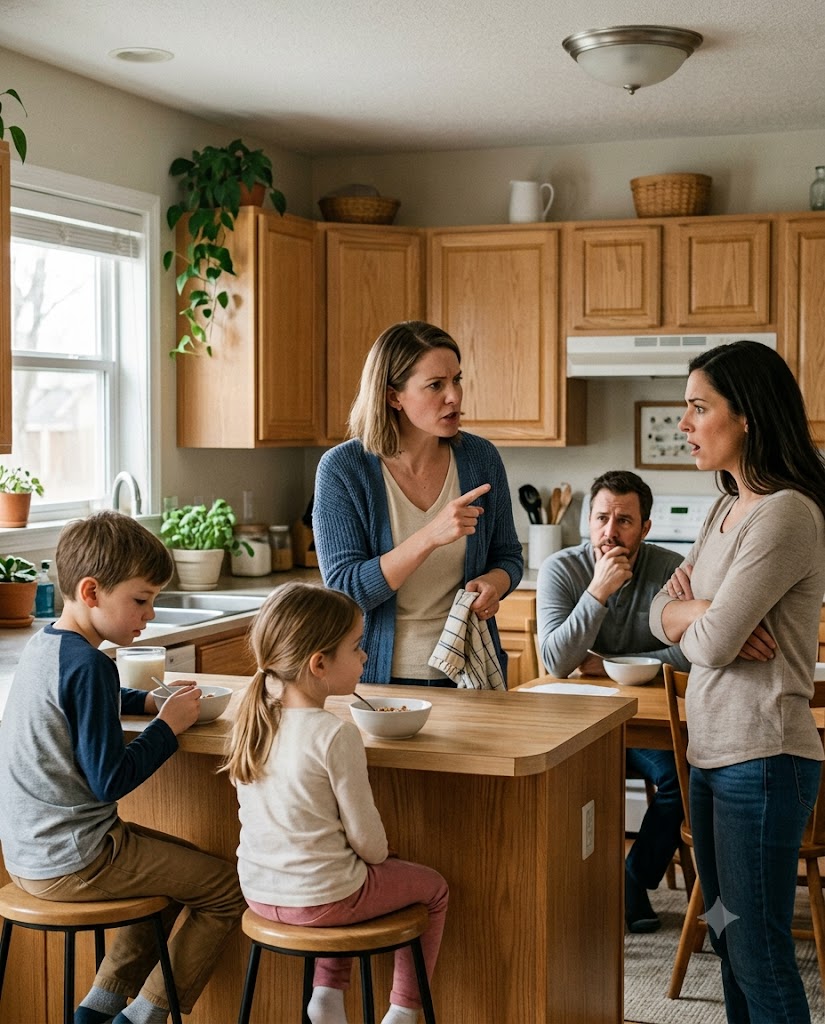
“Your wife is telling our children to call her Mommy Sarah.”
Sarah laughed.
“Because they already do.”
“They’re six and four,” I said. “They’re children. They shouldn’t be pressured into calling anyone something they’re uncomfortable with.”
Sarah leaned back.
“Maybe you should accept that things have changed.”
I stared at her.
“What does that mean?”
She smiled.
“Face it. I’m their real mother now.”
The room went silent.
I looked at Daniel.
He said nothing.
Not one word.
That silence hurt more than Sarah’s statement.
I had expected him to defend me.
Instead, he sat there staring at the table.
I stood.
“You can be their stepmother. You can love them. You can care for them. But you don’t get to erase me.”
Sarah rolled her eyes.
“You’re their ex-wife.”
“And I’m their mother.”
She smiled coldly.
“For now.”
I left before I said something I would regret.
That evening, Daniel finally called.
I didn’t answer.
He called again.
Then again.
Eventually, I picked up.
“I don’t want to fight,” he said.
“Then stop letting her do this.”
There was a long pause.
“I know.”
Those two words surprised me.
“You know?”
“I didn’t understand what was happening.”
“You didn’t understand?”
“I thought they were calling her that because they wanted to.”
I laughed bitterly.
“They’re scared to call her by her first name.”
“I know that now.”
His voice had changed.
It sounded heavier.
Then he told me what had happened after I left the café.
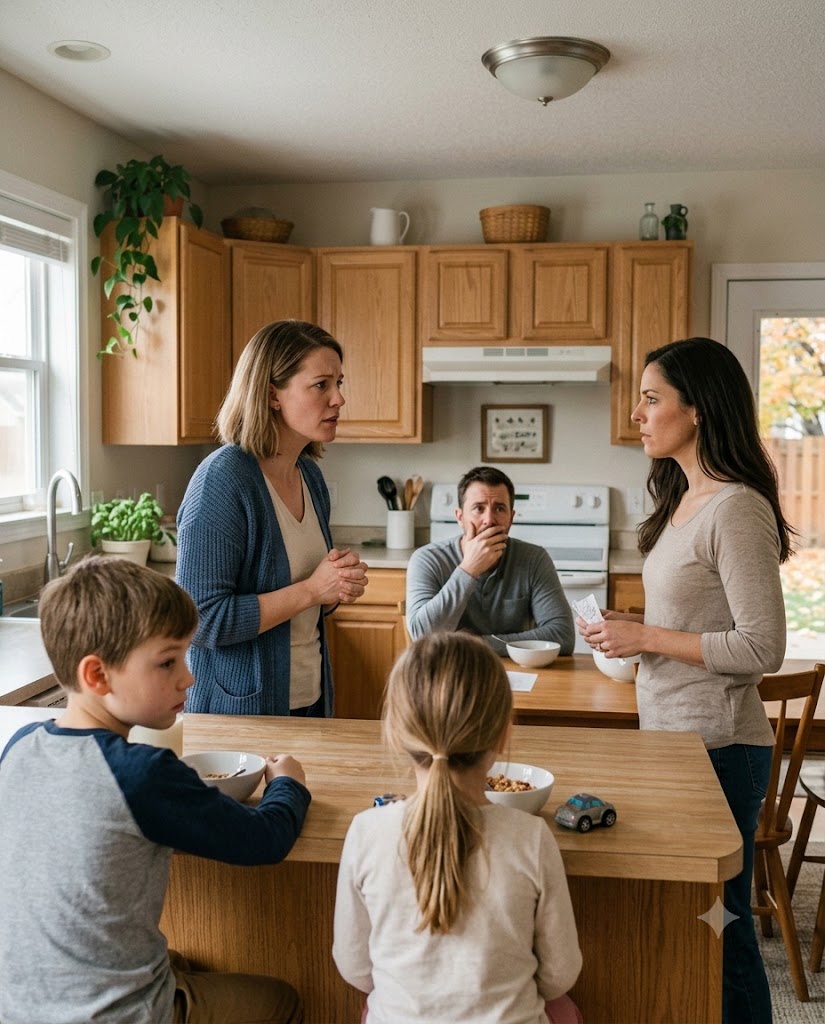
He had gone home and found Lily sitting at the kitchen table.
Sarah had asked her to get ready for bed.
Lily had accidentally called her Sarah.
Daniel heard Sarah’s voice rise.
“Don’t call me that.”
Lily apologized.
But Sarah continued.
“How many times do I have to tell you? I’m Mommy Sarah.”
Daniel said he had never heard that tone from her before.
He stood in the hallway and listened.
Then Lily started crying.
And that was when he finally understood.
His children weren’t happily accepting Sarah as another mother.
They were terrified of disappointing her.
Daniel told me he sat down beside Lily afterward.
He asked her why she was scared.
She didn’t know what to say at first.
Then she whispered,
“Mommy Sarah gets mad when we say Mom.”
Daniel asked what she meant.
Lily said,
“She says we only need one mom now.”
He told me that hearing those words made something inside him break.
Because he suddenly realized what Sarah had been doing.
She wasn’t trying to become another loving adult in their lives.
She was trying to replace me.
And the children were caught in the middle.
Later that night, Daniel came to my house.
I opened the door and found him standing there alone.
He looked exhausted.
“I owe you an apology.”
I didn’t answer.
He continued.
“I should have stopped this before it got this far.”
I folded my arms.
“Yes, you should have.”
He nodded.
“I know.”
Then he looked directly at me.
“If you ever feel disrespected, talk to me. You’ll always be their mother.”
For the first time that day, I felt my shoulders relax.
I hadn’t realized how badly I needed to hear those words.
Not because I needed Daniel to give me permission to be their mother.
I didn’t.
I had been their mother from the moment they were born.
But after months of being made to feel as though my place could simply be taken away, hearing him finally acknowledge the truth felt like breathing after being underwater.
“Thank you,” I said quietly.
He looked down.
“I should have said it sooner.”
“You should have.”
“I was wrong.”
I nodded.
“You were.”
He didn’t defend himself.
That mattered.
But an apology didn’t erase what had already happened.
The next few weeks were difficult.
Sarah stopped openly demanding that the children call her Mommy Sarah.
But she didn’t stop trying to make me disappear.
She simply became more subtle.
When Lily returned from her father’s house, Sarah had apparently told her,
“Some mothers don’t have time for their children, but I’m always here.”
Another time, Sarah gave Noah an expensive toy and said,
“Mommy Sarah knows what you really like.”
When the children were with me, they sometimes repeated things she had said.
“Sarah says her house is better.”
“Sarah says she takes better care of us.”
“Sarah says you’re always busy.”
Each comment was small.
Individually, they could almost be dismissed.
Together, they formed a pattern.
And I could see what that pattern was doing to my children.
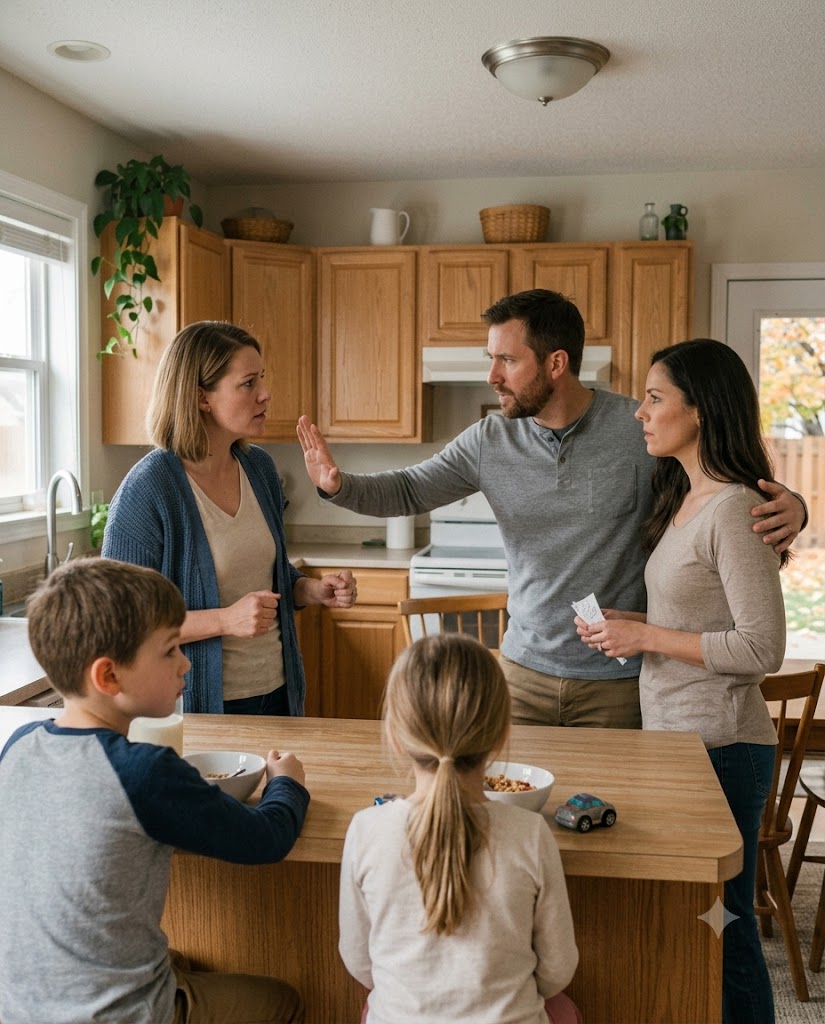
They were beginning to feel guilty whenever they enjoyed themselves with me.
If they had fun at my house, they worried Sarah would be angry.
If they had fun at Sarah’s house, they worried I would be hurt.
They had started walking on eggshells around everyone.
That broke my heart more than anything Sarah had said about me.
One evening, Lily asked me a question that I will never forget.
“Mom, do I have to choose?”
I sat beside her on the bed.
“Choose what?”
“Who my mom is.”
I pulled her into my arms.
“No, sweetheart.”
“But Sarah says…”
I gently stopped her.
“You don’t have to choose.”
She started crying.
“I love her sometimes.”
“I know.”
“Are you mad?”
“No.”
“Really?”
“Really.”
She wiped her tears.
“You can love Sarah.”
She looked at me.
“But you’re still my mom?”
I kissed her forehead.
“Always.”
That night, I realized something.
I couldn’t control what Sarah said when my children were at her house.
I couldn’t erase every cruel comment.
I couldn’t undo the confusion that had already taken root.
But I could give my children one place where they never had to question their worth, their identity, or whether they were allowed to love both sides of their family.
My home had to be that place.
So I stopped competing with Sarah.
I stopped explaining why I was the better mother.
I stopped trying to prove anything.
Instead, I told my children the same thing again and again.
“You never have to choose.”
“You never have to hide who you love.”
“And you never have to call someone Mommy just because they’re angry when you don’t.”
Daniel eventually established a firm boundary with Sarah.
He told her that she could be a loving stepmother, but she could not demand a parental title or speak negatively about me in front of the children.
Sarah was furious.
She accused him of taking my side.
Daniel reportedly answered,
“This isn’t about taking her side. It’s about protecting our children.”
For the first time, he understood that being their father meant protecting them from adult conflicts—not pretending those conflicts didn’t exist.
Things didn’t magically become perfect after that.
Sarah still made occasional remarks.
She still introduced herself to people as the children’s mother.
She still bought extravagant gifts and made little comments about how she “understood them better.”
But something had changed.
The children no longer believed they had to obey her every emotional demand.
And Daniel was finally paying attention.
As for me, I still have difficult days.
Sometimes I hear my children mention something Sarah said, and I feel that old anger rise in my chest.
Sometimes I wonder how much confusion could have been avoided if Daniel had spoken up sooner.
Sometimes I resent having to defend a role that should never have been questioned.
But then Lily runs through the front door and throws her arms around me.
“Mom!”
And every time she says it, I remember something important.
Motherhood isn’t a title someone can steal.
It isn’t a word another woman can claim simply by demanding it.
It is built in thousands of ordinary moments.
The bedtime stories.
The fevers.
The school mornings.
The nightmares at 2 a.m.
The scraped knees.
The forgotten lunchboxes.
The tears wiped away.
The hugs.
The endless questions.
The moments when a child needs someone and knows exactly whose arms to run into.
Sarah may have tried to take my place.
She may continue trying in quieter ways.
But I finally stopped seeing her as someone I needed to defeat.
Because I don’t need to defeat her.
I only need to be the mother my children know they can always come home to.
And if there is one thing this experience has taught me, it is this:
Children should never have to carry the emotional weight of adults fighting over who belongs in their hearts.
They should be allowed to love without fear.
To speak without rehearsing every word.
To call people by the names that feel natural to them.
And most importantly, to know that no matter how many adults enter their lives, their mother’s place is not a position that can simply be replaced.