“They cut me out of the family picture to save face in Italy… no heads-up, no remorse — just flawless prints in the hills of Florence. But the second my own guest list went live…”
In our family dynamics, my mother, Eleanor, operated like a cutthroat, image-driven chief executive officer. My father, Arthur, was merely the compliant, nodding board of directors who never dared to cross her line. And my younger sister, Daphne, was the flagship product — the absolute pride of the firm, meticulously polished for public consumption.
Me? My name is Roxanne. I was 26, living like the unpaid intern hidden away in a dark basement, completely out of sight and out of mind.
I was the undeniable black sheep. But let’s establish one thing right now: I wasn’t the outcast because I was a criminal, a reckless teenager, or a high school dropout. I was the black sheep simply because I dared to be painfully average in a household that worshiped high social status, physical perfection, and the validation of elite country club socialites.
While Daphne was a size-zero former pageant queen who coasted through a fine arts degree just to have something vague to talk about while dating hedge-fund managers, I was a size-12 software architect. I lived in a gritty industrial loft with exposed brick in downtown Manhattan. I had intricate, vibrant sleeve tattoos running down both arms. I cleared mid-six figures designing complex logistical systems, but to Eleanor, typing computer code for a living was basically manual warehouse labor that just happened to have climate control.
She couldn’t brag about it over afternoon tea. So, to her, my career literally did not exist.
The rift between Daphne and me wasn’t a sudden, explosive event. It was a slow, dripping poison Eleanor fed me my entire life. It was in the way dinner conversations revolved entirely around Daphne’s calorie counts, her skincare, and her social calendar. It was the way my straight-A report cards were briefly glanced at and tossed aside, while Daphne making the junior varsity dance team warranted a massive celebration at an expensive steakhouse.
I still vividly remember being 16 in the suffocating heat of July. We were forced to attend the annual country club summer gala. Daphne, who was 14 then, was paraded around the manicured lawns in a stunning backless silk gown that cost more than my first car.
I, on the other hand, was forced into a stifling beige, long-sleeved linen monstrosity that went all the way up to my jawline.
Why?
Because I had recently gotten a tiny star tattooed on the inside of my wrist. And Eleanor told me, with complete sincerity, that my arms were getting a little too thick to be exposed in polite company.
She used to gaslight me with this perfectly painted maternal smile, adjusting my collar while saying, “It’s for your own good, Roxanne. You just don’t have the delicate frame for those kinds of summer dresses. We want you to look appropriate and respectable, don’t we? We don’t want people getting the wrong impression.”
She conditioned me from childhood to believe my natural state was an embarrassment. That my loud laugh, my curves, and my tech career were all fundamentally flawed.
So, to survive, I played my part. I stayed out of the way. I became the reliable, invisible older sister who only existed to make Daphne look brighter and more refined by comparison. I truly thought if I just stayed quiet and accommodated their endless rules, I would at least keep a small corner in my own family.
I was dead wrong.
The real psychological warfare — the kind that eventually shattered our family entirely — began the moment Daphne got engaged to Julian Vance.
If you want to understand the Vance family, picture the absolute pinnacle of old-money Manhattan. We are talking about generational wealth, trust funds that mature at 30, and grandfathers with Ivy League university wings named after them. They had winter lodges in Aspen and summer estates in the Hamptons that looked more like European castles than houses.
When Julian finally proposed to Daphne with a blinding three-carat flawless diamond, my mother practically went into cardiac arrest from pure joy.
Within 48 hours, the impending Vance-Harrison union completely consumed her. Eleanor stopped being a mother and instantly transformed into a full-time, frantic wedding publicist. Every single conversation, every waking moment, was dedicated to impressing Julian’s mother, Victoria Vance.
And despite everything, despite a lifetime in the shadows, I was genuinely happy for my sister. I really was. I wanted to be part of this massive milestone. I wanted to do all the normal, supportive older-sister things.
The next morning, I called Daphne, told her how thrilled I was, and sent a $300 bottle of vintage champagne directly to her penthouse with a handwritten note. I didn’t wait to be asked. I immediately started researching bridesmaid dresses online.
I knew exactly who my mother was and what she valued. So, I proactively searched for high-end, conservative, long-sleeved gowns that could completely conceal my arm tattoos. I was fully prepared to swallow my pride, ready to wear whatever beige, suffocating fabric they picked out just to keep the peace.
I was even ready to pull thousands out of my savings for a lavish bachelorette trip, a luxury bridal shower, or whatever exorbitant expenses they demanded.
But weeks turned into months. And I heard absolutely nothing.
It was just a deafening, terrifying silence.
I would sit alone on my couch in Manhattan, watching Instagram stories of Daphne and my mother drinking champagne and dress-shopping at elite luxury bridal boutiques in Paris. I would see perfectly curated, filtered photos of cake tastings, elaborate floral arrangements, and venue walkthroughs that looked like movie sets.
Whenever the anxiety got to be too much, I would call my mom to ask about the dates. I’d ask what I needed to budget for, or when the bridal shower was happening, just trying to get a timeline.
And every single time, she would brush me off with this perfectly practiced, deeply dismissive tone.
“Oh, Roxanne, please don’t nag me right now,” she would sigh, sounding incredibly put-upon. “We are still working out complex logistics with Julian’s mother. You have no idea the level of detail this requires. You know how these high-society things are. It’s very complicated and delicate. Just keep your autumn schedule flexible. I’ll let you know when we need you.”
I trusted her.
As pathetic as it sounds now, I actually believed she was just overwhelmed by the scale of the planning. I told myself it was a massive society event and they were simply taking their time finalizing the details of the bridal party. I was so unbelievably desperate to be included, to finally be part of the inner circle, that I completely ignored the glaring red flags waving right in my face.
The shattering reality check crashed down on a dark, rainy Tuesday afternoon in early May. I was taking a quick break from a grueling coding sprint, sitting at my desk, eating a cold slice of pizza. I pulled out my phone and was mindlessly scrolling through social media just letting my brain rest.
Suddenly, a post popped up from a girl named Chloe. Chloe was Daphne’s former college roommate, a girl who had always looked at me like I was a strange bug she found on her shoe.
It was a photo of five beautiful girls holding custom-made, engraved wooden boxes. The boxes were filled with miniature bottles of expensive champagne, matching silk robes, and colorful macarons. The girls were all laughing, posing perfectly for the camera, holding up custom wine glasses with their names etched into the glass.
The caption below the photo read: “So incredibly honored to stand beside my absolute bestie in Florence. The Vance wedding is going to be the event of the decade. We are officially bridesmaids! #FlorenceBound #FiveBridesmaids”
I read the caption again.
And then a third time.
My brain simply refused to process the words on the screen.
I zoomed in on the photo, scanning the faces of the five girls.
I wasn’t one of them.
My own sister was flying halfway across the world to get married in an Italian villa. She had already meticulously picked her five bridesmaids, commissioned expensive custom gifts for them, and nobody had even bothered to pick up the phone to tell me.
My stomach plummeted so fast and so hard I felt physically sick. My hands started shaking violently. The cold pizza dropped from my hand onto my desk.
I immediately hit dial on Daphne’s number.
It rang twice and went straight to voicemail.
She was screening my calls.
I hung up and frantically called my mother.
She answered on the fourth ring, sounding breathless, highly annoyed, and completely unapologetic about the interruption.
“Roxanne, I am in the middle of a very important tasting with the caterer,” she snapped sharply. “What on earth is it?”
“Mom,” I said. My voice was trembling so hard I could barely form the words. My throat felt like it was closing up. “I just saw Chloe’s post on Instagram. Daphne is having her wedding in Florence, and she already picked her bridesmaids.”
I tried so desperately hard to keep my voice steady, to sound like a rational adult, but the pure rejection was thick and heavy in my chest. I sounded like a wounded, abandoned child.
There was a long, suffocating pause on the line. The silence was heavier than any scream. I could hear the faint clinking of expensive silverware in the background on her end.
“I was going to call you about this on Sunday when I had more time,” Eleanor finally said.
Her tone suddenly shifted. She dropped the annoyed-mother act and adopted this icy, corporate, human-resources cadence. It was the exact voice she used when she was delivering bad news that she fundamentally did not care about.
“The Vances are funding the vast majority of this destination wedding at a highly historic Italian villa. Julian’s mother, Victoria, has a very, very strict and curated guest list. It’s an intimate affair, Roxanne. Highly exclusive.”
“I am her sister,” I whispered.
The words felt foreign and useless in my mouth.
“And you are loved, darling,” she said. Though the word darling sounded exactly like an insult. “An intimate affair requires specific choices. But you have to understand the specific aesthetic Victoria is going for. It’s very traditional, very refined.”
She hesitated for a split second, taking a breath, and then she slid the knife right into my ribs and twisted it.
“To be completely honest with you, Roxanne, you stick out. Your prominent tattoos, your weight, your whole alternative vibe. It’s just not a fit for the formal photographs. Victoria is very particular about the visual presentation of her family. We all talked about it at length, and we thought it would be significantly less stressful for you if you just stayed home. You hate flying anyway.”
I felt the blood completely drain from my face.
I didn’t hate flying.
I hated them.
“You are uninviting me from my only sister’s wedding because I don’t fit an aesthetic?” I demanded. My voice finally rose, breaking the silence of my apartment, echoing off the walls. “Because you actually think I am too ugly and embarrassing for your precious photos?”
“Please don’t be dramatic and ruin my afternoon, Roxanne,” Eleanor snapped, her patience entirely gone. “It’s not about being ugly. It’s about visual cohesion. We will do a nice, quiet dinner at a local restaurant when we get back. Just you, me, your father, and the newlyweds. You can look at the photo album and hear all about it. I have to go.”
And then she hung up on me.
I didn’t cry.
Not immediately.
I just sat there in my rolling desk chair in a state of absolute, blinding, white-hot shock. The realization washed over me slowly. They hadn’t just forgotten me in the chaos of wedding planning. They had actively, purposefully conspired for months to hide the biggest event of my sister’s life from me, purely because they were physically ashamed of how I looked.
A few days later, my phone rang again.
This time, the caller ID showed it was my father, Arthur. For a brief, deeply pathetic second, a small, unhealed part of my inner child hoped he was calling to apologize. I desperately hoped he would tell me that Eleanor had completely lost her mind, that this was a huge, terrible misunderstanding, and that of course his oldest daughter was going to be standing there at the wedding.
Instead, he cleared his throat nervously, the sound echoing hollowly through the speaker, and offered to wire me $2,000 to, in his words, “make up for the disappointment.”
He spoke in rushed, hushed tones, constantly checking over his shoulder to make sure Eleanor wasn’t listening. He literally begged me not to cause a public scene on social media and asked me to please, for his sake, not ruin my sister’s special time with any emotional outbursts.
“It’s just easier this way, Rox,” he mumbled weakly into the phone. “Victoria Vance is a very intimidating, difficult woman to please. Your mother is under a massive amount of pressure to make this perfect. Take the $2,000, buy yourself something nice, take a little vacation, and we’ll see you when we get back. Promise me you won’t make a fuss.”
They were literally buying my silence.
They were paying the ugly troll to stay hidden under the bridge so the royals could have their glamorous, picturesque feast without the peasants ruining the immaculate view.
I didn’t yell at him.
I didn’t scream.
The exhaustion was too deep.
I just quietly told him to keep his filthy money, and I hung up the phone.
I didn’t take the money, and I didn’t cause a scene. Instead, I opened my phone and methodically blocked Eleanor, Arthur, and Daphne on every single social media platform. I blocked their phone numbers.
I walked around my apartment like a ghost, took down every single framed photograph I had of them, shoved them all into a brown cardboard box, taped it shut with heavy packing tape, and pushed it into the deepest, darkest corner of my hallway closet.
If I didn’t fit into their perfect picture, I was going to remove myself from their lives entirely.
The actual day of the wedding in September finally arrived. That morning, I turned off my Wi-Fi router, ordered enough spicy tuna sushi to feed a family of four, and marathon-watched classic horror movies until my eyes burned and my head throbbed. I absolutely refused to let myself cry over them.
When I finally turned my internet back on three days later, a sick, morbid curiosity got the better of me. I logged into an anonymous burner Instagram account that I usually only used for following digital art pages, and I looked up Chloe’s public profile.
It was exactly as sickeningly perfect as I had imagined.
There were high-definition videos of a 16th-century Florentine villa, rolling green hills bathed in golden-hour sunlight, and elegant string quartets playing on manicured lawns. Daphne looked like a professional runway model in her custom designer gown. Julian looked like a luxury catalog model, and my parents were beaming, clinking crystal glasses, and shaking hands with the New York elite.
But what really made my blood run cold, what truly solidified the betrayal, was the crowd.
There were easily over 200 people visible in the background of those videos. The excuse about it being an intimate, highly exclusive affair was a flat-out, calculated lie designed to make me feel better about being excluded.
I saw second cousins on Julian’s side that nobody even liked. I saw my father’s annoying, loud business associates. I saw random sorority sisters that Daphne hadn’t spoken to in three full years. They invited everyone they possibly could.
The only person missing from that entire luxurious Italian villa was me.
Seeing that absolute visual confirmation of their lies didn’t break me.
It did the exact opposite.
It flipped a heavy metallic switch deep inside my chest. The paralyzing grief and the desperate, lifelong need for their approval burned away instantly, leaving behind a cold, hard, razor-sharp resolve.
I threw myself entirely into my software development work with a borderline manic, obsessive intensity. My company, which I had painstakingly built from the ground up in my living room, developed highly specialized inventory management systems for boutique and luxury retailers. I didn’t just write code. I built a massive, impenetrable digital fortress.
It was a language my mother couldn’t speak, a complex world she couldn’t judge, and an empire she couldn’t ever touch or take credit for.
Without the constant, exhausting emotional drain of my family’s passive-aggressive criticisms, and without their endless demands for me to shrink my personality down to make them comfortable, my confidence skyrocketed.
I stopped wearing oversized long sleeves to hide my arms.
I stopped apologizing for taking up space.
I stopped hiding who I was.
I worked 20-hour days. I survived on black coffee and sheer spite. I barely slept, but the results were absolutely undeniable. My software system, which was faster and more secure than anything else on the market, started landing massive multi-million-dollar corporate contracts. I was rapidly hiring staff, expanding my server capacity, and watching my business bank account grow to numbers that would make even the wealthy Vances raise an eyebrow in respect.
Ten months after the Florentine betrayal, I packed a stunning, custom-tailored emerald green suit that finally fit my natural curves perfectly, and I flew to London to attend a massive, prestigious global tech summit.
I had fought tooth and nail to secure a coveted spot to pitch my proprietary software to a massive European retail conglomerate. I stood on that brightly lit stage in London, the sleeves of my blazer confidently pushed up, my intricate floral tattoos fully visible under the glaring stage lights.
I delivered the absolute pitch of my life.
I was sharp.
I was ruthless.
And I knew beyond a shadow of a doubt that my product was the absolute best in the entire room.
When I stepped down from the stage, the adrenaline was pumping fiercely through my veins. And that was the exact, life-altering moment I met Alistair Montgomery.
Alistair was not the kind of man I ever in a million years thought I would end up with. He was British, fiercely intelligent, with sharp, aristocratic features, dark hair, and a devastatingly dry, sarcastic sense of humor that immediately caught me off guard.
He was the keynote speaker of the entire event, a high-level venture capitalist whose massive firm focused exclusively on aggressively scaling major tech startups globally.
He didn’t walk up to me and offer a cheesy, predictable pickup line. He didn’t try to smoothly buy me a drink at the networking mixer. He walked right up to my presentation board, looked me dead in the eye, and immediately started arguing with me about my own software.
“Your data processing architecture has a fatal bottleneck in the third tier,” Alistair said, his British accent crisp, authoritative, and openly challenging. “If a retailer scales past 50 physical locations, your system is going to lag by at least four seconds during peak holiday traffic. It’s inefficient.”
I stared at him, completely taken aback by the sheer audacity of this man. And then my fierce competitive streak flared up.
“You’re completely wrong,” I fired back without missing a single beat, stepping closer to him. “You are assuming I’m using a standard, outdated relational database. I’m not. The data is pre-indexed on the edge servers locally. It doesn’t lag. It preempts the search queries entirely.”
A slow, genuinely impressed smile spread across his handsome face. The challenge in his eyes shifted into deep intrigue.
We stood right there in the middle of the crowded, noisy conference hall and aggressively debated server architecture, cloud computing limits, and global market scalability for an entire hour. We completely ignored the hundreds of other tech professionals swarming around us. The argument was heated, incredibly fast-paced, and utterly electrifying.
When the event staff finally started physically shutting down the conference hall and turning off the lights, he effortlessly suggested we grab coffee to continue the argument.
That quick coffee turned into a three-course dinner.
And that dinner seamlessly turned into us sitting in a quiet, dimly lit, luxurious hotel lobby bar, talking passionately until 3:00 in the morning.
Alistair was brilliant, obviously, but more importantly, he was profoundly, effortlessly kind. He didn’t look at me like I was a broken project that needed fixing or an embarrassment that needed to be hidden away. He looked at me like I was an intellectual equal.
At one point during the night, while I was passionately explaining a new line of code, he reached across the small table and gently traced the outline of a dark rose tattooed on my forearm.
“These are truly extraordinary,” he murmured, his dark eyes locking entirely onto mine, completely ignoring the code I was talking about. “Who is the artist? The line work is impeccable.”
I almost broke down and cried right then and there in the middle of the bar.
My entire life, I had been aggressively told by my own mother that my skin was a dirty, ruined canvas that needed to be hidden from polite society. And here was this incredibly successful, highly polished venture capitalist sitting in a luxury London hotel, looking at me like I was a walking masterpiece.
He loved my bluntness.
He loved my loud, unfiltered laugh.
He loved the exact things my mother had tried to violently suppress.
He made me feel seen.
Truly and completely seen, in a way I hadn’t felt in my entire 26 years of existence.
I eventually had to fly back to New York, but Alistair and I never stopped talking. We did the grueling, exhausting, long-distance relationship thing for eight long months. We spent countless sleep-deprived hours on video calls across different time zones, and we flew back and forth across the Atlantic Ocean every single chance we got, racking up thousands of air miles.
Finally, my software company grew large enough that opening a European branch became a strict business necessity. Alistair brilliantly convinced me to base the new headquarters in London. I quickly packed up my Manhattan loft, sold most of my heavy furniture, left the United States behind without a single look in the rearview mirror, and moved into his beautiful, historic multi-story townhouse in the heart of Kensington, London.
My career was absolutely thriving.
My heart was completely full.
The toxic ashes of my old life were completely gone, blown away by the wind, and I was far too busy building a massive empire to look back.
It was shortly after I officially moved my life to London that I finally learned the full truth about Alistair’s background. He wasn’t just a highly successful venture capitalist who did extremely well in the tech sector. The Montgomery family was deeply, historically embedded in the British aristocracy.
I am talking centuries of documented history. His grandfather was a literal earl, and his mother, Lady Vivien Montgomery, was a terrifyingly elegant, highly formidable woman who sat on the powerful boards of half a dozen major international charities, museums, and cultural institutions.
When Alistair casually mentioned his family’s title over breakfast one morning, I had a brief moment of absolute, paralyzing panic. My mind immediately flashed back to Victoria Vance and the snobby New York elite who thought I was too blue-collar and physically repulsive to even stand in the background of a wedding photograph.
If a rich country club mother hated me that much, I assumed a legitimate British aristocrat would probably try to have me immediately deported.
I was physically shaking the chilly autumn evening Alistair drove us out to his family’s sprawling estate in the countryside so I could meet his mother for the very first time. As we drove up the mile-long gravel driveway toward a house that looked like a museum, my heart hammered against my ribs. I wore a highly conservative, high-necked sweater, desperately trying to cover my tattoos, reverting right back to my traumatized, terrified 16-year-old self.
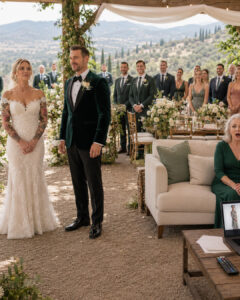
Lady Vivien walked into the massive, echoing grand drawing room. She took one highly observant look at me standing there, looking incredibly stiff and terrified. And she completely shattered every single negative expectation I had built up in my head.
Unlike Eleanor, Vivien didn’t care about my dress size, my lack of a pedigree, or my American accent. She saw exactly how her son looked at me. She saw the absolute, undeniable adoration in his eyes, and that was all the strict vetting she ever needed.
She walked straight over to me, bypassed the formal, stiff handshake I was offering, and poured me a very generous glass of incredibly expensive aged Scottish whiskey.
“Alistair tells me you built a highly successful tech company entirely from the ground up,” she said, her voice wonderfully warm but commanding. “And anyone who can get my stubborn, workaholic son to actually stop checking his emails during Sunday roast is an absolute saint in my book. Welcome to the family, Roxanne. Now, for heaven’s sake, take off that dreadful, suffocating cardigan. It is boiling in this room, and I want to finally see those beautiful tattoos he has been raving about for months.”
I nearly dropped my heavy crystal glass right onto the Persian rug.
I slowly took the cardigan off, and she genuinely spent the next 20 minutes admiring the detailed line work on my arms, asking me about the inspiration behind the floral patterns.
For two wonderful years, I lived in a state of absolute, untethered bliss. I had a thriving global business, a fiercely intelligent man who adored every single part of me, and a new family that accepted me completely without a single condition or demand for change.
I hadn’t spoken a single word to my parents or my sister.
The silence was golden.
Occasionally, my aunt Beatrice, my father’s older sister, who always thought Eleanor was a raging, toxic narcissist, would send me a quick email checking in on me. I kept my replies purposefully vague but polite.
“I am doing well, living in the UK. Work is very busy. Hope you are good.”
Then, on a quiet, rainy afternoon in Kyoto, Japan, during a highly anticipated vacation we had planned for our second anniversary, Alistair proposed.
We were walking slowly through the famous Arashiyama Bamboo Grove. It was incredibly quiet, just the sound of the wind rustling loudly through the massive, towering green stalks. There was hardly anyone else around us.
Alistair suddenly stopped walking, gently pulled me aside off the main dirt path, got down on one knee right there in the damp earth, and presented me with a vintage deep blue sapphire ring surrounded by a brilliant halo of crushed diamonds. It had belonged to his grandmother. It was, without a doubt, the most beautiful thing I had ever seen in my life.
I cried so hard I gave myself the hiccups.
I didn’t care about aesthetics, or vibes, or formal photographs.
I just cared about him.
I said yes.
That night, ecstatic, exhausted, and slightly intoxicated on expensive Japanese plum wine, I posted a single photo of the ring on my heavily locked-down private Facebook page. I only had about 40 people on there: close friends from Manhattan, a few key members of my tech team, and my aunt Beatrice.
The caption simply read: “From a tech summit argument to forever. I love you, Alistair.”
I didn’t think anything of it.
I thought my painful past was dead and buried.
I didn’t realize that in the modern age of digital screenshots, a secret never, ever stays a secret for long.
Three days later, while Alistair and I were sitting in the exclusive first-class lounge at Tokyo Haneda Airport, waiting for our long flight back to London, my phone suddenly vibrated.
I looked down at the illuminated screen resting on the glass table.
It was an unknown number, but the area code was Connecticut.
That was my parents’ area code.
I just stared at it. I watched the screen light up, vibrate against the glass, and go dark. It rang again. Then it stopped.
Ten seconds later, a text message came through.
The message read: “Roxanne, Aunt Beatrice just sent me the picture of your hand. A sapphire? Really? Very Princess Diana of you. We need to talk about the engagement party timeline immediately. Call your mother.”
The absolute, unmitigated audacity of that text message hit me so hard it felt like a physical blow to the chest.
Two entire years of absolute, unbroken silence.
Not a single birthday card.
Not a generic Merry Christmas.
Not even a forwarded email asking if I was alive or dead or living on the streets.
But the very second Eleanor got wind that I was engaged, and likely deduced from Aunt Beatrice that Alistair was incredibly wealthy based on a vintage sapphire ring, she summoned me. She snapped her fingers and ordered me to call her, treating me exactly like a misbehaving employee who had missed a shift at the family corporation.
I silently slid the phone across the table and showed the text message to Alistair. He read it, and I watched his jaw physically tighten. His dark eyes went cold. He knew the entire painful story of the Florentine wedding. He was the one who had held me while I cried out the last of my lingering, pathetic grief over my family a year ago.
“What do you want to do, my love?” he asked softly, reaching across the table and slipping his warm hand over mine.
I looked at the text message again.
Two years ago, if I had received that text, I would have immediately panicked. I would have ignored it, terrified of the impending confrontation, or I would have caved and called her, desperate for her sudden scrap of attention.
But I wasn’t the terrified scapegoat locked in the basement anymore.
I was Roxanne.
I was the chief executive officer of a multi-million-dollar tech company.
I was the soon-to-be daughter-in-law to an actual British earl.
And for the first time in my entire life, I held absolutely every single card in the deck.
“I am not going to block her,” I said slowly. A dark, dangerous smile started spreading across my face. “I am going to reply.”
I picked up the phone, my fingers flying across the digital keyboard. I typed out a quick, purposefully vague response: “Planning is already underway. We will keep you posted on the details.”
I hit send.
Let her think she was back in.
Let her delude herself into believing she was going to have another massive, high-society wedding to completely control, manipulate, and flaunt in front of her country club friends.
Because what I was about to meticulously plan over the next eight months would make Daphne’s Italian villa look like a cheap backyard barbecue. And Eleanor was going to experience exactly what she put me through, but this time it was going to be broadcast on a global scale.
The very moment I hit send on that vague text message to my mother, the game officially began.
I knew Eleanor better than anyone else on the planet. I knew that the silence of the past two years wasn’t born out of sudden respect for my boundaries. It was born entirely out of her stubborn, narcissistic refusal to admit she was ever wrong.
But the glittering prospect of a highly wealthy, aristocratic son-in-law?
That was a siren song she simply could not resist.
Within 48 hours of my text, the emails started rolling in. First, they were heavily masked as casual maternal check-ins.
“Just wondering if Alistair’s family has any specific venue preferences in New York,” she wrote on a Tuesday morning. “Victoria Vance knows the exclusive events coordinator at the Plaza. I could easily make an introduction for you.”
When I purposefully ignored that email, leaving it on read, her messages became much more frantic and demanding.
“Roxanne, you really cannot delay these things. The high-end floral designers need at least a nine-month lead time. Daphne’s florist in Florence was booked a full year in advance. Please pick up the phone and call me.”
I finally decided to reply on a Thursday evening. I was sitting comfortably on the plush velvet sofa in Alistair’s Kensington townhouse, a glass of expensive Cabernet in my hand. Alistair was sitting right next to me, reading a prospectus, occasionally glancing over with a wicked, knowing smirk as I typed on my laptop.
“Hi, Mom,” I wrote. “There is absolutely no need to worry about New York venues or booking Italian florists. We are keeping things incredibly low-key and strictly budget-friendly. We have decided on a micro wedding. We are actually looking into reserving a small public pavilion at a local park here in London. We are just going to do a potluck-style lunch afterward with some paper plates. Less stress, less money.”
I hit send, closed the laptop, and waited.
I didn’t have to wait long.
My phone rang less than three minutes later.
I let it ring until it went to voicemail.
The audio message she left me was a sheer masterpiece of barely contained panic and aristocratic horror.
“Roxanne, you need to call me and tell me this is a sick joke,” Eleanor hissed into the phone. “A public park? A potluck? You are marrying into a prominent, wealthy family, for God’s sake! What will Lady Vivien think? What will the Vances think when they inevitably find out my oldest daughter is having a picnic with potato salad for her wedding reception? You absolutely cannot do this to our family’s reputation. It is embarrassing!”
I immediately forwarded the voicemail audio file to my aunt Beatrice back in New York.
Two minutes later, Aunt Beatrice texted me back: “I am cackling so loudly. My dog is hiding under the bed. Please keep going.”
I replied to my mother’s furious email with complete, feigned innocence: “Mom, Alistair’s family is totally fine with the park. They love nature. In fact, we aren’t even having a bridal party to save money on expensive dresses, and we are just doing a digital electronic invite instead of paper. It’s very eco-friendly. I’ll send you the email link when it’s ready.”
Predictably, Daphne was deployed next.
My golden-child sister texted me for the very first time since she had walked down the aisle without me in Italy.
“Hey, Rox. So crazy about the engagement.” Daphne wrote. “Mom is having a literal full-blown meltdown about this public park thing. Listen, if you guys are seriously struggling with the budget, Julian and I can totally chip in to pay for a nice restaurant dinner instead of a potluck. You really don’t have to embarrass yourself like this.”
Embarrass myself?
The sheer, unadulterated condescension practically dripped through the glass screen of my phone.
I smiled widely, typing back my response: “Thanks for the offer, Daph, but we absolutely love the public park idea. It’s just so us.”
While Eleanor and Daphne spent the next eight months hyperventilating over the sheer social humiliation of my fictitious budget picnic, Alistair and I were quietly orchestrating an event that would entirely rewrite the definition of high society.
Because we obviously weren’t getting married in a dirty public park.
We were getting married at Syon House, the spectacularly grand, historic London residence of the Duke of Northumberland.
Alistair’s mother, Lady Vivien, was a true force of nature. Where my own mother saw my curves and my tattoos as disgusting liabilities that needed to be hidden away in dark corners, Vivien saw them as striking, powerful features that needed to be highlighted.
A few months before the wedding, she personally introduced me to the lead design team at the Alexander McQueen atelier in London. When I first stepped into their pristine, brightly lit studio for my initial consultation, my old trauma flared up. I instinctively braced myself for the usual bridal industry judgment. I expected them to hand me heavy, opaque fabrics and suggest long, matronly sleeves to cover my tattooed arms.
Instead, the brilliant designer walked around me, took one long look at the vibrant, intricate floral sleeves inked deep into my skin, and smiled warmly.
“We are framing these,” the designer said definitively. “We are absolutely not hiding them.”
Over the next few months, they painstakingly designed and tailored a custom gown made of heavy, luxurious silk crepe and sheer, delicate French Chantilly lace. The lace was strategically and mathematically placed to intertwine flawlessly with the specific floral patterns of the tattoos on my shoulders and arms. It created a breathtaking optical illusion where the expensive fabric and the ink became one seamless, moving piece of art.
When I looked in the massive floor-to-ceiling mirror during my final fitting, I didn’t recognize the terrified, invisible girl from Manhattan.
I looked edgy, regal, and fiercely unapologetic.
It was exactly the kind of bold, powerful statement that Eleanor would have absolutely despised, which made it absolutely perfect.
But the dress was just the beginning.
The guest list was where the true, worldwide scale of our revenge really began to take shape.
Alistair’s venture capital firm had successfully funded some of the most prominent, high-profile tech startups of the decade. Meanwhile, my own software company had rapidly grown into a highly respected global enterprise. The RSVPs flooding back from our custom, thick, gold-foil-stamped invitations weren’t just local family friends.
We had the billionaire chief executive officer of a major Tokyo robotics firm.
We had massive venture capitalists flying in from Silicon Valley and Dubai.
And then there was Alistair’s side of the aisle.
The Montgomerys were deeply embedded in the upper echelons of the British aristocracy. Our confirmed guest list included several prominent members of the British Parliament, the notoriously picky editor-in-chief of Vogue UK, and a heavy smattering of European nobility who Lady Vivien regularly played bridge with on Tuesday afternoons.
It was a networking gold mine.
It was the exact, specific kind of powerful room that Victoria Vance, Daphne’s fiercely status-obsessed mother-in-law, would have literally sold her soul to stand in. The quaint New York old money that the Vances prided themselves on was absolutely nothing compared to centuries-old British peerage and global tech billionaires.
As the wedding date rapidly approached, I finalized the trap.
Two weeks before the ceremony, I sat at my kitchen island, opened my laptop, and sent a group email to my parents and my sister.
“Hi everyone,” I typed, making sure to sound incredibly casual and slightly disappointed. “Just a quick update. Since the city permit for the public park was getting too complicated and expensive, we decided to just cancel it entirely. We are going to do a super private, 10-minute ceremony with a cheap celebrant right in our living room. We are only having two legal witnesses present to sign the paperwork. But we really want you there in spirit. We’ve set up a private Zoom link so you can log on and watch us say our vows. It will be exactly at 9:00 a.m. Eastern Standard Time on Saturday.”
My father immediately texted back a simple thumbs-up emoji.
My mother sent a brief, highly formal, and clearly relieved email back within 10 minutes.
“That is probably for the best, Roxanne,” Eleanor wrote. “A private living room is much more appropriate and dignified than a public park with paper plates. We will log onto the link on Saturday.”
I laughed out loud in my empty kitchen.
They were incredibly relieved.
To them, a private living room wedding meant there were absolutely no guests, no professional photographs, and nothing for them to be publicly embarrassed by. They could easily lie to their snobby country club friends and simply say, “She eloped privately because she hates attention.”
They had absolutely no idea what kind of freight train was actually coming for them.
The morning of the actual wedding, London was completely draped in a perfect, ethereal silver mist that eventually burned off to reveal a brilliant, cloudless blue sky.
I sat in the massive, luxurious bridal suite of the hotel, surrounded by my closest, truest friends from Manhattan. These were the brilliant, loyal women who had actually been there for me when my family completely discarded me.
My aunt Beatrice was there, too. She was sitting on a velvet chair, sipping an expensive mimosa and adjusting a stunning, custom-made feathered fascinator she had bought specifically for this occasion. I had flown them all out in first class and covered the cost of their hotel suites.
At exactly 1:00 p.m. London time, which was exactly 8:00 a.m. back in New York, my phone buzzed on the vanity table.
It was a text from Daphne: “Getting my morning coffee and logging onto the Zoom link soon. Can’t wait to see your little living room setup. Have fun today! Kisses.”
I picked up the phone and handed it directly to my aunt Beatrice.
“It’s time,” I said quietly.
Aunt Beatrice giggled mischievously. She took the phone, tapped the screen a few times to make sure all the alarms were off, and then held down the power button, turning my phone completely and totally off. She tossed the dead piece of metal into her expensive designer clutch and snapped it shut.
“Let them stare at the blank holding screen all day,” Aunt Beatrice said firmly, her eyes shining with pride. “Today is about you, Roxanne. You have earned this.”
When the sleek black car finally arrived at Syon House and I stepped out, the sheer, overwhelming magnitude of what we had built hit me all at once.
The historic great hall with its towering Roman statues and magnificent, echoing black-and-white marble floor had been completely transformed. Thousands of rare white orchids and trailing, vibrant green English ivy cascaded dramatically from the upper balconies, filling the air with a fresh, sweet scent. A massive 60-piece live orchestra was seated in the upper gallery, softly tuning their string instruments.
As I stood alone at the back of the hall, waiting for the massive, carved oak doors to open, I peeked through the crack. The vast room was packed to the brim with 500 of the most wealthy, influential people in the entire world.
Women were draped in spectacular custom couture gowns, and men were wearing sharply tailored bespoke morning suits. In the very front row, Lady Vivien sat looking exactly like a queen, beaming with genuine pride as she waited for me.
And then the heavy doors slowly pulled open.
The orchestra immediately began playing a sweeping, powerful classical arrangement of a song Alistair and I both loved.
Everyone in the room stood up.
I walked down that long marble aisle entirely alone.
I didn’t need Arthur to give me away.
My father had given me away years ago for $2,000 and a quiet life.
As I walked, the heavy silk of my McQueen gown brushing against the cold marble, I felt a profound, overwhelming sense of absolute triumph. I wasn’t the rejected, heavily tattooed, overweight outcast from the basement anymore.
I was exactly where I was meant to be, holding my head high, walking toward a brilliant man who looked at me like I personally hung the moon in the sky.
The ceremony was breathtaking.
It was officiated by a high-ranking bishop who happened to be a close personal friend of Alistair’s grandfather. When we finally exchanged our rings and Alistair pulled me in and kissed me, the entire grand hall erupted into massive, echoing cheers that bounced off the vaulted, painted ceilings.
The reception that followed in the great glass conservatory was something straight out of a cinematic billionaire dream. The magnificent, glass-domed building was beautifully illuminated by thousands of floating, flickering candles. The catering was flawlessly handled by a famous three-Michelin-starred chef, featuring a decadent five-course tasting menu that included imported Wagyu beef and shaved white truffles.
The vintage champagne flowed like a literal river, and mingling perfectly among the wealthy guests, snapping discreet, high-definition photographs, was a highly dedicated professional media team.
Because of the Montgomery family’s aristocratic standing and the high-profile nature of the tech billionaires in attendance, Tatler magazine had formally requested exclusive rights to completely cover the wedding.
Alistair and I had agreed to give them the exclusive rights on one very specific, non-negotiable condition: The massive digital article, complete with an expansive, high-resolution photo gallery, had to go completely live on their global website at exactly 10:00 a.m. Eastern Standard Time.
That was right around the exact time my parents and my sister, sitting in their suburban living room in America, would finally realize the blank Zoom link was never going to start.
The reception went incredibly long into the night. We danced under the beautiful glass dome, completely surrounded by people who celebrated us genuinely and loudly. Aunt Beatrice was the absolute life of the party, holding court with a large group of older British lords and loudly regaling them with funny stories of my childhood.
I had never in my life felt so deeply loved, so incredibly secure, and so undeniably powerful.
At 2:00 in the morning, Alistair and I finally collapsed into the soft leather back of a vintage, chauffeur-driven Rolls-Royce, utterly exhausted and ecstatically happy. As the luxury car pulled away from Syon House, winding smoothly through the dark, quiet streets of London, I leaned my heavy head on his strong shoulder.
“Do you want your phone back yet?” Aunt Beatrice had discreetly slipped it into my silk evening bag right before we left the venue.
“Not yet,” I whispered, closing my eyes and smiling in the dark. “Let it stew.”
I knew exactly what was happening across the Atlantic Ocean, and I wanted them to sit in the mess they had made.
We didn’t turn our phones back on until Monday afternoon.
For two glorious, entirely uninterrupted days, Alistair and I existed in a perfect, quiet bubble of pure, untouchable marital bliss. We spent our very first weekend as husband and wife tucked away in a remote, ultra-luxury suite deep in the English countryside, entirely disconnected from the loud digital world.
No Wi-Fi.
No cellular signal.
No unhinged, screaming family members.
By the time we finally found ourselves sitting in the highly exclusive first-class Concorde Room at Heathrow Airport, waiting to board our Emirates flight to the Maldives for a three-week honeymoon, the absolute silence felt incredibly heavy with anticipation.
I sat back in a plush leather wingback chair, sipping a perfectly brewed cup of hot Earl Grey tea. I watched the massive commercial jets taxi across the rain-slicked runway outside the floor-to-ceiling glass windows.
“Are you ready for this?” Alistair asked softly. He was sitting directly across from me, a heavy crystal glass of vintage champagne in his hand. His dark eyes were crinkling at the corners with a complex mixture of deep amusement and fierce protectiveness.
“I think so,” I replied, taking a slow, deep breath to steady my nerves.
I reached into my leather tote bag, pulled out the cold metal of my phone, and finally held down the power button. The glowing Apple logo appeared on the dark screen, and then the home screen slowly loaded.
For about three highly tense seconds, absolutely nothing happened.
I actually wondered if the Wi-Fi in the airport lounge was down.
Then, the massive digital dam completely broke.
My phone didn’t just vibrate.
It violently convulsed in the palm of my hand. It sounded exactly like a casino slot machine rapidly paying out a massive jackpot. It was a relentless, overlapping, chaotic symphony of chimes, buzzes, and rings that actually caused the physical device to grow incredibly warm against my skin. The screen froze entirely under the sheer, crushing weight of thousands of simultaneous push notifications.
When the processor finally caught up to itself 10 minutes later, I stared at the red numbers on the screen in sheer, unadulterated disbelief.
I had exactly 84 missed phone calls.
Forty-seven were from my mother, Eleanor.
Twenty-two were from my father, Arthur.
And 15 were from Daphne.
But the frantic family barrage was a mere drop in the ocean compared to the rest of the digital chaos. My private Instagram account, which I used mostly for my software business updates and close friends, had entirely exploded. I went from a quiet, normal 1,200 followers to nearly 40,000 overnight.
My professional LinkedIn inbox was aggressively displaying the dreaded 99-plus red bubble.
The Tatler magazine article hadn’t just been published.
It had become a massive, global digital phenomenon.
Alistair opened his iPad and pulled up the digital spread. The headline dominated the glowing screen in an elegant, bold serif font: “Silicon Valley Meets British Nobility: Tech CEO Roxanne Harrison’s Breathtaking Exclusive Nuptials to Alistair Montgomery at Syon House.”
The professional photographs were nothing short of spectacular. The massive lead image was a full-page, high-definition shot of me standing confidently in the great conservatory under a glowing canopy of thousands of floating candles. My custom Alexander McQueen gown flowed around me like liquid ivory, the delicate French Chantilly lace perfectly framing the vibrant, unapologetic floral tattoos on my arms.
I looked regal.
I looked fiercely independent.
I looked undeniably powerful.
The article itself was an absolute masterpiece of high-society journalism. It detailed the highly intimate but globally influential guest list, specifically noting the attendance of prominent British Parliament members, wealthy European nobility, and famous Silicon Valley titans. It even featured a glowing quote from the lead designer at McQueen, heavily praising my unapologetic modern edge.
And hilariously, in the fourth photo of the digital carousel, there was a brilliant candid shot of my aunt Beatrice. She was wearing her custom feathered fascinator, throwing her head back in roaring laughter, clinking a crystal flute of vintage Dom Pérignon with the notoriously strict editor-in-chief of Vogue UK.
It was the absolute perfect visual representation of everything my mother and Victoria Vance worshiped, and they had been entirely, publicly, and humiliatingly locked out of it.
“Look at Twitter,” Alistair murmured, turning the iPad screen toward me.
The Syon House wedding was the number one trending topic in the United Kingdom and was rapidly gaining massive traction in the United States. People weren’t just fascinated by the obscene wealth; they were completely fascinated by the narrative.
Someone on the internet had dug up my old business interviews where I talked about starting my software company from a cramped, messy Manhattan loft. The public narrative had quickly become the ultimate real-life Cinderella story: the self-made, heavily tattooed tech queen who captured the heart of a British aristocrat.
I finally minimized the internet browser, took a sip of my tea, and slowly opened my voicemail inbox. I skipped the first 30 frantic, unhinged messages and decided to just listen to the rapid progression of Eleanor’s total mental breakdown.
I put the phone on speaker, resting it flat on the polished mahogany table between Alistair and me.
The first voicemail, left at exactly 9:05 a.m. Eastern Standard Time on Saturday morning, was laced with sharp, condescending annoyance: “Roxanne, we are sitting here on the Zoom link. It just says, ‘Waiting for host.’ Your father is missing his very important golf tee time for this little living room thing. Please fix the internet connection immediately and let us in.”
The tenth voicemail, left roughly three hours later, was trembling with deep confusion and the very first sharp edge of panic: “Roxanne, Aunt Beatrice just posted a highly bizarre photo on Facebook. She is in London. She is at a massive palace. She tagged a British lord. What on earth is going on? Pick up the phone and call me back right now. Daphne is getting very upset and confused.”
Then came the final voicemail.
It was left only two hours ago.
The carefully constructed, polite mask of the perfectly composed corporate CEO wife was entirely, spectacularly gone. Eleanor sounded completely unhinged, breathless, and utterly hysterical.
“Roxanne, pick up the damn phone! I demand you pick up this phone right now!” Her voice cracked into a shrill shriek that made an older gentleman sitting two tables over in the lounge look up from his financial newspaper.
“Victoria Vance saw the Tatler article on her country club’s iPads! She called me screaming at 6:00 in the morning! She wants to know why the Vances weren’t invited to network with the Montgomerys! Daphne is locked in her upstairs bathroom hyperventilating because Julian’s parents are treating her like absolute garbage because we missed out on a royal connection! You lied to us! You completely, intentionally humiliated this family on a global scale! Call me!”
I let the recording officially end.
The heavy silence in our private corner of the first-class lounge felt wonderfully, incredibly sweet.
I looked across the table at Alistair. He simply raised his crystal glass of champagne in a silent, deeply impressed toast, taking a slow, appreciative sip.
“Well,” I said, a slow, dangerous smile spreading completely across my face. “It would be incredibly rude to keep my mother waiting any longer.”
I confidently tapped Eleanor’s contact name and hit dial.
She answered the phone on the first half-ring.
She must have been sitting on her couch with the phone clutched desperately in her hand, just staring blankly at the screen.
“Roxanne,” she gasped, her voice ragged and completely frantic. “Where the hell are you? We have been trying to reach you for 48 hours! Do you have any earthly idea what you have done? The Vances are literally threatening to pull their financial backing for Julian and Daphne’s new house if we don’t arrange a formal, in-person introduction with Alistair’s family! You need to fix this right now! You need to call Victoria immediately and tell her there was a horrible mix-up with the postal service and their invitations got lost!”
I just let her rant.
I sat back in the leather chair and let her spill all of her desperate, status-obsessed anxiety and terror directly into the silence of the phone line. I didn’t interrupt her once. I just listened to the pathetic sound of an arrogant woman finally realizing that the daughter she threw away like trash was now holding the heavy iron keys to the exact kingdom she so desperately wanted to enter.
“Hello, Mom,” I said finally. My voice was smooth, cool, and entirely, brutally detached. It was the exact, emotionless voice of a CEO addressing a defunct, bankrupt vendor. “There was absolutely no mix-up with the postal service. You simply weren’t invited.”
“What are you talking about?!” she yelled. The sheer, piercing volume forced me to pull the phone a few inches away from my ear. “I am your mother! We are your family! You do not exclude your own flesh and blood from a high-society wedding of this magnitude! It is unnatural and cruel!”
“Funny,” I replied, casually leaning forward and resting my elbows on the table. “Two years ago, when you secretly uninvited me from Daphne’s wedding in Florence, you had a very, very different philosophy about how family works.”
“That was completely different!” Eleanor stammered, frantically scrambling for a defense. “Victoria had a very specific, traditional vision for the photos!”
“Yes, she did,” I cut in, my tone instantly hardening into polished steel. “You specifically told me I was excluded because I didn’t fit the aesthetic. You told me I was too blue-collar. You told me my tattoos would ruin the pristine photographs. You said I would embarrass you in front of the New York elite.”
A dead silence fell over the line.
It was a heavy, suffocating, absolute silence.
The steel trap had finally, unequivocally snapped shut, and she was caught firmly in the teeth.
“Mom,” I continued, my voice dropping to a soft, absolutely lethal whisper. “My wedding at Syon House was an intimate, highly exclusive affair. We had British lords, global tech innovators, Parliament members, and billionaires. I had to be very, very strict with the curated guest list. And to be completely honest with you, you, Dad, and Daphne just didn’t fit the aesthetic.”
I paused, letting the words hang in the air.
“You’re a bit too suburban middle class. It just wasn’t a fit for the Tatler magazine photographs. I thought it would be significantly less stressful for you if you just stayed home.”
I threw her exact, verbatim words right back in her face.
Hearing her own cruel words echoed back to her, completely weaponized and undeniably true, finally broke her.
“You,” Eleanor gasped, her voice shaking violently with horror. “You planned this for eight months. You maliciously made us think you were having a picnic. You set up a fake Zoom link. You kept us away so you could humiliate us.”
“I kept you away because you are toxic, incredibly shallow people who only value human beings based on what they can do for your social standing,” I corrected her firmly. “And the beautiful, poetic irony, Mom, is that your sick obsession with status is exactly what is tearing Daphne’s marriage apart right now. Victoria Vance never cared about Daphne as a person. She only cares about leverage, and you just cost her the biggest leverage she could have ever made.”
“Rox, please.” It was Daphne’s voice. She must have ripped the phone right out of my mother’s hand. She was sobbing so hard she was physically choking on her own breath.
“Julian’s mom is so mad at me, Rox,” Daphne cried. “She said, ‘Our family is a joke.’ She said, ‘I’m useless.’ Please just introduce us to Alistair’s mom. Just invite us to London for one dinner. I’ll do anything. I’m so sorry about Florence. I’m sorry.”
It was utterly pathetic.
Two years ago, I would have crumbled hearing my little sister cry like that. But sitting there in the airport lounge, I felt absolutely nothing. I felt zero pity for the girl who had gleefully posted photos of her custom bridesmaid boxes, knowing exactly what she was doing.
“I offered to buy you a nice dinner when you got back from Florence, remember?” I said, my voice empty of any warmth. “But you will never, ever meet my husband. You will never meet my new family, and you will never step foot in my home. Goodbye, Daphne.”
Before she could scream out another desperate apology, I hit the red button.
The call disconnected.
I sat there for a long moment, staring at the black screen of my phone. Then I went into my settings. I navigated to my mother’s contact file.
Block Caller.
I did the same for my father.
Block Caller.
I did the same for Daphne.
Block Caller.
I severed the cord completely, definitively, and forever.
“Done?” Alistair asked softly. He reached across the small table, his large, warm hand completely covering mine.
“Done,” I said. And I truly meant it.
A massive, invisible weight that I had carried for 26 years finally evaporated into the quiet air of the Heathrow lounge.
They had tried to bury me in Florence. They thought I was a weed that would ruin their perfectly manicured garden. They didn’t realize I was a seed. And when I finally broke through the dirt, I bloomed so brightly that it cast a permanent shadow over their entire world.
A sleek, uniformed attendant approached our table with a warm smile.
“Mr. and Mrs. Montgomery, your flight to the Maldives is ready for boarding.”
“Thank you,” I said, standing up.
I took my husband’s arm.
The ultimate revenge wasn’t the worldwide guest list, or the magazine spread, or the sheer, poetic justice of Victoria Vance’s fury.
The ultimate revenge was that I was finally, unapologetically happy, and the family who had discarded me had absolutely zero access to it.
I walked out of the lounge, onto the plane, and into the rest of my beautiful life, never looking back once.