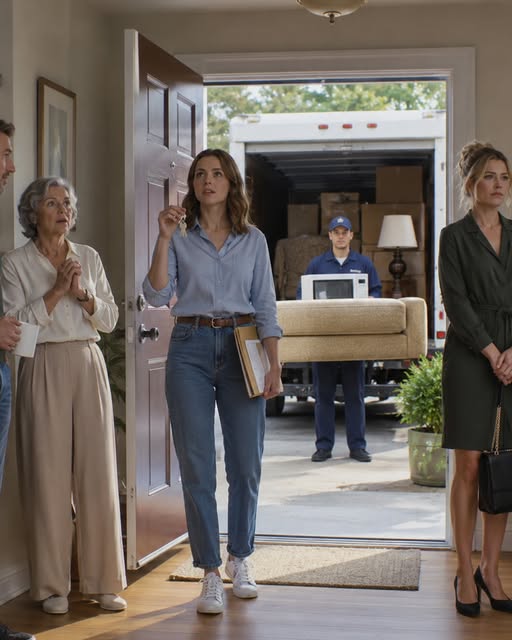
My Mother Told Me To Give My Bedroom To My Sister Or Get Out, So I Left Quietly — But Three Days Later, When The Movers Finished Taking Everything I Had Paid For, My Sister Looked Around The Empty House And Asked The One Question My Mother Had Been Hiding From Her For Six Years
“You can take the guest room. Or move out,” my mother told me when my sister suddenly arrived with her husband.
“Great if you’re out by the weekend,” my sister added cheerfully. I moved out.

But days later, her smug smile disappeared — panic took over.
“She’s lying…? Mom, tell me she’s lying…”
When my sister came home for family support, my mom kicked me out. But when I left, panic set in.
My name is Sophia. I’m 28 years old, and for the last 6 years, my life was not my own.
It belonged to a house, to a memory, and to a family that saw me as a fixture, not a person. The key felt cold in my hand.
After a 10-hour shift at the diner, my second job, all I wanted was the quiet of home. My feet were screaming, and my apron smelled of stale coffee.
I craved my bed, the one I’d saved for months to buy after Dad died because the old one held the shape of his absence. But when I pushed the door open, the house was wrong.
A thick staged silence had replaced the familiar hum of the refrigerator. The TV was dark.
In the living room, my mother sat rigid in her armchair. On the sofa, curled like a cat, was my sister Danielle.
She wasn’t supposed to be here. A familiar knot of dread tightened in my stomach.
Sophia,” my mother said, her voice devoid of warmth. “We need to talk.” I knew then it wasn’t a talk.
It was a judgment. She didn’t wait for me to answer.
“Your sister needs family support,” she stated, her voice as cold as the key in my hand. “She’s moving in.
You can take the guest room or get out.”
Danielle finally looked at me, a cruel smirk on her lips.
“Be gone by the weekend. We need your space.”
I sat on the edge of my bed, the one with the firm mattress I’d bought during a Memorial Day sale 3 years ago.
My hands were trembling, but the rest of my body felt strangely numb, like it belonged to someone else. The echo of my mother’s ultimatum, take the guest room or get out, was a deafening roar in the sudden quiet of my room.
My room for now. I stared at the framed photo on my nightstand.
It was of me and Dad at my high school graduation. He had his arm around my shoulder, his smile so wide and proud it crinkled the corners of his eyes.
“You’re going to do great things, Soph,” he’d told me that day, his voice thick with emotion. “You’re my rock.”
He died 6 months later. It was a Tuesday.
I remember the absurd, mundane details of that morning. I was arguing with him about borrowing the car, a silly teenage disagreement.
He was in the garden, his happy place, kneeling over a bed of stubborn weeds. He laughed and told me I drove too fast.
Take it easy, Soph were the last words he ever said to me. Enjoy the ride.
I went to my part-time job at the library, annoyed. The phone call came 3 hours later.
It was my mother. Her voice a shattered thing I didn’t recognize.
There had been a heart attack. Sudden, massive, brutal.
He was gone before the paramedics arrived. When I got home, the garden was empty, save for his kneeling pad and a small trowel lying in the dirt.
It was as if he’d just stepped away for a moment. But inside, our world had ended.
The foundation of our family hadn’t just cracked. It had been obliterated.
And my mother went down with it. Her grief wasn’t a quiet sadness.
It was a complete and total system failure. She didn’t just weep.
She ceased to function. The vibrant woman who loved to cook and blast old music from the radio was replaced by a hollow-eyed ghost who lived in the perpetual twilight of her drawn curtains.
For the first month, she didn’t leave her bedroom. I would bring her trays of food, toast, soup, anything I could manage to make, and find them hours later, cold and untouched.
She lost weight, her clothes hanging off her shrinking frame. The house, once so full of Dad’s laughter and the smell of his woodworking projects, became a tomb sealed by silence and sorrow.
The bills started to pile up on the kitchen counter. Unopened envelopes that felt like tiny bombs waiting to go off.
The garden he loved became an overgrown memorial to our neglect. Danielle was in her first year of college, 100 miles and a world away.
She came home for the funeral, of course. She arrived in a chic black dress that looked more appropriate for a cocktail party, her eyes already red from what I suspected was a pre-grieving performance.
She was magnificent in her sorrow, a tragic heroine. She clutched Mom’s arm, her sobs loud and performative, whispering about how lost she was without her Daddy.
She was the focal point of everyone’s sympathy. While I was the one making sure there was enough coffee for the guests and that the funeral home was paid on time, I moved through those days in a fog of numb practicality.
Someone had to. A week after the funeral, Danielle packed her bags.
I just can’t be here. So, she’d said, dabbing her eyes with a tissue.
It’s too depressing. I need to get back to my life, you know.
It’s what Daddy would want. She hugged a still catatonic Mom, promised to call every day, and left.
She drove away from the suffocating grief, leaving me behind to breathe it in. So, I stayed.
I was 19 with a full scholarship to the state university sitting on my desk. My acceptance letter felt like a relic from another life.
I called the admissions office and deferred. I told myself it was just for a semester, just until Mom was back on her feet, but one semester bled into the next.
Mom wasn’t getting back on her feet. She was barely moving.
Her depression was a heavy, suffocating blanket, and I was the only one there to try and lift a corner so she could breathe. My life became a small repeating loop.
Wake up, check on Mom, go to work, come home, check on Mom, pay a bill, sleep. I got a full-time job waiting tables at the local diner.
The hours were brutal, but the tips were essential. Dad’s life insurance wasn’t a fortune.
He was a carpenter, a good one, but not a rich one. It was enough to keep the wolves from the door for a while, but I knew it wouldn’t last.
I learned to read the intimidating jargon of bank statements and insurance policies. I watched YouTube videos to learn how to fix the leaky faucet under the kitchen sink and how to relight the pilot light on the water heater.
I became the sole operator of our broken little world. I would sit with Mom for hours in her darkened room, sometimes reading to her, sometimes just sitting in silence, a quiet presence against her overwhelming absence.
Slowly, painfully, she began to surface, but she was changed. She was fragile, anxious, and deeply dependent on me.
My life, my future was a price I was willing to pay for her stability. After a year, the life insurance money was nearly gone.
The reality of losing the house became a terrifying imminent threat. Panic set in, a cold dread that lived in the pit of my stomach.
That’s when I got the second job, stocking shelves at a bookstore from 6:00 p.m. to midnight. My days became a marathon of exhaustion.
I’d work the breakfast and lunch rush at the diner, run home to make sure Mom had eaten, then head to the bookstore. I’d get home after midnight, my body aching with a fatigue so deep it felt like it was in my bones, and study for an online accounting certificate.
My one small hope for a future that didn’t involve aprons and name tags. I was a ghost haunting the edges of my own life.
I had no friends, no social life. My world had shrunk to the four walls of that house and the two jobs that kept it standing.
Danielle, meanwhile, was living a life of vibrant cinematic drama. She would call, usually in a breathless panic, and the calls were always about money.
So, my car broke down and the repair is $500. I’ll pay you back next week, I swear.
Or, my friends are all going on this amazing spring break trip to Mexico, and I’ll just die if I can’t go. It’s only $800 and it’s a once-in-a-lifetime experience.
Each time I’d hesitate. I’d think of the new tires I desperately needed, of the dental appointment I’d been putting off.
But then Mom would be in the background, her voice filled with anxiety. Just help your sister Sophia.
She sounds so upset, so I always did. I would take an extra weekend shift, eat ramen noodles for a week, and transfer the funds from my savings account, an account that was meant for a future I was no longer sure I’d have.
She never paid me back, not once. The next week, she always promised never came.
When I tried to gently bring it up with Mom, she would get a pained look on her face. Don’t be so hard on her, Sophia.
Her life isn’t easy. She feels things so deeply.
She’s sensitive. Sensitive.
That was the word that excused a multitude of sins. It was the justification for her selfishness, her irresponsibility, her endless drama.
Danielle was sensitive, so she couldn’t be burdened with the harsh realities of budgets or consequences. She was.
The most painful moments were the comparisons. One Christmas, Danielle made a rare visit home.
She breathed in a whirlwind of bright scarves and funny stories, and for 2 days, the house was alive again. Mom laughed more in those 48 hours than she had in the entire year.
On the day Danielle left, Mom stood at the window watching her drive away. “She just lights up a room, doesn’t she?” Mom said with a wistful sigh.
She turned to look at me, my apron already on as I prepared to leave for my shift at the diner. Her smile faded.
You’re so different. You’re just so serious.
I didn’t say anything. I just nodded, swallowing the familiar bitter taste of my own invisibility.
The sting of it was sharp, a tiny shard of glass in my heart. I let her believe it.
I let her believe that I was naturally quiet, naturally serious, naturally built to handle the burdens Danielle was too special for. It was easier than fighting.
It was easier than explaining the truth that they had broken me of my smile. When Danielle announced she was getting married to Brent, a man who worked in finance and had a portfolio of investments, Mom was ecstatic.
He’ll take care of her, she’d said. The relief in her voice palpable.
It was a relief I didn’t feel. It just meant Danielle’s requests for money got bigger.
For things like a down payment on a condo with a view of the city, I sent a check. Money I had been saving for a new car because mine was on its last legs.
That was the pattern. A relentless soul crushing cycle.
I gave, they took, I worked, they lived. I sacrificed, they dreamed.
And I did it all under the mistaken belief that this was love. I thought that by being the rock, the dependable one, the silent engine, I was earning my place in the family.
I thought my quiet, unwavering loyalty would one day be seen, be appreciated. But sitting here now in my room that was no longer mine.
I saw the truth with a clarity that was as sharp and cold as a surgeon’s scalpel. I hadn’t earned their love.
I had only earned their expectation. They didn’t see my sacrifice as a gift.
They saw it as my function. I wasn’t the rock holding the family up.
I was just the foundation buried deep underground, unseen and unappreciated, there to be stood upon. And now the golden child was home.
And they were ready to build a new life right on top of me without a second thought for the foundation they were about to shatter. The next morning, the house was transformed.
It was as if a gray film had been lifted from everything, replaced by a nervous, fluttering energy that radiated from one source, Danielle. The air, usually thick with a quiet melancholy, now buzzed with a manufactured urgency.
It was the day after the ultimatum, and my world had tilted on its axis. But in the kitchen, a cheerful domestic play was in full swing.
I emerged from my room after a night of staring at the ceiling, feeling hollowed out and brittle like a dead leaf. The smell of freshly brewed coffee, a luxury we usually saved for weekends, as I was the only one who drank it, and I couldn’t justify the expense for just myself, and frying bacon filled the air.
In the kitchen, my mother, who for 6 years had barely managed to make herself toast, was bustling around the stove. She was making a full breakfast.
Pancakes from scratch, bacon, scrambled eggs. She was humming, a little tuneless melody of maternal devotion.
I hadn’t heard her hum since before Dad died. The sound was a knife in my gut.
Danielle was seated at the kitchen table, the queen upon her throne. She was wrapped in Mom’s expensive cashmere robe, the one I had saved up for two Christmases ago, hoping the soft warmth might be a comfort to her.
Her blonde hair was piled in a messy but artfully stylish bun. Her face was scrubbed clean of makeup.
A strategic choice to make her look younger, more vulnerable. She was sipping orange juice from one of the good crystal glasses, the ones we were never supposed to use because they were from Mom’s wedding set.
Neither of them acknowledged me as I walked in. I was a ghost at the feast, a walking reminder of the grim reality that had funded this cozy scene.
I felt like an intruder in the kitchen I had single-handedly kept stocked for years. “Good morning,” I said.
My voice was a croak, rough with unshed tears and a lack of sleep. Mom glanced over her shoulder, her practiced smile faltering for a microsecond before she locked it back into place.
Oh, Sophia, there you are. I was just making your sister some breakfast.
The poor thing was so restless. I heard her tossing and turning all night.
Danielle let out a delicate, perfectly pitched sigh and stared into her glass as if it held the secrets of the universe. Every time I closed my eyes, I just saw his face.
She whispered, her voice trembling. He was so cold, Mom.
Sh. Shh.
Don’t you think about that man? Mom cooed, her voice dripping with a sympathy I hadn’t heard in years.
She slid a plate piled high with fluffy pancakes, crispy bacon, and creamy scrambled eggs in front of Danielle. You’re safe here now.
We’ll take care of you. We.
The word was a joke. I stood by the counter, my stomach a tight, hungry knot.
There was no plate for me. There was no we.
I opened the cupboard and took out a chipped bowl, reaching for the box of generic brand oat rings that constituted my daily breakfast. The rustle of the plastic bag seemed obscenely loud in the hushed atmosphere of the Danielle shrine.
“Could you try to be a little quieter, Sophia?” Mom said, her voice sharp with irritation, though she didn’t turn from her post beside Danielle. “Your sister has a dreadful headache.”
I poured the cereal and milk as if I were diffusing a bomb. My movement stiff and constricted with a rage that had nowhere to go.
I ate standing up, leaning against the counter, an uninvited guest at the spectacle. It was nauseating to watch.
Mom fussed over Danielle with an intensity that was almost frantic. She cut Danielle’s pancakes into bite-sized pieces, just like she did when we were children.
She refilled her orange juice. She gently tucked a stray strand of hair behind her ear.
She was completely absorbed in the act of mothering her favored child, making up for six years of neglect in one morning. Danielle, for her part, played the role of the wounded bird to perfection.
She recounted the story of her breakup with Brent, a masterpiece of vague accusations and self-pity. According to Danielle, Brent was a soulless corporate monster, a man who was emotionally distant, who constantly criticized her, who didn’t appreciate her spirit.
There were no concrete examples, no mention of her own behavior, just sweeping emotional statements designed to paint her as the blameless victim. “Brent, the man who had seemed perfectly pleasant and endlessly patient the few times I’d met him, was now the villain in her fairy tale.
“He just doesn’t get me,” Danielle said. A single perfect tear tracing a path down her cheek.
“I’m a creative person, Mom. I need to be surrounded by people who understand my soul.
I need support. I almost choked on my cereal.”
Her soul. This was the same woman who last year had called me sobbing because her landlord was threatening to evict her after she’d spent her rent money on a weekend trip to a spa.
Her creative energy, she had explained, had been blocked, and the spa was a necessity. I had paid her rent.
What was most infuriating was that my mother absorbed every word without question. She nodded sympathetically, her eyes full of a fierce, protective love I had been starving for my entire life.
She saw a fragile daughter in need, not a 30-year-old manipulator who had failed at yet another chapter of her life. While Danielle performed her tragedy, my eyes were drawn to the details that didn’t fit the narrative of a woman left with nothing.
The diamond stud earrings sparkling in her ears, the brand new iPhone sitting face down on the table, a tiny black mirror to her lies, and then I saw it slung casually over the back of her chair. The purse.
It was a designer bag made of soft cream colored leather with a distinctive gold clasp. It was the same one she had sent me a picture of a month ago with a text that read, “OMG, I’m obsessed with this, but it’s so expensive.
I could never.” A week after that text, she had called me in a manufactured panic.
She was $400 short on her car payment. She’d claimed the dealership was going to repo the car.
She was frantic. She’d get paid the next week.
She just needed a float. I had wired her the money for my grocery budget.
Seeing that purse now, a purse that I and my mother, after six long years of me being her sole physical, emotional, and financial support, had switched her allegiance without a moment’s hesitation. The moment a more compelling patient arrived, I was demoted.
She was no longer the one who needed care. She was now a caregiver herself, and all her pent up, unused maternal energy was being lavished on the golden child who had finally returned to the fold.
I looked around my room at the worn out comforter on my bed, the secondhand desk where I wrestled with my accounting coursework, the cracked phone screen I couldn’t afford to fix. Every single object was a testament to a choice I had made.
A hundred small sacrifices for the good of the family. And for what?
So that my room, my only sanctuary, could be redecorated into a recovery suite for my sister and her designer purse. So I could be shoved into the dusty, forgotten guest room like a piece of unwanted furniture.
The simmering anger inside me began to boil over into a cold, hard rage. They weren’t just pushing me out.
They were systematically erasing me. They were acting as if the last 6 years of my life, of my work, my sweat, my sacrifice, had never happened.
They were living in a fantasy where the house had magically stayed afloat on its own, just waiting for the true princess to return and claim her rightful throne. I pulled on my uniform, my movements jerky and precise.
I grabbed my keys and my bag and I walked out of that room, out of that house without looking back. The injustice of it all was a physical weight pressing down on my chest, making it hard to breathe.
And for the first time, a dangerous question began to form in my mind. What would happen if I just let them fall?
That evening, I came home with a grim sense of determination. All day, while serving coffee and clearing plates, I had been in a state of suspended animation, my body on autopilot while my mind raced.
I couldn’t just let this happen. I couldn’t just silently pack my things and move into the junk filled guest room like a chastised servant.
I had to say something. I had to make them see the monstrous injustice of what they were doing.
I spent my entire shift rehearsing the conversation, trying to find the perfect combination of words, the calm, rational tone that would somehow penetrate their bubble of self-interest. I was naive enough to believe that a logical appeal to fairness could still work.
I found them in the living room, a space I had furnished with my own hard-earned money, the sofa they were lounging on, the television they were watching, the very electricity powering the lights. I paid for it all.
They were looking through old photo albums, a sight that should have been heartwarming, but instead felt like another act of exclusion. Laughter, real and genuine, filled the space.
It was a sound that had been absent from this house for years, and it felt like a betrayal. They were smiling at pictures of Danielle as a child.
Danielle at her dance recital in a pink tutu. Danielle on a pony at a county fair.
Danielle blowing out the candles on a lavish birthday cake. It was a curated history of a perfect childhood.
“Oh, look at this one,” Mom said, her voice soft with nostalgia as she pointed to a photo. “You were always so photogenic.”
“Such a little star,” Danielle giggled. A light tinkling sound.
“I still am.” They were so absorbed in their shared history, in the mythology of Danielle the Golden Child, that they didn’t notice me standing in the doorway.
It was as if I didn’t exist, or worse, as if I was just part of the scenery, the silent functional background for the main story. I cleared my throat, the sound unnaturally loud in the cozy room.
“Mom, can we talk?” The laughter died instantly.
My mother looked up, her face closing like a fist, her brief happiness evaporated, replaced by a familiar, weary defensiveness. “What is it, Sophia? We’re in the middle of something.
We. There was that word again.
A tiny exclusive club I was not invited to join. “This will only take a minute,” I said, forcing my voice to remain steady.
I walked into the room and stood before them, feeling like a prosecutor in a courtroom where the judge and jury were in collusion. I’ve been thinking about what you said last night about Danielle moving in.
“What about it?” Danielle asked, not bothering to hide the sharp edge of impatience in her voice. She didn’t look at me, instead feigning interest in a photo of herself at age 5.
I took a deep breath, marshalling my carefully rehearsed arguments. This house barely fits two people comfortably.
I began, my tone deliberately reasonable. It’s a small house.
I just don’t think it’s practical. Where is she going to stay?
I knew the answer, of course, but I wanted to hear them say it again. I wanted to force them to speak the ugly, selfish truth out loud, hoping that hearing it would expose its absurdity.
My mother carefully closed the photo album and placed it on the coffee table with an air of finality. She looked at me and any trace of the nostalgic doting mother was gone.
In her place was a hard, unyielding stranger. “I already told you,” she replied bluntly, her voice as cold and sharp as broken glass.
“She’s staying in your room. It’s the best room in the house.
You can move your things to the guest room or you can leave. There it was again.
The same cold, dismissive command. It wasn’t a suggestion.
It wasn’t the start of a discussion. It was a decree.
My room, the space I paid for, the sanctuary I had built for myself piece by painful piece was being expropriated without a second thought. The flicker of hope I had foolishly clung to all day.
The hope that they might have reconsidered that a night’s sleep might have brought a shred of guilt or perspective was extinguished. Danielle leaned back against the sofa cushions, a slow, triumphant smirk spreading across her face.
She was enjoying this. She was savoring my humiliation.
She looked me up and down, a flicker of something between pity and contempt in her eyes. It was the look of someone who had always gotten her way and always would.
Yeah, Sophia,” she said, her voice dripping with a venomous false concern that was more insulting than open hostility. “Maybe it’s time you get a life of your own.”
The words struck me with the force of a physical blow, knocking the air from my lungs. A life of my own.
As if the life I had been living for the past 6 years wasn’t a life. As if my 16-hour days, my two jobs, my responsibilities, my constant grinding sacrifices were nothing more than a placeholder.
A waiting period before my real life began. A torrent of unspoken words screamed in my mind.
This is my life. A life I didn’t choose, but a life I lived for you.
Getting a life of my own was the scholarship I gave up so Mom wouldn’t be alone. It was the friends I stopped seeing because I was always too tired.
It was the car I couldn’t afford because I was sending my money to you. I have been living your life and Mom’s life for 6 years.
What I haven’t had is a life of my own. But I said none of it.
I couldn’t. The betrayal was too profound, the injustice too vast to be contained in words.
I looked at my mother, my eyes pleading with her to intervene, to defend me, to show some flicker of loyalty or gratitude to say, “That’s not fair, Danielle. Sophia has done everything for us.”
She just stared back at me, her silence a ringing endorsement of Danielle’s cruel assessment. In her eyes, Danielle was right.
I was the stagnant one, the boring, serious daughter who had failed to launch. My loyalty, my years of unwavering support didn’t count as living.
It was just existing. In that moment, I understood that I was not just disposable to them.
I was contemptible. My voice came out as a ragged whisper.
“The guest room is full of Dad’s old things,” I said. A last desperate appeal to sentiment.
His clothes, his books. There’s no space.
My mother’s face hardened even further. “Then make space,” she snapped, her voice utterly devoid of emotion.
“Throw it out. Put it in the attic.
I don’t care. Your sister has been through a traumatic experience.
She needs a comfortable place to rest and heal. Your room is the biggest.
It has the best light. Of course, only the best for Danielle.
The best room, the best food, the best of our mother’s love. I was being instructed not only to give up my own room, but also to personally dispose of the last remaining vestiges of my father, the man whose death had set my own life on this sacrificial path to make it happen.
The cruelty of it was breathtaking. It was a systematic dismantling of my entire existence in this house.
First my space, then my father’s memory. I finally understood this was.
That night, I didn’t cry. The capacity for tears felt like a luxury I no longer possessed.
The sadness had burned away, leaving something harder and colder in its place. I sat on my bed in my room that was legally and financially mine, but emotionally a foreign country.
And I felt a profound and terrifying stillness. The emotional storm that had been raging inside me for the past 48 hours had passed, leaving behind a landscape of stark, brutal clarity.
They didn’t love me. They didn’t respect me.
They didn’t even see me. And they never would.
It was a truth I had spent 6 years refusing to accept. And now it was the only thing I had left.
My eyes scanned the room, lingering on the objects I had painstakingly acquired. The bookshelf I’d assembled myself filled with worn paperbacks from the store where I worked.
Each one a small escape. The sturdy secondhand desk where I’d spent countless nights hunched over my accounting textbooks, dreaming of a different life.
The small colorful rug I’d found at a flea market. A tiny rebellion of cheerfulness in a house of gray grief.
These weren’t just objects. They were the artifacts of my survival.
They were the evidence of a life I had tried to build for myself in the cracks of my obligations. My gaze fell on the closet.
On the top shelf, behind a stack of old sweaters I never wore, was a large manila folder. I hadn’t looked at it in months.
I had tried to forget it existed, but now it called to me. I got up, pulled over my desk chair, its slight wobble of familiar annoyance.
I climbed onto it, my movement steady and deliberate, and retrieved the folder. Dust puffed off the top as I carried it back to my bed like a sacred text.
I opened it. Inside, a single letter was clipped to a sheath of papers, printed on crisp corporate letterhead.
It was from the national chain that owned the bookstore where I worked. 6 months ago, my manager, a kind, no-nonsense woman named Linda, had recommended me for a promotion.
The company was opening a new flagship store in a city 5 hours away, a vibrant place with a university and a thriving downtown. They were looking for an assistant manager.
The position came with a salary that was nearly double what I made from both my jobs combined. It came with full health benefits, a 401(k), and most importantly, a relocation package that included a generous stipend for housing.
I remembered the day Linda had called me into her small, cluttered office to tell me I had gotten the job. My heart had hammered against my ribs with a feeling I could only identify as pure, unadulterated hope.

It was a door swinging open. A real tangible escape hatch from the life that was slowly suffocating me.
It was a future. My future.
I had come home that evening, the offer letter clutched in my hand, a nervous, joyful energy thrumming through me. I was ready to share the news, to finally announce that I was moving on, moving up.
I found my mother in the kitchen, staring blankly at the wall, her face pale and drawn. Danielle called, she’d told me, her voice trembling.
She and Brent had a huge fight. She was crying so hard I could barely understand her.
I’m so worried about her. I don’t know what I’d do if I didn’t have you here, Sophia.
You’re the only one I can count on. She had looked at me with such raw, desperate need in her eyes.
And in that moment, the door to my future had slammed shut. The offer letter in my hand suddenly felt like a betrayal.
How could I abandon her? She needed me.
My own dreams, my own life seemed selfish and insignificant in the face of her fragility. So the next day I had called Linda.
My voice had been thick with a regret so profound it felt like I was choking on it. I had declined the offer.
I’d given the vague but powerful excuse of family reasons. Linda had been disappointed but understanding.
The offer stands if you change your mind in the next year, she’d said kindly. A talent like yours is hard to find, Sophia.
Don’t forget that. I had put the folder away on the highest shelf in my closet.
A symbolic burial of the life I could have had. I had tried not to think about it, convincing myself I’d made the right noble choice.
My duty was here in this house with my mother now holding the letter in my hands. My mother’s words from that day, “You’re the only one I can count on,” echoed in my head, a hollow, mocking refrain.
She didn’t count on me out of love. She counted on me out of convenience.
She needed me the way a person needs a functional appliance. My sense of duty, my love for her, had been nothing more than a leash she used to keep me tethered to her side, a tool to ensure her own comfort.
My loyalty hadn’t been a virtue. It had been a cage of my own making with a steadiness that felt like it was coming from someone else.
I picked up my phone. My heart was pounding, a frantic drum against my ribs.
But my fingers were sure as I found Linda’s number in my contacts. It was late, but I knew she was a night owl.
She picked up on the third ring. “Sophia, is everything all right?”
“Hi, Linda,” I said, and I was shocked by how clear and strong my voice sounded. I’m sorry to call so late.
I’m calling about the assistant manager position. I was wondering if by some miracle it’s still open.
There was a pause on the other end of the line, and for a terrifying second, I thought I was too late. Then I heard her smile through the phone.
“For you? Absolutely. I haven’t even bothered to interview anyone else.
I had a feeling you’d come to your senses. When can you start?”
A wave of relief so powerful it almost buckled me washed through my body. It was real.
The escape hatch was still there. “I have,” I said, a real smile touching my lips for the first time in what felt like years.
“I would like to officially accept the offer. I can start in 2 weeks.
We talked for another 20 minutes, hashing out the practical, beautiful details. The relocation package was still in place.
She would email me the official paperwork in the morning. She told me the keys to a temporary corporate apartment were waiting for me.
I could stay there for up to a month while I found my own place. It was small, she warned, a simple one-bedroom, but to me, it sounded like a palace.
It was a start. It was an escape.
It was mine. When I hung up the phone, the stillness inside me had been replaced by a quiet, fierce joy.
For the first time in 6 years, I had made a decision that was purely and unapologetically for myself. The ultimatum they had given me, take the guest room or get out, had been designed as a punishment, a final assertion of their power over me.
But they had made a fatal miscalculation. They assumed I had no power of my own.
They assumed I had nowhere else to go. They assumed I would fold, that I would accept the scraps they were offering because I was too scared or too beaten down to do anything else.
They had forgotten who I really was. I was the one who handled the bills.
I was the one who negotiated with the bank. I was the one who worked two jobs and still found the energy to study.
I wasn’t weak. I was just quiet and my silence was about to end.
I spent the next hour in a flurry of focused activity. I booked a moving company for Saturday morning just 3 days away.
I logged onto my diner’s employee portal and submitted my 2 weeks notice citing a sudden relocation. Then I opened a fresh notebook and started a list, a meticulous, detailed inventory.
I walked through the quiet house, a ghost with a purpose. I moved from room to room, my pen flying across the page.
It wasn’t just a list of my personal belongings. It was a list of every single thing in that house that I had paid for.
The microwave I’d bought on Black Friday when the old one started sparking. The coffee maker.
The new set of pots and pans I’d gotten last Christmas because the old ones were peeling. The living room sofa.
The one they had been sitting on when they passed judgment on me. The 50-in smart TV I had bought so Mom would have something to watch.
The vacuum cleaner. The toaster, the good towels in the linen closet, even the area rug in the dining room.
My paychecks had been absorbed into the household for so long that I think my mother and sister had simply forgotten where everything came from. They saw these objects as part of the house, part of their life, permanent fixtures of their comfort.
They didn’t see them as the result of my long hours, my aching feet, my missed opportunities. They saw the comfort, but they refused to see the cost.
Well, I was about to give them an itemized bill. For the first time in years, sitting in that room that would soon be my past.
I breathed freely. The air felt lighter, cleaner.
The crushing weight of responsibility, of misplaced loyalty, was finally beginning to lift. They thought they were kicking me out.
They had no idea that this was real. This was happening.
I walked to the living room to let the movers in. My mother and Danielle were on the front porch, mugs of coffee in their hands, wrapped in blankets against the morning chill.
They were pointedly ignoring the spectacle of the large truck, chatting with an air of forced nonchalance, as if it were a minor inconvenience, like a neighbor having some work done. They wanted me to know how little my departure mattered to them.
They thought I was just moving my few belongings into the guest room. The sheer scale of the truck must have seemed absurd to them.
Two men in company jackets stood on the doorstep. The older one, a man with a kind, weathered face named S, held a clipboard.
“Sophia,” he asked.
“That’s me,” I said, stepping aside to let them in. “It should all be straightforward.
The boxes in the bedroom are ready to go. And then there are the larger items on this floor.”
They walked in, their boots making solid, purposeful sounds on the hardwood floors. They looked around the living room and then at the list on S’s clipboard.
He raised an eyebrow. “All right,” he said, tapping his pen on the paper.
So, we’re starting with the sofa, the television, and the coffee table. From the porch, my mother’s voice dripped with condescension.
Isn’t that a little much, Sophia? You’re only moving across the hall.
Danielle let out a small, cruel laugh. Let her have her drama, Mom.
She needs to make a big show of it. I didn’t look at them.
I looked at S. “That’s right,” I said, my voice even.
Let’s start here. S nodded to his younger partner, who immediately went to start wrapping the television.
As he unplugged the tangle of cords from the wall, the screen went black, and it felt like a switch being flipped. The illusion of our shared life was officially being dismantled.
“What do you think you’re doing?” My mother’s voice was sharp as she appeared in the doorway, her coffee mug held tight in her hand. “That’s my television.”
“No, Mom,” I said calmly, turning to face her for the first time that morning. “It’s my television.
I bought it 2 years ago on my credit card. I have the receipt.”
She stared at me, her mouth opening and closing. The simple factual statement seemed to shortcircuit her brain.
She had no argument against it. Well, the sofa then, she stammered, gesturing wildly.
Your father and I bought that sofa. “You and Dad bought the old sofa,” I corrected her gently as if explaining something to a child.
The one with the broken springs that we threw out last year. I bought this one from the furniture store downtown.
You were with me, remember? You picked out the color.
The color drained from her face. The memory was undeniable.
The movers, sensing the tension, worked with a quiet, awkward efficiency, hoisting the sofa onto a dolly. Danielle stormed in from the porch, her face a mask of indignation.
This is insane, Sophia. You can’t just take everything.
“I’m not taking everything,” I replied, my voice still level. I’m only taking what is mine.
The process continued, a slow, methodical stripping away of the life I had provided. We moved to the dining room.
The table and chairs were Dad’s, so I left them. But the area rug, the one I’d bought to cover the stains on the floor, was rolled up and taken away.
The nice set of dishes in the china cabinet, which I’d purchased piece by piece with my bookstore discount, were carefully packed into boxes. The kitchen was the true battlefield.
As the movers unplugged the microwave, my mother let out a small wounded sound. “But how are we supposed to heat up our food?”
“I guess you’ll have to use the stove,” I said without malice. It was a simple statement of fact.
The coffee maker, the new set of pots and pans I’d bought after Danielle had ruined the old ones, the blender I used for my morning smoothies. All of it was packed away.
With each item that was removed, the room looked emptier, poorer. The counters, once filled with the appliances of a functional home were now vast, empty expanses.
My mother and sister stood huddled by the back door, watching in stunned, horrified silence. The arrogance they had displayed on the porch was gone, replaced by a dawning panic.
S, the head mover, was professional, but clearly taken aback. “You’ve got everything really well organized, miss,” he said to me in a low voice as his partner carried out a box of silverware.
“Don’t see this every day.”
“I’ve had a long time to think about it,” I told him, and he gave me a small, understanding nod. The final act was my bedroom, my bed, my desk, my bookshelf, the boxes of my clothes and books.
It was all cleared out in less than an hour. I stood in the empty room, my footsteps echoing slightly.
The nail holes on the walls where my pictures used to hang looked like tiny wounds. This room had been my sanctuary, my prison, and now it was just an empty box.
Danielle was going to love it. Before leaving, I did one last walkthrough of the house.
It was a shell. The living room contained only an old armchair, Mom’s, and a rickety side table.
The kitchen was stripped bare. The rooms looked vast and dirty.
The absence of furniture revealing dust bunnies and scuff marks that had long been hidden. The house no longer felt like a home.
It felt like a recently vacated rental property left in a hurry. The shadows of dust on the floor where my things once stood were like ghosts.
The only remaining evidence of my six years of life here. My mother and sister were in the living room standing in the middle of the empty space looking lost.
Their faces were a mixture of shock, fury, and a helplessness they had never before had to experience. “You’ve left us with nothing,” my mother whispered, her voice trembling with rage.
“I left you with the same thing I started with when Dad died,” I replied, my voice clear and steady. “A house?
Everything else, you’ll have to provide for yourselves.” Danielle finally found her voice, and it was shrill with fury.
“You are the most selfish, hateful person I have ever met after everything we’ve done for you.” The absurdity of that statement was so profound that I almost laughed, but I didn’t.
I just looked at her at the beautiful, spoiled child in a 30-year-old woman’s body, and I felt nothing. No anger, no pity, nothing at all.
“Goodbye, Mom. Goodbye, Danielle,” I said.
I walked out the front door and didn’t look back. I got into my old beat up car, the one I was finally going to replace, and followed the moving truck down the street.
In my rear view mirror, I could see my mother and sister standing on the porch of the empty house, two small, furious figures shrinking in the distance. And as I turned the corner, leaving my old life behind for good, I felt the first true breathtaking gust of freedom.
The drive to my new city took 5 hours, but it felt like a lifetime. With every mile I put between myself and that house, another layer of a heavy, invisible cloak seemed to peel away.
The corporate apartment was exactly as Linda had described it, small, clean, and completely impersonal. It was in a large, modern building with a security desk in the lobby.
The furniture was generic, a beige sofa, a simple dining table with two chairs, a bed with a plain white comforter. There was no art on the walls, no personality, no history.
It was the most beautiful place I had ever seen. It was mine.
The movers, S and his partner, were incredible. They worked quickly and professionally, but something inside me had fundamentally changed.
I looked at the buzzing phone, at the angry words flashing on the screen, and I felt a strange sense of detachment. It was like watching a storm rage from behind a thick soundproof window.
I could see the lightning and the wind, but I couldn’t feel it. Their anger was their problem.
Their panic was their own creation. I was no longer the designated fixer, the emotional janitor for their messes.
With a strange sense of ceremony, I picked up the phone. I didn’t check the messages.
I simply went into the settings and blocked my mother’s number. Then I blocked Danielle’s.
The buzzing stopped. The ringing stopped.
The angry notifications vanished. The silence that followed was absolute.
It was deafening. And it was glorious.
That first evening, I unpacked my kitchen boxes. I put my plates, my plates that I had paid for, into the clean, empty cupboards.
I set up my coffee maker, the one they thought was theirs, on the counter. I plugged in my microwave.
I arranged my pots and pans. Every simple domestic act felt like a declaration of independence.
This was my space, my property, my life. I made myself a cup of tea using my favorite mug and sat on the small balcony that overlooked the city lights.
The air was cool and crisp. In my old life, an evening like this would have been filled with obligations.
Making dinner for Mom, listening to her complaints, bracing for a dramatic phone call from Danielle. Tonight, there was nothing.
Just me, my tea, and the quiet hum of a city full of possibilities. The silence was my weapon.
It was my shield. In the past, I had used my silence to absorb their cruelty, to make myself smaller, to keep the peace.
I had swallowed my words, my anger, my pain. Now, my silence was a boundary.
It was a locked door. It was a clear and unwavering statement.
You no longer have access to me. The next few days were a revelation.
I slept through the night and woke up feeling rested, not exhausted. I explored my new neighborhood, discovering a coffee shop, a bakery, and a small park.
I bought groceries, things that only I liked, and filled my new refrigerator. I started my job at the bookstore.
It was terrifying and exhilarating. I was an assistant manager.
I had keys to the store. I had responsibilities that were recognized and respected.
People listened to my ideas. Linda, my new boss, was a mentor, guiding me with a firm but gentle hand.
She treated me like a competent adult, an equal. It was a feeling so foreign, it made me dizzy.
At the end of each day, I would come home to my quiet, peaceful apartment. There were no emotional landmines waiting for me.
There was no one to take care of but myself. For the first time, I was learning what I actually liked, what I actually wanted.
I had spent so many years reacting to the needs of others that I had forgotten how to have needs of my own. The silence they had tried to fill with their rage and panic became my sanctuary.
It was in that silence that I began to heal. It was in that silence that I began to hear my own voice again.
A voice that had been drowned out for far too long. And it was telling me one thing over and over.
You are free. A week after I moved, the peace of my new life was shattered.
It was a Tuesday afternoon and I was in the middle of training a new employee on the inventory system. The bookstore was quiet with just the gentle rustle of turning pages and the soft classical music Linda insisted on playing.
I was feeling confident, capable. I was in my element.
Then the bell above the door chimed and a wave of cold air swept in and with it them. My mother and Danielle stood just inside the entrance, their eyes scanning the store with a frantic energy.
They looked completely out of place. My mother’s face was pale and pinched with a familiar aggrieved expression.
Danielle looked furious, her designer purse clutched in her hand like a weapon. They had driven 5 hours.
The thought sent a jolt of ice through my veins. Their desperation was far greater than I had imagined.
Our eyes met across the store. Danielle’s narrowed into slits.
My mother’s filled with a look of wounded accusation. For a second, the old instinctual guilt flared up inside me.
The urge to run, to appease, to manage their emotions was a powerful phantom limb. But then I looked around me, at the towering shelves of books, at the new employee watching me, waiting for instruction, at Linda, who was now emerging from her office, sensing a shift in the atmosphere.
This was my new life, my new territory, and they were invaders. Danielle started walking towards me, her heels clicking angrily on the wooden floor.
Sophia, we need to talk to you now. Her voice was loud, demanding, meant to create a scene.
I held up a hand, a small, simple gesture that felt monumental. “No,” I said, my voice quiet but firm.
“This is my place of work. You are not welcome here.
Don’t you talk to me like that,” my mother snapped, rushing to join Danielle. “We are your family.
You can’t just ignore us.” Linda stepped forward, positioning herself between me and them.
She was a small woman, but she radiated an aura of unshakable authority. “Ma’am,” she said to my mother, her tone polite but steel-edged.
Is there a problem? “Our problem is with her,” Danielle spat, pointing at me.
She abandoned us. “This is a place of business,” Linda said calmly.
“And Sophia is at work. I’m going to have to ask you to leave.
If you have a family matter to discuss, you can do so on her personal time. “We tried,” my mother cried, her voice rising hysterically.
She blocked our numbers. What were we supposed to do?
I stayed silent, letting Linda handle it. I refused to be drawn into their drama to perform for an audience of customers who were now openly staring.
This was their tactic. Public humiliation, forcing my hand through sheer embarrassment.
But it wasn’t working. I was no longer their captive audience.
Linda’s voice dropped, becoming even colder. You can leave on your own, or I can call security and have you escorted out.
The choice is yours. My mother stared at her, then at me, her mouth agape.
The idea that someone would defend me, that someone would choose me over them, was a concept she simply could not compute. Defeated, they turned and stormed out of the store, the bell chiming mockingly behind them.
The store was silent for a moment. Then Linda turned to me.
“Are you okay?” she asked, her eyes full of concern.
“Yes,” I said, surprised to find that it was true. My hands were trembling slightly, but inside I felt a strange steely calm.
“Thank you, Linda. Don’t mention it,” she said with a grim smile.
“Now, let’s get back to work.” That evening, I couldn’t settle.
The confrontation had shaken me more than I wanted to admit. Their desperation was a tangible thing.
They hadn’t just come to yell. They had come to drag me back.
I realized that for them, this was not over. For me, it had to be.
That’s when I decided to go back. Not to their jobs, not to their ambush, but to the old house.
I needed to see it one last time. I needed to confront them on my own terms.
In that empty space that held all our history. I needed to deliver the final message in person.
A message they couldn’t ignore or delete. It was a reckless, perhaps foolish idea, but I knew I wouldn’t be able to move forward until I had.
I made the drive that night. The familiar roads dark and alien.
I didn’t call ahead. I parked down the street and walked up to the house.
The lights were on, casting a sad yellow glow. The garden was a mess of weeds.
I used my old key. I was half surprised to find that it still worked.
I stepped inside. The house felt like a shell just as I had left it.
It was cold, echoing, and smelled of stale fast food. Takeout containers were piled on the kitchen counter.
In the living room, my mother and Danielle were sitting on blankets on the floor, watching a tiny laptop screen. They looked up, their faces a mixture of shock and triumph at seeing me.
They thought I had come crawling back. “Finally,” my mother said, her voice sharp with a week’s worth of stored-up venom.
“You came to your senses. Are you here to apologize?
To bring back our things?” I’m not here to apologize,” I said, my voice echoing in the empty room.
Danielle scrambled to her feet. “What the hell did you do, Sophia?” she shrieked, her voice bouncing off the bare walls.
“Look at this place. There’s nothing left here.
We’re living like squatters.” “No,” I said, my voice dangerously calm.
“It was a calmness I had never felt before, a calmness born of absolute certainty. You’re living with the consequences of your own actions.
You told me to get out, so I got out and I took what was mine. “Yours?” My mother scoffed.
“Everything in this house was ours.” I let the words hang in the cold, empty air.
I didn’t raise my voice. I didn’t need to.
The simple, verifiable truth was more powerful than any shouting match. I watched their faces, saw the confusion warring with their rage.
They had built their world on a foundation of assumptions. Assumptions about my role, my money, my eternal silent compliance.
And I had just pulled that foundation out from under them. The air in the empty living room was thick with a silence that felt heavier than sound.
My mother and sister stared at me, their expressions frozen in a tableau of disbelief and fury. The simple, unassalable logic of my statement, I took what I paid for, had left them momentarily speechless.
They had always operated in the murky subjective world of emotional currency, where guilt, duty, and obligation were the only things that mattered. I had just introduced the cold, hard mathematics of reality, and they had no defense against it.
Danielle was the first to recover. Her panic, which had been simmering since the day I left, finally boiled over.
Her face, which a moment ago had been contorted with rage, now crumpled with a raw, desperate fear. The charade of the wronged sister fell away, revealing the terrified, entitled child underneath.
“This is insane,” she stammered, her eyes darting around the empty room as if searching for a solution that wasn’t there. Okay, fine.
You took the stupid TV. Whatever.
But what are we supposed to do? How are we supposed to live?
What about Dad’s money? The question hung in the air.
A final desperate gamble. “What money?” I asked, my voice flat.
“The insurance money.” She practically screamed, her voice cracking.
Dad’s life insurance. There should be plenty left.
Mom said we were fine. She turned to my mother, her eyes wild with accusation.
You said we had a cushion. You said everything was taken care of.
This was it. The moment the final load-bearing lie of their lives was about to be exposed.
I looked at my mother. Her face was ashen.
She wouldn’t meet Danielle’s gaze. She couldn’t because she knew what was coming.
I decided to be the one to detonate the bomb. I had carried the weight of this secret for 6 years.
It was time to put it down. “The life insurance money,” I said, my voice devoid of any emotion.
I let out a short bitter laugh. Danielle, that money has been gone for years.
It ran out less than a year after Dad died. It paid for the funeral, and it covered the mortgage for a few months.
That’s it. Danielle stared at me, her brow furrowed in confusion.
“No,” she said, shaking her head. “No, that can’t be right.
The mortgage, the bills. How?
The answer dawned on her slowly. A horrifying sunrise of comprehension.
Her eyes darted from my face to my mother’s and then back to me. The puzzle pieces were clicking into place, forming a picture she did not want to see.
I delivered the final killing blow. “I’ve been covering it,” I said, my voice as steady as a rock.
All of it for the last 6 years. The mortgage on this house, the property taxes, the insurance, the utilities, the groceries.
All of it was paid for by my two jobs. There is no cushion.
There is no family money. There is nothing.
The only thing keeping this house afloat was me. The silence that followed was absolute.
Danielle’s face went through a rapid, devastating transformation. The confusion gave way to shock.
The shock to dawning horror and the horror to a deep, soul-crushing despair. She had come home not just for family support, but for a financial bailout.
She had run away from her failed marriage, assuming she could land softly in the cushy safety net of her inheritance. She had treated me with such contempt, kicked me out of my own room, all while believing she was the rightful heiress, and I was just the hired help.
The realization that the safety net was gone and that the person she had so cruelly discarded was the one who had been weaving it all along was too much for her to bear. She sank to the floor, her legs giving out from under her.
“No,” she whispered to the empty room. “No, no, no.”
Then she turned her gaze on our mother and all the despair in her face curdled into a venomous white-hot rage. “You lied to me,” she hissed, her voice low and trembling.
“All this time you lied to me. “I didn’t lie,” my mother shot back, her voice defensive and weak.
“I just… I didn’t want you to worry.
I was protecting you. “Protecting me?” Danielle shrieked, scrambling to her feet.
The alliance between them. An alliance forged in their mutual dependence on me shattered like glass.
You let me believe we were wealthy. You let me come home to nothing.
You watched her pay for everything and you never said a word. You used her and you lied to me.
“I didn’t use her,” my mother cried, her own voice rising. She offered.
And what about you? You came home with thousands of dollars in credit card debt and a failed marriage.
You never asked where the money came from. You just assumed it would be here for you like you always do.
You’re just as selfish as you claim I am. I stood by the doorway, a silent observer to the spectacular collapse of their world.
It was uglier than I could have imagined. They circled each other in the empty room, hurling accusations and resentments that had been simmering for years.
Danielle blamed Mom for her deception, for creating the fantasy that had led to her ruin. Mom blamed Danielle for her irresponsibility, for her bottomless needs, for the debt she had brought back home.
It was a snake eating its own tail. Their relationship, I realized, had never been about love.
It had been a partnership of convenience with me as their silent, endlessly renewable resource. I was the enemy they could unite against, the foundation they could both stand on.
Now that the foundation was gone, they had nothing left to do but turn on each other. I watched them for a few more minutes, my heart a cold, still stone in my chest.
There was no triumph in this, no joy, but there was a profound and terrible sense of validation. I was seeing them, truly seeing them for the first time.
Two deeply broken, selfish people who were now trapped in the wreckage they had created. They had become so engrossed in their fight that they had forgotten I was even there.
I didn’t need to say another word. My work here was done.
Quietly, I backed out of the doorway and pulled the front door shut behind me. The sound of their shouting was cut off, muffled by the wood.
I walked down the driveway and back to my car, the cool night air feeling clean and fresh on my skin. I had returned to the house, seeking closure, and I had found it in the ashes of their implosion.
They had each other now, and I had finally a clear and open road ahead. A month passed, then two.
The seasons changed. The crisp autumn air giving way to the sharp bite of early winter.
My new life began to take shape. Not as a temporary escape, but as a solid, tangible reality.
The corporate apartment, once a sterile refuge, started to feel like home. I filled it with things that brought me joy.
A comfortable reading chair, shelves of books that weren’t part of a store’s inventory, a small collection of plants that I carefully tended to. I was putting down roots, my own roots, for the first time in my adult life.
My job at the bookstore was more fulfilling than I could have imagined. I was good at it.
I was promoted from assistant manager to store manager within 3 months after the previous manager left unexpectedly. Linda had championed me for the role and the promotion came with another raise.
For the first time, I wasn’t just surviving. I was building a career.
I had a savings account that was actually growing. I had a 401(k).
I had a future. I learned about what happened to the house through a former neighbor, a kind older woman who occasionally sent me messages on social media.
She told me the for-sale sign went up about a month after I left. They had tried to sell it themselves to avoid paying a realtor, but the empty, neglected house lingered on the market for weeks.
Eventually, they had to slash the price. It sold at a significant loss, barely enough to pay off the remaining mortgage.
There was nothing left over. The safety net was officially gone.
My neighbor told me that my mother had downsized to a small one-bedroom apartment on the other side of town in a less desirable neighborhood. She said that Danielle had stayed with her for a few weeks, but the fighting was constant and loud.
Eventually, Danielle moved out, renting a room in a shared house. She was working a part-time job at a retail store in the mall, the kind of job she had always considered beneath her.
The life of comfort and privilege they had both taken for granted. The life that had been built on the back of my silent sacrifice had evaporated the moment I walked out the door.
I felt a strange sense of detachment hearing this news. There was no pleasure, no triumphant, I told you so.
There was only a quiet, somber acknowledgement of cause and effect. They had made their choices and now they were living with the consequences just like I had been forced to live with the consequences of theirs for so long.
My own life, in contrast, was expanding. I reconnected with old high school friends online who lived in my new city.
I went out for dinner. I went to the movies.
I started taking a pottery class on weekends, rediscovering a simple joy I had forgotten. One Saturday afternoon, I found myself sitting alone in a bright, airy cafe, the kind my sister used to call pretentious.
I was sipping a latte that cost more than I used to allow myself for a week’s worth of coffee, reading a book for pleasure, not for work. The sunlight streamed through the large window, warming my face.
And in that simple, quiet moment, the full reality of my freedom settled over me. I was not just okay.
I was happy. I was at peace.
A deep, unshakable peace that came from knowing I was the sole architect of my own life. I was no longer a function, a utility, a foundation to be stood upon.
I was a person. They kicked me out thinking I was worthless, a disposable part of their lives they could easily replace.
But I wasn’t the worthless one. I was the only one holding it all together.
And when I left, so did their stability, their comfort, their entire world. Now they have each other trapped in the bitter reality of what they’ve lost.
And I have peace.