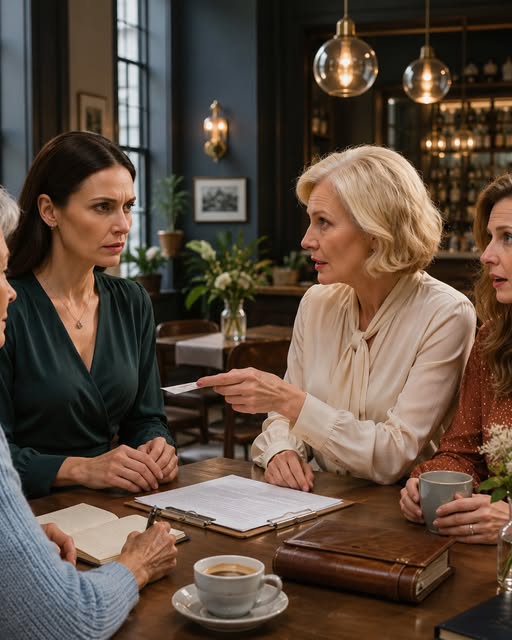
The invoice was already warm from my mother’s hand when she pushed it across the restaurant table and tapped the balance due with one polished red nail.
“The deposit clears Friday,” she said, as if she were reminding me to bring dinner rolls to Thanksgiving, not telling me that my sister had listed me as the person responsible for tens of thousands of dollars in wedding expenses.
Across from me, Brooke kept admiring her engagement ring under the chandelier light.
Beside the bread basket, my grandmother sat perfectly still, staring at the paper as if it had insulted someone who could no longer defend themselves.
My name is Hannah Mercer. I was thirty-four years old. And what my mother did not know was that the quietest woman at that table had been keeping receipts for my entire family longer than I had been keeping wounds.
I did not reach for the invoice right away.
That was the first thing that bothered my mother.
She expected panic. She expected me to grab the paper, scan the numbers, and start bargaining against myself the way I had been trained to do since I was old enough to babysit my sister instead of going to birthday parties.
Instead, I looked at the folded napkin under my water glass, at the tiny wet ring spreading through the linen, and I tried to make my face as still as my grandmother’s.
Brooke Ellison gave a little laugh.
“Oh my God, don’t be dramatic,” she said. “It’s not like you’re paying for the whole thing.”
I finally looked at her.
Brooke was twenty-eight, with glossy hair, perfect teeth, and the kind of helplessness our mother had spent decades polishing into a weapon. She had never asked for help like a person asking. She announced emergencies, then watched everyone else form a rescue crew.
My mother, Denise Mercer, sat beside her with the tight smile she used in public when she wanted me obedient but quiet.
“Hannah, lower your voice,” she said.
“I haven’t said anything.”
“That face says plenty.”
The restaurant was one of those old downtown places with white tablecloths, heavy curtains, and servers who pretended not to hear family disasters happening six feet away. My mother had chosen it because she said we needed a nice girls’ lunch to talk wedding plans.
I should have known something was wrong when she invited Grandma Evelyn.
My grandmother hated nice lunches. She liked diner coffee, crossword puzzles, and telling cashiers when their produce prices were nonsense. But she had come anyway, wearing her navy cardigan and the small gold watch my grandfather had given her in 1979.
Her purse sat in her lap, both hands folded over it.
Brooke slid a cream-colored folder toward me.
Inside were contracts.
Not ideas. Not estimates. Contracts.
A ballroom at the Marbury Hotel. A photographer with a cancellation fee. A string quartet. A custom dress rush order. A floral installation described as an immersive garden wall, which sounded harmless until I saw the line item beside it.
Nine thousand dollars.
My name was typed neatly under responsible party.
Hannah Mercer.
Not asked.
Not informed.
Typed.
Something in me went very quiet.
“Why is my name on these?”
Brooke blinked, already offended by the inconvenience of my question.
“Because you’re contributing.”
“Contributing is giving someone money voluntarily.”
Mom leaned in.
“Don’t start with semantics.”
Semantics. That was what my family called boundaries when they did not like them.
I turned one page, then another.
My name appeared four times. On the venue guarantee. On the floral contract. On the catering deposit. On the final balance estimate circled in blue ink.
My mother’s handwriting.
“Did you sign anything for me?”
“No one signed your name,” Mom said quickly.
That answer told me she had considered it.
Brooke sipped her mimosa and looked toward the windows, bored already.
“They just needed a payer on file. You’re the most financially stable one. It made sense.”
It made sense.
Not because I was her sister. Not because she loved me. Not because she had sat down and asked whether I could help.
Because I had a steady job, an emergency fund, and a long history of being too embarrassed to say no in front of strangers.
I worked as a project manager for a medical software company. I owned a small townhouse I bought by myself after years of skipping trips, packing lunches, and driving a car with a passenger window that sometimes needed help going up.
To my family, that did not make me disciplined.
It made me available.
Mom’s voice softened, which was always worse than when she snapped.
“Hannah, your sister only gets married once.”
I looked at Brooke’s ring again. It was pear-shaped, huge, and tilted slightly because it was too loose.
“And I get financially cornered how many times?”
Brooke’s mouth fell open.
Mom set her palm down lightly on the table. Not hard enough to make a scene. Just enough to remind me she still believed she could summon the old version of me.
“The jealous tone is unnecessary.”
There it was.
The word they always reached for when I refused to bleed on schedule.
Jealous.
When Brooke got a car for graduation and I got luggage because I was practical, I was jealous. When Mom spent my college move-in weekend planning Brooke’s sweet sixteen, I was jealous. When Brooke announced her engagement at my thirtieth birthday dinner before the cake came out and everyone clapped while I stood there holding my own unlit candles, I was jealous.
I was not jealous.
I was tired of being asked to applaud while they picked my pockets.
Grandma Evelyn cleared her throat.
It was a small sound, but my mother’s eyes flicked to her immediately.
“Evelyn,” Mom said, warning tucked inside her name.
Grandma did not look at her.
She looked at Brooke.
“Who told the vendors Hannah was paying?”
Brooke shifted.
“Mom handled most of it.”
Mom’s lips tightened.
“I coordinated, yes, because someone had to. Brooke is overwhelmed.”
“Brooke is engaged,” Grandma said. “That is not a medical condition.”
For the first time since we sat down, I almost smiled.
Brooke did not.
“This is exactly why I didn’t want Grandma here,” she muttered.
My mother moved her foot under the table. I knew because Brooke’s knee jerked and because I had grown up watching women in my family communicate pressure through furniture, silence, and perfectly timed smiles.
Mom turned back to me.
“The point is, deposits are due. If we lose the venue, Brooke’s wedding is ruined.”
“Then why book it without the money?”
Brooke’s eyes filled instantly.
Not tears falling. Just tears appearing like stage lights.
“I knew you’d do this,” she whispered. “I knew you’d make my wedding about you.”
A man at the next table glanced over.
Mom saw him. Her face hardened.
“Pay the deposits, Hannah.”
It was not a request anymore.
It was an order.
Something hot moved through my chest, but my voice stayed even.
“No.”
The word landed so cleanly that even the silverware seemed to pause.
Brooke stared at me as if I had transformed into someone she did not recognize. Mom’s face changed first into disbelief, then embarrassment, then something uglier.
“Excuse me?”
“No,” I repeated. “I’m not paying contracts I didn’t agree to. I’m not covering a flower wall that costs more than my first car. And I’m not being listed as financially responsible for a wedding where nobody even asked me to be a bridesmaid.”
That part slipped out before I could stop it.
Brooke looked away.
Mom did not.
“You said you were too busy.”
“No,” I said. “Brooke said she wanted a soft visual balance in the bridal party and I was welcome to help with logistics.”
Grandma’s head turned slowly toward Brooke.
Brooke flushed.
“That was taken out of context.”
“It was a text message,” I said.
Mom inhaled through her nose.
“Enough. You are humiliating your sister.”
I looked at the invoice between us.
“My name is on her debt.”
“She’s family.”
“So am I.”
That silence was different.
Not empty.
Full.
Full of every Christmas morning where Brooke opened six gifts before I found one with my name on it. Full of every time Mom called me selfish for not transferring money fast enough. Full of every crisis I solved quietly so no one had to admit Brooke had caused it.
Grandma reached into her purse.
Slowly.
Deliberately.
My mother noticed and went pale in a way I had never seen before.
“Evelyn,” she said again.
But this time, it was not a warning.
It was fear.
Grandma pulled out an old checkbook cover, cracked brown leather, fat with folded papers. She set it beside the wedding invoice and rested her fingertips on top.
“I was wondering when this family would finally put a price tag on Hannah in public,” she said.
Brooke rolled her eyes.
“Grandma, please don’t start.”
But Grandma was already opening it.
Inside were receipts, copies of checks, and little yellow notes in her handwriting. Dates. Amounts. Names.
Seven years of my life flattened into proof.
Mom whispered, “This is not the place.”
Grandma looked at her.
“No, Denise,” she said. “This is exactly the place. You picked witnesses.”
Then she turned one receipt toward me.
I recognized it immediately.
Brooke’s first apartment security deposit. The one Mom said she had covered because Brooke was starting over.
The amount was two thousand four hundred dollars.
The check number was mine.
Grandma tapped it once. Then she looked at my mother and asked loud enough for the next table to hear, “How many times did you make this girl buy peace for the rest of you?”
My mother’s hand shot across the table for the receipt.
Grandma moved faster than I expected. For a seventy-six-year-old woman with arthritis and a bad hip, she pulled that paper back like a card player protecting a winning hand.
“Don’t,” Grandma said. “One word.”
My mother froze.
Brooke looked between them, confused in a way that made me realize she had never really known where the money came from. She knew money appeared. She knew bills got paid. She knew disasters dissolved.
But she had never cared which account was drained to make it happen.
“What is that supposed to prove?” Mom asked.
Grandma adjusted her glasses.
“Let’s find out.”
She unfolded another paper and laid it beside the first.
“May 2018,” she read. “Brooke’s car insurance reinstatement. Eight hundred sixty dollars. Hannah paid after Brooke let it lapse and bumped a mailbox.”
Brooke’s face reddened.
“It was icy.”
“It was July,” Grandma said.
A sound escaped me before I could stop it. Not a laugh exactly. More like the air leaving a punctured tire.
Mom turned on me.
“You agreed to help.”
“I was told Brooke couldn’t get to work without a car.”
“She couldn’t.”
“She had quit that job two weeks earlier,” Grandma said, placing down another receipt. “I checked.”
Brooke stared at her.
“You checked?”
“Yes,” Grandma said. “People say things to old women because they assume we don’t remember.”
The waiter appeared near our table holding a water pitcher. He took one look at my mother’s face, refilled nobody’s glass, and retreated.
Grandma kept going.
“September 2019. Emergency dental bill. Brooke cracked a veneer before a beach trip. Hannah paid twelve hundred dollars.”
“It was a front tooth,” Brooke snapped.
“Not an emergency,” Grandma said.
Mom’s voice dropped low.
“Evelyn. Stop this now.”
“No.”
The word sounded different coming from Grandma than it had from me.
Mine had been shaky underneath.
Hers had roots.
She pulled out a clipped stack of papers.
“January 2020. Denise told Hannah she needed three thousand dollars to avoid foreclosure.”
My stomach tightened.
That one I remembered too well.
I had been sitting in my townhouse kitchen at midnight, laptop open, budget spreadsheet glowing blue in the dark. Mom had called crying. Not pretty crying. Gasping. Saying she had nowhere else to turn. Saying she was ashamed. Saying if I loved her, I would not make her beg.
I transferred the money before dawn.
For six months after that, I ate rice bowls and canceled my dental cleaning.
Mom stared at Grandma.
“That was private.”
“So was Hannah’s bank account.”
Grandma placed a printed county record on the table.
“The mortgage was never behind,” she said.
My ears rang.
I looked at my mother. For a moment, she would not meet my eyes. Then she lifted her chin.
“There were other expenses.”
“What expenses?” I asked.
Brooke studied her nails.
Mom said nothing.
Grandma answered for her.
“Brooke’s destination bachelorette weekend for her friend Tessa. Flights, hotel, matching swimsuits, bottle service.”
Brooke exploded.
“That was not all for me.”
I turned to her.
“You let Mom tell me she might lose her house.”
Brooke’s eyes went glossy again, but this time the tears did not know where to go.
“I didn’t know exactly what she said.”
“Did you ask?”
She looked away.
That was answer enough.
Grandma reached deeper into the checkbook cover. Her fingers trembled slightly, but her voice did not.
“April 2021. Hannah paid eighteen hundred dollars for Brooke’s online certification course.”
Mom muttered, “Education is important.”
“She never finished it.”
“I got busy,” Brooke said.
“June 2021,” Grandma continued. “Hannah paid six hundred dollars for Denise’s medical care.”
Mom straightened.
“It was a spa package,” Grandma said.
Mom’s mouth opened.
Grandma lifted a brow.
“You posted it on Facebook, dear.”
For the first time, I saw something crack in my mother’s confidence.
Not guilt.
Not remorse.
Strategy.
She reached for her purse.
“We’re leaving.”
But Brooke did not move.
She was staring at the pile now. Maybe she was adding it up. Maybe she was realizing that the family story she had been told, the one where I was cold and selfish and had to be guilted into helping, had paper cuts along the edges.
Grandma pulled out the final sheet in that stack.
“This one is my favorite,” she said quietly.
Mom went still again.
I knew before I saw it that this receipt was different.
Grandma slid it toward me.
It was a cashier’s check copy from two years earlier.
Seven thousand five hundred dollars.
Memo line: Brooke legal retainer.
My hand went cold.
“What is this?”
Brooke’s face drained so fast I thought she might faint.
Mom whispered, “Mother.”
Grandma’s eyes were on me, softer now. Sorry, even.
“You paid it,” she said. “But you were told it was for your mother’s surgery deductible.”
I heard the restaurant around me all at once.
The clink of glasses. Distant laughter. Someone ordering salmon. Normal life continuing while mine rearranged itself.
“Surgery deductible,” I repeated.
Mom’s eyes shone with angry tears.
“I had a health scare. I was under stress.”
“What legal retainer?” I asked Brooke.
She pressed her lips together.
“Brooke,” Grandma said.
My sister’s fingers clenched around her mimosa glass.
“It was handled.”
“What was handled?”
She looked at Mom.
Mom closed her eyes.
Grandma answered because no one else would.
“Brooke rear-ended a delivery driver while texting. There were questions about whether she handled the situation properly afterward.”
“I panicked,” Brooke said.
I leaned back in my chair. The breath had gone out of me.
Seven thousand five hundred dollars for a surgery that never happened. For a legal problem I never knew existed. For a sister who had not even invited me to stand beside her at her wedding.
My mother started crying then, but not like she had on the phone that night.
These tears were quieter. More controlled. Public tears. The kind meant to make witnesses uncomfortable.
“I did what I had to do to protect my child,” she said.
Grandma’s face hardened.
“You have two.”
Mom flinched.
So did I.
Because no one had said it like that before.
Not in front of me.
Not to her face.
Brooke wiped under her eye.
“I didn’t ask you to pay, Hannah.”
“No,” I said. My voice sounded far away. “You just accepted it.”
She looked wounded.
“What was I supposed to do? Let everything fall apart?”
Grandma laughed once, sharp and humorless.
“For rear-ending a van? Don’t flatter yourself.”
Mom pushed her napkin onto the table.
“This is cruel.”
“No,” Grandma said. “Cruel is raising one daughter to believe love means rescue and the other to believe love means sacrifice.”
The words struck so deep I had to grip the edge of the table.
My mother saw it.
For a second, I thought she might soften.
Instead, she turned the knife.
“You know, Hannah, if you’re going to keep score every time this family needed you, maybe we were wrong to think you had a generous heart.”
There she was.
The woman who could turn taking from me into my character flaw.
I looked at the contracts again.
My name, typed neat and official, sat under obligations I had never made.
Then I took out my phone.
Mom narrowed her eyes.
“What are you doing?”
“Calling the vendors.”
Brooke jerked upright.
“No. You can’t.”
“I can, actually.”
“You’ll ruin everything.”
I tapped the first number on the venue contract.
“No,” I said. “I’m correcting a lie.”
Mom reached for my phone.
Grandma caught her wrist.
It was not dramatic. She did not squeeze hard. She just held my mother there.
Two women locked by decades of things unsaid.
“Let her,” Grandma said.
The call connected.
“Marbury Events. This is Alina.”
My heart hammered so hard I could barely hear myself.
“Hi, Alina. My name is Hannah Mercer. I’m listed as the responsible party on an upcoming wedding contract for Brooke Ellison.”
Brooke whispered, “Please.”
I closed my eyes for half a second.
For years, that word would have worked.
Please had cost me rent money, vacation days, sleep, dignity.
I opened my eyes.
“I need to make something very clear,” I said. “I did not authorize my name to be used, and I will not be paying any deposits or balances for this event.”
Across the table, my sister began to sob.
My mother looked at me like I had become a stranger.
But Grandma Evelyn smiled.
Not big. Not triumphant. Just enough to tell me she recognized me.
Maybe for the first time, I did too.
Alina from Marbury Events went very quiet. Then her voice changed. Not rude. Not panicked. Professional in the way people become when they realize a simple booking has become something else.
“May I place you on a brief hold while I get my manager?”
Brooke dropped her face into her hands.
“Oh my God. Oh my God.”
The hold music started, some cheerful piano version of a song I recognized but could not name. It sounded obscene against Brooke’s crying.
Mom pointed at me.
Her hand shook.
“You are going to fix this.”
I put the phone on speaker and set it in the middle of the table.
“No,” I said. “I’m done fixing things I didn’t break.”
Brooke lifted her head, mascara beginning to darken beneath her eyes.
“It’s my wedding, Hannah.”
“I know. That’s why your name should be on the bills.”
“You have money.”
Grandma made a small sound.
Not surprise.
Disgust.
Brooke heard it and turned on her.
“What? She does. She has a house, a retirement account, savings. She doesn’t even have kids. What is she saving it for?”
There it was.
The truth.
Finally stripped of lace and family language.
Not help.
Entitlement.
I stared at my little sister, and for one painful second, I did not see the selfish woman across from me. I saw the toddler with sticky hands reaching for my crayons, the teenager borrowing my sweaters and returning them stained, the bride-to-be who had never been told no long enough for it to become a full sentence.
Mom had made her.
But Brooke had chosen to stay made.
“What am I saving it for?” I repeated. “My life.”
Brooke laughed bitterly.
“Must be nice to only think about yourself.”
Grandma brought her palm down on the table. The silverware jumped. Every head nearby turned.
“Enough,” she said.
Brooke shrank back.
Grandma’s face had gone pale except for two bright spots high on her cheeks.
“I have listened to this family call Hannah selfish for twenty years because she didn’t smile while being used. I have watched her give up weekends, pay bills, miss opportunities, and apologize for having needs. And you—”
She pointed at Brooke.
“You sit there in a designer coat she indirectly bought and ask what her money is for.”
Brooke looked down at her cream wool coat.
I remembered that coat.
Christmas two years earlier. Mom had called me saying Brooke was depressed and needed something beautiful after her breakup. I sent five hundred dollars because I was too tired to fight.
I had never even seen Brooke wear it until now.
The hold music clicked off.
“This is Martin Reyes, event manager at the Marbury. Yes, I understand you’re disputing financial responsibility for the Ellison wedding.”
“That’s correct,” I said.
He cleared his throat.
“We have an online inquiry listing you as payer, but no signed authorization from you and no payment method on file belonging to you. The deposit is scheduled but not processed.”
I looked at Mom.
She stared at the phone like it had betrayed her.
“Then remove me from the contract,” I said.
“We can do that. However, the event cannot remain active without a responsible party and deposit by Friday at five.”
Brooke whispered, “Hannah, don’t.”
Martin continued, “Would Miss Ellison like to provide updated billing information?”
Every eye at our table moved to Brooke.
She looked at Mom.
Mom looked away.
For the first time all afternoon, no one looked at me.
Brooke’s mouth opened, closed, opened again.
“I need to talk to my fiancé.”
Grandma leaned back.
“Imagine that.”
Martin said he would email confirmation of my removal within the hour. I gave him my address, then called the florist, the caterer, and the bridal salon one by one.
Each call was a small funeral.
Not for Brooke’s wedding.
For the version of me that would have paid to keep everyone comfortable.
By the time I finished, Brooke had stopped crying. Mom had stopped speaking. Grandma had gathered her receipts into one careful stack but left them on the table like a loaded truth.
Then Mom said the sentence that finally broke something clean.
“Your father would be ashamed of you.”
The restaurant faded.
My father, Daniel Mercer, had been gone nine years. He was not perfect, but he had loved quietly and practically. He taught me to check tire pressure, made pancakes on Saturdays, and slipped twenty-dollar bills into my coat pocket during college with a wink like we were co-conspirators.
He had also protected me from my mother in ways I did not understand until after he was gone.
Grandma’s chair scraped back.
She stood slowly, one hand braced on the table.
“My son,” she said, each word sharp enough to cut, “would be ashamed of you, Denise.”
Mom’s face crumpled. Not with grief. With outrage.
“Don’t you dare.”
“Oh, I dare.”
Grandma’s voice trembled now, but not from weakness.
“Daniel knew. Not all of it, but enough. He worried about Hannah. He told me before he died, ‘Mom, if anything happens to me, don’t let Denise turn Hannah into the family wallet.’”
My throat closed.
I had never heard that.
Grandma looked at me, and her eyes softened.
“I’m sorry, sweetheart. I thought stepping in quietly was enough. I thought keeping records was enough. It wasn’t.”
Mom stood too.
“This is absurd. You’ve always favored Hannah.”
Grandma laughed sadly.
“No. I noticed her.”
That landed harder than the receipts.
Mom grabbed her purse.
“Brooke, we’re leaving.”
But Brooke did not move. She was staring at one of the contracts.
“The dress?” she said faintly.
Mom snapped, “What?”
“The dress deposit was due today.”
I remembered the bridal salon call. They had been less calm than the hotel. Apparently, the custom rush order had already been started because the bride’s mother had assured them the sister was covering all premium charges.
Brooke looked at me.
“They said if it’s canceled, I still owe forty percent.”
I said nothing.
Her voice rose.
“That’s almost six thousand dollars.”
Grandma picked up her water and took a sip.
Mom stared at me.
“See, this is exactly what I mean. You made impulsive calls without considering consequences.”
I stared at her.
For once, the guilt did not arrive.
Not even a shadow of it.
“The consequence,” I said, “is that Brooke owes money for a dress Brooke ordered.”
Brooke’s lower lip trembled.
“I can’t afford that.”
“Then you shouldn’t have ordered it.”
She flinched like I had said something cruel instead of obvious.
Mom’s expression hardened into something cold and familiar.
“Fine. If you want to tear this family apart over money, don’t expect to be included in it.”
There it was.
The final threat.
Exile.
The thing I had spent my life paying to avoid.
My hands were shaking under the table, but my voice was steady.
“Included where?”
Mom blinked.
I stood.
“In emergencies you invent? Holidays where I cook and Brooke gets thanked? Phone calls that start with ‘I hate to ask’ and end with my bank app open?”
Brooke whispered, “You’re being awful.”
“No,” I said. “I’m being accurate.”
Grandma slid the receipt stack into a large envelope and handed it to me.
“Keep these.”
Mom lunged again.
“Those are private family matters.”
Grandma stepped between us.
“They are financial records involving Hannah’s money.”
I took the envelope.
It felt heavier than paper.
Mom’s eyes narrowed.
“If you walk out with that, don’t come crying when you regret it.”
For a second, the old reflex rose in me.
Apologize. Soothe. Make smaller.
Then my phone buzzed.
An email from Marbury Events.
Subject: Confirmation of removal — financial responsibility.
I turned the screen toward my mother.
“I won’t.”
Grandma hooked her arm through mine.
“Come on, Hannah. I’m buying you pie.”
We left them there among the contracts, the melting ice water, and the bill for a lunch my mother had probably expected me to pay.
Outside, the afternoon air hit my face cold and bright.
I made it three steps before my knees almost gave.
Grandma held me up.
“I’m sorry,” she whispered.
I clutched the envelope to my chest and finally cried.
Not because I was losing my family.
Because I was starting to understand I might never have had one the way I thought.
Grandma did buy me pie.
Not at the restaurant with white tablecloths and family ghosts, but at a diner three blocks away where the coffee tasted burnt and the waitress called everyone “hon.”
Grandma ordered pecan for herself, apple for me, and sat across from me while I cried into a paper napkin that dissolved against my face.
She did not tell me to calm down.
She did not defend my mother.
She did not say that is just how she is.
For once, nobody translated someone else’s cruelty into my assignment.
After a while, I opened the envelope.
The receipts were arranged by year. Grandma had written notes on sticky tabs in her small, slanted handwriting.
“Why did you keep all this?” I asked.
Grandma stirred cream into her coffee.
“Because your mother is very good at making people doubt what happened.”
That was true.
Mom did not rewrite history all at once. She sanded it down gradually.
I didn’t demand money. You offered.
Brooke didn’t ruin your birthday. She shared happy news.
I didn’t pressure you. I reminded you what family means.
By the time she was done, I always sounded petty, sensitive, ungrateful.
Grandma tapped the envelope.
“Paper doesn’t get guilted.”
I almost laughed.
Then my phone began vibrating.
Mom.
I watched her name flash until it disappeared.
Then Brooke.
Then Mom again.
Then an unknown number.
Grandma eyed the screen.
“Don’t answer.”
I was not going to, but part of me still wanted to.
That was the humiliating thing about being trained for guilt. Even when you knew the trap, your body still leaned toward it.
A text appeared from Mom.
You embarrassed me in public. Call me now.
Then another.
Your sister is hysterical.
Then Brooke.
I hope you’re happy. Aaron is furious.
Aaron was her fiancé. I had met him four times. He sold luxury gym memberships, wore loafers without socks, and once asked me if project management was mostly email stuff.
He came from a family with money, which made the wedding situation stranger.
I typed before I could overthink.
If Aaron is furious, he can pay the deposits.
I showed Grandma.
She smiled into her coffee.
“Good.”
The reply came almost instantly.
Brooke: His parents are contributing to the rehearsal dinner. They shouldn’t have to do everything.
Me: Neither should I.
Three dots appeared, disappeared, appeared again.
Then Mom called.
I turned my phone face down.
Grandma reached across the table and squeezed my wrist.
“Hannah, listen to me. Tonight they will try every door. Shame, fear, love, your father, holidays, illness. They’ll knock on all of them.”
I swallowed.
“What do I do?”
“You don’t open.”
That night, they came to my house.
Not metaphorically.
Literally.
A black SUV pulled up to the curb in front of my townhouse just after eight. I was standing in my kitchen with the lights off, eating crackers because dinner felt impossible, when the headlights swept across my ceiling.
My phone buzzed.
Mom: We are outside. Open the door.
Then Brooke.
Please don’t make this uglier.
I looked through the peephole.
Mom stood on my porch in her camel coat, arms crossed. Brooke was behind her, face blotchy, phone clutched in one hand. Aaron stood near the steps, hands in his pockets, looking like he had been inconvenienced by a scheduling issue rather than a family finally telling the truth.
That made me angry enough to unlock my voice.
I spoke through the door.
“Leave.”
Mom recoiled like the wood itself had insulted her.
“Do not speak to me like that.”
“I’m not opening the door.”
Aaron stepped forward.
“Hannah, this got out of hand. We just need to discuss the optics.”
The optics.
I almost opened the door just to laugh in his face.
Instead, I said, “Get off my property.”
Brooke sobbed louder.
“You’re destroying my wedding.”
“No,” I said. “I’m declining to finance it.”
Mom’s face moved close to the peephole, distorted and furious.
“You owe your sister after everything this family has done for you.”
My hand went to the envelope Grandma had left on my entry table.
“What exactly have you done for me?”
Silence.
Then Mom said, “I raised you.”
There it was.
The bill for being born.
I closed my eyes.
“And now I’m raised,” I said. “Good night.”
Aaron muttered something I could not catch.
Mom pressed her palm against the door.
“If you don’t fix this, I will tell everyone what you did.”
“Please do,” I said. “I have receipts.”
That stopped her.
Through the peephole, I watched her face change.
For the first time, my mother understood that my silence had been her shelter too.
Brooke whispered, “Mom, let’s go.”
But Mom was not finished.
“You think your grandmother is your savior?” she hissed. “Ask her why she didn’t stop any of this sooner.”
The words hit their mark.
She knew they would.
Then she turned and walked down the porch steps. Brooke followed, crying into Aaron’s shoulder. He looked annoyed more than comforting.
Their car doors shut.
I stayed by the door until the engine faded.
Then I slid down to the floor and sat there in the dark hallway with my knees pulled to my chest.
Because Mom was cruel, but she was not entirely wrong.
The next morning, Grandma called before I had coffee.
“I need to tell you something,” she said.
My body went cold.
“What?”
A pause.
“Your mother called me last night. She said if I kept interfering, she’d challenge your grandfather’s estate distribution.”
“Can she do that?”
“She can try,” Grandma said. She sounded tired. “But that’s not why I’m calling.”
I gripped the phone.
Grandma exhaled slowly.
“There’s one receipt I didn’t give you yesterday.”
My heart thudded.
“Why not?”
“Because it isn’t about Brooke.”
I sat down.
“It’s about your house,” she said.
My eyes moved automatically around my kitchen.
The cabinets I had painted myself. The secondhand table. The window over the sink where I grew basil every summer.
“What about my house?”
“When you bought it,” Grandma said gently, “your mother told the family she gave you the down payment.”
I frowned.
“She didn’t give me anything.”
“I know.”
Something in her voice made my skin prickle.
“She borrowed ten thousand dollars from me,” Grandma continued, “saying it was to help you buy your first home. She said you were too proud to ask.”
I stopped breathing.
“She what?”
“I wrote the check to Denise. A month later, she told everyone you accepted it and never thanked her properly.”
My mind raced backward through years of comments.
Must be nice.
After your mother helped you get that place.
You wouldn’t have that townhouse without family.
Denise sacrificed so Hannah could feel independent.
I had argued the first few times. Then I stopped because no one believed me anyway.
Grandma’s voice broke.
“Yesterday after the diner, I pulled my bank copies. Hannah, that money never went to your closing. I checked with the title company this morning.”
I pressed my palm against the table.
“Where did it go?”
Grandma was quiet for so long that I knew.
“To Brooke.”
My laugh came out empty.
“Of course it did.”
“There’s more,” Grandma said.
I closed my eyes.
“Your mother has been telling people for years that you owe her, not just emotionally, financially. She says she invested in your home and you refused to repay her.”
The room seemed to tilt.
That lie had followed me through birthdays, funerals, holidays, every cold look from an aunt, every snide joke from a cousin about me being independent when convenient.
Suddenly, it all had a source.
Mom had not just taken from me.
She had made me look like the selfish one.
Grandma said, “I’m coming over. And Hannah?”
“Yeah?”
“Today we stop letting her tell the story.”
Grandma arrived with a tote bag full of folders and the expression of a woman who had spent the night sharpening truth into a blade.
She did not sit down right away.
She walked through my townhouse slowly, touching the back of my thrifted dining chair, the windowsill where my basil had gone dormant, the framed print above my sofa that I bought after my first promotion.
“You built this,” she said.
I nodded, but my throat hurt.
“No,” she said, turning to me. “Say it.”
“I built this.”
“With whose money?”
“Mine.”
“With whose work?”
“Mine.”
Her eyes filled.
“Good. Don’t let her take that too.”
We spent the morning at my kitchen table, not crying, not yelling, just documenting.
Grandma had copies of checks. I had bank transfers, old texts, emails from vendors confirming my removal, and closing paperwork showing every dollar of my down payment came from my account.
Then Grandma made three phone calls.
The first was to her attorney.
The second was to Aunt Carol, my father’s older sister, who had not spoken warmly to me in years.
The third was to my mother.
She put that one on speaker.
Mom answered with ice in her voice.
“If this is about Hannah—”
“It is,” Grandma said. “I’m giving you one chance to correct the lies.”
Silence.
“What lies?”
“That you gave Hannah money for her house. That she owes you repayment. That she agreed to pay for Brooke’s wedding.”
Mom laughed once.
“You’re confused.”
Grandma looked at me across the table. I watched her face.
“By five o’clock,” Grandma said, “you will send a message to the family group chat stating clearly that you did not contribute to Hannah’s home purchase, that Hannah is not responsible for Brooke’s wedding bills, and that any suggestion otherwise came from you.”
“You can’t force me to humiliate myself.”
“No,” Grandma said. “But I can forward the records to everyone and let them decide what to call it.”
Mom’s voice changed.
“You would destroy your own family.”
Grandma’s answer was soft.
“You already did.”
Mom hung up.
At 4:57 p.m., the family group chat lit up.
For years, I had hated that chat. It was where birthdays were organized, illnesses announced, jokes shared, and somehow I always became the person assigned to bring extra food, send extra money, do extra work.
Mom’s message was short.
There has been a misunderstanding. I did not contribute money to Hannah’s townhouse. Hannah is not financially responsible for Brooke’s wedding. Please stop discussing this.
It was not an apology.
It was not accountability.
But it was the first crack in the wall.
Aunt Carol called me ten minutes later.
Her voice was stiff at first, embarrassed.
“Hannah, I owe you an apology.”
I stood in my kitchen, gripping the counter.
She told me Mom had been saying for years that I took money after Dad died and forgot where I came from. She said people believed it because Mom sounded so wounded.
“I should have asked you,” Aunt Carol said.
I closed my eyes.
“Yeah,” I said. “You should have.”
There was a pause.
Then she said, “I’m asking now. Are you okay?”
That was the first time anyone on that side of the family had asked me that without needing something afterward.
“No,” I said honestly. “But I think I’m going to be.”
Brooke’s wedding unraveled over the next month.
Not completely. People like Brooke always find some version of a soft landing.
Aaron’s parents refused to cover the hotel ballroom, but offered their country club on a Sunday afternoon. The flower wall vanished. The string quartet became a playlist. The custom dress was replaced with one off the rack after the bridal salon sent Brooke to collections for the rush fee.
Mom told anyone who would listen that I had sabotaged the wedding out of jealousy.
But this time, the story did not travel as far.
Because Grandma sent receipts.
Not to be cruel.
Not to punish.
To end the spell.
Brooke texted me once from a new number.
I hope you understand. You made my engagement the most stressful time of my life.
I stared at the message for a long time.
Then I typed back, “I hope one day you understand I was never your budget.”
I blocked that number too.
I did not attend the wedding.
That decision hurt less than I expected and more than I wanted.
The morning of, I woke up early, made coffee, and waited for grief to flatten me.
It did not.
It came in waves, but between them there was space.
At noon, Grandma picked me up. She wore the navy cardigan again and a mischievous little smile.
“Where are we going?” I asked.
“Somewhere your money isn’t invited.”
She drove us to a garden center outside town.
We spent two hours choosing flowers for my backyard. Lavender, marigolds, hydrangeas, and one stubborn little rose bush she insisted would survive if I stopped apologizing to it.
That afternoon, while Brooke walked down a smaller aisle than she imagined, I dug holes in my own yard with dirt under my nails and sunlight on my shoulders.
Grandma sat on the patio reading instructions she refused to follow.
“Too deep,” she called.
“You said you weren’t supervising.”
“I lied.”
I laughed so hard I had to sit back on my heels.
Six months later, my life was quieter.
Not empty.
Quiet.
I started therapy.
I changed my emergency contact from my mother to Grandma.
I spent my birthday with people who brought food without assigning me labor. Aunt Carol came too, awkward and sincere, holding a lemon cake and saying, “I didn’t know what you liked, so I asked.”
I nearly cried over that cake.
Mom still sent occasional emails. Long ones. Wounded ones. Ones with subject lines like Family Should Matter and Your Father Would Want Better.
I saved them in a folder I never opened.
Brooke got married, posted the photos, and cropped me out of a childhood picture for her slideshow. Someone sent me a screenshot, expecting me to be upset.
But I looked at that little girl in the photo, me at ten, standing slightly behind Brooke with one hand on her shoulder like I was already responsible for keeping her upright.
And I felt only tenderness.
Not for Brooke.
For me.
By the following spring, the rose bush bloomed.
Grandma came over the day the first flower opened. She brought diner pie in a cardboard box and sat beside me on the back steps while evening settled over the yard.
The rose was pale yellow, small but defiant, its petals catching the last light like it had been waiting all winter to prove something.
Grandma touched my hand.
“You know,” she said, “your father would love this.”
For once, hearing about Dad did not feel like a weapon.
It felt like a blessing.
I looked at my house, my garden, my grandmother, my own two hands resting open in my lap.
For years, my family told me I owed them because I had survived being useful.
But that night, with the receipts finally out of the dark and a rose blooming where I had planted it myself, I understood the truth.
I did not owe them my life.
I owed myself the chance to live it.