Part 1: The Call That Changed Everything
The phone rang at 2:46 a.m., and before two minutes had passed, I knew something terrible had happened. My identical twin sister, Emily Carter, was crying so hard that she could barely speak before her voice was swallowed by panic.
“Rachel, please come get me. Mark is—”
A loud crash interrupted her sentence, followed by a sharp gasp and the sound of her phone hitting the floor. The line went dead, leaving me staring at the screen with a feeling I had experienced countless times while investigating violent crimes, except this time the victim wasn’t a stranger. It was my sister.
My name is Rachel Carter, and at thirty-six I had spent more than a decade working as a detective in the Domestic Violence Unit of the Columbus Police Department. I had interviewed frightened victims, documented injuries, and listened to countless offenders explain away their own violence. Yet the moment I heard Emily’s voice, every bit of professional distance disappeared, replaced by the fear only a sister could understand.
Emily and I had shared every important chapter of our lives growing up, but things changed after she married Mark Whitaker six years earlier. She slowly withdrew from family gatherings, rarely answered calls unless Mark wasn’t around, and always found excuses whenever I suggested meeting face to-face. She insisted everything was fine, but I had begun noticing long sleeves in warm weather, carefully chosen explanations for bruises, and conversations that ended the moment he entered the room.
For months I convinced myself not to push too hard because victims often retreat further when they aren’t ready to talk. Looking back, I realized I had confused patience with hope, telling myself she would ask for help when she felt safe enough. That hope ended the moment her call was cut short.
I immediately contacted emergency dispatch, reported a suspected domestic assault, requested patrol officers and paramedics, and gave them Mark’s address in Upper Arlington. I deliberately waited until the report was complete before identifying myself as Emily’s sister because I didn’t want personal involvement affecting the initial response.
Within minutes I was driving through nearly empty streets while police units approached from different directions. My badge remained inside my jacket, my service weapon stayed secured according to department policy, and every mile toward Emily’s house felt longer than the last.
Mark opened the front door before I had the chance to knock. He wore gray sweatpants, no shirt, and an easy smile that seemed completely out of place for someone whose wife had just called for help.
“Emily is sleeping,” he said.
I looked past him and immediately noticed shattered ceramic scattered beside the hallway table and what appeared to be a dark stain near the staircase. None of it matched the calm expression on his face.
“I heard her call for help.”
He leaned casually against the doorway, making no effort to let me inside.
“You heard a married couple arguing. This is private family business.”
“Move away from the doorway.”
Instead of stepping aside, he smiled even wider. Mark had never respected my career, often making jokes during family dinners about my badge and treating my work as though it were little more than a hobby.
“You have no authority to enter my home without a warrant.”
Before I could answer, a weak sound drifted from the second floor.
It wasn’t crying.
It was a painful, uneven moan.
I stepped toward the stairs, but Mark grabbed my wrist in an attempt to stop me. Years of defensive training returned automatically as I twisted free, shifted my weight, and pinned him against the wall without throwing a punch.
“Touch me again, and the patrol officers approaching this house will add assaulting a police officer to whatever else happened tonight.”
The distant sound of approaching sirens erased the confidence from his face. I released him immediately and ran upstairs without waiting for another excuse.
Emily was lying beside the bed with one arm trapped beneath her body. Bruises covered her neck, shoulders, and forearms, while swelling around one eye had nearly forced it shut. Her breathing was shallow, dried blood marked the corner of her mouth, and for one heartbreaking second I stopped thinking like a detective.
I saw only my twin sister, the little girl who used to crawl into my bed whenever thunderstorms frightened us both.
Then Emily slowly opened her eyes.
“Rachel,” she whispered. “He said nobody would believe me.”
Mark appeared in the bedroom doorway only moments later, already preparing another explanation.
“She fell after drinking. She always becomes dramatic when she drinks.”
I barely looked at him. Kneeling beside Emily, I carefully held her hand while the flashing lights from arriving patrol cars painted the bedroom walls red and blue.
“They don’t need to rely on belief alone,” I said quietly. “They only need to preserve what he left behind.”
Part 2: The Phone That Preserved the Truth
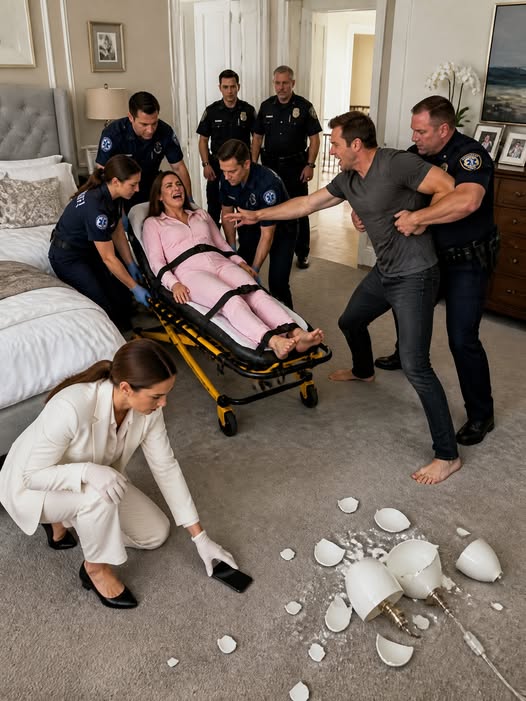
Patrol officers and paramedics reached the bedroom within moments, and the atmosphere changed as soon as Mark realized other people were watching him. His posture relaxed, his voice softened, and concern appeared on his face with remarkable precision, as though he had rehearsed the performance many times before.
“My wife has struggled emotionally for years,” he told Officer Luis Mendoza. “She drank too much, became aggressive, and fell when I tried to calm her.”
Emily flinched the instant she heard his voice. That tiny reaction caught my attention, but I knew it couldn’t become the foundation of the case. Because I was both her sister and the first family member at the scene, department policy required me to step away from the investigation itself. Procedure mattered more than emotion, and if I overstepped my role, Mark’s attorney would undoubtedly argue that any arrest resulted from personal bias rather than legitimate evidence.
Mark mistook my restraint for uncertainty.
“Even Rachel knows this is nothing,” he said with a confident smile. “She has always hated that Emily chose me.”
I ignored him completely. There was no value in arguing with someone who had already begun constructing his defense before the ambulance even left the driveway.
As paramedics carefully lifted Emily onto a stretcher, something slid out from beneath the bed and struck the side of my boot. I looked down and saw a cracked smartphone with its recording indicator still glowing. The screen was badly damaged, but the device hadn’t stopped recording.
Mark noticed it at exactly the same moment.
For the first time since I arrived, genuine panic crossed his face.
I picked up the phone using a clean tissue so I wouldn’t contaminate possible evidence, then immediately handed it to Officer Mendoza.
“Potential evidence,” I said. “Please document where it was recovered and preserve the chain of custody.”
Mark lunged toward the device before Mendoza could secure it.
“That belongs to me!”
Officer Mendoza forced him back against the wall and placed him in handcuffs before he could take another step.
From the stretcher, Emily gathered enough strength to speak.
“No,” she whispered. “It belongs to me.”
At Riverside Methodist Hospital, doctors quickly confirmed what I already feared. Emily had suffered three fractured ribs, a dislocated shoulder, a concussion, and bruises in various stages of healing. The pattern of her injuries made it obvious that this wasn’t the result of a single argument. Someone had been hurting her for months.
Even then, Mark already had an explanation prepared.
He produced old text messages in which Emily apologized after previous arguments. He showed photographs of broken dishes that he claimed proved she regularly lost control. His mother, Patricia Whitaker, had spent months quietly telling neighbors, friends, and even medical staff that Emily struggled with emotional instability. Several weeks earlier, after another assault, Mark had forced Emily to tell an urgent care nurse that she injured herself by slipping in the bathroom.
By sunrise, Patricia arrived at the hospital accompanied by an attorney. She found me sitting near the vending machines with a paper cup of coffee that had long since gone cold.
“You’ve always hated my son,” she said. “Now you’re using your badge to destroy his marriage.”
I looked at her calmly.
“Your son appears perfectly capable of destroying his own life.”
She stepped closer, lowering her voice.
“Mark knows judges, business owners, and senior officers. Complaints disappear when the right people understand the situation.”
Then she smiled.
There wasn’t any fear behind that smile, only confidence. It told me she believed influence mattered more than evidence and that she had watched similar accusations disappear before.
Instead of responding, I requested dispatch records through official channels. The history revealed two disconnected emergency calls from Emily’s phone, three disturbance complaints from neighbors, and one welfare check that had been canceled after Mark claimed Emily was traveling.
The pattern became impossible to ignore.
Later that morning, Officer Mendoza called from the evidence unit.
“The phone survived,” he said.
“What did you find?”
“The recording lasted fifty-one minutes.”
I closed my eyes.
“And?”
“Mark admitted to previous assaults.”
He continued summarizing the contents of the recording while I listened in complete silence. Mark could clearly be heard threatening Emily, admitting he had forced her to lie to doctors after earlier attacks, and warning that he would kill her if she ever contacted me again. Patricia’s voice also appeared several times, advising her son to take Emily’s phone and remove anything that could be used against him.
Then the conversation shifted.
Mark demanded that Emily sign paperwork transferring her inheritance into his construction company. When she refused, Patricia calmly reminded him that she had copied Emily’s signature before and could do it again.
The case was no longer about domestic violence alone.
It had become a scheme involving abuse, financial exploitation, forgery, and intimidation that had stretched across several years.
They believed they had isolated Emily so completely that no one would ever question their story. They controlled her finances, monitored her communications, and convinced her that shame would keep her silent forever.
What neither of them realized was that Emily had quietly done the one thing they never expected.
She had recorded everything.

Part 3: The Recording That Ended His Lies
The forensic team completed its analysis of Emily’s phone two days later, and every minute of the recording strengthened the case against Mark. What investigators initially believed would be a domestic violence prosecution quickly expanded into something much larger as audio specialists recovered conversations that neither Mark nor his mother realized had been preserved.
The recording began shortly before Emily called me that night. At first, their voices remained relatively calm as Mark demanded access to her inheritance. He insisted that signing several financial documents would “solve all their problems,” while Emily repeatedly refused, telling him the money had been left to her by our grandmother and would never become part of his business.
“You’re choosing money over your husband,” Mark said.
“No,” Emily answered. “I’m protecting what isn’t yours.”
That single sentence seemed to push him over the edge.
The recording captured furniture being knocked over, Emily screaming for him to stop, and Mark threatening her if she ever involved the police again. Every strike, every cry for help, and every desperate attempt to escape was preserved in painful detail. There was no room left for alternative explanations or carefully rehearsed stories about accidental falls.
Several minutes later, another voice entered the recording.
It was Patricia.
Instead of helping her injured daughter-in-law, she calmly instructed Mark to collect Emily’s phone before officers arrived.
“Take it,” she said. “If she has recordings, they’ll destroy you.”
Mark answered immediately.
“I can’t find it.”
“Then look harder.”
The phone had slipped beneath the bed during the assault, where neither of them noticed it remained recording long after they believed the evidence had disappeared.
As investigators continued reviewing the audio, they uncovered something even more damaging. Patricia began discussing previous incidents as though they were ordinary family disagreements rather than violent crimes. She reminded Mark which doctors had accepted Emily’s explanations, which neighbors already believed Emily was emotionally unstable, and which injuries had been blamed on household accidents.
“This isn’t the first time,” Detective Karen Willis quietly said while listening through headphones.
“No,” I replied. “It isn’t.”
Medical records soon confirmed what the recording suggested. Emily had visited urgent care clinics and emergency departments several times during the previous three years with unexplained fractures, bruises, and head injuries. Every visit had been explained away as an accident, and every explanation had closely matched the stories Patricia described on the recording.
Financial investigators also began examining the paperwork Mark wanted Emily to sign. They quickly discovered forged signatures on several loan applications connected to his struggling construction company. Those documents had been used to secure hundreds of thousands of dollars in financing, all while falsely suggesting Emily had agreed to guarantee the debt.
Mark’s legal problems multiplied almost overnight.
What began as charges related to domestic violence soon expanded to include attempted financial exploitation, forgery, witness intimidation, and evidence tampering. Patricia faced her own charges after investigators confirmed her role in encouraging the cover-up and helping conceal previous assaults.
Several weeks later, Emily was finally strong enough to leave the hospital. Her injuries would heal slowly, but for the first time in years she no longer looked over her shoulder every time someone entered the room. She moved into a secure apartment arranged through a victim assistance program, began counseling, and started rebuilding a life that had been controlled by fear for far too long.
Before the first court hearing, Mark requested a plea meeting through his attorney. He claimed he wanted to apologize and hoped Emily would help reduce his sentence.
Emily listened quietly before answering.
“No.”
Mark looked shocked.
“I made mistakes,” he insisted.
“You made choices.”
“I loved you.”
She met his eyes without raising her voice.
“People who love you don’t spend years convincing you that the abuse is your fault.”
There was nothing else left to say.
Months later, a jury found Mark guilty on multiple felony charges after hearing the complete recording, reviewing the medical evidence, and examining the forged financial documents. Patricia was convicted for her role in the conspiracy to intimidate Emily, conceal repeated assaults, and facilitate the financial fraud.
After the verdict, reporters gathered outside the courthouse asking whether Emily regretted secretly recording her husband.
She smiled gently before answering.
“No.”
“They told me nobody would ever believe me.”
She paused for a moment, then looked toward the courthouse doors where Mark was being escorted into custody.
“I stopped asking people to believe me.”
“I simply let the truth speak for itself.”