PART 1: THE STRANGER BESIDE ME
One month after burying my husband, Mark, I boarded a six-hour flight with our two children, hoping a visit with my mother would help us breathe.
Mark had been thirty-seven. Cancer took him within nine months, leaving me to raise eight-year-old Louise and five-month-old Noah alone. Louise had stopped asking when her father was coming home. Noah still turned toward every man’s voice.
The flight was crowded, and the only available seats placed Louise one row behind me. I sat in the aisle seat with Noah against my chest while she promised to manage.
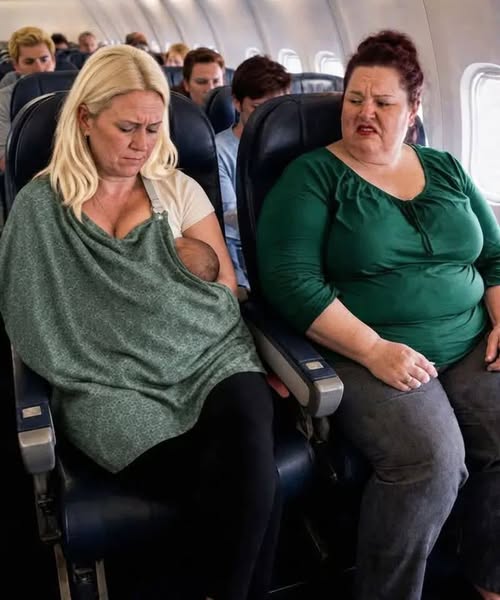
The woman beside me looked irritated. She wore a gray suit, pearl earrings, and the expression of someone preparing a complaint.
“If that baby starts screaming, I am not listening for six hours,” she warned.
“I will do my best.”
“People always say that. Then everyone suffers.”
Louise leaned forward.
“My brother is usually quiet.”
For two hours, Noah slept. I watched the clouds and tried not to remember Mark’s hospital bed. Then Noah woke crying. I checked his diaper, offered his pacifier, rocked him, and whispered the song Mark once sang badly.
Nothing worked because he was hungry.
I arranged a nursing cover and began feeding him.
The woman recoiled.
“I paid for this seat, and now I have to watch that?”
“He needs to eat.”
“Women with babies should stay home. Go to the bathroom.”
“A bathroom is not where babies eat.”
She reached for the call button, but Louise appeared beside us.
“Mom, take my seat. I can sit here.”
As we changed places, Louise whispered that the woman had dropped something.
From the row ahead, I watched my daughter pick up a photograph near the woman’s shoe and place it beside the picture displayed on her tablet.
The woman noticed and cried out.
A flight attendant hurried over while passengers turned.
“You dropped this,” Louise said.
The woman snatched the photograph away. Then she saw the image on Louise’s tablet: me holding Noah while Louise leaned against my shoulder.
Her anger vanished.
Something heavier replaced it.
PART 2: THE QUESTION SHE COULD NOT ESCAPE
The woman demanded another seat, but the flight was full. She stepped into the galley, then returned later.
She remained standing beside Louise.
“Would you repeat what you asked me?”
Louise placed the images beside each other.
“I asked whether you would want someone speaking to your daughter the way you spoke to my mom.”
The woman stared at the photographs.
“The woman in this picture is my daughter, Jenna,” she admitted. “The baby is my grandson.”
“Would you want anyone treating her that way?”
The woman swallowed.
“No.”
“Then do not treat my mother that way.”
An older passenger lowered his newspaper.
“The child asked a fair question,” he said.
The woman sat without arguing. For several moments, only the engines and passengers pretending not to listen filled the cabin.
When Noah finished eating, I returned to my seat. The woman kept the photograph facedown on her lap.
“My name is Evelyn,” she said. “I have never met my grandson.”
Jenna had invited her several times, but Evelyn disapproved of her daughter’s home, partner, schedule, and decision to feed the baby during family gatherings instead of leaving the room.
“You are flying to see them now?”
“For the first time.”
“And you planned to criticize her?”
Evelyn gave a bitter laugh.
“I spent the flight preparing everything I would tell her she was doing wrong.”
I adjusted Noah against my shoulder.
“You knew nothing about me either. My husband died one month ago. I am learning how to do ordinary things without him, and after five minutes you decided I was a terrible mother.”
Tears appeared in her eyes.
“I am sorry.”
I believed her, but sincerity did not erase what she had done.
“Do not apologize because Louise embarrassed you. Apologize because you understand why you were wrong.”
“I do.”
She took out her phone.
“I need to write to Jenna, but I do not know how.”
“Tell her what you did without explaining it away. Then say what will change.”
Evelyn began typing. She admitted judging Jenna from a distance and preparing to arrive with criticism instead of support. She wrote that she wanted to meet her grandson and learn what her daughter needed.
Then she sent it.
Ten minutes later, Jenna replied:
You may still come, but only if you mean every word.
“Does she believe me?” Evelyn asked.
“She is giving you an opportunity to prove it.”
PART 3: WHAT HAPPENED AFTER LANDING
Evelyn read the message three times.
At first, relief softened her face. Then she noticed the condition inside the invitation. By the third reading, relief had become responsibility.
She asked Louise whether Jenna looked angry in the photograph.
Louise studied it.
“She looks tired. Those are not the same thing.”
Evelyn accepted the correction without defending herself.
That exchange reminded me that apologies are easier than change. An apology lasts a minute. Change must survive everything afterward.
When the plane landed, my mother texted that she was near carousel six. Evelyn walked beside us through the airport, gripping Jenna’s photograph while her confidence faded.
Jenna stood near baggage claim with a baby in a green carrier. She had Evelyn’s eyes, but her expression was guarded.
Evelyn stopped several feet away.
“May I hug you?”
Jenna considered the question, then nodded.
Evelyn approached carefully. The embrace lasted only seconds. Jenna kept one arm around her baby, and Evelyn did not reach for him.
When they separated, Evelyn spoke too quietly for me to hear. Jenna listened and nodded once.
Neither smiled, but they walked toward the carousel together.
It was not forgiveness.
It was a beginning.
Several weeks later, a card arrived at my mother’s house.
Inside was a photograph of Evelyn sitting beside Jenna on a sofa, holding her grandson while Jenna rested one hand against the baby’s back. No one looked comfortable, but no one appeared ready to leave.
Beneath the picture, Evelyn had written:
I am learning to ask before helping and listen before correcting. Thank you for interrupting the person I was becoming.
Louise pinned the card to my mother’s kitchen notice board.
“Why keep it?” I asked.
She smoothed one corner against the cork.
“Because speaking up does not only stop a bad moment,” she said. “Sometimes it helps someone choose a better next one.”
Mark had taught Louise that silence should never protect the person causing harm. That day, she had done more than defend me.
She had forced a stranger to see her own daughter in the woman she was judging.
Grief had made every ordinary task feel impossible without Mark. Yet Louise reminded me that pieces of him remained with us—in her courage, fairness, and refusal to stay quiet when someone was treated unfairly.
Evelyn still had work to do. One message could not repair years of criticism, and one airport embrace could not rebuild trust.
But she had stopped preparing to correct her daughter and started learning how to support her.
One honest question cannot change the past.
But it can change what happens next.