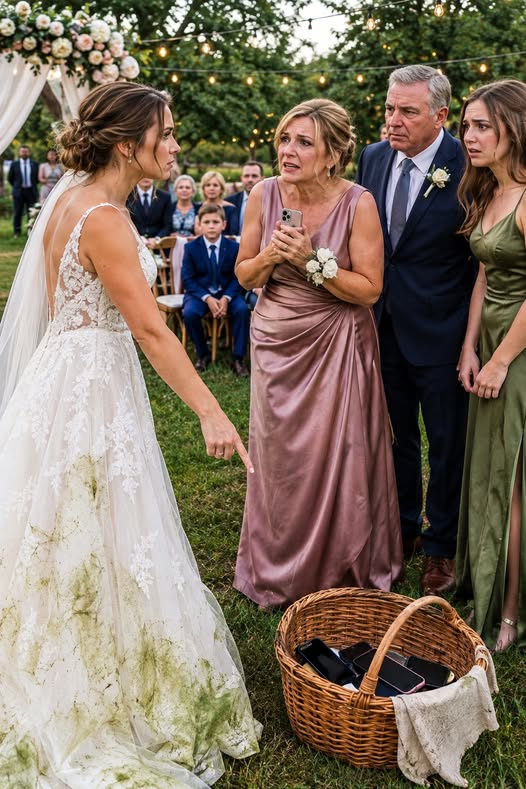
And when she finally rushed into Hollow Bow Orchard hours later, pale beneath perfect makeup and gripping her phone with both hands, she wasn’t crying because she had missed seeing me walk down the aisle.
She was terrified because of one photograph.
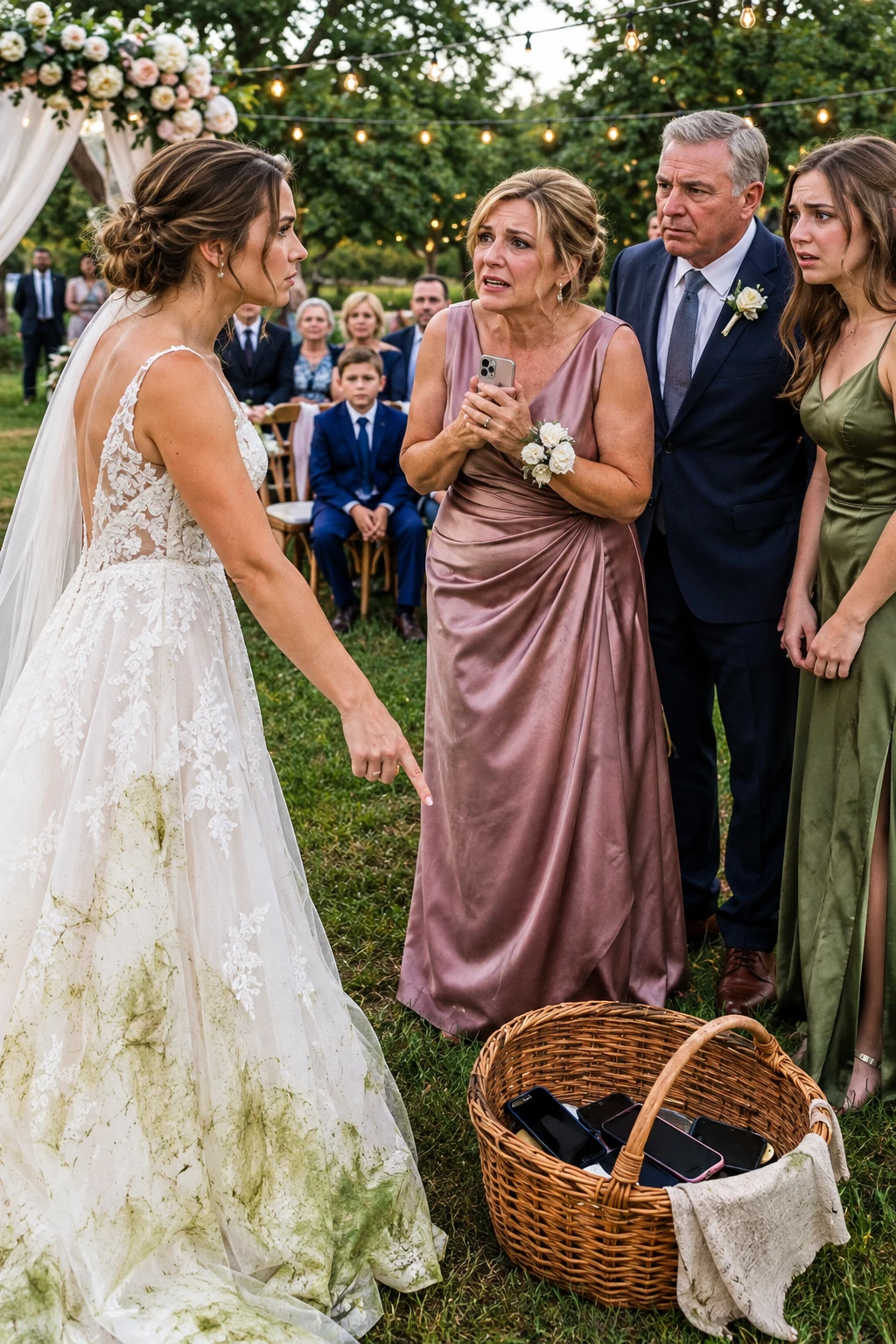
“Fay, thank God,” she said beneath the string lights. “Take the post down. Right now.”
My father, David, followed her in a wrinkled suit. My younger sister, Kylie, came behind him in a green dress that looked chosen for a luxury resort, not a Vermont orchard.
Seventy guests went quiet.
“What post?” I asked.
Mom’s jaw tightened. “You know exactly what I mean.”
I did.
Two hours earlier, after marrying Ben beneath an arch of white roses and apple branches, I had posted one picture on Facebook.
I was in my wedding dress, the hem stained green from the grass. Ten-year-old Theo, one of my former pediatric patients, stood beside me laughing. Behind us were colleagues, friends, patients’ families, and the people who had filled the two front-row seats marked FAMILY after my parents and sister failed to appear.
The caption was only five words:
Everyone who mattered made it.
No tags. No accusation. No explanation.
Then I put my phone back into the wicker basket by the entrance and danced with my husband.
What I hadn’t known was that my mother had spent the afternoon at Silver Pines Lodge posting sponsored content: matching robes, champagne, spa treatments, selfies beside a waterfall pool.
And timestamps.
Her followers did the math.
My mother lowered her voice. “People are saying horrible things.”
“Are they wrong?”
“Fay.”
There it was—that tone that had trained me for twenty years to stop talking before I made the family uncomfortable.
For most of my life, silence had been my specialty.
When I was fifteen, Dad lost his job in Albany. A foreclosure warning appeared on our kitchen counter, and Mom responded by creating a family lifestyle blog. The first advertising check arrived three days before the mortgage was due.
The audience saved our house.
After that, the audience became another member of the family.
Then it became the most important one.
Dinner moved toward better light. Christmas morning waited for charged batteries. Kylie, naturally charming, learned to cry on cue before she was ten.
I hated cameras, so I became useful behind them. I held reflectors, edited captions, answered sponsor emails, cleaned kitchens before “candid” breakfast videos.
Mom used to squeeze my shoulder and say, “You’re the spine of this family, Fay.”
For years, I mistook usefulness for love.
At seventeen, I won first place at a regional science fair. The seats I saved for my parents and Kylie stayed empty because a sponsor had sent Kylie curling irons and Mom said the bedroom light was “too good to waste.”
May you like
That night, I asked why she hadn’t even posted my ribbon.
She smiled.
“If it isn’t posted, it didn’t happen, honey.”
That sentence followed me through medical school, residency, birthdays, and milestones they missed.
Then I met Ben.
On our third date, he brought an old film camera and took exactly one picture of me.
“One?” I asked.
He smiled. “Because you look down when you smile, not at the lens. One’s enough.”
It was the first time I understood the difference between being seen and being displayed.
So when Ben proposed, I wanted a wedding with no content.
Seventy people. A Vermont apple orchard. A bluegrass trio. Disposable cameras in a wooden crate.
And beside them, a wicker basket with a handwritten sign:
PHONES SLEEP IN THE BASKET.
My mother hated it.
Two weeks before the ceremony, I drove to Albany and asked her to choose my wedding over a sponsored weekend at Silver Pines Lodge.
“The lodge deadline can’t move,” she said.
“My wedding can’t move either.”
“We’ll celebrate afterward. Properly. Hair, makeup, golden hour.”
“You’re talking about reshooting my wedding like a campaign.”
She sighed. “Don’t be dramatic.”
Even then, I protected her. I told Ben my family might only be late.
On my wedding morning, I kept watching the gravel road.
At 11:15, I finally called.
“Mom, thank God. Are you okay? Where are you?”
A pause.
Then she laughed.
“Oh, was that today? A trip sounded more fun.”
I heard Kylie laughing behind her and the roar of the spa waterfall.
Something inside me went still.
“Okay, Mom.”
Eleven minutes later, I stopped waiting.
The ceremony began twenty minutes late. Ben’s mother quietly filled the empty front-row seats with people who had actually shown up. When I saw Theo there in his tiny navy suit, grinning at me, I nearly broke.
Ben squeezed my hands.
“You’re here,” he whispered. “I’m here.”
So I married him.
For one beautiful hour, I felt free.
Until my mother arrived.
Now Dad stepped closer and said, “Fay, please. The sponsorship contracts are tied to the house. Some cover our insurance.”
For the first time, I saw real fear beneath all the performance.
Then I saw the wicker basket ten feet away.
“You can stay,” I told them. “There’s cake. There’s music. Your daughter got married today.”
Mom’s face softened.
I pointed at the basket.
“Phones in there. Come in as people, not as a page.”
Her phone buzzed again.
“If I put this down,” she whispered, “we could lose everything.”
“You might lose the version of everything you built for strangers.”
Then Kylie spoke.
“Mom… put it in the basket.”
Everyone turned.
My mother looked at her as if she had been slapped.
Kylie’s eyes filled. She reached into her purse, pulled out her own phone, and dropped it into the wicker basket.
The sound was small.
But it changed the night.
“I’m tired,” Kylie said.
“Kylie—”
“I’m so tired, Mom.”
Then she started crying. Not delicately. Not photogenically. Her mascara streaked and her shoulders shook.
“I didn’t know she was going to skip the ceremony,” she told me. “I swear.”
Mom snapped, “That is not true.”
Kylie flinched.
That tiny movement made me believe her.
“What do you mean?” I asked.
“Mom told me the wedding had been moved to Sunday.”
My breath caught.
Dad turned sharply. “What?”
Kylie wiped her face. “She showed me an email. It looked like it came from you. It said there was a permit issue and the ceremony moved.”
“I never sent that.”
“I know now.”
Dad’s voice hardened. “Marianne?”
Mom looked at me. “I was trying to keep the weekend from falling apart.”
Not my wedding.
The weekend. The campaign. The content.
Dad stepped back. “Did you lie to me too?”
Her silence answered.
He stared at her. “You told me Fay canceled brunch because of a venue problem.”
“There was no venue problem,” I said.
Something in his face broke. “I didn’t know.”
For twenty years, I had grouped the three of them together: they chose the camera, they chose Kylie, they chose everything except me.
Now that history shifted.
Not enough to excuse them.
But enough to make me wonder how much had been chosen—and how much had been arranged.
Mom moved toward me. “I made a mistake.”
“A mistake is forgetting flowers. You manufactured a lie to keep them away from my wedding.”
“I thought we could fix it afterward.”
“How?”
“With another ceremony.”
I laughed because the alternative was screaming. “You were going to restage my wedding?”
“Just the family portion.”
Ben appeared beside me.
Mom looked at him. “Families compromise.”
Ben’s expression never changed. “No. Sometimes one person decides everyone else is a prop.”
Then Mom’s phone rang.
She looked at the screen and went white.
Dad noticed.
He took it before she could stop him.
“Who is Graham Vale?”
Mom lunged. “Give me that.”
Kylie whispered, “Her manager.”
Mom stared at her.
“No,” Kylie said. “Don’t lie again.”
Dad scrolled, then read aloud.
“‘If Fay’s post stays up, the archive becomes discoverable. Do not let her mention 2008.’”
My skin turned cold.
I was seven in 2008.
Dad kept scrolling. “There are bank transfers.”
“What archive?” I asked.
No one answered.
Then Theo’s mother, Rachel, rose from a nearby table. She was a local investigative reporter.
“I know that name,” she said. “Graham Vale ran BrightNest Media.”
I had heard of BrightNest. Years earlier, it had built some of the first major parenting channels online before collapsing under lawsuits involving hidden contracts and child labor complaints.
Mom looked suddenly older.
Rachel stepped closer. “You worked with BrightNest?”
The fight left Mom’s face.
“Not here.”
I almost smiled.
“Actually, here is perfect.”
Mom looked at me for a long moment.
Then she said the sentence that split my childhood open.
“Fay, you were the reason they chose us.”
“What?”
“You were seven. You had that hospital video.”
A memory surfaced: fluorescent lights, a paper gown, Dad holding my hand after surgery to repair a congenital heart defect. Mom had filmed me because I said something funny while groggy.
“You posted that?”
“It went viral. BrightNest contacted me. They wanted a family with a medical story. Resilience. Sisters growing up together.”
Kylie looked sick.
“They offered us money,” Mom continued. “Before your father lost his job.”
Dad stared at her. “Before?”
Silence.
“You told me the blog started after I lost my job.”
“I knew you would say no.”
Rachel asked, “What did BrightNest require?”
Mom’s voice dropped.
“Access.”
“To what?”
“Everything. School events. Medical appointments. Birthdays. Setbacks. They wanted a family arc.”
She looked at me.
“They said you tested badly on camera.”
I almost laughed.
“So they chose Kylie.”
“Yes.”
“And you let them.”
“Yes.”
The orchard blurred.
The science fair. Medical school graduation. Birthday dinners. Empty seats.
They rearranged themselves in my mind.
My childhood had not simply been neglected. It had been edited for retention.
Dad looked sick. “You let a company decide which daughter mattered?”
“I was trying to protect the family!”
“From what?” I demanded.
She froze.
Rachel noticed too.
“What happened in 2008, Marianne?”
Mom looked at the ground.
“BrightNest didn’t just pay us. They controlled part of the channel. They also created custodial accounts for the girls.”
Kylie blinked. “Trusts?”
Mom nodded.
“How much?” Dad asked.
“At the peak? About three-point-eight million dollars.”
No one spoke.
“Where is it?” I asked.
Mom’s mouth trembled.
“Gone.”
Kylie covered her mouth.
Mom rushed on. “There were legal fees. BrightNest collapsed. Then David lost his job. The house—”
“You used our trusts?” Kylie whispered.
“I borrowed against them.”
Dad’s voice turned flat. “You stole from your children.”
“I kept a roof over our heads!”
Then Kylie pointed at Dad’s phone.
“Open the attachments.”
Mom shouted, “No!”
Dad did.
A stack of trust documents appeared.
Rachel leaned over his shoulder. “Those are amended statements.”
Dad’s face changed.
“These signatures are mine.”
Mom said nothing.
“I never signed these.”
Rachel looked at her. “That’s fraud.”
Mom sank into a chair.
I should have felt victorious.
Instead, I felt hollow.
Then Dad frowned.
“Wait.”
He zoomed in.
“There’s a current balance.”
Mom stood abruptly.
“What balance?” I asked.
Dad stared at the screen.
“Fay’s trust.”
Mom whispered, “David, stop.”
He read the number.
“Two million, six hundred and forty-two thousand dollars.”
Kylie grabbed the phone and searched for her own account.
Her face went white.
“Mine has twelve thousand.”
We all looked at Mom.
“Why is mine still there?” I asked.
She closed her eyes.
“Because yours wasn’t mine to touch.”
Dad’s voice was low. “What does that mean?”
“The trust wasn’t established by BrightNest.”
“Who established it?”
Mom looked at me with fear, grief, and guilt all mixed together.
Then she whispered:
“Your biological mother.”
The world stopped.
Dad looked as shocked as I felt.
“What are you talking about?”
Mom began crying.
“Fay, I didn’t give birth to you.”
“Then who did?”
“My older sister.”
The name came before she said it.
Elise.
Aunt Elise.
The woman I had been told died in a car accident when I was a baby.
Mom spoke through tears. “Elise was twenty-two when she had you. She struggled with addiction. She asked me to take you temporarily.”
Dad shook his head. “You told me Fay was ours.”
“I was afraid you’d leave.”
“I signed her birth certificate.”
“I know.”
My knees weakened.
“What happened to Elise?”
Mom looked at me.
“She got sober.”
My heart stopped.
“What?”
“She came back when you were seven.”
The hospital video.
The trust.
“Then she didn’t die.”
“No.”
“Where is she?”
Before Mom could answer, Rachel inhaled sharply.
She was staring toward the orchard gate.
We all turned.
A woman stood just outside the string lights.
Late fifties. Silver threaded through dark hair. Navy coat. Simple dress.
And in her hands, an old film camera.
The woman looked at me as if she had spent her whole life memorizing a face she wasn’t allowed to touch.
Mom whispered, “Elise.”
My entire body shook.
“You’re alive.”
Her eyes filled.
“Yes.”
Elise took another step beneath the lights, but she didn’t reach for me.
That restraint hurt more than if she had.
“I brought something for you,” she said, touching the camera. “I’ve carried it to every birthday I wasn’t allowed to attend.”
My throat tightened.
“You came to my birthdays?”
“From far away. A parking lot. Across a street. Once from the back of an auditorium.”
Mom whispered, “Elise—”
“No,” Elise said, and her voice was suddenly steel. “You’ve had thirty years to tell the story.”
She looked back at me.
“I never wanted photographs of you for an audience. I took them because I was afraid memory would be all I was ever allowed to have.”
That was the cruelest part: the woman I had been taught to think was dead had been watching me live from the edges of rooms, while the woman I called Mom turned my life into a product.
I turned on Mom. “You told me she was dead.”
“She came back for you,” Mom said. “BrightNest found out. They threatened the contract. Elise had created your trust with money from your grandfather. She said it stayed yours if I kept you safe. If I exploited you, she would fight for custody.”
Rachel’s face hardened. “So BrightNest helped bury her.”
Mom nodded. “Graham helped.”
I looked at Elise.
“Why didn’t you fight?”
“I did,” she said.
She told me she had filed for custody more than once. BrightNest’s attorneys used her addiction history against her. Articles appeared online calling her unstable. Eventually, she agreed to stay away until I turned eighteen because she was promised that my trust would remain protected.
“But I’m thirty-one.”
“I know.”
“Why didn’t you come when I turned eighteen?”
Elise looked at Mom.
Then she said, “Because I received letters from you.”
I stared.
“What letters?”
“Every year. They said you knew who I was. They said you wanted no contact. They said Marianne was your mother and I was a stranger.”
I looked at Mom.
“You forged them.”
She couldn’t meet my eyes.
Something inside me broke—not chaotically, but cleanly, like a rope finally cut.
I walked to the wicker basket and picked up my phone.
Mom stood.
“Fay, please.”
For one second, instinct returned.
Protect the family.
Fix the story.
Keep ugly things off camera.
Then I remembered Mom’s favorite sentence.
If it isn’t posted, it didn’t happen.
I opened Facebook.
“You taught me something when I was seventeen.”
Her face went still.
“If it isn’t posted, it didn’t happen.”
Then I smiled through tears.
“But you were wrong.”
I deleted the wedding photograph.
Mom looked stunned.
Then relieved.
For exactly two seconds.
Because I handed my phone to Rachel.
“I don’t want a revenge post.”
Mom’s relief vanished.
“I want an investigation.”
Rachel held my gaze. “Everything?”
I looked at Dad. Kylie. Elise.
“Everything.”
Six months later, BrightNest’s sealed records became part of a state fraud investigation. Graham Vale was indicted on financial and forgery charges tied to several former family channels.
Mom accepted a plea agreement.
Dad filed for divorce.
Kylie sued over the money taken from her trust.
The investigation did more than expose my family. It uncovered dozens of former child creators whose earnings had been drained, contracts signed in their names, and private moments sold before they were old enough to consent.
For months, strangers asked me for interviews.
I refused most of them.
For once, I wanted the truth to exist without becoming another performance.
Kylie did the same. She deleted her public accounts, enrolled in community college, and started therapy. One afternoon she called me and said, “I don’t know who I am when nobody is watching.”
I told her, “Then maybe you finally get to find out.”
It was the first honest conversation we had ever had as sisters.
I didn’t sell my story or become an influencer. Instead, I used part of the money Elise had protected to establish a legal fund for children whose earnings had been controlled by family-content businesses.
We called it The Unframed Project.
At the opening, a reporter asked why.
Across the room, Dad helped Kylie carry boxes. Theo stole cookies from the refreshment table. Elise stood beside Ben.
No one was posing.
“Because children deserve a life outside the frame,” I said.
That night, after everyone left, Elise handed me a small envelope.
Inside was an old photograph.
A seven-year-old girl sat in a hospital bed, messy-haired, looking down while she smiled.
Me.
On the back, in Elise’s handwriting, were six words:
One was always enough for me.
My breath caught.
I looked across the room at Ben.
At the old film camera hanging from his shoulder.
Then I remembered our third date.
Because you look down when you smile, not at the lens. One’s enough.
I walked toward him.
“Ben.”
He looked up.
I held out the photograph.
His face changed.
Not guilt.
Recognition.
“Where did you hear that line?”
For a long moment, he said nothing.
Then Elise started crying.
And Ben looked at her.
That was when the final truth arrived.
He had known.
Not everything.
But enough.
Years earlier, after giving up the custody fight, Elise hired a private investigator to make sure I was safe from a distance.
The investigator was Ben’s father.
When Ben was in college, he sometimes helped organize files and photographs for him.
He had seen me before we met.
He had known who Elise was.
And he had recognized me the first time we crossed paths.
My stomach dropped.
“Our third date wasn’t an accident.”
“No.”
“Did Elise send you?”
“No.”
“Ben.”
He stepped toward me, then stopped.
“She asked my father to make sure you were safe. Years later, I saw you at the hospital cafeteria. Then at the bookstore. The third time, I spoke to you. Nobody told me to fall in love with you.”
“So our whole relationship started with a secret.”
“Yes.”
Elise wiped her face. “When I realized you two were dating, I told him to leave you alone.”
Ben nodded.
“She did.”
“And you didn’t?”
“No.”
“Why?”
His eyes filled.
“Because by then I loved you.”
I wanted to rage at him.
Part of me did.
But the twist cut deeper than betrayal.
My entire childhood had been built by adults deciding what I should know, what I should see, and which truths I could handle.
Ben had repeated the same mistake—even with better intentions.
So I didn’t forgive him that night.
And I didn’t leave him.
I told him, “If we stay married, there are no more secret keepers in my life. Ever.”
He nodded. “I understand.”
“No. You earn it.”
“I will.”
Then I turned to Elise.
“No more secrets from you either.”
“Never.”
I looked around the quiet room at the woman who gave birth to me, the man I had married, and the broken pieces of a family that had spent decades turning truth into content, contracts, protection, and lies.
Then I placed the old photograph in a simple wooden frame.
Not online.
Not for followers.
Not for strangers.
For me.
Because the most important lesson my mother ever taught me turned out to be the exact opposite of what she believed.
A moment does not become real because strangers see it.
Sometimes the most precious things in your life are the things no audience gets to own.
And sometimes the person standing just outside the frame has been there all along.