After my husband di3d, I finally learned how to drive at sixty-two.
The first time I took his beloved pickup truck out alone, I pressed the button marked **“Home”** on the GPS.
But instead of leading me back to our house, it directed me to an address twenty minutes away.
When I arrived, my hands went cold.
It was the home of the woman Richard had spent nearly forty years convincing me to avoid.
His mother.
And when she opened the door and saw me standing there, she whispered something that changed everything I thought I knew about my marriage.
“Then he never told you.”
Richard had been gone for two months, but the house still felt impossibly empty.
Every morning, I still reached automatically for his coffee mug before remembering there was no reason to fill it.
But grief wasn’t the hardest part of losing my husband.
The hardest part was realizing just how dependent I had become on him.
I couldn’t drive to the grocery store.
I couldn’t visit his grave without asking someone for a ride.
I couldn’t even pick up my own prescriptions.
For forty years, Richard had done all the driving.
He always claimed my reflexes were too slow.
Sometimes he joked that women simply weren’t meant to be behind the wheel.
I had believed him.
So after his death, my adult daughter became the person who drove me everywhere.
She tried to be patient, but she had a job, children, and a life of her own.
One afternoon, after taking me to the pharmacy, she sighed as she pulled out of the parking lot.
“Mom, you can’t depend on me every time you need to go somewhere.”
“I know,” I said quietly. “Your father always took care of that.”
She tapped her fingers against the steering wheel.
“I still don’t understand why Dad never encouraged you to learn. Grandma Eleanor has always done everything herself.”
The mention of Richard’s mother immediately made me uncomfortable.
“Eleanor was never particularly kind to me.”
My daughter glanced at me.
“That doesn’t sound like Grandma.”
“You didn’t know her the way I did.”
“Maybe you should talk to her now.”
I shook my head.
“You were young. You never heard what she said about me. Richard spent decades keeping us apart because he was constantly trying to prevent arguments. I’m not reopening that relationship now.”
My daughter didn’t push further.
Still, I could tell she disagreed.
“It just seems sad,” she murmured. “Families shouldn’t stay broken forever.”
“Some things are better left alone.”
We drove home without saying much more.
That evening, I sat alone at the kitchen table staring at the calendar Richard had always used to organize our lives.
Every appointment was written in his handwriting.
Every trip.
Every plan.
Every decision.
And suddenly, something uncomfortable occurred to me.
I had spent most of my adult life being taken somewhere by someone else.
I had rarely decided for myself where I wanted to go.
“I’m sixty-two years old,” I whispered into the empty kitchen. “And I’ve never driven a car.”
The thought frightened me.
But beneath the fear, something else appeared.
Determination.
The following morning, I put on comfortable shoes and walked two miles to the nearest driving school.
When I reached the counter, a young instructor smiled at me.
“How can I help you?”
“I want to learn to drive.”
“Of course. Have you driven before?”
“Never. My husband always told me I couldn’t.”
The instructor smiled.
“Well, maybe it’s time to find out for yourself.”
For the next several weeks, I practiced without telling anyone.
Not my daughter.
Not my son.
Nobody.
At first, I was terrified.
I stalled the car.
I held the steering wheel so tightly my hands hurt.
Every intersection made my heart race.
But little by little, something changed.
The fear faded.
One afternoon, my instructor leaned back in his seat and laughed.
“You know, you’re actually very good at this. Better than plenty of teenagers I teach.”
“My husband would never believe that.”
The instructor shrugged.
“Sometimes the people closest to us are wrong about what we’re capable of.”
I didn’t realize then how important those words would become.
A few weeks later, I took my road test.
At sixty-two years old, I passed on my first attempt.
When the examiner handed me my license, I cried in the parking lot.
For the first time in four decades, I could go wherever I wanted without asking anyone for permission or assistance.
I thought about driving to Richard’s grave myself.
I imagined taking little day trips.
Maybe even visiting places I had spent years saying I would see “someday.”
But before any of that, there was something else I wanted to do.
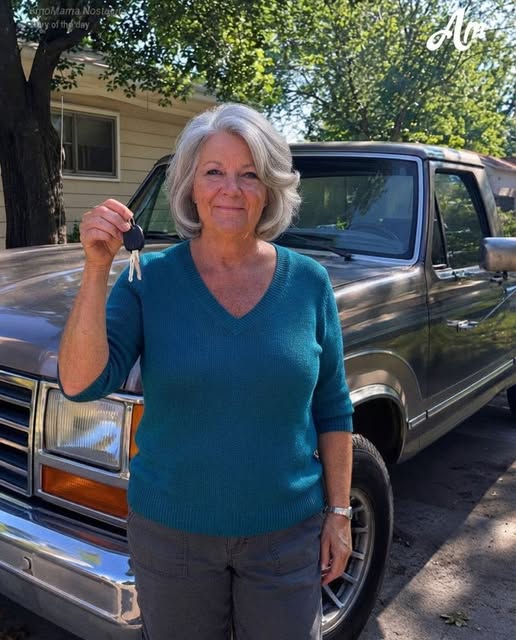
I wanted to drive Richard’s pickup truck.
He had loved that truck.
Every Sunday, he polished it until it shone.
“Nobody drives this except me,” he used to joke whenever I reached toward the keys.
Now the keys belonged to me.
The following afternoon, I climbed into the driver’s seat.
The truck still smelled faintly of leather and old coffee.
I inserted the key.
The engine came alive beneath me.
For a moment, I simply sat there smiling.
“Look at me now, Richard,” I whispered.
Then I began exploring the dashboard.
There were buttons I had never touched because Richard had always controlled everything inside the truck.
Eventually, I tapped the navigation screen.
A small house icon appeared.
**HOME.**
Without thinking much about it, I pressed the button.
I expected our address to appear.
Instead, the GPS displayed a street I didn’t recognize.
I stared at the screen.
“That isn’t our house.”
I pressed the button again.
Same address.
A town about twenty minutes away.
My hands suddenly felt cold.
Why would Richard have another address saved as “Home”?
My mind immediately went somewhere terrible.
Another woman.
Another relationship.
Maybe even another family.
None of it seemed possible.
But grief does strange things to curiosity.
Once the question entered my mind, I couldn’t ignore it.
“I need to know.”
I shifted the truck into reverse.
Then I followed the GPS.
The roads became less familiar as I drove farther from my neighborhood.
Eventually, the navigation system directed me into a quiet area filled with older brick homes and mature trees.
Then the voice announced:
“You have arrived at your destination.”
I pulled over.
For several seconds, I couldn’t process what I was seeing.
Blue shutters.
Rose bushes along the walkway.
A porch swing I remembered sitting on when I was a newlywed.
“No.”
I stared at the house.
It belonged to Eleanor.
Richard’s mother.
The woman I had barely spoken to in almost forty years.
According to Richard, Eleanor had disliked me almost from the beginning.
He told me she considered me beneath their family.
He claimed she thought I wasn’t intelligent enough for him.
Whenever I suggested repairing the relationship, Richard discouraged me.
“She says horrible things about you,” he would tell me. “You’re happier staying away.”
So I stayed away.
When Richard took our children to visit their grandmother, I usually remained home.
We became strangers.
Yet somehow, during the final months of his life, Richard had saved Eleanor’s house in his GPS as **Home**.
Nothing made sense.
I sat in the truck for several minutes debating whether to leave.
The old version of me would have.
The woman who had spent forty years sitting in the passenger seat would have turned around and gone home before asking a difficult question.
But I wasn’t that woman anymore.
I had learned to drive because I wanted control over where my life went next.
So I opened the door.
My legs trembled as I climbed the porch steps.
Before I could lose my nerve, I rang the bell.
A moment later, the door opened.
Eleanor stood there.
She looked smaller than I remembered.
Older too.
Her eyes moved from my face to Richard’s truck parked at the curb.
“You drove here yourself?”
“I did.”
She seemed genuinely stunned.
“I finally learned. I passed my test yesterday.”
I expected sarcasm.
Maybe even criticism.
Instead, Eleanor’s expression crumbled.
She stared at me for several seconds.
Then she whispered:
“Then he never told you.”
My stomach tightened.
“Told me what?”
She opened the door wider.
“You should come inside.”
I followed her into a modest living room that smelled faintly of lavender.
Eleanor made tea.
Her hands shook as badly as mine.
Finally, I spoke.
“Richard always told me you hated me.”
Her eyes lifted.
“He told me the same thing about you.”
I frowned.
“What?”
“He said you wanted nothing to do with me.”
“That isn’t true.”
“And I never hated you.”
The room suddenly felt much smaller.
“We were both lied to,” Eleanor said quietly. “By the same person.”
I stared at her.
“Why would Richard do something like that?”
Instead of answering immediately, she asked something unexpected.
“Do you remember the paintings you used to make?”
I froze.
I hadn’t thought about them in decades.
Before my marriage, I painted small watercolor landscapes, especially harbor scenes.
“I stopped painting after Richard and I got married.”
“Why?”
“He thought it was childish.”
Eleanor’s mouth tightened.
“It wasn’t childish.”
She leaned closer.
“Do you remember displaying one of those paintings at the church fair?”
“Barely.”
“A gallery owner saw it.”
My heart skipped.
“He thought you were talented. He wanted to include your work in a group exhibition. More importantly, he offered you the chance to study with him.”
I stared at her.
“That never happened.”
“Yes, it did.”
“I would have remembered something like that.”
“You never knew.”
She looked down at her tea.
“The gallery owner sent a letter. I gave it to Richard because I thought he would be excited for you.”
I could barely breathe.
“He never gave it to me.”
“No.”
Eleanor continued.
“The studio was two towns away. Richard complained that he couldn’t keep driving you there. I told him I would teach you to drive myself.”
My stomach dropped.
“What did he say?”
“That you weren’t interested.”
She paused.
“He told me you laughed at the idea and said all you wanted was to be a wife.”
“I never said that.”
“I know that now.”
I felt tears forming.
“And what did he tell you about me?” Eleanor asked.
“That you thought I was simple. That you believed I would never amount to anything. That you didn’t think I deserved your son.”
Eleanor closed her eyes.
“I never said any of those things.”
Suddenly, the last forty years of my life looked completely different.
Eleanor’s voice softened.
“Don’t you understand? That’s why he never wanted you driving.”
I looked at her.
“If you could drive yourself wherever you wanted, you wouldn’t have needed him to decide where you could go.”
The words struck me harder than I expected.
“He kept you dependent,” she continued. “And he kept us separated because if we had ever sat down and compared what he was telling us, everything would have fallen apart.”
I stared at my hands.
Once, those hands had held paintbrushes.
For decades afterward, they had mostly held grocery bags while I waited for Richard to unlock the passenger door.
“Why didn’t you tell me sooner?”
“I tried.”
Tears filled Eleanor’s eyes.
“But he controlled the contact between us. Eventually, I believed you genuinely wanted nothing to do with me.”
I remembered the GPS.
“But Richard came here recently.”
She nodded.
“Several times.”
“Why?”
“Toward the end, something changed in him.”
Her expression became sad.
“He would come here and sit in this room for hours. Sometimes he barely spoke.”
“What did he want?”
“I think he wanted to confess.”
She swallowed.
“But he never found the courage.”
“And then his heart gave out.”
Eleanor nodded.
“And then his heart gave out.”
I sat quietly, feeling forty years rearrange themselves inside my mind.
Eventually, another fear emerged.
“My children won’t believe this.”
Eleanor looked at me.
“They adored their father. They’ll think I’m angry because he died. Or that grief has made me confused.”
Without saying anything, Eleanor stood.
She walked toward a cabinet in the corner and unlocked it.
Then she removed an old file box.
“I kept everything.”
She carried it back to the table.
“I always thought there might come a day when someone would need proof.”
An hour later, Eleanor climbed into Richard’s truck beside me.
I drove us back to my house.
Then I called my children.
All three came over.
They were still grieving their father and clearly confused about why their estranged grandmother was sitting in my living room.
My daughter looked at me.
“Mom, did you finally decide to take my advice and talk to Grandma?”
“Not exactly.”
Eleanor straightened in her chair.
“Forty years ago, I tried to help your mother build a life of her own.”
My son frowned.
“What do you mean?”
“She had talent. A gallery wanted to represent her work. Your father intercepted the opportunity and rejected it without ever telling her.”
My son immediately stood.
“That’s a horrible accusation to make against someone who isn’t here to defend himself.”
“Sit down,” I said.
He stared at me.
“Dad might have been overprotective, but he loved you.”
“He controlled where I went,” I replied. “He prevented me from learning to drive. He kept Eleanor and me apart. And he lied to both of us.”
My daughter shook her head.
“Dad wasn’t a liar.”
Eleanor reached into the old file box.
“Then look at this.”
She removed a yellowed piece of paper and handed it to my daughter.
“This is the response the gallery received.”
My daughter slowly unfolded it.
Her eyes moved across the page.
Then her expression changed.
“This is Dad’s handwriting.”
My son leaned over her shoulder.
The letter stated that I had no interest in pursuing the opportunity.
At the bottom was my name.
But I hadn’t signed it.
Richard had.
My son’s face went pale.
“He signed Mom’s name.”
“Yes,” Eleanor said.
“He answered for me,” I whispered.
Then I looked at my children.
“He answered for me for forty years.”
Nobody spoke.
My daughter began crying.
“Mom, I’m sorry. We didn’t know.”
I reached across and took Eleanor’s hand.
Two women who had spent nearly four decades believing they hated each other were finally sitting side by side.
“I don’t need anyone to apologize,” I said. “I just needed you to understand the truth.”
For a long time, we sat together in silence.
The perfect image my children had carried of their father was gone.
So was the version of my marriage I had believed for most of my adult life.
Eventually, my eyes moved toward Richard’s truck keys hanging beside the door.
For forty years, someone else had decided where I could go.
Now, for the first time in my life, **the road ahead belonged entirely to me.