Part 1: The Flight Attendant’s Warning
The first warning came before I understood there was anything to fear. At seventy-one, I was boarding a flight from Phoenix to Las Vegas with my only son, Mark, and his wife, Sabrina, for what they had described as a simple weekend of family bonding.
My seat was several rows behind theirs, and by the time I settled in, Mark and Sabrina were already leaning toward each other in an intense whispered conversation. I noticed it but dismissed the uneasy feeling because I expected nothing more dangerous from the weekend than crowded casinos and too much walking.
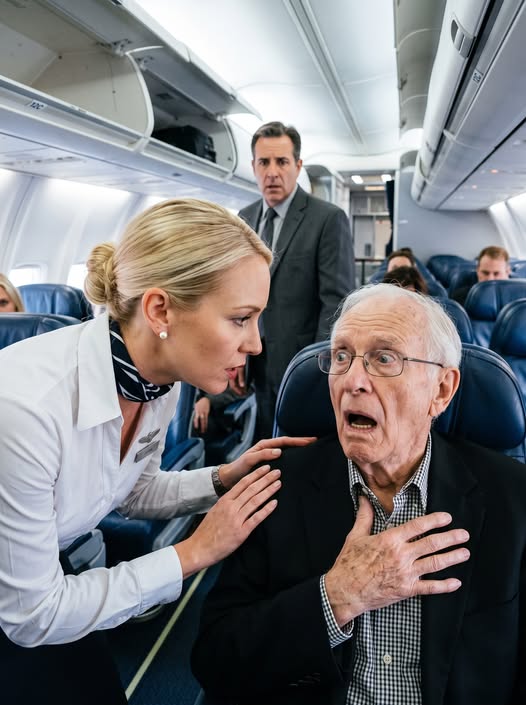
Then a flight attendant named Grace Miller stopped beside my seat. While checking my seatbelt, she gripped my wrist tightly, leaned close to my ear, and spoke in a whisper that instantly erased every thought of Las Vegas.
“Sir, pretend you’re not feeling well. Get off this plane. Do it now.”
I stared at her, wondering whether she had confused me with another passenger, but the fear in her eyes was unmistakable. I had spent forty years working as a tax advisor, and decades of audits had taught me to recognize when someone was bluffing, so I decided to trust her.
“I… I don’t feel right.”
Within seconds, two attendants were helping me into the aisle. As Grace escorted me toward the exit, I looked back at Mark and Sabrina, expecting them to be frightened by the possibility that something was wrong with me.
Instead, I saw disappointment.
They covered it quickly with expressions of concern, but I had already seen enough. A few minutes later, I was sitting in an airport medical room when Grace closed the door and took out her phone with trembling hands.
“I recorded something before boarding. Your daughter-in-law didn’t know someone was in the bathroom stall next to her.”
Grace pressed play, and Sabrina’s voice filled the room. She sounded disturbingly calm as she explained that the altitude could make my condition appear natural and that emergency response aboard the plane would be limited.
“The altitude will make his body give out naturally. He won’t remain in this world by the time we land.”
Then I heard my son.
“Six hundred fifty thousand dollars. I’m ready.”
The recording ended, and with it went the version of my family I had believed in. Grace explained that her own father had died three years earlier under circumstances that looked accidental, and when she overheard Sabrina speaking, she couldn’t ignore what she was hearing.
Through the medical room window, I watched the plane leave the gate without me. Somewhere aboard it were my only son and his wife, apparently expecting a $650,000 insurance payout from a trip they had never intended me to survive.
The warning signs suddenly began rearranging themselves in my mind. Eight months earlier, Mark had lost his job, and I had immediately invited him and Sabrina to live with me because helping my only child seemed natural.
Mark gradually became withdrawn, while Sabrina took increasing control over my household. First she managed groceries and organization, then the mail and bills, always presenting her involvement as an attempt to make my retirement easier.
One evening, she casually asked about my life insurance.
“Your life insurance is around six hundred fifty thousand, right?”
I had never told her that amount.
Three months later, Sabrina surprised me with the Las Vegas trip, claiming it was her treat despite having no job and living in my house. The flights and hotel had already been booked before I agreed, and Mark barely looked at me when he tried to make the invitation sound normal.
“It could be fun. Like old times.”
We had never spent any “old times” together in Las Vegas.
Even our seats had been arranged separately. Mark and Sabrina boarded early while I had been deliberately placed several rows behind them, and suddenly every detail that had seemed strange now looked calculated.
I returned to my house alone, but I wasn’t the same trusting father who had left that morning. If Mark and Sabrina had planned something this elaborate, I knew there would be evidence somewhere because complicated schemes always leave financial and documentary trails.
I had spent my career finding those trails.
Now I was going to follow one through my own home.
Part 2: The Numbers Never Lie
The morning after I returned from the airport, I walked into Desert Valley Bank and asked to speak with Linda James, the manager and an old colleague. I told her I needed complete transaction histories for every account connected to my name, although I didn’t yet explain what Grace had recorded.
“Of course, Leonard. Is everything okay?”
“Not yet. But it will be.”
The statements told a story I had been too trusting to notice inside my own home. For six months, money had been disappearing in carefully chosen amounts, each withdrawal small enough to avoid attracting immediate attention but together totaling forty-five thousand dollars.
What disturbed me most were the signatures authorizing several transactions. They resembled mine closely enough to fool someone unfamiliar with my handwriting, but forty years of examining financial documents had taught me to recognize the difference between an authentic signature and a copied one.
“These aren’t mine.”
Linda’s face changed as she examined them more carefully.
“Leonard… if someone forged your…”
“I need the full scope before we act.”
I returned home with copies of everything and spread the documents across my dining table. Once I stopped viewing each irregularity separately, a pattern emerged that was far more disturbing than the missing forty-five thousand dollars.
Someone had submitted a beneficiary change involving my insurance. I also discovered a forged power of attorney and medical reports describing cognitive decline, supposedly documenting problems I didn’t have and signed by a physician I had never met.
The dates were particularly revealing because the paperwork began appearing after Mark and Sabrina moved into my home. Then I searched Mark’s old bedroom and found a shoebox filled with unopened letters, overdue notices, and demands for repayment connected to habits he had been hiding from me.
My son owed more than eighty thousand dollars.
Suddenly, the $650,000 figure on Grace’s recording made terrible sense. Mark wasn’t simply helping Sabrina execute some bizarre scheme because he had become trapped beneath enormous debt, while my insurance and assets represented a way out.
That realization didn’t excuse him. If anything, understanding his motive made the betrayal more painful because the child I had welcomed home when he lost his job had apparently been studying my finances while I believed I was helping him rebuild his life.
On Saturday morning, I carried the entire file to Daniel Price, an attorney specializing in elder exploitation. He reviewed the bank records, forged documents, insurance changes, and false medical reports before finally looking across his desk at me.
“Mr. Hayes, this is one of the clearest cases I’ve ever seen. You are in immediate danger of being pushed out of this world under the guise of natural circumstances.”
Hearing a professional say it aloud made the situation brutally real. I asked what we needed to do, and Daniel responded with the precision of someone who understood that hesitation could give Mark and Sabrina another opportunity.
“We move fast. We freeze your accounts. Revoke every forged authority. Draft a new will that leaves everything to charity. And then… we involve the police.”
Daniel gave me the contact information for Detective Raul Ortiz and explained that protecting me was only part of the plan. If we wanted a case strong enough to survive every denial Mark and Sabrina would eventually make, we needed evidence of what they intended to do next.
By Sunday night, small cameras had been installed discreetly throughout my house, hidden inside ordinary fixtures. A panic button linked directly to Detective Ortiz rested beside my bed, while my accounts and legal documents were secured beyond Mark and Sabrina’s reach.
I had spent my professional life auditing strangers.
Now I was auditing my own son.
Mark and Sabrina returned from Las Vegas on Friday night with no souvenirs and no cheerful stories about the trip. I watched them enter the house with rigid expressions, then deliberately made myself appear weaker than I felt.
“Dad, you look… better.”
Sabrina studied me more carefully than Mark did.
“How are you feeling, Leonard?”
“In truth, I’ve felt a bit weak. Dizzy. A little pressure.”
Their reactions told me almost as much as the documents had. Mark looked conflicted, while Sabrina watched me with cold interest, as though my health were a problem whose progress she needed to measure.
“Oh, Leonard. Bodies at your age have their own timetable.”
Over the next several days, I occasionally pretended to stumble, paused on the staircase, and rubbed my chest whenever Sabrina was nearby. Each performance caught her attention, while Mark became increasingly uncomfortable.
I had hoped fear might force my son to stop whatever they were planning.
Instead, Detective Ortiz contacted me Thursday night.
“We have a full recording. Stay calm.”
What the cameras had captured was even worse than the conversation Grace overheard before the flight.
Sabrina and Mark had developed another plan.
And this time, they intended to carry it out inside my own home.
Part 3: Their Second Plan
Detective Ortiz told me to remain calm before showing me what the cameras had captured. Sabrina’s voice was unmistakable on the recording, and unlike Mark, she sounded neither frightened nor uncertain as she discussed what they intended to do next.
“He’s slowing down. A fall at his age looks natural. We adjust his medication just enough to make him unsteady.”
There was a short pause before she continued.
“Tomorrow night, when he comes down for dinner… one gentle nudge. We wait thirty minutes before calling for help. Nature will be blamed.”
Then Mark spoke, and the hesitation in his voice made the betrayal more complicated without making it any less real.
“Are you sure about this?”
“Completely. I’ve handled something like this before.”
That final sentence disturbed me almost as much as the plan itself. Until then, I had believed Sabrina was acting out of financial desperation, but her casual admission suggested this might not be the first time someone close to her had suffered under suspicious circumstances.
Ortiz told me the recording strengthened the case considerably, but we still needed to proceed carefully. The authorities already had Grace’s airport recording, the forged financial documents, the false medical records, and the surveillance from my house, so I followed instructions and continued behaving as though I suspected nothing.
Living under the same roof with Mark became the hardest part. I watched my only child avoid my eyes at breakfast and wondered how the boy I had raised had become a man capable of listening while his wife planned my disappearance.
Sometimes I caught flashes of the son I remembered. Mark looked increasingly exhausted and frightened, but every time I hoped he might confess or warn me, he retreated into silence, and silence had already carried him far beyond innocence.
The situation changed on Sunday night when I heard Sabrina gasp downstairs. I checked the live surveillance feed on my phone and saw her staring at the faint red glow of one of the hidden cameras.
“Mark. Come here. Now.”
Mark entered the room, and Sabrina pointed toward the device.
“He knows.”
Panic replaced the careful control she had maintained for weeks. They began searching the house, pulling devices from walls and turning rooms upside down as they realized their conversations had been recorded.
I remained upstairs with the panic button within reach. At approximately two in the morning, my bedroom door suddenly opened, and Sabrina appeared with a narrow reflective object she had taken from the kitchen while Mark stood behind her looking pale and terrified.
“Clever old man. You should have just let the world take you quietly.”
I sat upright and kept my voice steady. The panic button was beside my hand, but I needed her attention focused on me rather than on what I might be reaching for.
“How long have you known?”
“Long enough to document everything.”
Mark’s composure finally collapsed.
“Dad, I’m sorry. I never wanted…”
“Quiet. He’s heard it all.”
Sabrina stepped farther into the bedroom and lifted the object slightly. Her expression told me that the carefully disguised accidents and forged paperwork no longer mattered because she believed she had reached the point where eliminating the evidence meant eliminating me.
“You won’t remain here much longer. And this time, no altitude and no strangers will intervene.”
My thumb pressed the panic button.
Within moments, pounding shook the front door and police voices filled the house. Sabrina froze when she heard officers entering downstairs, while Mark immediately raised his hands and began crying.
“Tucson Police Department! Open the door!”
Boots rushed upstairs, and several officers entered my bedroom before Sabrina could move closer.
“Drop it!”
They restrained her while Mark sank to the floor with his hands raised. The man who had once been my little boy looked up at me through tears as officers moved toward him.
“I’m sorry, Dad. I’m so sorry.”
Minutes later, both of them were in handcuffs. Sabrina looked back at me as officers escorted her away, still trying to make me believe she retained some power over what happened next.
“This isn’t over.”
But she was wrong.
The surveillance system had already transmitted hours of recordings to investigators in real time. Destroying the cameras couldn’t erase the conversations, just as removing documents from my house couldn’t erase the bank records, forged signatures, altered medical reports, or Grace’s recording from the airport.
For weeks, I had been pretending to be a vulnerable old man while Mark and Sabrina watched for the perfect opportunity.
Now the performance was finished.
And the evidence was already waiting for them in court.

Part 4: When the Recordings Played in Court
The courtroom felt strangely quiet compared with the chaos of the night Mark and Sabrina were arrested. By then, investigators had assembled a case that stretched far beyond what happened in my bedroom, and Assistant District Attorney Elena Cruz presented each piece of evidence in an order that made the pattern impossible to dismiss.
Grace testified about what she overheard before our flight to Las Vegas and why she secretly recorded Sabrina’s conversation. The jury listened as she explained how frightened she had been after hearing my daughter-in-law calmly discuss what was supposed to happen to me once the plane was in the air.
Linda James testified next about my bank accounts. She walked the jury through the suspicious transactions and forged signatures, showing how approximately forty-five thousand dollars had disappeared gradually rather than through one obvious withdrawal.
Then came the paperwork. Prosecutors presented the changed insurance beneficiary documents, the forged power of attorney, and medical reports falsely describing me as cognitively impaired, while an expert confirmed that I was fully capable of managing my own affairs.
The financial evidence explained the motive, but the recordings revealed intent.
I sat silently as Sabrina’s voice filled the courtroom.
“He’s slowing down. A fall at his age looks natural.”
Hearing those words again was different with strangers around me. In my home, they had sounded terrifying, but in court they sounded methodical, almost administrative, as though my life had been reduced to an obstacle in somebody else’s financial plan.
The prosecution also played the portion where Sabrina admitted she had “handled something like this before.” Investigators had treated that statement seriously, and although the case before the jury centered on what she and Mark had done to me, the admission revealed something darker than a single desperate decision.
Then Mark’s voice came through the speakers.
“Are you sure about this?”
That question hurt more than I expected because part of me still wanted to hear him refuse. Instead, the recordings showed that my son had remained involved despite understanding what Sabrina intended, and his hesitation could not erase the choices he had already made.
When the verdicts finally came back, they arrived quickly. Sabrina received a lengthy sentence for the plan against me and the fraudulent conduct surrounding it, while Mark received a lighter sentence because he cooperated with investigators and demonstrated remorse.
The physician connected to the falsified medical paperwork also lost his license and faced prison time. One by one, the people who had tried to turn fabricated records into a false version of my life were forced to answer for what those documents had helped create.
I had imagined that justice might feel triumphant. Instead, when officers led Mark away, I felt mostly relief mixed with a sadness I couldn’t neatly explain.
He was guilty, and I knew it. He had allowed debt and fear to pull him into something unforgivable, but knowing that did not erase decades of memories from before Sabrina entered our lives.
Six months after the trial, my house finally felt like mine again. I could sit outside with my morning coffee beneath the Tucson sunrise without listening for whispers behind closed doors or wondering whether someone had opened my mail.
Then a letter arrived from prison.
I recognized Mark’s handwriting immediately.
“Dad, I know I don’t deserve forgiveness. But I want you to know the part of me you raised still exists. I’m trying to find it again.”
I read those words three times. The letter didn’t undo his choices, and I had no intention of pretending that remorse could erase what he had helped plan.
Still, eventually, I visited him.
Not because he had earned forgiveness.
I went because I wanted to see whether the son I remembered was truly still somewhere inside the man sitting behind that prison glass.
Part 5: The Stranger Who Saved My Life
Visiting Mark in prison did not give me the clean resolution people sometimes imagine comes after a trial. I sat across from my son knowing that he had helped build a plan around my disappearance, yet I could also see the shame in his face and the exhaustion of someone who had finally run out of excuses.
I did not tell him that everything was forgiven. I told him that remorse mattered only if it changed what he did next, and that rebuilding any part of our relationship would require more than letters about the person he used to be.
He nodded and looked down at his hands.
“I know.”
That was enough for the first visit.
I kept going occasionally, not because I wanted to erase what happened, but because I wanted Mark to understand that accountability and abandonment were not the same thing. He had consequences to face, and I had boundaries to protect, but I also believed that if the decent part of him still existed, it needed to be confronted rather than romanticized.
My own life changed in a way I never expected. Once my house felt safe again, I began volunteering at senior centers, speaking to older adults about financial manipulation and the warning signs I had ignored when Sabrina gradually took control of my mail, bills, and personal information.
Detective Ortiz occasionally invited me to community events, where I explained how exploitation rarely begins with one dramatic act. It often starts quietly, with someone offering to “help,” asking questions that seem harmless, inserting themselves into finances, isolating documents, or making decisions before the older person realizes control has shifted.
I told people about the insurance question Sabrina asked long before the flight.
“Your life insurance is around six hundred fifty thousand, right?”
At the time, I had dismissed it as coincidence. Looking back, it was one of the first moments when my instincts told me something was wrong and I chose comfort over curiosity.
That became the central lesson I tried to give other people.
“Family should protect you, not push you toward an early exit. Trust your instincts. If something feels wrong, it probably is.”
Grace and I stayed in contact as well. The flight attendant who had once been a complete stranger became one of the most important people in my life because she had been willing to risk being wrong rather than ignore something dangerous.
Sometimes we talked about her father. She never received the certainty she wanted about what happened to him, but she told me that helping me had given her some peace because, this time, she had heard a warning and acted before it was too late.
That thought stayed with me.
For most of my life, I believed numbers were safer than people. Numbers could expose dishonesty, reveal patterns, and prove what someone had tried to hide, but the first thing that saved me was not a bank statement or surveillance recording.
It was Grace whispering beside my airplane seat.
“Sir, pretend you’re not feeling well. Get off this plane. Do it now.”
Everything that followed came from listening to that warning.
If I had ignored her, the flight to Las Vegas might have become the final chapter of my life. Instead, I returned home, found the missing money, uncovered the forged documents, discovered the false medical reports, and learned how deeply Mark and Sabrina had already rearranged my life without my knowledge.
I nearly disappeared beneath a story they were preparing to tell for me. According to that story, I was an aging man whose health had declined naturally, whose judgment had weakened, and whose financial decisions could conveniently be explained by paperwork carrying my copied signature.
But I was still capable of telling my own story.
These days, I sit outside beneath the Arizona sun with my coffee, and the quiet around me feels different from the quiet before the flight. Back then, silence hid conversations behind closed doors, while now it belongs to me.
I do not know whether Mark will ever become the man I remember raising. I do know that forgiveness, if it ever comes fully, will not mean pretending his choices were smaller than they were.
What I know for certain is much simpler.
I survived because someone noticed what I could not yet see.
Sometimes the person who saves your life is not the person who shares your blood, your name, or your home.
Sometimes it is a stranger who leans close enough for only you to hear and says:
“Please. Trust me. Something isn’t right.