Grandpa Henry had been stationed on Oahu during World War II. He survived Pearl Harbor, returned home to Ohio, and eventually met my grandmother, Evelyn.
He always talked about going back to Hawaii someday.
But life kept getting in the way. There was Grandma Evelyn, three children to raise, a mortgage, and endless bills. Then Grandma passed away, and Grandpa began spending more and more time staring at maps of the Pacific.
“Just once more,” he would say. “I’d like to smell that ocean before I go.”

I had always been his girl.
He taught me how to drive. He called me every Sunday, even when his hands had started to tremble.
So I decided it was time to give him the trip he had dreamed about for so long.
I saved every dollar I could and bought two tickets to Hawaii.
The moment we arrived, Grandpa seemed like a different man.
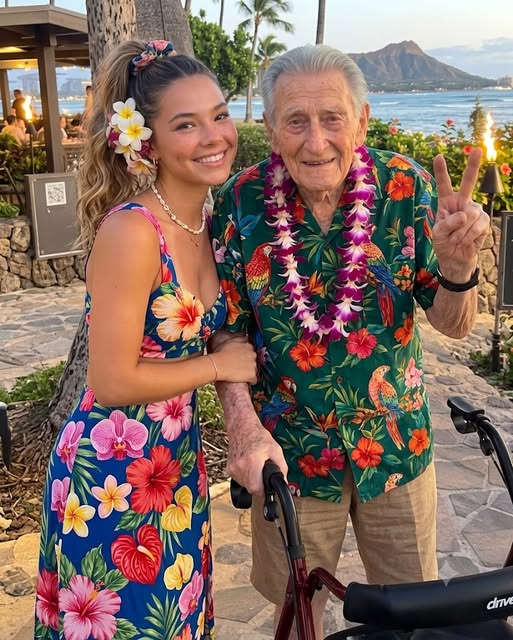
He let the warm sand slip through his fingers. He ran his hand over a banyan tree as though greeting an old friend. And when we stood at Pearl Harbor, he held Grandma’s photograph tightly against his chest.
We stayed at a small, old-fashioned hotel that had been run by the same family for generations.
Everything seemed perfect.
Except for one strange thing.
From the moment we checked in, the hotel staff kept staring at Grandpa.
A housekeeper nearly dropped a stack of towels when she saw him in the hallway. The cook kept peeking through the kitchen doorway while we ate. Twice, I noticed the front-desk clerk pointing toward Grandpa when he thought I wasn’t looking.
Grandpa only laughed.
“Maybe they’ve never seen an old man in a hibiscus shirt,” he joked.
I laughed too.
But on our final afternoon, while Grandpa was resting upstairs, the hotel manager stopped me in the lobby.
“Ma’am,” he said, his eyes filling with tears, “we’ve searched for your grandfather for more than 80 years. We had already given up hope. But here he is.”
I stared at him.
“My grandfather served here when he was young,” I explained. “But he hasn’t been back to Hawaii since.”
The manager shook his head.
“He did something I’m certain he never told you about.”
Then he looked toward a locked door behind the lobby.
“Please. Follow me.”
He unlocked a narrow room tucked behind the front desk.
The moment the door opened, the smell of cedar and old paper filled the air.
An elderly Hawaiian woman was sitting quietly against the wall.
The second she saw me, tears rolled down her cheeks.
“You look so much like Henry,” she whispered.
I turned toward what was behind her.
And suddenly, I couldn’t breathe.
My chest tightened as I stared at it.
“Grandpa, what have you done?” I whispered. “How are we supposed to live with this now?”
I stood there staring at the old photographs, unable to understand what I was seeing.
The young man in those pictures was Grandpa Henry.
But the woman beside him wasn’t Grandma Evelyn.
And the little girl in the photographs wasn’t my mother.
Her name was Rose.
The hotel manager, Andrew, explained that his family had kept the photographs and letters for decades. Rose was Henry’s daughter, born after he had left Hawaii following the war.
My heart sank.
My mother, Alison, had always believed she was Grandpa Henry’s oldest daughter.
Now I was standing in front of proof that she had an older sister.
Rose told me that her mother, Leilani, had written to Henry after he returned to Ohio. She had tried again and again to tell him that she was pregnant and that he had a daughter.
But Henry had never answered.

At first, I couldn’t believe it.
“That doesn’t sound like my grandfather,” I said.
Rose looked at me sadly.
“You know the grandfather who called you every Sunday. I know the young man who never came back.”
Then Andrew showed us a box filled with old letters.
Some had been returned unopened.
Others had never reached Henry.
I picked up one of the oldest envelopes and noticed something written across the back.
The message was simple.
Henry had moved on. They were told to stop contacting him.
Then Grandpa Henry walked into the room.
The moment he saw Leilani, all the color seemed to leave his face.
“She’s alive?”
I realized immediately that he knew exactly who she was.
Then Rose stepped forward.
“I’m Rose. I’m your daughter.”
Grandpa Henry struggled to stay standing.
He had no idea.
He insisted that he had written back and that his letters had been returned. Leilani insisted she had written to him too.
For decades, both sides had believed the other had deliberately chosen silence.
Then we discovered the truth.
One of the returned letters carried handwriting belonging to Henry’s mother.
She had intercepted the correspondence and convinced Leilani that Henry had moved on.
She had effectively erased an entire branch of his family before he ever knew it existed.
Grandpa Henry was devastated.
He had spent more than eighty years believing his life had unfolded one way.
Now he was looking at photographs of birthdays, graduations, marriages, children, and grandchildren he had never known.
Rose asked him the question that seemed impossible to answer.
“If you’d known about me, would you have come back?”
Grandpa Henry didn’t pretend to know what the younger version of himself would have done.
He admitted that he had been young, frightened, and changed by the war.
But then he said something that made Rose cry.
He couldn’t promise that he would have been the perfect father.
But if he’d known she existed, she deserved the chance to know him.
And he deserved the chance to know her.
That evening, none of us tried to pretend that eighty lost years could be repaired in one dinner.
Rose didn’t suddenly call him “Dad.”
Grandpa Henry didn’t ask her to.
They simply began talking.
Slowly.
Awkwardly.
Honestly.
Then Rose asked about the rest of his family.
When Grandpa Henry mentioned Alison—my mother—Rose looked at me.
“I have a sister?”
I realized I couldn’t make that decision for my mother.
She deserved to know.
But she also deserved the choice of how and when to process something this enormous.

Grandpa Henry agreed.
He wanted to tell his children himself.
He didn’t want me carrying the weight of his past for him anymore.
So instead of flying home as planned, Grandpa decided to stay in Hawaii.
“I’ve waited eighty years to come back,” he told me. “I’m not going to leave after two dinners.”
For the first time since we arrived, I realized that the trip I had planned for my grandfather had become something neither of us could have imagined.
I had brought him back to Hawaii so he could revisit the place he had once loved.
Instead, he found a daughter he’d lost before he even knew she existed.
And I discovered that the family history I thought I understood had been missing an entire chapter.
That night, I called my mother.
Grandpa Henry took the phone.
His hands were shaking.
“Alison,” he said quietly, “there’s something about my life you should have known a long time ago.”
He looked at Rose.
“And her name is Rose.”
For a moment, nobody spoke.
This time, Grandpa Henry wasn’t running from the past.
He was finally telling his family the truth.