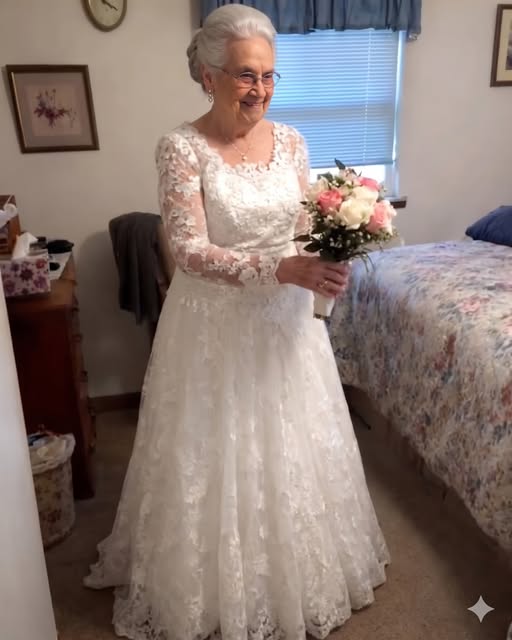
At 72, I never imagined I would have the chance to fall in love again. After my first husband, Howard, passed away, I spent most of my time volunteering at church, helping with bake sales, and distributing food to people in need. I gradually became accustomed to a quiet life until one April morning, when a familiar voice behind me made me freeze.
“Eleanor!”

I turned around and saw Garrett, the young man who had once held my hand as we walked through the rain in 1972. He had aged considerably, but that familiar crooked smile of his hadn’t changed at all.
More than fifty years earlier, Garrett had promised to buy me a diamond ring. But life had taken us down separate paths. I married Howard, while Garrett built a family of his own with a woman named Patricia.
Now, both of us had lost our spouses.
We began meeting every Tuesday at a little diner in town. Garrett told me about his late wife and his two grown children, Margaret and Daniel. I shared stories about Howard and the years I had spent living alone after his death.
One day, Garrett looked at me over his coffee cup and said:
“I’ve always wondered how you’ve been all these years.”
I laughed.
“You have a funny way of showing concern. You stayed silent for more than fifty years!”
He simply smiled and replied that sometimes life didn’t turn out the way we wanted.
Six months later, Garrett proposed to me on his front porch. He didn’t have a ring yet, but he told me he was finally preparing to fulfill the promise he had made all those years ago.
I said yes.
I wasn’t marrying him because of his luxurious mansion or the considerable wealth people said he possessed. I simply wanted to spend the rest of my life with the boy who had once walked me home in the rain.
However, our engagement dinner at Garrett’s mansion made me realize that this marriage might not be as simple as I had imagined.
His two children, Margaret and Daniel, greeted me with obvious coldness. Margaret gave me a reluctant hug, while Daniel merely shook my hand as though he were meeting a business associate.
I tried to be friendly, but as I walked down the hallway, I accidentally overheard Margaret speaking quietly to her father.
“Dad, please reconsider. You can’t just change everything like this.”
Garrett replied that he wasn’t going to change his decision.
I quietly walked away, not wanting them to know I had heard their conversation.
After our wedding, I moved into Garrett’s home. The first few days felt like a dream. He brought me coffee in bed, kissed my forehead, and often told me that he had waited far too long to finally have these days together.
But his children’s disapproval became increasingly obvious.
Margaret frequently showed up with an irritated expression. She criticized the way I decorated the dining table, deliberately brought up her late mother, Patricia, and constantly made me feel like an outsider in my own home.
One time, she even asked me directly:
“Exactly how much of my father’s estate do you think you’re going to inherit?”
Before I could respond, Garrett placed his fork firmly on the table.
“Margaret! Your father will not tolerate you speaking to Eleanor that way!”
His daughter coldly replied:
“She’s the biggest mistake you’ve ever made, Dad!”
Garrett immediately warned her that he would never allow anyone to disrespect his wife under his roof.
I knew he loved me and wanted to protect me, but those words only made the tension between him and his children worse.
Occasionally, I also heard Margaret mentioning documents related to her late mother’s assets. Garrett frequently called a lawyer named Whitfield and spent hours in his study with thick folders of paperwork.
Whenever I asked about it, he would simply smile and say:
“I’m just taking care of some old paperwork. You don’t need to worry. I’ve had everything arranged for a long time. No matter what those two think, I won’t let you suffer.”
I trusted him and didn’t ask any further questions.
The following months passed peacefully. I almost forgot about the conflicts with his children until one fateful Tuesday morning.
Garrett was sitting with his coffee when he suddenly clutched his chest. He looked at me with an expression of disbelief, as though there was still something he hadn’t managed to tell me.
Then he collapsed.
A heart attack took him away in a matter of moments.

I couldn’t believe that the man I had found again after more than fifty years was suddenly gone.
At the cemetery, I stood in front of my husband’s coffin wearing a black dress, tears streaming down my face. Margaret stood across from me, her expression cold, showing no sympathy whatsoever.
But the worst part happened when we returned to the mansion.
Less than ten minutes later, Margaret approached the living room holding a stack of papers.
“Pack your things and get out!”
I stared at her in disbelief.
“What? Why?”
She raised the documents in front of me.
“This house belongs to our family trust. It was established long before you came along. My father already signed the necessary papers. Your name isn’t on any of them. You’ve caused enough pain to our family and to my mother!”
Daniel walked in right behind her, carrying the old suitcase I had brought when I moved in. He dropped it at my feet without saying a word.
I tried to remain calm.
“Please… I just want to take one photograph of Garrett. The picture of him fishing that sits on the mantel. I’ll pay you to have it sent to me.”
Margaret immediately refused.
“No. Nothing in this house belongs to you!”
I looked at Daniel, hoping he would at least speak up. But he simply lowered his eyes toward the floor.
Finally, I picked up my suitcase and walked out of the mansion in the very same black dress I had worn to bury my husband.
At 72, I had lost my home all over again.
I moved into an old mobile home that had belonged to my late sister. She had left it to me before she passed away, and I had continued paying the lot rent even though I hadn’t used it in years.
Those first few nights were incredibly difficult. I wore the robe Garrett had once bought me, trying to find a little warmth in what remained of his memory.
I cried more than I could explain.
A few days later, I called the mansion, hoping to ask for the photograph of Garrett fishing. But the moment Margaret heard my voice, she coldly said:
“Don’t ever call this house again!”
Then she hung up.
Two days later, a delivery driver brought me an envelope. Inside was a letter from Daniel, demanding that I stop contacting his family or attempting to claim any of their assets.
They even suggested that Garrett had not been mentally competent during his final months.
I read the letter several times before putting it away in a drawer. I was simply too exhausted to argue anymore.
Fortunately, my neighbor, Joyce, took the initiative to visit me. She brought a tray of food and told me that her own husband had passed away many years earlier.
She didn’t ask too many questions. She simply said that she understood what it felt like to lose the person you loved.
Gradually, I began attending gatherings at a small church nearby. I baked cakes, sang in the choir, and tried to rebuild my life.
I stopped waiting for calls from Margaret and no longer expected her to apologize.
I thought perhaps my story with Garrett would end in loneliness after all.
But exactly two weeks after my husband’s funeral, something unexpected happened.
That morning, I was hanging laundry behind the mobile home when I heard a car approaching along the gravel road.
I turned around and saw a sleek black limousine stopping beside my mailbox.
A tall man in a gray suit stepped out, carrying a leather briefcase and a carefully sealed cream-colored envelope.
He walked toward me.
“Are you Mrs. Eleanor? My name is Whitfield. I’m your late husband’s attorney.”
I was so surprised that the clothespin I had been holding between my lips fell to the ground.
He continued:
“Garrett instructed me to contact you only after his passing. He wanted you to see your children’s true character for yourself. It took me some time to locate this address through the church. But he gave me very specific instructions to deliver this personally to you, so that you would receive exactly what you deserve.”
I accepted the envelope. Garrett’s familiar handwriting was on the front.
My hands were trembling so badly that it took me three attempts to break the seal.
The moment I read the first few lines, my knees nearly gave out.
Whitfield helped me inside and placed the letter on my little kitchen table.
“Garrett wrote this letter six months before he passed away. He knew exactly what his children were going to do, ma’am.”
I continued reading through my tears.
It turned out that Garrett had known his children would never accept our marriage. He also understood that once he was gone, Margaret and Daniel would do everything they could to force me out of the mansion.
But he had quietly prepared everything years earlier.
He had still left the mansion and most of his estate to his two children, just as they had always wanted. However, long before Margaret pressured him to change his will, Garrett had secretly established a separate trust specifically for me.
It included a beautiful lakeside cottage, a guaranteed lifetime income, and other assets that would allow me to live comfortably without depending on anyone.
Whitfield placed another small wooden box on the table.
I opened the lid and immediately covered my mouth with my hand.
Inside were all the photographs of Garrett that his children had refused to let me take. There was also his old class ring from 1972 and a beautiful diamond ring.
Engraved inside the ring were the words:
“To Eleanor, the girl I promised a ring to after those school dances.”
I burst into tears.
The promise Garrett had carried in his heart for more than fifty years had finally become a reality.
Whitfield gently explained:
“Garrett didn’t want to openly fight with his children. He didn’t want memories of his first wife dragged into legal battles either. So he arranged everything in advance to ensure that no one could take your future away from you.”
That was when I finally understood that my husband had seen everything coming.
He knew what Margaret and Daniel were capable of. He knew I would be hurt, thrown out of the house, and perhaps even denied the right to keep a single photograph of him.
But he also knew I would never have to live without a place to call home.
Two months later, I moved into the lakeside cottage Garrett had left me. I planted tomatoes, lavender, and a small white rose bush beside the porch.
The diamond ring remained on my finger.
Later, Margaret sent me a letter. Daniel also tried to contact me. But I sent them only a brief message:
“I hold no resentment toward either of you. I wish you both peace. But please don’t write to me again.”
Joyce often drove over to visit me every Sunday. We drank coffee, talked, and enjoyed the peaceful days by the lake.
Sometimes, I would sit on the wooden dock, gaze across the water, and think about the young man from 1972 who had once walked me home through the rain.
I had thought I had lost Garrett all over again. But in the end, he had left me much more than a house or a diamond ring.
He had given me security, dignity, and proof that genuine love never disappears simply because time passes.
Because some promises take an entire lifetime to fulfill.
And some people, even after they are no longer in this world, still find a way to protect the ones they love.