I still remember that evening clearly because, even years later, the words I said to her continue to haunt me.
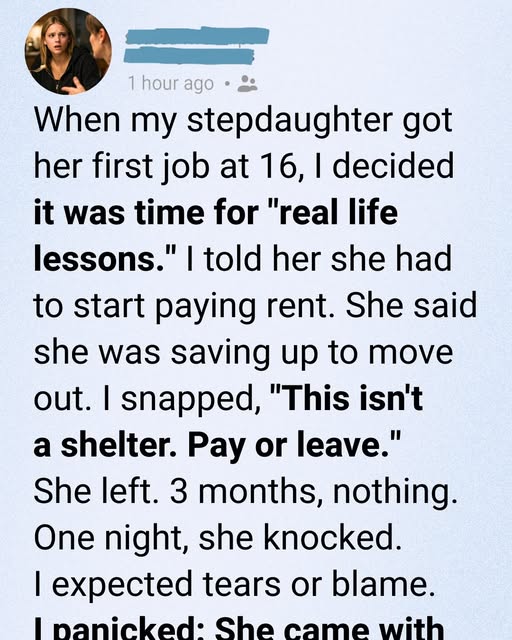
When my stepdaughter, Emily, turned 16 and got her first part-time job, I started thinking it was time for her to learn how to support herself.

My husband, David, worked long hours, and money was always tight. I felt like I was carrying the entire household on my shoulders. I paid the electricity and water bills, bought groceries, handled household chores, and worried about countless other expenses.
Meanwhile, Emily often talked about saving money so she could move out when she turned 18. She always said she wanted to take care of herself and never depend on anyone else.
At first, I didn’t pay much attention. But the more I heard it, the more irritated I became.
I felt as though Emily was indirectly telling me that she didn’t consider our house her home. That nothing I did for her mattered. I never admitted it, but deep down, I constantly felt unappreciated.
One evening, while the family was having dinner, I finally brought up something I’d been thinking about for weeks.
“Emily, now that you have a job, I think it’s time you started contributing to the household expenses.”
She looked up, her fork frozen halfway to her mouth.
“What do you mean?”
“I mean you need to start paying rent. You’re earning money now. You can’t expect to live here for free forever.”
Emily remained silent for a few seconds before answering gently.
“But I’m saving so I can move out when I’m 18. I still have a lot of things to buy, and I need to put money aside for my future.”
Her response immediately irritated me. Instead of recognizing that a 16-year-old girl was trying to build a future for herself, I took it as a challenge.
“Then that’s even better. If you want to live like an adult, you need to learn to take responsibility like one.”
Emily looked at me, confused.
“I’m still in school. I only work a few shifts a week.”
But by then, I was too angry to listen.
I placed my glass down forcefully and said something I would spend years wishing I could take back.
“This isn’t a free hotel. Either you pay rent, or you find somewhere else to live.”
The room fell completely silent.
Emily stared at me for a long moment. I expected her to argue, cry, or storm upstairs like she had during previous disagreements.
But she didn’t.
She simply nodded.
“Okay. I understand.”
Then she stood up, carried her plate into the kitchen, and quietly went upstairs.
I didn’t think she would actually leave. I assumed it was just another emotional reaction from a teenager. I believed that after a few days, she would realize how difficult life outside our home could be and come back to apologize.
But the next morning, I walked into her bedroom and froze.
Her bed was stripped bare. Most of her clothes were gone. The backpack she usually kept beside her desk had disappeared.
Emily had left.
There was no goodbye, no explanation, and no note. Just an empty room and a desk so neatly cleared that something about it felt unsettling.
When I told David what had happened, he immediately became furious.
“What exactly did you say to her?”
I explained the argument, carefully leaving out some of the harsher things I had said.
David looked at me with disappointment.
“Emily is only 16. She can’t just go somewhere and figure everything out on her own.”
I crossed my arms, trying to remain calm.
“She has a job. She wants independence, so let her try. We can’t keep spoiling her forever.”
David called his daughter that same day. He left a voicemail saying he wanted to know where she was and hoped she would call him back.
But Emily never responded.
The following days passed with no news. Then one week became two, and two weeks became a month.
No calls. No messages.
David tried reaching her several more times, but every attempt went unanswered.
I started feeling frustrated by her silence. I thought Emily was being stubborn and deliberately punishing us by disappearing.

Three months passed.
The house gradually began to feel different. The chair Emily used to sit in at dinner was still there, but nobody occupied it anymore. Whenever I walked past her bedroom, I glanced inside before quickly looking away.
Sometimes I wondered whether she was doing okay. But I always pushed those thoughts aside.
I didn’t want to admit that I might have been wrong.
Then, one evening, at nearly 10 p.m., someone unexpectedly knocked on the front door.
I was in the living room while David had already gone to bed. I got up and opened the door myself.
The moment it swung open, I froze.
Emily was standing on the porch.
She looked much thinner. Her hair was tied back carelessly, her clothes looked worn, and her face was noticeably paler than before. Her red, swollen eyes suggested she had been crying for a long time.
In her hands was a crumpled envelope, damp from being held too tightly.
I didn’t know what to say.
Emily lowered her head and spoke in a trembling voice.
“I didn’t want to come back here. But I honestly don’t know where else to go.”
I looked at her, then at the envelope.
She held it out toward me.
“This is what I owe you.”
I opened it with trembling hands.
Inside were small bills, mostly tens, twenties, and a few ones. They had been carefully arranged into neat stacks, as though whoever had put them there had counted them over and over again.
On top was a small piece of paper, folded neatly.
I opened it.
There were only a few words written in Emily’s familiar handwriting:
Three months’ rent.
My chest tightened as if someone had reached inside and squeezed my heart.
Emily explained that after leaving home, she had initially slept on a friend’s sofa. Later, she found a small room to share with two other girls.
It was cramped, but at least she had somewhere to sleep.
She picked up extra shifts at work and spent almost nothing on herself. Some days, she skipped meals to save money. She walked to work instead of taking the bus, regardless of the weather.
I stood there speechless, listening to every word.
“I’ve been keeping track of everything I earned,” Emily said. “I didn’t want you to think I was lazy or that I just wanted to depend on everyone else.”
She hesitated before continuing.
“I know you said I had to pay rent. I tried my best to do exactly that. I didn’t want anyone to think I was a burden.”
I stared at the money in my hands.
For three months, I had imagined all sorts of scenarios. I thought she would fail quickly, that she wouldn’t survive without our help. I had even imagined that when Emily finally returned, I would have the chance to prove that I had been right.
But reality was completely different.
A 16-year-old girl had been forced to struggle through everything alone because of something cruel I had said. And what hurt me most was that, after all those hardships, she had still come back carrying money she believed she owed me.
I gently pushed the envelope back toward her.
“No. I’m not taking this.”
Emily looked at me suspiciously.
I tried to continue, but my voice was already breaking.
“I’m sorry. I never should have said those things. I was wrong to kick you out.”
Emily lowered her head, and tears began rolling down her cheeks.
I stepped closer.
“I was exhausted, selfish, and focused only on my own problems. I turned your desire to become independent into something that hurt my feelings. But you never deserved to go through any of this.”
I began to cry.
“I was supposed to help you grow up, not throw you out and force you to struggle through life on your own.”

Emily stood silently for a few seconds.
I had no idea whether she could forgive me. I didn’t even feel I deserved to ask for it.
Then Emily slowly stepped across the threshold.
That one small step was enough to make me feel as though I had been given another chance I hadn’t earned.
David heard our voices and woke up. When he saw his daughter, he immediately rushed over and wrapped his arms around her. He asked where she had been, whether she had been eating properly, and why she hadn’t called home.
Emily burst into tears in her father’s arms.
That night, we sat around the kitchen table for hours.
Emily told us about her life away from home. David listened carefully, while I kept my head down, trying not to miss a single word.
We talked about family rules, money, responsibilities, and the boundaries that needed to be respected. But more importantly, we talked about the emotional wounds adults sometimes inflict on children without realizing it.
I told Emily she could stay for as long as she wanted. She didn’t have to pay rent. She didn’t have to prove that she deserved a place in our home.
“This is your home,” I told her. “And I will never use that against you again.”
Emily stayed.
Things didn’t immediately return to normal. It took a long time before she felt comfortable talking to me the way she used to. I understood that an apology couldn’t erase the pain I had caused.
But we began rebuilding our relationship, one small step at a time.
I still keep that little piece of paper with the words “Three months’ rent” written on it in my kitchen drawer.
Not to remind Emily of what she went through, but to remind myself that sometimes the most painful lessons don’t come from being mistreated by someone else.
They come from realizing that you were the one who hurt someone who only wanted to feel loved and accepted.
I once thought kicking Emily out would teach her how to grow up.
But in the end, I was the one who needed to learn that lesson.