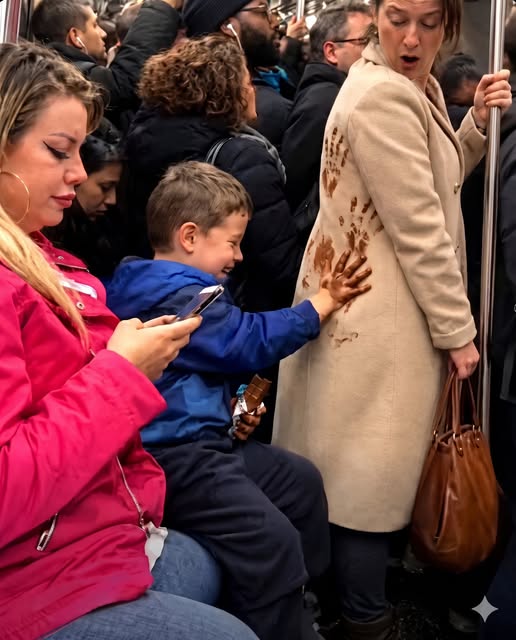
New York’s subway was packed that morning. I was on my way to work, struggling to stay awake after spending almost the entire night caring for my sick two-year-old daughter.
There were no empty seats, so I had no choice but to stand, holding onto the overhead rail among the other passengers.

Right behind me sat a woman with her approximately five-year-old son on her lap. The boy was eating chocolate bars, giggling and swinging his little legs.
Suddenly, I felt something touch my back.
The train was crowded, so I assumed someone had accidentally bumped into me and didn’t pay much attention.
But then it happened again.
And again.
This time, I realized someone was deliberately touching my back. When I turned around, I was stunned by what I saw.
The little boy was laughing gleefully, rubbing his chocolate-covered hands against the back of my beige coat.
Dark brown handprints covered the fabric, as if he were using my coat as his personal canvas. He even seemed to be deliberately putting more chocolate on his hands so he could continue his little game.
I stared at the spreading stains, feeling like I might burst into tears.
That was the only decent coat I owned for work. I had bought it on sale two winters earlier and had always been careful to keep it in good condition. As a single mother supporting a young child on a modest salary, even paying for professional dry cleaning was an expense I had to think twice about.
Trying to remain calm, I turned to the boy’s mother, who was completely absorbed in her phone.
“Excuse me, could you please tell your son to stop? He’s getting chocolate all over my coat!”
The woman didn’t even bother looking up.
“Oh, relax. He’s just playing!”
I couldn’t believe what I was hearing.
“Playing? My coat is covered in chocolate! How am I supposed to go to work looking like this?”
She rolled her eyes.
“He’s little! What do you expect me to do?”
She didn’t apologize or make any effort to stop her son.
“But my coat is ruined!” I insisted.
The woman scoffed.
“Lady, mind your own business! If you can’t tolerate children, you should have taken a cab!”
I felt both furious and helpless. There was nothing I could do in the middle of a packed subway car except stand there and watch my coat become more and more of a disaster.
Just then, an older man sitting nearby unexpectedly winked at me.
He looked to be in his late sixties, wearing a dark wool coat with a canvas bag beside him.
Then he turned toward the woman and spoke politely.
“Excuse me, ma’am.”
She rolled her eyes again.
“What now?”
The man calmly opened the bag beside him, pulled something out, and handed it to her.
It was a white handkerchief.
The woman took it, but the moment she unfolded it, she let out a scream so loud that every passenger in the train turned to look.
There was a large chocolate stain on the white fabric. Even worse, some melted chocolate had gotten onto her cream-colored leather handbag.
She jumped to her feet, nearly causing her son to slide off her lap.
“What the hell is this?!”
The older man calmly replied.
“Oh, relax. It’s just chocolate.”
A few passengers nearby burst out laughing.
The woman glared at him.
“You’ve ruined my bag!”
He raised his eyebrows.
“Have I?”
She pointed furiously at the stain.
“This bag cost me $1,200!”
The man nodded thoughtfully.
“That sounds rather unfortunate.”
I had to cover my mouth to keep from laughing.
The woman looked at him, then at me.
“You did this on purpose, didn’t you?”
The man shrugged.
“Your son dropped a melted chocolate bar on the seat between us. I was about to use that handkerchief to pick it up when you placed your handbag right on top of it.”
He pointed toward her bag.
“You put it directly on the chocolate before I had a chance to clean it up.”
Suddenly, everything became clear.
He hadn’t deliberately stained her handbag. She had accidentally placed her expensive purse on the chocolate bar her own son had dropped.
Everyone in the subway seemed to understand what had happened. Some passengers laughed, while I could only smile at the man.
He winked at me again.
The woman shouted angrily.
“You could have warned me!”
The man looked genuinely surprised.
“Warned you?”
“About the chocolate!”
He tilted his head and glanced at my chocolate-covered coat.
“I thought adults were supposed to know how to behave around children.”
The woman fell silent.
A passenger behind us burst out laughing. Someone else even called out:
“If you can’t handle it, take a cab!”
The laughter grew louder. For the first time since boarding the train, the woman realized that nobody was on her side.
She hurriedly pulled a packet of wet wipes from her handbag and began rubbing the stain.
The older man spoke up again.
“I wouldn’t recommend doing that. You might spread it even further.”
She looked up at him irritably.
“Are you some kind of leather expert?”
“No.”
“Then stop interfering in my business!”
He simply nodded.
“All right.”
She continued scrubbing the bag aggressively. Just as he had warned, the chocolate stain didn’t disappear. Instead, it spread even further.
I had to turn away because I couldn’t hold back my laughter.
While the mother struggled with her expensive handbag, her son continued sitting there, happily eating chocolate as though nothing had happened.
Then, unexpectedly, the little boy looked at me and whispered:
“I’m sorry.”
I bent down slightly.
“What was that?”
He hesitated before speaking more clearly.
“I’m sorry I got chocolate on your coat.”
I could hardly believe it.
The apology I had been waiting for finally came from the child himself, not from the irresponsible mother.
I smiled.
“Thank you.”
The boy lowered his head, looking embarrassed.
“I just wanted to make handprints. I thought it would be fun.”
“I understand.”
“But are you mad at me?”
“A little. But I’m glad you know how to apologize.”
He nodded quietly.
However, his mother immediately interrupted.
“Don’t apologize to her!”

The atmosphere in the subway car changed again.
She glared at her son and said:
“You’re just a child. You don’t need to apologize because some grown woman doesn’t know how to take a joke!”
The boy looked up at his mother, confused.
The older man slowly folded his handkerchief and spoke again.
“Ma’am, your son has shown more manners in the last few seconds than you have in the past ten minutes.”
Her face turned bright red.
“Nobody asked for your opinion!”
“That’s true. But you’ve been making your problem everyone else’s business.”
A woman sitting across from us laughed. The mother looked around and finally realized that nobody was supporting her.
Angrily, she grabbed her son’s wrist.
“We’re getting off!”
The little boy looked confused.
“But this isn’t our stop, Mommy.”
“I don’t care!”
She stuffed the remaining chocolate bars into her bag and turned toward me.
“Happy now?”
I calmly replied:
“Not really. My coat is still covered in chocolate.”
She glared at me.
“What more do you want?”
I looked her straight in the eyes.
“I just want you to teach your son that when he damages someone else’s property, he can’t expect them to stay quiet and put up with it.”
She opened her mouth to respond, but the subway doors opened at that moment. She dragged her son out of the train.
Before the doors closed, the little boy turned around and looked at me.
“I’m sorry again!”
I smiled.
“Thank you.”
The doors slid shut, leaving me with the older man and the other passengers who had witnessed everything.
He turned toward me.
“Take off your coat.”
I looked at him in surprise.
“What?”
“Chocolate is easier to remove before it dries. Take it off and sit down.”
He pointed toward the empty seat the woman had just left.
I did as he suggested.
The man introduced himself as Harold, a 67-year-old retired high school chemistry teacher.
He opened his canvas bag. Inside were sandwiches, milk, oranges, and a bottle of soda. Then he pulled out a clean, unused cloth.
He explained that cold water was generally more effective than hot water when dealing with chocolate stains.
I glanced at my watch.
“I have about 40 minutes before I need to be at work.”
He smiled.
“Then let’s make the most of those 40 minutes.”
What surprised me even more was that the passengers around us began offering help. One person handed me some paper towels, another offered a bottle of water, and someone even recommended a nearby dry cleaner that offered same-day service.
Over the next few stops, complete strangers worked together to help clean my coat.
New York is often known as a city where everyone is in a hurry and few people have time to care about others. But that morning, I realized that sometimes one small incident can bring strangers together through simple acts of kindness.
The stains didn’t disappear completely, but they had faded considerably.
Harold assured me that a dry cleaner could take care of the remaining marks.
I sighed.
“Honestly, I can’t afford to spend much money on this.”
He asked how much I thought it would cost.
“Probably $30 to $40.”
He immediately reached for his wallet, but I quickly stopped him.
“No, I can’t take your money.”
He looked at me.
“Why not?”
“Because this isn’t your fault.”
He smiled and handed me a business card instead.
“Take your coat to Martin’s Cleaners on 44th Street. Tell them Harold sent you.”
It turned out that his late wife had once owned the dry-cleaning business, which was now managed by his grandson.
I thanked him and slipped the card into my pocket.
When I arrived at the office, I was about 20 minutes late. My manager, Denise, immediately noticed my coat and asked what had happened.
I simply said:
“Chocolate accident.”
When I turned around to show her the handprints covering my back, Denise burst out laughing.
We both ended up laughing so hard that we could barely stop.
She told me to go to the break room and borrow a sweater from her office.
During my lunch break, I called the dry cleaner Harold had recommended.
As soon as I mentioned Harold’s name, his grandson sighed.
“Uncle Harold again?”
I laughed.
“Yes, that’s him.”
The man on the other end told me to bring the coat in after work. After examining the stains, he said he could remove them and would only charge me $20.
I knew that wasn’t the usual price.
Two days later, my coat looked almost as good as new. Only a faint mark remained near one of the seams, barely noticeable unless someone looked closely.
I thought the story was over.
But about a month later, I learned another lesson about raising children.
It was a Saturday, and I was taking my daughter, Mia, on the subway. She was sitting beside me, eating cookies and playing happily.
I only looked down at my phone for about 30 seconds.
When I looked up, I discovered that Mia was holding a red crayon and drawing on the plastic panel beside her seat.
My heart nearly stopped.
“Mia!”
She jumped, immediately stopping what she was doing.
A bright red line was clearly visible on the panel.
A man standing nearby looked down at it. I wanted to disappear from embarrassment.
But at that moment, I remembered what had happened with my coat.
I took the crayon away from my daughter.
“No. We don’t draw on things that don’t belong to us.”
Mia started to whimper.
The people around us glanced over, but I didn’t make excuses about her being too young or tell anyone to mind their own business.
She was only two. That explained why she had done it, but it didn’t mean I was allowed to ignore the consequences.
I immediately took some wet wipes from my bag and started cleaning the mark.
A man standing nearby suggested using hand sanitizer. Surprisingly, he even had a small bottle with him.
After testing it on a small corner, we noticed that the red mark was beginning to fade. I carefully wiped the entire area clean.
Mia cried throughout the process. Once I had finished, I asked her to apologize.
I wasn’t sure she fully understood what an apology meant at her age. But I wanted her to begin learning one simple principle:
When you make a mess, you stop, help clean it up, and learn to apologize.
I found myself thinking about the five-year-old boy from that earlier subway ride.
He was old enough to understand that his actions could upset someone, but still young enough to need an adult to teach him how to behave.
What stayed with me most wasn’t his mother’s attitude. It was the fact that the boy had apologized on his own, even though his mother had tried to stop him.
I hoped that apology would remain in his memory longer than anything his mother had said.
About six months later, I happened to run into Harold again on the same subway line.
He was still carrying his familiar canvas bag and reading a newspaper.
When he recognized me, he glanced at my coat and burst out laughing.
“Chocolate lady!”
I laughed too.
“Is that my nickname now?”
He pointed at my coat.
“Looks much cleaner than last time!”
I replied:
“It only cost me $20.”
He shook his head.
“My grandson is getting into business now!”
I burst out laughing.
That day, Mia was with me too. She shyly hid behind my legs when Harold bent down to greet her.
I told him about the incident with the red crayon and how I had handled it.
Harold laughed so loudly that a few passengers turned around to look.
I joked:
“Looks like karma finally caught up with me.”
But he shook his head.
“No. That’s just life teaching you a lesson.”
Before our stop arrived, Harold said something I have never forgotten:
“Children don’t automatically understand the boundaries between themselves and the people around them. That’s why they need parents.”
I looked at him and quietly nodded.
He was absolutely right.
At first, I thought this story was simply about a rude mother facing the consequences of her own irresponsibility. And honestly, seeing her expensive handbag covered in chocolate had felt incredibly satisfying.
But the more I thought about it, the more I realized that the most important part wasn’t the stained handbag.
It was the moment when the little boy apologized to me.
Nobody forced him. Nobody threatened him. He saw that I was upset, realized he had done something wrong, and apologized on his own.
Yet his own mother had tried to teach him that doing so was unnecessary.
I could only hope that the mother’s lesson wouldn’t stay with him longer than the sincere apology he had offered me.
One day, that little boy would grow up and find himself riding crowded trains, living among strangers, and navigating a world where his actions affected other people.
And when that day came, what mattered wouldn’t be whether he could do whatever made him happy, but whether he knew how to respect the people around him.
Children need love, but they also need to learn accountability for their actions. That is one of the most important lessons a parent can ever teach.