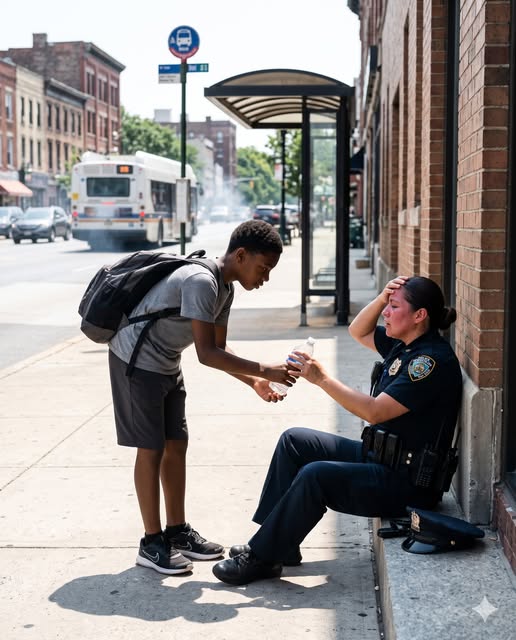
“Don’t you dare fall asleep,” the boy whispered, pressing his last bottle of water into the police officer’s trembling hands. “Please. My grandpa always says you have to stay with someone who needs help.”
Officer Elena Ruiz sat slumped against a metal trash can beside a traffic barricade. Her uniform was soaked with sweat, her face pale, and her hands shaking uncontrollably. The July sun had turned the pavement into a furnace, and she had been directing traffic at an outdoor street fair for hours.

Fifty yards away, the number six bus pulled away from the curb.
Fourteen-year-old Miles Carter watched it disappear into traffic. It was the last bus that could take him home without transferring. He had only ninety-three cents in his pocket, his phone battery was dead, and his mother wouldn’t be home from work until six.
But he couldn’t leave the woman sitting helplessly in the scorching heat.
“What’s your name?” he asked.
“Elena,” she managed to whisper. “Officer Ruiz. You shouldn’t be here.”
“Neither should you.”
Miles had noticed her stumbling while trying to move a barricade. At first, people passing by seemed too busy to pay attention. Then her radio slipped from her hand and hit the pavement.
He immediately ran toward her.
“I called 911,” he explained. “They said help is coming.”
“Good,” she whispered. “Now you need to get out of this sun.”
“I’m not leaving until you get help.”
Miles used the cardboard sign he had been carrying to shield her face. It was part of a summer civics project he had made at the community center. Written in large letters were the words: EVERYBODY DESERVES A RIDE.
He opened his backpack and pulled out his only bottle of water. He had planned to drink it on the journey home, but now he carefully placed it in the officer’s hands.
“Please drink some. My grandpa says water is important when it’s this hot.”
Elena tried to smile, but she looked too exhausted to speak.
When the ambulance finally arrived, Miles explained everything he had witnessed. The paramedics examined her, began cooling her down, and prepared to transport her to the hospital.
Before they lifted her onto the stretcher, Elena looked at him again.
“What’s your name?”
“Miles. Miles Carter.”
“Thank you, Miles Carter.”
He watched the ambulance disappear before turning toward the long road home.
He didn’t feel like a hero. He only worried about his mother finding an empty kitchen and wondering where he was.
Miles lived six miles beyond the river, in a small row of brick houses behind an abandoned paper mill. Walking home in the hundred-degree heat was exhausting. He hadn’t eaten since eleven that morning, and the sandwich he had received at the community center was still in his backpack. He had saved half of it for his nine-year-old sister, June.
When he finally reached the public library, he collapsed onto a low wall beneath the awning.
A librarian named Mrs. Baines recognized him from his volunteer shifts. She brought him a cup of water, found a phone charger, and tried calling his mother.
When she couldn’t reach her, she contacted the community center and eventually arranged for a transit worker to drive him close to home.
It was nearly seven when Miles walked through his front door.
His mother, Tanya, was still wearing her nursing-home uniform. She stood beside the refrigerator, her expression filled with fear and frustration.
“Where have you been?”
“Mom, I—”
“Your grandmother said someone from the transit office brought you home. What happened to your bus?”
“I missed it.”
Tanya stared at him.
Then Miles explained what had happened.

He told her about the police officer, the scorching intersection, the ambulance, and the bottle of water.
His mother listened without interrupting. Finally, she pulled out a chair and sat down.
“You helped someone who needed you?”
He nodded.
She covered her face with both hands.
“I wasn’t angry about the bus, sweetheart. I was terrified something had happened to you.”
Miles hugged her tightly.
His family had already experienced too much loss. Four years earlier, his father had died in an accident at a warehouse loading platform. Since then, Tanya had worked overtime to keep the household running, while Miles helped care for June and his seventy-two-year-old grandmother, Ruth.
His father had always taught him that helping others mattered, especially when nobody else was willing to step forward.
That night, Miles went to bed thinking the incident was over.
He was wrong.
The following morning, a firm knock came at the front door.
Miles was still eating breakfast when he saw a woman in a neatly pressed navy uniform standing outside beside an unmarked city vehicle.
“Good morning,” she said. “I’m Chief Margaret Ellis of the Riverton Police Department. I’m looking for Miles Carter.”
Miles froze.
Had he done something wrong?
His grandmother, Ruth, stepped beside him.
“Is there a problem?”
“I hope not,” the chief replied. “Officer Elena Ruiz specifically asked me to find Miles by name.”
Miles’s heart began racing.
The chief explained that Elena was recovering and wanted him to know she was going to be all right. But there was another reason for her visit.
“Yesterday, did you hear anyone telling Officer Ruiz she wasn’t allowed to leave her post?”
Miles immediately remembered the man standing beneath a blue city tent. He had been watching the traffic and seemed more concerned about the schedule than the officer struggling in the heat.
“Yes, ma’am,” Miles answered. “I heard him say they were already behind schedule and she had to stay.”
The chief’s expression became serious.
She explained that the department was investigating the circumstances surrounding Elena’s medical emergency. Miles might have witnessed something important.
She also thanked him personally for staying with the officer until the ambulance arrived.
“I just didn’t want her to be alone,” he said quietly.
“Sometimes,” the chief replied, “that’s exactly what someone needs.”
Later that day, Miles accompanied his mother and grandmother to the police station to provide a formal statement. He carefully described what he had seen, including the man wearing a blue lanyard who had ordered Elena to remain at her post.
The investigators explained that Officer Ruiz had been assigned to the street fair under an overtime arrangement involving the city and the event organizer. They were reviewing whether proper breaks and safety measures had been provided during the heat advisory.
Meanwhile, word of Miles’s actions spread through the community center.
Some people called him a hero. Others wanted photographs and interviews. But Miles insisted he hadn’t done anything extraordinary.
His friend Leah, a fifteen-year-old volunteer, asked a question that nobody else seemed to be considering.
“Why was a police officer standing outside for hours without a break in the first place?”
That question stayed with Miles.
At the community center, Leah showed him a map she had created for a project about extreme heat in their neighborhood. She had measured temperatures across different parts of Riverton and discovered that areas west of the river were significantly hotter because they had fewer trees and more concrete.
The map also showed something else.
There were very few public water fountains, libraries, or cooling centers near Miles’s neighborhood. The number six bus stopped running before the hottest part of the afternoon was over.
Miles recognized the problem immediately. It wasn’t just about one police officer or one missed bus. Elderly residents, children, and workers without cars were all struggling with the same conditions.
His grandmother Ruth had spent thirty-one years driving city buses. She knew exactly how difficult it was for people in their neighborhood to access public transportation.
That evening, she brought out an old metal cookie tin filled with transit maps, union notices, and letters she had kept from years of arguing with city officials.
“I thought you threw all that away,” Tanya said.
“I said I was finished arguing with city hall,” Ruth replied. “I never said I stopped caring.”

Miles looked through the papers, realizing that his grandmother had spent years fighting for better transportation in their neighborhood.
A few days later, Officer Ruiz sent him a handwritten card.
She thanked him for remembering that there was a person beneath the uniform. Inside was a drawing of a water bottle with a little red heart, signed by her eleven-year-old daughter, Lily.
Miles placed the card beside a photograph of his father.
He smiled.
His father would have been proud.
Over the following weeks, the investigation continued, and the city began reviewing its outdoor staffing policies and transportation services. Miles, Leah, and Ruth also worked together on a community proposal calling for more shaded bus stops, accessible drinking fountains, and reliable afternoon transportation.
Miles had originally made his cardboard sign for a simple school project.
Now, it had become something much bigger.
At a community meeting, Chief Ellis publicly thanked him for helping Officer Ruiz and for speaking honestly about what he had witnessed. Elena, still recovering, attended with her daughter and personally embraced him.
“You didn’t just give me water that day,” she told him. “You reminded me why people choose to serve their communities.”
Miles looked down, embarrassed by all the attention.
“I just didn’t want you to get hurt.”
Elena smiled.
“And that’s why it mattered.”
Months later, the city approved several improvements to the neighborhood’s public transportation and summer heat-safety program. Ruth was invited to help advise the transit committee, while Miles and Leah were asked to present their findings to local officials.
Miles never forgot the day he missed the number six bus.
He had started that afternoon with ninety-three cents, a dead phone, and a bottle of water.
He ended it having discovered something far more important than getting home on time.
His father had once taught him that kindness wasn’t about receiving recognition or expecting something in return. It was about noticing when someone needed help and choosing not to walk away.
And now, whenever Miles passed the intersection where he had first found Officer Ruiz, he remembered those words.
Sometimes, one small act of kindness doesn’t just save a person.
It can make an entire community stop, look around, and realize how much still needs to change.