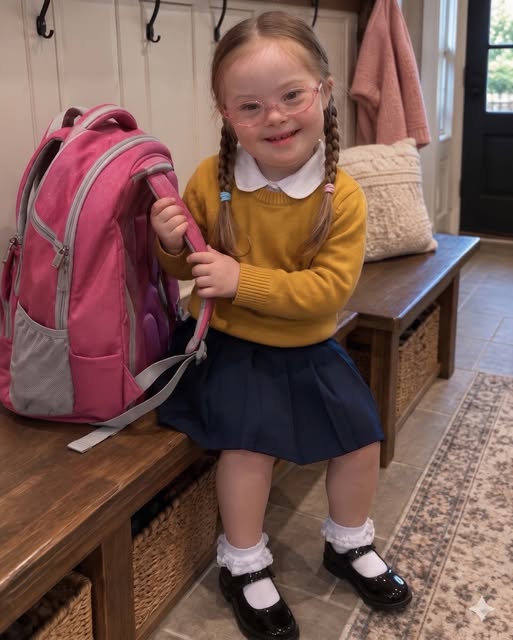
Victoria was only six years old and had Down syndrome. To me, she was the greatest gift life had ever given me. But ever since she started first grade, I had always worried that one day she would face discrimination from the people around her.

Every afternoon when I picked her up from school, I asked the same question.
“Did anyone tease you today?”
“No, Mommy!”
“Did everyone treat you nicely?”
“Yes!”
I always reminded Victoria that if anyone ever made her feel sad, whether it was a classmate or an adult, she should tell me. She would nod and promise she would.
The first two weeks of school went smoothly. Victoria often came home with colorful drawings, telling me about her new friends and excitedly describing the games they played in class.
Then one afternoon, I noticed something was different.
Victoria walked into the house, quietly took off her shoes, and sat down on the sofa. When I asked about her day, she gave me only short answers.
“Did something happen at school, sweetheart?”
“Not really.”
I sat beside her and noticed that her favorite yellow sneakers, which she usually loved showing off, had been replaced by a plain white pair.
“Why aren’t you wearing your yellow shoes today?”
Victoria lowered her head and played with the shoelaces.
“Emma said princesses don’t wear yellow shoes. She said mine looked weird.”
I tried to reassure her that princesses could wear whatever shoes they wanted. But when I asked if she wanted to wear her yellow sneakers again the next day, she hesitated.
“Maybe I should wear the white ones. I don’t want the other kids to laugh anymore.”
I made a mistake that I didn’t recognize at the time.
Instead of encouraging her to be confident in her choices, I suggested she wear the white shoes for a few days until the other children got used to her.
I thought I was protecting her from teasing. But in reality, I was unintentionally teaching her that she had to change herself to be accepted.
Then the school’s first festival finally arrived.
Victoria had been excited about it for days. She told me that her classmates, Lily and Emma, wanted colorful butterflies painted on their cheeks. I asked if she wanted one too. She hesitated for a moment before nodding.
I thought it would be a wonderful day for her.
But barely an hour after I returned home, my phone suddenly rang.
It was Principal Harris.
“Mrs. Parker, Victoria is in my office. She’s been crying for nearly twenty minutes and keeps asking for her mother. Could you come to the school right away?”
I immediately jumped to my feet.
“Is she hurt?”
“No, physically she’s fine. But I think you should come here.”
I grabbed my car keys and drove straight to the school.
When I entered the hallway, I saw children running around happily, their faces decorated with flowers, butterflies, and colorful patterns. Victoria, however, was standing outside the principal’s office with red, swollen eyes.
The moment she saw me, she ran into my arms.
“Mommy!”
I knelt down and hugged her tightly.
“What happened, sweetheart?”
Victoria pointed toward a young teacher who was painting another little girl’s face.
“She wouldn’t paint a butterfly on me.”
I tried to remain calm.
“Why not, honey?”
Victoria swallowed hard before answering.
“She said makeup wouldn’t make girls like me pretty.”
I felt as though someone had squeezed my heart.
My daughter looked up at me, her little voice trembling.
“Mommy, am I not pretty? Please don’t lie to me!”
I gently held her face between my hands.
“You are beautiful, Victoria. Nothing in this world could ever change that.”
But she still didn’t believe me.
“But she’s a teacher, Mommy. Teachers don’t lie.”
I looked toward the young woman. She was still happily chatting with the other children, seemingly unaware that she had just shattered a six-year-old girl’s confidence.
I told Victoria to sit inside the principal’s office while I spoke to the teacher. I promised her that afterward, we would go to the movies and get ice cream with plenty of colorful sprinkles.
She gave me a small nod and went inside.
I turned back toward the teacher. She didn’t know I was Victoria’s mother, and I decided to let her explain herself before revealing who I was.
Before approaching her table, something suddenly came back to me.

Nine years earlier, I had worked as a professional face painter at children’s birthday parties. I always carried a notebook filled with designs that children loved.
Back then, I used to ask every child the same question:
“What would you like to be today?”
Some wanted to become princesses, others superheroes, and a few insisted on becoming terrifying dragons.
I never forced them to choose designs based on what adults thought was appropriate. I believed every child deserved the freedom to express their personality.
But after Victoria was born, I gradually left that job and switched to working as a graphic designer from home so I could spend more time caring for her.
I loved my daughter more than anything, but perhaps that love had made me overly protective.
Before school started, Victoria had wanted a bright green dinosaur backpack with little spikes along its back. I had convinced her to choose a pink one instead, just like the other girls.
She had also loved her yellow sneakers, but I had encouraged her to wear white ones after hearing about Emma’s comments.
I thought I was helping her fit in. Now, standing in front of the face-painting table, I realized that I had also contributed to making her believe that being different was something to be ashamed of.
I returned to the principal’s office and asked him if I could speak privately with Ms. Collins, the teacher who had refused to paint Victoria’s face.
Then I approached her table.
“Hello! Would you mind painting a little crown on my cheek?”
The teacher laughed.
“Sorry, this area is only for children.”
I pretended to look disappointed.
“That’s unfortunate. I’ve even been practicing my royal wave!”
She laughed again and said perhaps I could try next year.
I continued asking questions.
“So, children are allowed to choose whatever design they want?”
“Of course. That’s the whole point of this activity.”
“Even if you personally don’t like their choices?”
She frowned slightly.
“Absolutely. Every child is welcome.”
I looked directly at her.
“Then why did you refuse to paint one little girl’s face simply because of her appearance? Why did you tell her that makeup wouldn’t make girls like her pretty?”
The smile immediately disappeared from her face.
She asked who had told me that.
I calmly replied:
“Does that really matter?”
She began defending herself, claiming that children sometimes misunderstood adults’ words. Then she explained that she only wanted Victoria to understand that appearance wasn’t everything.
But when I asked why she had made a child feel ugly, she folded her arms and said:
“Some children need to understand reality. Victoria keeps saying she wants to look like the other girls. I was simply helping her understand that painting a butterfly won’t change what makes her different.”
I could hardly believe what I was hearing.
“She’s only six years old. She wanted a butterfly painted on her cheek. Why did you think she needed a lesson about being different during a celebration that’s supposed to be fun?”
The teacher began looking irritated.
Just then, Principal Harris approached. He had heard most of our conversation.
I turned toward the teacher and said:
“I’m Victoria’s mother.”
Her expression immediately changed.
She quickly claimed that everything had been a misunderstanding and that she had never intended to hurt my daughter.
But the principal wasn’t satisfied with her explanation. He asked her to come to his office to discuss the incident and instructed her to leave the festival area temporarily.
I demanded that the school investigate the matter seriously. I also made it clear that Victoria was not responsible for comforting adults simply because they had been reprimanded.
I thought everything had been resolved.
But then another little girl began crying because there was no one left to paint her face. Several other children started asking why their teacher had disappeared.
Victoria was standing beside me, listening to everything.
“Mommy, did she have to leave because I cried?”
I immediately knelt down.
“No, sweetheart. You didn’t do anything wrong. Adults are responsible for what they say and do.”
But Victoria still looked upset.
“I don’t want the other children to lose their butterflies.”
Her words reminded me of my old job.
I approached the principal and offered to take over the face-painting station. I explained that I had once done this professionally and still had a fresh set of supplies in my car.
The principal looked surprised but quickly agreed.
Ten minutes later, I was sitting behind the table with boxes of paint and clean brushes.
Victoria stood nearby, quietly watching me.
I called her over.
“Mommy is going to paint you the prettiest butterfly at the whole festival!”
But she shook her head.
“I don’t want one anymore, Mommy.”
I looked at her in surprise.
“Why not, sweetheart?”
She stared at her white shoes and whispered:
“I don’t want to be pretty anymore.”
I put down my brush.
“Why would you say that?”
“Because everyone keeps arguing about being pretty. My teacher said I’m not pretty. You got angry. Now the other children are sad too.”
I pulled her into my arms and gently explained that she hadn’t caused any of this. Nobody needed to become beautiful to deserve kindness.
Victoria remained quiet for a moment before asking:
“Can we still go to the movies, Mommy?”
“Of course!”
She gave me a tiny smile.
I returned to the painting table and began helping the children waiting in line. I asked each one what they wanted to become, which colors they liked, and whether they wanted extra glitter.
One little girl wanted an orange butterfly but worried her friends might think it looked strange. I encouraged her to choose whatever color made her happy.
When Victoria saw the girl proudly showing off her painting to her friends, she began paying closer attention.
A little while later, she gently tugged at my sleeve.
“Mommy, can I choose something different?”
“Anything you want.”
“Even if nobody else chooses it?”
“Especially if nobody else chooses it.”
Victoria leaned closer and whispered:
“I want a green dinosaur. With lots of sharp teeth!”
I burst out laughing.
“Then let’s make it really scary!”

I carefully painted a green dinosaur on her cheek, complete with angry eyebrows, huge teeth, and a funny little tail.
When she looked into the small mirror, she squealed:
“Mommy! It’s amazing! I’m going to name him Mr. Chompy!”
A little girl standing nearby became curious and asked Victoria about her painting. After hearing the explanation, she immediately announced:
“I want a dinosaur too!”
Before long, more children lined up to get dinosaurs just like Victoria’s.
My daughter looked at me with sparkling eyes.
“Mommy, do they really like my idea?”
“Of course they do!”
Victoria smiled brightly. Then she picked up a clean brush and decided to paint a little golden crown on my cheek.
“Now you’re a queen too!”
I laughed when I saw the slightly crooked painting on my face.
Victoria admired her work and declared:
“Now we’re both beautiful!”
I kissed her forehead.
“We’ve always been beautiful, sweetheart.”
As the festival was coming to an end, Victoria suddenly asked me:
“Mommy, can I bring my dinosaur backpack to school tomorrow?”
I froze for a moment.
It was the very backpack I had once convinced her not to choose.
I knelt in front of her and held her little hands.
“Of course you can. I’m sorry I made you think you had to hide the things you love just to be accepted. From now on, you can choose whatever makes you happy.”
Victoria gently touched my cheek.
“You’re different too, Mommy.”
“Am I?”
“Yes! You have paint on your nose!”
I burst out laughing.
As we walked toward the parking lot, she asked another question.
“Mommy, can I wear my yellow shoes tomorrow? Even if Emma laughs at me?”
I smiled.
“If those are the shoes you love, then wear them. What matters most is that you’re happy being yourself.”
That evening, after watching a movie and eating ice cream, Victoria looked at the dinosaur painted on her cheek in the ice cream shop window and suddenly asked:
“Mommy, am I pretty now?”
I hugged her tightly.
“You’ve always been beautiful, even before you had that dinosaur.”
Victoria grinned.
“Then tomorrow I want to be a purple monster!”
I laughed and replied:
“Sounds wonderful. I’ll get the purple paint ready.”
This time, I didn’t suggest she choose a butterfly.
Because I had finally understood that a mother’s job isn’t to teach her child how to become like everyone else so she can be loved. It’s to help her become confident enough to never hide who she truly is.
And sometimes, the greatest lessons we need to learn come from the very children we think we are supposed to protect.