Part I: The Parking Lot
The text hit just before we parked.
My mother: Come around to the garden entrance. Alone. Don’t bring Emma.
I read it twice.
Derek looked over from the driver’s seat. “Problem?”
“My mom wants to talk before we go in.”
Emma was in the backseat, smoothing her flower-girl dress with both hands. White daisies clipped in her hair. She had spent four months practicing that walk in our hallway. There was still a gray scuff mark on the baseboard where she pivoted at the end.
“Is Uncle Ryan going to notice my daisies?” she asked.
“He’ll notice everything,” I told her.
That was a lie, and I knew it even then.
The Hargrove Inn sat on the lake like money with landscaping. White columns. Crushed stone paths. String quartet somewhere inside. My daughter looked at it like she was arriving at the center of the universe.
I left Derek with her and followed the path around the house.
My mother was waiting by the garden bench in a navy dress, already braced for impact.
“What happened?” I asked.
She didn’t waste time.
“Madison changed the flower girl. Her sister’s daughter is doing it.”
I stared at her.
“She changed it weeks ago,” Mom said. “Ryan didn’t want a scene. Madison wanted the bridal party to feel cohesive.”
I heard the words. They just didn’t fit inside my head.
“Emma has practiced for four months.”
“I know.”
“She’s in the car in the dress we drove to three cities to find.”
“I know, Sarah.”
“She’s six.”
Mom exhaled like I was being difficult. “It’s Madison’s wedding.”
That sentence did it.
Not the switch. Not the cowardice. That.
I looked at her and said, “And what exactly are we?”
She gave me the tone she used when she wanted obedience. “I need you to be gracious. Ryan is stressed. Madison is overwhelmed. Tonight does not need you making this bigger than it is.”
There it was. The family script. Hide the damage. Smile through it. Bleed privately.
I stepped back.
“Okay,” I said.
She relaxed too soon.
“I’m going back to the car.”
I walked away before she could say anything else.
I had to go tell my daughter that her uncle had let her spend four months loving a role he already gave away.

Part II: The Girl with the Daisies
Derek saw my face and straightened immediately.
“What happened?”
“They replaced her,” I said. “Madison’s niece. Ryan knew for weeks.”
His jaw locked. “How do you want to handle it?”
I looked at Emma in the gravel, lining up white stones on the toe of her shoe like she had all the time in the world.
“I have to tell her.”
Derek nodded once. “Then tell her. The rest can wait.”
I knelt on the gravel.
Emma held up another stone. “This one has sparkles.”
“That’s a good one,” I said.
Then I took both her hands.
“Hey, bug. I need to tell you something.”
She looked at me, already reading the room better than most adults.
“The job changed a little,” I said. “Another little girl is going to carry the flower basket today.”
She went still.
“Did I do the walk wrong?”
That almost dropped me.
“No. You did it perfectly. This is not because of you. Not one bit.”
She looked down at her shoes. “So I don’t get to carry it?”
“Not today.”
She thought about that. Hard. Six-year-old hard. Which is deeper than people think.
“Can I still go to the party?”
“Yes.”
“Can I still wear my dress?”
“Yes.”
She nodded once. “Okay. Will there be snacks?”
Derek barked out a short laugh. I almost did too.
“So many snacks,” I said.
“Okay.”
That was it. No tantrum. No dramatic tears. Just a child swallowing hurt because she trusted the adults around her to tell the truth from that point on.
We went inside.
Then she saw the other girl.
Five years old, white dress, pink sash, basket in hand, trotting past us like she had always belonged there.
Emma stopped walking. Her hand found mine without looking.
That was when it became real.
Dinner was a blur. My daughter ate her chicken, charmed an old couple by talking about a frog in our backyard, and held herself together with more grace than the people who had caused this.
I made it through appetizers before I had to leave the room.
In the restroom, I locked the door, turned on the faucet, and gripped the sink until my hands stopped shaking.
I bought the dress. I curled her hair. I watched her rehearse in the hallway for months. And my brother didn’t have the spine to call me.
Then my phone buzzed.
My father.
He never texted.
The message said: Come to the east porch. Now.

Part III: The Porch
He was standing at the railing when I got there.
Suit jacket on. Hands braced on the wood. Looking out at the lake like he needed something bigger than the room to keep him from exploding.
“Your mother told me what happened,” he said.
“She ambushed me in the garden.”
“She told me during the bruschetta.”
I almost smiled at that. My mother could reduce any betrayal to table service.
Dad turned toward me. “Ryan knew for three weeks.”
I stopped breathing for a second.
“He texted your mother this afternoon,” Dad said. “Said, ‘Sarah will make it a whole dramatic thing and I can’t deal with her on top of the wedding stress.’”
That hurt worse than the flower basket. Not because it was surprising. Because it was clean. He had already made me the problem before I even arrived.
“He called me a thing to manage,” I said.
Dad nodded. “Yes.”
He looked old suddenly. Not weak. Just done.
“I have covered for your brother his entire life,” he said. “Every mistake. Every dropped ball. Every shortcut. I called it helping. Tonight he let your little girl get dressed for a role he had already taken from her because he didn’t want one uncomfortable phone call.”
He reached into his jacket and pulled out his phone.
“Six weeks ago, your grandmother’s estate finally cleared. There was one remaining asset. The Vermont acreage.”
I stared at him.
“The cabin?” I said.
He nodded. “I was going to split it between you and Ryan. I changed the deed Tuesday. It’s yours. Sole ownership.”
I just looked at him.
“This isn’t because of tonight,” he said. “Tonight only confirmed what I already knew.”
Then he reached into the other pocket and handed me a dark green velvet pouch.
I opened it.
My grandmother’s gold locket dropped into my palm.
I felt the air leave my body.
“Mom gave it to Madison three months ago,” he said. “As a ‘welcome to the family’ gift.”
I looked up at him.
“I asked for it back tonight,” he said. “Madison gave it to me immediately.”
My fingers closed hard around the locket.
For one second I couldn’t speak.
Then Dad said, “I’m going back in there. I’m going to say what should have been said the moment this happened. I want you standing next to me.”
I should have told him no.
I should have protected the room.
Instead I thought about my daughter counting stones in the parking lot so she wouldn’t cry.
“Okay,” I said.
Part IV: The Speech
When we walked back into the dining room, people noticed.
Not because we were loud. Because my father looked like a man who had finally run out of reasons to stay quiet.
He went straight to the head table.
Ryan looked up and smiled the automatic smile people use when they think they still control the next five seconds.
That smile died fast.
My father didn’t ask for a microphone. Didn’t tap a glass. He just stood there until the room shut itself down around him.
Then he said, “I need to say something.”
Every fork stopped.
Madison’s hand tightened on her champagne flute.
“My daughter and granddaughter drove forty minutes to be here tonight,” my father said. “My granddaughter spent four months preparing to be flower girl. She was told in the parking lot that the role had been given away weeks earlier. No one called. No one warned her. No one gave her the basic dignity of the truth.”
You could feel the room contract.
Ryan tried to stand. “Dad—”
“No.”
That one word pinned him down.
“You knew for three weeks,” Dad said. “And instead of calling your sister, you asked your mother to intercept her so you wouldn’t have to deal with the discomfort.”
Ryan went pale.
Madison stared at her plate.
My mother looked like she wanted the floor to split open.
“I love my son,” Dad said. “That is exactly why I’m saying this in daylight. What happened to Sarah and Emma tonight was cowardly.”
Nobody moved.
“My granddaughter is family,” he said. “She was owed a phone call. So was her mother.”
Then he stepped back.
That was all.
No screaming. No drama. No threat.
Which made it worse.
The room stayed silent for a long, ugly beat. Then conversation restarted in broken pieces. No one knew where to look. Some people stared openly. Some stared into their wine. My mother hissed at Dad that he had humiliated the family.
He said, “Good.”
Derek was holding Emma by then. She had one arm around his neck and looked from my father to me like she knew something serious had just happened but hadn’t yet decided if it was good or bad.
Grandpa took her from Derek and held her close.
“I like your hair clips,” he told her.
“They’re daisies,” she said.
“I noticed.”
Then, later, when dessert was being cleared and the room was trying to pretend it had a pulse again, Ryan came over.
He looked wrecked.
“I should have called you,” he said.
“Yes,” I said.
He looked at Emma, who was focused on a lemon tart like it was the only honest thing in the room.
“I want to fix it,” he said. “Maybe tomorrow she can lead the bridal party in with a peony. Just at the start.”
I looked at him.
“You clear that with Madison first,” I said. “And if she hesitates for even a second, you do not say a word to Emma. You do not get to disappoint her twice.”
He nodded.
For once, he had nothing else to say.
Part V: The Locket
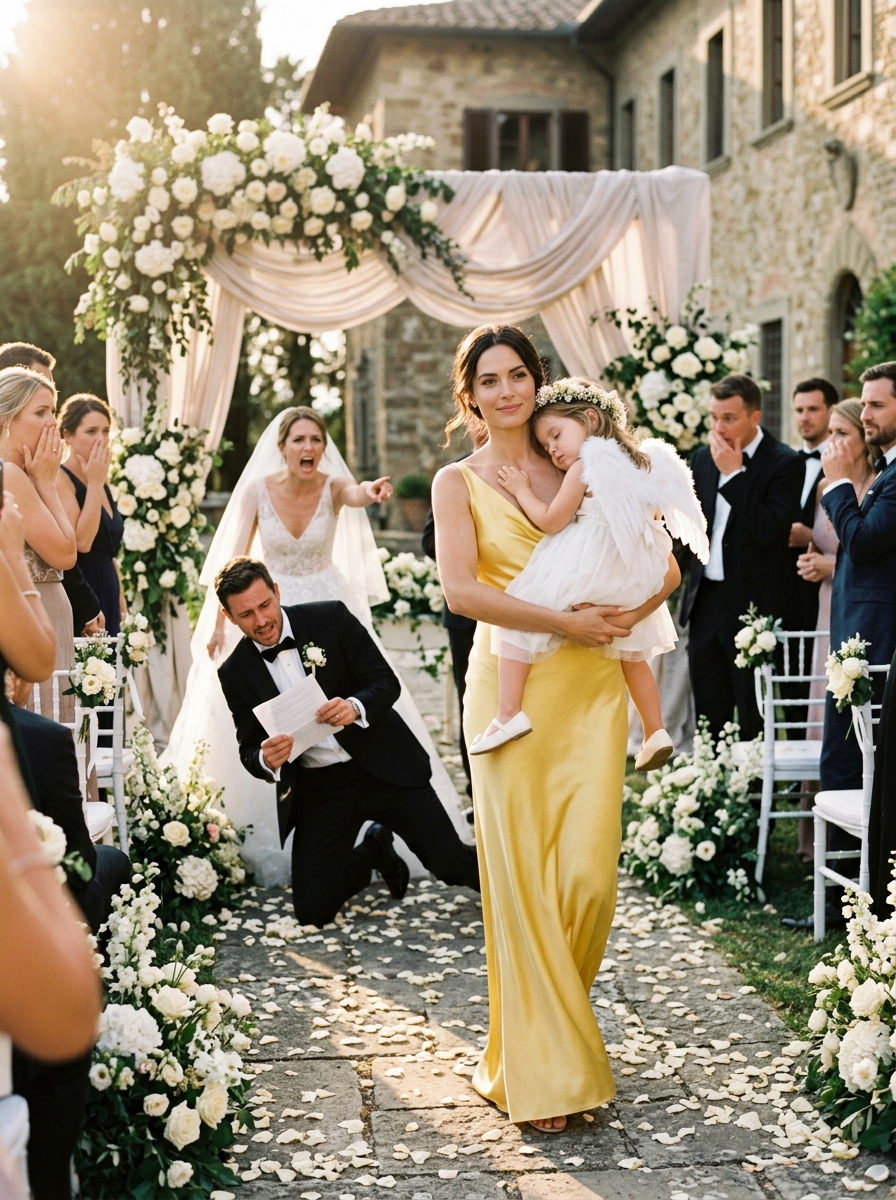
The next day, Emma walked down the aisle first carrying a single white peony.
Not the flower basket. Not the thing she had trained for. But she walked like it was state business. Chin up. Tiny hands locked around the stem. Every step careful. Every step earned.
When she reached the front and saw us, she smiled so hard I thought it might break my chest.
Dad clapped until his hands turned red.
Ryan looked ashamed.
Madison looked tired.
My mother looked furious in the contained way only women like her can manage in church clothes.
It wasn’t a fix.
There isn’t one for certain things.
But it was something.
Two weeks later, on a Tuesday morning, I finally opened the velvet pouch.
I put the locket around my neck while Emma ate cereal and swung her legs under the kitchen chair.
She looked up. “Shiny?”
“It belonged to your great-grandmother.”
She nodded like that explained everything.
The truth is, life didn’t become magically clean after that weekend.
Ryan and I still had years of damage between us.
My mother still believed she had “kept the peace.”
My father called every Thursday at 6:15 p.m. sharp and insisted on being put on speaker so he could talk to Emma about the red cardinal in his backyard. She named it Gerald. He mailed her a photocopied page about cardinals with the important parts highlighted. She kept it beside her bed like scripture.
That was how we rebuilt.
Not beautifully.
Not all at once.
Piece by piece.
My daughter still asked too often if she was being difficult. Still apologized for small things she shouldn’t even have noticed. Still carried old fear in her shoulders.
But in our house, when she coughed, nobody punished her for it.
When she practiced walking down a hallway, nobody let her dream on borrowed time.
When she asked if someone would notice her daisies, the answer was yes.
And if they didn’t, that was their failure, not hers.
Some families break in one loud moment.
Ours broke quietly, over years, and then all at once in a dining room full of candles and people who suddenly didn’t know where to look.
That night didn’t heal anything.
It did something better.
It named the wound.
And once a thing is named, it can stop pretending to be love.
The End.