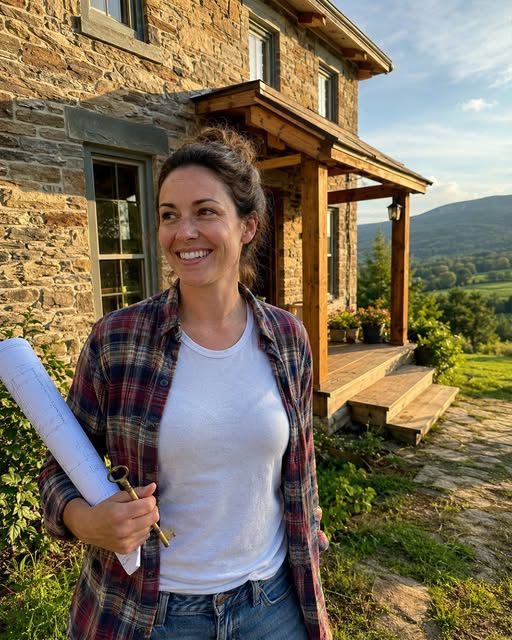
I am Audrey Appleton.
At thirty-two, I watched my father look me dead in the eyes and issue a countdown: I had exactly seventy-two hours to surrender my empire.
Every single beam.
Every foundational stone.
Every midnight shift I had burned crawling through drywall debris, armed with nothing but a tape measure and a headlamp.
My older brother, Derek, had systematically torched a million-dollar Manhattan penthouse.
He had bled cash on VIP bottle service and amateur day trading.
Now, he was coming for my territory.
My upstate property.
The punchline of my father’s generosity.
The dump my relatives branded the “chicken coop.”
But they were totally blind.
They had no idea what I had resurrected from that dirt, nor did they know the failsafe my mother had orchestrated two decades before her grave to ensure this place remained mine forever.
What went down when they rolled up my driveway in a rented pickup, flat-packed cardboard boxes tossed in the back, is the sequence I still replay in my head.
My mother, Laura, passed away when I was twelve.
She went to war with her illness for two brutal years, but the universe doesn’t always hand out medals for fighting hard.
Derek was fifteen—old enough to retain the memories.
Old enough to be the son Dad leaned on.
They processed their grief as a unit.
Sunday football. Hunting excursions. Long drives with the volume turned up.
I processed mine in the shadows.
I was the invisible kid, the girl silently prepping her own brown-bag lunches, chasing the 6:15 AM bus, grinding out perfect grades because no one else was going to care if I failed.
Two years post-funeral, Dad married Patricia.
She was fifty-eight now, sporting salon highlights, a voice dripping with artificial syrup, and a smile that froze before it hit her eyes.
Within her first week, she gutted our living room layout.
By week two, she had gutted the family dynamic.
Derek was the golden ticket.
That became the household doctrine.
He made varsity football.
Dad attended every single kickoff.
Patricia crafted a scrapbook.
I signed up for the architecture club and engineered a balsa-wood replica of the Chrysler Building.
Nobody bothered to show up to the exhibition.
Patricia possessed a talent for spinning neglect into a compliment.
She’d drop lines like, “Your sister doesn’t require hand-holding. She’s fiercely independent.”
She’d cap it with a tight little nod, playing the supportive stepmother.
But the subtext was loud and clear: I wasn’t worth the emotional capital.
I didn’t fight back.
I mentally archived it, the way you hoard a receipt for a future return.
I clung to exactly one memory from that era.
A singular sentence my mother rasped the final time I sat beside her IV drip.
“I left a failsafe for you, Audrey. When the time comes, it will find you.”
I couldn’t decode it.
Not back then.
Fast forward twenty years.
Dad opted to liquidate and distribute his portfolio while he was still breathing.
He framed it as “organizing his estate.”
Patricia framed it as “proactive planning.”
I framed it as a dinner invitation I should have declined.
We gathered around the mahogany dining table at Dad’s Connecticut estate—the exact table my mother purchased in 1998.
Patricia had swapped out the chairs.
She sat anchored to Dad’s side, her manicured hand draped over his wrist.
Derek dragged along Chloe, a twenty-seven-year-old dental hygienist he’d been sleeping with for four months who somehow already commanded the house Wi-Fi.
Dad stood at the head of the table.
He cleared his throat, projecting the boardroom baritone of a CEO rather than a retired regional sales rep.
“Derek,” he announced, “you are receiving the East 73rd Street apartment. Two beds, fully furnished. Current market valuation is $1.2 million.”
Derek flashed a shark grin.
Chloe dug her nails into his bicep.
Patricia beamed like a mastermind watching a heist go off without a hitch.
“Audrey,” Dad shifted his gaze.
A heavy beat.
“I’m transferring a rural asset to you. Five acres and a structure up in Middlebury, Vermont.”
No glossy printouts.
No square footage.
No monetary appraisal.
He dug into his blazer and extracted a key.
It was oxidized brass, an antique skeleton key featuring a long barrel and a double-notched bit.
It was so remarkably light it nearly slipped through my fingers when he dropped it into my palm.
Derek slumped back and barked a laugh.
“Vermont? You’ve gotta be kidding.”
Patricia dabbed her lips with a linen napkin.
“It’s a breathtaking region,” she purred. “Extremely rustic.”
Dad stared at me with the expectant glare of a man handing out charity and waiting for his applause.
“Your brother requires the liquid asset,” he justified.
I gripped the warm brass tight in my fist.
“Thanks, Dad,” I replied.
I meant every syllable.
Just not for the reason he assumed.
The following Saturday, I drove four hours straight from Boston to Middlebury.
Riding solo, windows rolled down, the razor-sharp November wind biting at my face.
The property was marooned at the dead end of a gravel road, a half-mile past civilization.
Five acres of feral pasture flanked by barren sugar maples.
At the rear, the Green Mountains loomed like an impenetrable fortress wall.
The structure itself looked completely asphyxiated, gasping for air after three decades of neglect.
The roofline dipped aggressively to the left.
The veranda railing was AWOL.
Weeds choked the crumbling foundation.
I forced the front door.
It jammed, then shrieked open like it hadn’t been touched in a century.
Inside: zero heat, zero hot water.
Ruptured pipes hidden behind drywall that reeked of rot and rodent waste.
The floor joists felt spongy underfoot.
The kitchen boasted one functional electric coil and a faucet bleeding brown sludge.
But the skeleton?
The skeleton was bulletproof.
Intact 1890 stone foundation.
Massive, hand-hewn oak rafters spanning the overhead.
A colossal hearth forged from indigenous fieldstone, massive enough to walk into.
And beyond the glass: five acres of sweeping territory, a crystal-clear creek slicing through river rocks, and a mountain panorama that genuinely knocked the wind out of me.
I immediately dialed Nora, my best friend and a heavy-hitting general contractor out of Burlington, forty minutes north.
“Get down here,” I ordered. “You need to see this.”
That night, Derek fired a text into the family group thread.
Anybody check out Dad’s chicken coop yet? Audrey is gonna crush it in her new barn.
He tacked on a crying-laughing emoji.
Patricia heart-reacted the message.
Dad stayed silent.
I took a screenshot.
I didn’t fire back, because Derek was missing the ultimate punchline.
I am an architect.
My entire career is built on historic preservation.
And I was standing in the middle of a masterpiece.
Back in Boston, I executed my standard protocol for when the universe hands me shattered glass.
I strategized.
Commercial zoning codes. Historic rehabilitation tax incentives. Vermont hospitality regulations.
I devoured the fine print.
I yanked the municipal deeds.
I ran the analytics on every converted historic inn within a hundred miles.
The margins were glaring.
The math was flawless.
But before drafting a single blueprint, I made one specific call.
Margaret Chen was seventy-two.
She was my mother’s former Wellesley roommate and, crucially, her estate attorney.
We hadn’t crossed paths in six years.
The last time was at a New Hampshire wedding, where she gripped my wrists and instructed, “Call me when it’s time.”
I made the call.
“Ms. Chen,” I started. “Mom told me she left a failsafe. Dad just dumped a Vermont property on me. Is there a catch I need to know about?”
Dead air on the line.
The kind of silence that shifts tectonic plates.
“Audrey,” she finally breathed, her tone plummeting an octave. “I have been sitting by the phone for two decades waiting for this exact moment. How fast can you get here?”
I agreed before I even took my next breath.
We locked in a meeting for the following week.
She operated out of a secluded cottage in Hanover, New Hampshire, a two-hour burn from Boston.
I slapped her address on a Post-it and stuck it to my bathroom mirror.
A daily morning anchor.
On my lunch hours, I started drafting aggressive schematics.
Load-bearing analyses, spatial mapping, structural tear-downs.
I sketched them frantically on the flip side of old project blueprints.
Before hanging up, Margaret had dropped one line that kept my eyes pinned to the ceiling for three straight nights.
“Your mother was lethal with her planning.”
While I plotted, Derek was burning through Dad’s cash.
The East 73rd penthouse was a cliché.
Floor-to-ceiling glass.
A terrace overlooking Central Park.
Imported Italian marble.
It also carried a $2,800 monthly HOA fee, which Derek casually brushed off as “the premium for elite living.”
He dumped his sales gig a fortnight after moving in, declaring himself a “founder.”
In reality, that meant he lounged in his underwear at the kitchen island, gambling on margins across three monitors while Chloe broadcasted their fake wealth to the internet.
“Penthouse living,” she tagged a shot of her pedicured feet kicked up on the terrace glass.
She boasted 12,000 followers.
Nora kept tabs for me.
I didn’t hit follow.
I didn’t have to.
Then my phone buzzed. Dad.
“How’s the country shack?” he probed, playing it cool, like asking about traffic.
“Surviving,” I deflected.
“Listen, if it’s a money pit, we can list it and chop the equity. Probably the smartest play.”
He wanted to liquidate the acreage to fund Derek’s next disaster.
“I’m holding it, Dad.”
Radio silence.
The deafening quiet of a man whose script just got flipped.
Patricia slid into my texts twenty minutes later.
Don’t be difficult, sweetheart. Your father is just trying to protect you.
I read the words.
Flipped my phone face down.
Cracked open my laptop and launched Excel.
Material costs. Phased timelines. Gross revenue models. ROI calculations.
I didn’t text her back.
Certain ultimatums don’t warrant a text back.
They demand a spreadsheet.
Margaret Chen’s Hanover hideout was nestled in two acres of white birch.
Crisp clapboard siding, forest-green shutters, a mailbox shaped like a silo.
A property that kept its mouth shut.
She flung the door open before my knuckles hit the wood.
Seventy-two, silver hair clamped back, spectacles dangling on a chain, and eyes burning with a twenty-year-old secret.
“Take a seat, Audrey,” she commanded. “I’m about to execute an order your mother gave me when you were in middle school.”
We anchored ourselves at her butcher-block table.
She poured Earl Grey without offering.
Then she slapped a thick manila folder down and flipped it open.
“Laura secured the Middlebury deed in the summer of 2004, exactly six months prior to her cancer diagnosis. Pure cash transaction. $62,000, funded entirely from a life insurance policy she inherited when your grandmother Grace died in 2003.”
I was paralyzed.
“She bought it solo?”
“With heavily guarded, independent capital,” Margaret confirmed. “Zero commingling with Ray’s portfolio. Not a single cent of marital equity ever crossed that threshold.”
She peeled back a page.
“Next, she locked it into an irrevocable trust. The structure and the five acres were shielded for you, Audrey. The trust fully vested on your thirtieth birthday. You’ve been the absolute legal proprietor for two years.”
My pulse hammered in my wrists.
“Is Dad aware of this?”
“Not a clue.”
She slid a second file across the wood.
“Here is the kill shot. During the 2006 divorce proceedings, your father executed a quitclaim deed. He legally surrendered any and all rights to real estate titled under your mother’s name. His signature is right there. Fully notarized.”
I stared at the ink.
I couldn’t breathe.
“Why the secrecy?”
Margaret offered a razor-thin, melancholy smile.
“Her exact words: ‘Audrey will trigger the trap when she has the ammunition.’”
She then pushed a sealed, cream-colored envelope toward me.
My name, penned in my mother’s flawless cursive.
“She ordered me to hand this over when you were weaponized,” Margaret said. “You’re weaponized.”
I drove back to Boston with that envelope riding shotgun like an explosive device.
I didn’t crack the seal that night.
Or the next.
I leaned it against my bedside lamp, staring at it like a vault I wasn’t quite ready to crack.
Meanwhile, Derek’s empire of dirt was crumbling.
He dialed my number for the first time in sixty days.
No pleasantries. Just panic.
“Listen, I might sub-lease a couple of rooms in the penthouse,” he muttered. “Cash flow is a little restricted right now.”
Restricted.
A grown man squatting rent-free in a $1.2 million skybox was restricted.
Soon after, Patricia frantically dialed Dad.
Derek was facing a brutal HOA special assessment.
$4,200 he couldn’t cover.
Dad wired him $15,000 straight out of his 401(k).
Patricia rubber-stamped it.
Nobody briefed me.
I caught the intel from my cousin Ellen at a family dinner two weeks later.
She dropped it casually, figuring I was in the loop.
I wasn’t.
Then Dad’s name flashed on my screen.
“Could you float your brother a bridge loan? Just to get him out of the woods?”
“Absolutely not, Dad.”
Dead air.
Then the venom: “You can be remarkably toxic, Audrey, considering how much this family has sacrificed for you.”
I killed the call.
I sat in my leased Boston apartment, glaring at the cream envelope.
Glaring at my MacBook.
I opened the MacBook.
Not the envelope.
I hammered out a ruthless business model until 3:00 AM.
It wasn’t fueled by rage.
It was fueled by absolute clarity.
In March, I pulled a ninety-day sabbatical from my architectural firm.
I crammed my SUV with steel-toe boots, thermal gear, power tools, and the master blueprints I’d been refining since winter.
I floored it to Vermont.
Nora was waiting in the driveway, flanked by her four-man wrecking crew.
She gave me a look teetering between sheer adrenaline and total panic.
“This is either your magnum opus,” she muttered, eyeing the rotting eaves, “or the fastest way to declare bankruptcy in the tri-state area.”
Day one: I unrolled the schematics across the splintered living room floor.
Twelve pages of aggressive transformation mapped out on timber that hadn’t been swept since the nineties.
The scope was violent.
Total structural stabilization.
Premium cedar shake roof.
Complete masonry restoration on the mega-hearth.
Gutting three bedrooms and the adjacent barn to engineer twelve luxury suites.
A commercial farm-to-table culinary setup.
A zen garden flanking the river.
The war chest: $400,000.
I liquidated my $80,000 savings.
I locked down a $260,000 SBA commercial loan.
Nora threw in $60,000 of her own cash for silent equity.
I kept my bloodline entirely in the dark.
By the end of week one, we had stripped the interior down to the skeletal frame.
Beneath rotting sheetrock, we exposed the 130-year-old oak bones.
Bulletproof.
And beneath a slab of decaying wallpaper in the upper corridor, I struck something else.
A tiny graphite sketch.
A house.
Scrawled directly beneath it, in penmanship I’d know blindfolded, was a single word:
Someday.
My mother had walked these floors.
She had stood in this exact spot, pressed lead to plaster, and drafted a vision of the future.
I traced the graphite with my index finger and left the wall intact.
The family snipers kept taking shots.
Derek uploaded a shot from his Manhattan balcony, skyline gleaming, a rocks glass of bourbon in his grip.
The caption read: Some people flip chicken coops. I flip markets.
He tagged my handle.
Nora spotted it immediately.
“Should I accidentally back a bulldozer over his phone?”
Patricia rang me on a Tuesday while I was manually stripping the porch spindles.
“Your father is losing sleep over your financial recklessness, Audrey. Dump the dirt and pivot to a high-yield asset.”
She wanted me to liquidate and wire the capital to Derek.
Come Thanksgiving, I subjected myself to the four-hour drive to Connecticut.
You do those things when you still harbor the delusion that presence equals respect.
Over the turkey, Dad hoisted his wine glass and toasted to Derek’s “disruptor mentality.”
He branded him a maverick. A pioneer.
Zero acknowledgment of the $15,000 retirement bailout.
Zero mention of my construction site.
Two glasses deep, Derek smirked across the centerpiece.
“So, Audrey, how’s the poultry farm? Harvesting any eggs out there?”
The room erupted.
Chloe giggled.
Patricia chuckled.
Even Dad let a smile slip.
I deliberately sliced my meat, chewed with precision, and swallowed.
“We’re making headway.”
Patricia leaned across the table.
“Darling, you should have taken the cash buyout. A woman your age needs to be hunting for a husband, not playing Bob the Builder.”
I dropped my fork.
Folded my linen.
“Appreciate the hospitality, Dad.”
I drove back to Vermont in pitch black, slicing through sleet on Route 7 for four hours straight.
Nora had left the floodlights blazing.
A bowl of ziti sat in the microwave with a Post-it note attached:
Their funeral.
I devoured the ziti.
I was back on the power saws at 5:00 AM.
Hit month six, and the facade was a different beast entirely.
Fresh cedar shingles.
Stonework chemically cleaned and repointed by a Rutland masonry legend who specialized in historic bridges.
The veranda resurrected using salvaged timber from a demolished Stowe barn.
The grounds were transforming rapidly—lavender and sweet basil aggressively flanking the riverstone walkways.
The locals rallied hard.
Hal, a dairy kingpin, locked me into wholesale butter and cream.
Iris, the town ceramicist, threw custom plating for the dining room.
Sam, an old-school painter, blasted a panoramic mural of the Green Mountains across the lobby.
Pro bono.
He claimed he just wanted his fingerprints on a resurrection.
Meanwhile, Manhattan was burning to the ground.
Derek’s portfolio bled out $47,000.
The HOA dropped the hammer—another $6,200 special assessment piled onto the monthly fees he was already dodging.
Chloe bailed.
She abandoned a sticky note on his imported marble: I don’t do poverty.
Derek panicked and called Dad.
He demanded another lifeline.
Dad cut another check.
I didn’t get the exact figure until Christmas, huddled in the Connecticut kitchen while Patricia sliced store-bought pie.
“Another twenty grand,” Ellen muttered to me. “Straight out of the pension.”
I toweled off a dinner plate and stacked it.
“His money, his funeral,” I replied.
Ellen stared at me.
“You are terrifyingly icy about this.”
I wasn’t icy.
I was constructing an empire.
There is a massive distinction.
Passive people freeze.
Builders just look frozen because they are entirely focused on the blueprint.
Early February.
Nine months deep into the grind.
I was camped out alone in the near-finished lobby.
The massive hearth was roaring.
Nora and I had spent three filthy days rebuilding the masonry chimney from the inside out.
The ancient oak overhead was oiled and glowing like whiskey in the firelight.
I held Margaret’s cream envelope.
My name. Faded ink. Unbroken seal.
I ripped it open.
Inside: a ragged page ripped from a spiral pad.
Mom’s distinct, microscopic handwriting, tilting aggressively to the right.
Just like mine.
My brilliant Audrey,
If this is in your hands, Margaret held the line, and you made it to Middlebury.
I bought this dirt the summer I hit forty. The exact same summer oncology gave me an expiration date. I could have blown the cash chasing experimental treatments to buy a few extra months. I decided to buy you a fortress no one could ever breach.
Not Ray.
Not a single soul.
I stopped.
The logs snapped.
Sparks hit the grate.
This foundation is limestone, just like your spine. The world will march right by it. They’ll dismiss it as basic rock. But limestone is what holds up the cathedrals. Don’t ever forget that.
She signed off: Mom.
Not Laura.
Not your mother.
Just Mom.
I collapsed on the raw floorboards and broke.
Not the loud, theatrical kind of crying.
The silent, violent kind that bleeds out of you like a ruptured water main until nothing remains but the reinforced steel underneath.
Nora walked in twenty minutes later.
She dropped to the wood beside me.
No interrogations.
No pity platitudes.
She just gripped my fingers, stared into the flames, and let me bleed it out.
When the tears stopped, I shoved the paper back in the envelope and held it over my heart.
“Limestone,” I whispered.
Nora crushed my hand.
“Limestone.”
By month ten, the interior was a weapon.
Twelve bespoke suites, each aggressively themed around Vermont’s extreme ecology.
The Birch Suite. The Sugar Suite. The Creek Suite.
Artisan textiles sourced from a Woodstock syndicate.
Custom-blacksmith hardware.
Hardwoods buffered and oiled until they mirrored the ceiling.
The commercial kitchen was my undisputed masterpiece.
Surgical stainless steel.
Industrial burners.
A walk-in vault stockpiled with my own summer canning.
Blistered tomato jam. Fermented ramps. Whipped maple butter.
The farm-to-table manifesto was locked in.
Hal’s dairy truck hit us twice a week.
The garden was exploding with root crops and heavy greens.
I branded the compound Limestone House, honoring the letter.
A heavy-hitting culinary critic rolled through in October, tipped off by Sam the muralist.
She booked one night, crushed the tasting menu, and paced the riverstones at sunrise.
Her column dropped that Tuesday.
Limestone House is the terrifyingly beautiful result of an architect building a sanctuary with her bare hands and her own blood.
The reservations trickled.
Then they surged.
Then they detonated.
The Vermont Tourism Syndicate begged to headline Limestone House for their spring offensive.
I greenlit it.
Then, on a freezing November Sunday, I dropped one raw image on my personal Instagram feed.
Limestone House at dusk.
Golden hour blazing through the glass, the masonry radiating heat, the hand-chiseled cedar sign anchoring the driveway.
Zero text. Zero hashtags. Zero filters.
Eight hundred hits in one day.
Ghosts crawled out of the woodwork.
High school alumni. College mentors. Ellen. Nora’s mom.
Then, at 11:00 PM, the digital landmine tripped.
A comment from Dad’s handle, operated by Patricia.
Looks nice. Call me.
I ignored it.
Three days later, the earth shifted.
We were wrapping the master suite, the crown jewel on the second floor featuring the bay glass over the river.
Nora tapped her framing hammer against the stonework behind the headboard.
It echoed hollow.
“Could be a dead chimney shaft,” she diagnosed. “Or just a void.”
We pried it open with crowbars.
Concealed behind the lath, wedged between two massive rocks, sat an antique cedar lockbox.
Aged black, but the brass hinges were intact.
A wax seal locked the lid.
I shattered the wax.
Buried in navy cotton lay three items.
A brass skeleton key.
An exact clone of the one Dad had dropped in my hand at the dinner table.
Same notched bit. Same barrel.
Except this one was polished.
Cherished.
Beneath it, a scrap of paper in Mom’s script.
For the main entry. The original. Love, Mom.

And the final piece: a Xerox of the irrevocable trust, dripping in yellow highlighter, flanked by Mom’s handwritten tactical notes.
Recorded with Addison County.
Ray executed quitclaim. Reference page 12.
Audrey triggers at 30 in 2024.
My mother had entombed this arsenal inside the walls of the fortress she bought me.
She buried it with the absolute certainty that I would eventually gut this place, rip down these walls, and unearth the weapon she forged for me.
I held both keys in my palm.
Dad’s: oxidized, weightless, dismissive.
Mom’s: glowing, heavy, deliberate.
Two keys.
One fortress.
Only one handed over with actual love.
I dialed Margaret immediately.
“I breached the wall. I have the box.”
A heavy pause on the line.
“She swore you’d find it,” Margaret whispered. “She said the architecture would speak to you when you were ready.”
It took exactly ninety-six hours for Dad to break.
“Audrey,” he barked.
Not playing the casual CEO anymore.
Tightly coiled.
“I analyzed that Instagram photo. That is absolutely not the original structure.”
“It’s not.”
“What was the capital expenditure on this?”
“Sufficient.”
A beat of silence.
“Where did you source the capital? Tell me you didn’t leverage the deed for a loan. Because legally, that real estate was a gift from me.”
“Legally what, Dad?”
He choked on his words.
He actually stuttered—a mechanical failure I had never witnessed in Ray Appleton’s thirty-two years of existence.
He recalibrated.
“I’m coming up to inspect it.”
“We launch in April. Feel free to book a suite.”
“Book? I’m your father.”
“And Limestone House is an LLC. I’ll text you the booking portal.”
Click.
Patricia attacked twenty minutes later.
Clockwork.
“Your father is devastated, Audrey. He desperately wants to be part of the journey. You know his heart.”
“He wasn’t part of the blood and sweat. He doesn’t get to claim the victory lap.”
“That is wildly out of line. He handed you that dirt.”
“He handed me what he deemed trash. I forged it into gold. Vastly different concepts.”
Dead air.
Patricia immediately pivoted.
The syrupy tone seeped back in, laced with battery acid.
“You know how Ray operates. He just firmly believes your brother needs the equity more right now. Derek is in a very dark place.”
There it was.
The anthem.
The soundtrack of my entire existence, recited like a holy text.
Your brother needs it more.
I could have shattered my screen against the brick.
Instead, I went ice cold.
“Have a great night, Patricia.”
Call terminated.
I posted up on the veranda and watched the sun bleed out over the peaks.
I knew the play.
I could smell the ozone before the lightning struck.
They were going to mount a hostile takeover.
The match was lit by a technical error.
Not mine.
Nora’s.
She was compiling footage for her master contractor reel and blasted a high-def story to her feed: a cinematic drone sweep through the twelve suites, the industrial kitchen, the zen garden, finishing on the mountain terrace.
Hollywood production value.
Thirty seconds of undeniable proof of what Limestone House was worth.
But in a split-second frame, resting on the lobby counter, my architectural schematics were exposed.
Twelve pages unrolled, the entire financial and structural scope laid bare.
Derek looped that story four times.
Nora’s analytics caught his handle.
He panicked and called Dad instantly.
“Dad, look at this!” he shrieked, the desperate pitch of a drowning man spotting a helicopter. “She flipped that garbage into a luxury compound. That dirt is easily pulling three, maybe four million.”
I know verbatim what went down because Derek—in a monumental stroke of incompetence—accidentally dropped his voice memo into the family chat instead of Dad’s private thread.
Ray: “I gifted her that deed.”
Derek: “Exactly! You gifted it. That makes it a family asset. We need our equity stake.”
Ray: “Let me strategize.”
Derek, practically sobbing: “Dad, I’m dying here. The bank is foreclosing the penthouse. I’m ninety days delinquent. Everything is collapsing.”
Then Patricia, ghosting in the background: “You gave her that land, Ray. Which means you can revoke it.”
I played that leaked audio sitting on the hardwood of my finished kitchen, surrounded by Iris’s custom plates.
I played it exactly once.
I hit save.
I dialed Margaret.
“They’re mobilizing,” I stated.
“I know,” she replied. “My guns are loaded.”
April hit.
Launch day.
Limestone House ran at 100% capacity.
Twelve suites maxed out through the fall.
Eight local salaries on payroll.
A standby list pushing into winter.
My Burlington CPA took one look at the quarterly projections and cursed out loud.
Then Architectural Digest reached out.
Not a lifestyle blog. Not the local tribune.
AD.
They wanted Limestone House for their summer feature.
An architect resurrecting a dead Vermont farmhouse into the Northeast’s most exclusive sanctuary—it was algorithmic gold for their demographic.
Their shooter arrived on a Tuesday.
Captured the stonework at dawn and dusk.
The piece dropped on Thursday.
Headline: How One Architect Engineered a Forgotten Vermont Farmhouse Into the Northeast’s Premier Retreat.
Two hundred thousand hits in two days.
The waitlist spiked to fourteen months.
The compound officially appraised at $3.8 million—structure, acreage, and brand equity.
I maintained total radio silence with my bloodline.
I had learned the hard way that broadcasting a victory just invites thieves.
I called Margaret instead.
“If Ray attempts to seize the deed, what is the exact fallout?”
“He signed a binding quitclaim in 2006. The trust vested in 2024. You possess 100% legal immunity. He has zero leverage. Absolutely zero.”
“What if he ignores the law?”
Margaret didn’t blink.
“Then you slide the documents across the table and let the law crush him.”
My cell buzzed on Friday.
Derek.
“So you’re a millionaire now,” he spat.
No greeting. No check-in.
Just the bitter calculation of a man running out of chips.
“I run a corporation.”
“Cut the crap, Audrey. I read the AD piece. Every design influencer is spamming it. You’re everywhere.”
“State your business, Derek.”
Pause.
“Dad is convening a board meeting.”
I pinched the bridge of my nose.
“Regarding what?”
“Regarding the asset. Regarding equity.”
Equity.
The word made my stomach turn.
Equity was Dad handing him a $1.2M skybox while I got ruptured pipes.
Equity was two decades of cheering at tailgates while my architecture awards gathered dust.
Equity was Patricia branding me “fiercely independent” while she drained the 401(k) to cover Derek’s bar tabs.
“Give me a time,” I demanded.
“Saturday. Connecticut.”
“Done.”
I killed the connection, walked out to the veranda, and watched the finches swarm the lavender.
The air reeked of cut cedar and victory.
Inside, Marcus was dialing in a roasted squash puree for the autumn rotation.
This was my kingdom.
Every rock.
Every rafter.
Every cent of debt, sweat, and midnight math.
Mine.
And they were mobilizing to hijack it.
I booted up my Mac and assembled the war room.
The trust. The quitclaim. The $3.8M appraisal.
The $260k SBA loan locked solely under my social security number, collateralized by land titled solely to me.
Construction receipts topping $397,000.
I shoved it all into a manila envelope.
I jammed the envelope into my duffel bag.
I wasn’t showing up for a family meeting.
I was showing up for an execution.
The Connecticut dining table hadn’t changed.
Same mahogany Mom bought.
Same chairs Patricia hijacked.
Dad anchored the head.
Patricia flanked his right.
Derek on the left.
I took the absolute opposite end.
My duffel stayed in the trunk.
Dad cleared his throat.
“Audrey, the family is incredibly impressed with the Vermont turnaround.”
“Noted.”
“However, we need to restructure the equity.”
I laced my fingers together on the wood.
“Proceed.”
Patricia slid forward.
“Ray gifted you that foundation. Your upgrades are spectacular, truly, but the core asset belongs to the bloodline.”
“It is not a family asset, Patricia.”
“Audrey, listen—”
“It’s not. Keep talking, though.”
Derek hijacked the floor.
“We need to reorganize. I’ll take over operations. Marketing, guest relations, scalability. You stick to the kitchen and the decor. Even split. Fifty-fifty.”
I locked eyes with him.
My big brother.
Thirty-five, carrying dead eyes, a five o’clock shadow, and wearing a Rolex he couldn’t afford to wind.
“You want half the equity of a corporation you didn’t build.”
“I bring extreme value to the board.”
“What board? You haven’t successfully managed anything except—”
I caught myself.
Inhale. Exhale.
“Denied.”
Derek’s jaw clenched tight enough to crack teeth.
“I am out of options, Audrey. My financials are highly complex right now.”
“Your financials are irrelevant to my corporation.”
Dad slammed his fist into the mahogany.
“Stop being hostile! We are blood.”
I shoved my chair back.
It shrieked against the floorboards.
“Dad, you tossed me a deed you deemed entirely worthless. I forged it into a goldmine, and now you want to confiscate it. That isn’t family. That’s a hostile takeover.”
Patricia hissed, “Stop with the theatrics.”
“It’s not theater. It’s a fact. And I have a business to run in Vermont.”
I marched for the exit.
As I hit the foyer, I heard Patricia buzzing in Dad’s ear and Derek throwing around the word “litigation.”
Before my tires hit the interstate, my screen lit up.
Dad.
This isn’t over.
I flipped the phone face down and gunned the engine.
The eviction hammer dropped on Derek’s penthouse that Monday.
Ninety days to clear the debt or get locked out.
The luxury management group publicly posted the default notice in the lobby.
His elite neighbors read every word.
Derek blew up Dad’s phone three times.
Patricia leaked it to Ellen, who fed it to me.
The math was brutal.
Derek was in the hole for $63,000—HOA arrears, special assessments, and an illegal equity loan he’d pulled against a unit he didn’t technically own, since Dad held the master deed for protection.
Dad didn’t have $63k in liquid cash.
He’d already bled $35,000 from his pension over the last eighteen months.
Patricia’s capital was locked in a four-year fixed annuity.
So, Patricia engineered a strike.
“The Vermont estate is the liquidity we need,” she told Dad over dinner. “We just have to force Audrey’s hand.”
Derek fired a text at dawn.
I read it standing in the industrial kitchen while Marcus fired up breakfast for fourteen paying clients.
You think you’re untouchable, but Dad gave you that dirt and Dad can take it back. We’re retaining counsel.
I didn’t type a word.
I forwarded the threat to Margaret.
She called me back in nine seconds.
“Let them bleed cash on a lawyer. The trust precedes his fake gift by years. Ray can’t reclaim what he never legally owned. The quitclaim is titanium. I forged it myself.”
Derek actually found a lawyer—a frat buddy running a strip-mall real estate practice in Jersey.
The buddy ran the Addison County titles, verified the deed was flawlessly registered to Audrey Appleton, and informed Derek he had zero legal ammunition.
But Derek buried that intel.
He fed the family a lie: “My guy is building a massive case.”
False hope is lethal when you build your house on it.
The call came in at 11:14 PM.
I was deep in a manual on Japanese timber joinery I’d been trying to crack for half a year.
I almost let it go to voicemail.
“Audrey.”
Dad’s voice was gutted.
Deflated.
The tone of a man staring at the wall in the dark, dialing the daughter he’d spent three decades ghosting.
“Your mother,” he choked out, then stalled. “She had the brains. I know I lacked them. I failed at… distributing things evenly.”
I held the line.
I let the dead air hang, because sometimes silence is the deadliest weapon against a guilty conscience.
“But Derek is going under,” he pleaded. “He’s my boy, and I am begging you as your father to throw him a lifeline.”
“Dad, I would throw him a lifeline. I really would. But not by liquidating my empire.”
“I’m not asking for your empire.”
“Yes, you are.”
More dead air.
A massive void.
I heard his ragged breathing.
I heard Patricia’s reality TV blasting in the master suite.
Then the frequency shifted.
The vulnerability vanished.
The classic Ray Appleton programming kicked back in, snapping into its original aggressive groove.
“That land was supposed to be a write-off, Audrey. A pile of rocks and a collapsed roof. You were supposed to flip it for pennies and walk.”
“You handed me the garbage you thought I deserved. I engineered it into the empire I actually deserved.”
He had no counterattack for that.
He was boxed in.
So he deployed his only remaining weapon.
“Your brother requires the equity more.”
Loud and clear.
The soundtrack of my trauma.
Delivered like an absolute law of physics.
Swallowed like holy communion.
“Have a nice life, Dad.”
I killed the line.
Slammed the phone down.
Picked up the joinery manual.
He had been inches away.
One different sentence, and we could have rewritten history.
But the programming always overrides the man.
The next morning, I was manning the lobby terminal, processing summer deposits and locking in a massive corporate buyout from Boston, when the screen flashed.
Dad.
I hit speaker.
The hollow acoustic feedback meant he was in the kitchen; the shallow breathing meant Patricia was hovering.
“Audrey, I’m making this surgical,” he barked. “You have seventy-two hours to transfer the deed back into my name. I will authorize a fair-market reimbursement for your material costs. We’ll appraise the upgrades, and I’ll cut you a check. But the acreage and the structure revert to the family trust.”
I let the threat hang in the lobby.
Let it bounce off the stonework.
“The acreage and the structure,” I echoed, deadpan.
Patricia hijacked the mic.
“Derek is assuming operational control. He brings high-level sales management to the table.”
“Derek brings an Instagram addiction to the table. He has zero operational capacity.”
“Watch your tone!”
“I’m watching the metrics.”
Dad’s baritone went to ice.
“Seventy-two hours, Audrey. Refuse, and we file injunctions. I gifted you that real estate. I have absolute authority to seize it.”
I pushed back from the terminal, walked to the panoramic glass, and surveyed the grounds.
The lavender lines.
The riverstone.
The water flashing in the sun.
My crops.
My stones.
My water.
“Negative, Dad,” I said. “You have zero authority.”
“We’ll let a judge decide that.”
The line snapped dead.
I froze for thirty seconds, letting the adrenaline spike.
Then I hit Margaret on speed dial.
“We’re at war.”
“I’m aware,” she replied. “I’ve been tracking this storm for twenty years. The payload is prepped. It’s going out via overnight courier. You’ll have the warheads by dawn.”
I hung up and stared at the lobby calendar.
Seventy-two hours.
He started a clock.
He had no idea my clock had been running for two decades.
I burned the next sixty hours doing exactly what I’m trained to do.
I engineered a defense.
Margaret’s payload hit the desk Thursday morning in a reinforced legal mailer.
Inside: the pristine original irrevocable trust.
Notarized, embossed, twenty-two years old, and completely bulletproof.
The certified carbon copy of the 2006 quitclaim deed bearing Ray’s signature.
The Addison County stamp.
I already held the $3.8M appraisal.
The $260k commercial loan, signed exclusively by me, leveraged against dirt titled exclusively to me.
The $397,000 in contractor receipts.
The LLC registration.
The IRS filings.
I stacked the entire arsenal inside a manila folder.
I rolled up my master blueprints—the exact twelve sheets I had mapped on the rotting floorboards on day one—and tucked them under my arm.
Nora rolled in at sunset.
She leaned against the doorframe, watching me load the weapons.
“Need backup?”
“Negative,” I told her. “I execute this solo.”
She gave a tight nod.
“I’ll be at my kitchen island. Wine open. Phone off silent.”
I cracked a smile.
“Appreciate it.”
“For what?”
“For never referring to my empire as a chicken coop.”
She ducked out.
I posted up at the terminal and watched the sun bleed out behind the ridge.
I traced the brass key resting on my chest.
The cedar box key.
Mom’s key.
The hardware she embedded in the exact wall she knew I was destined to smash open.
He gave me a seventy-two-hour clock.
I forced his hand at sixty.
Saturday morning.
I suited up in a crisp white oxford, raw denim, steel-toes, and the brass key chain.
I hauled the manila payload and the blueprints out to the veranda, took a seat, and locked in.
They breached the perimeter at 0800.
A white Ford F-150 crept off the county blacktop onto my gravel, crawling like they had the wrong GPS coordinates.
Ray drove.
Derek rode shotgun.
Patricia was crammed in the back next to a stack of collapsed U-Haul boxes.
They actually brought boxes.
Corrugated cardboard.
Packing tape.
A hand truck.
They came to physically gut my life.
The truck idled in front of the lobby.
Gravel popped.
The engine died.
Derek hit the dirt first.
Decked out in khakis and a polo, dressed for a boardroom coup.
He locked eyes on the facade, and his jaw physically unhinged.
For a split second, he completely forgot the mission.
The last visual Derek had of this coordinates was a disaster zone.
Pixelated group-chat mockery of collapsed beams and shattered glass.
The chicken coop.
Now, the resurrected masonry was radiating in the morning light.
The cedar shake roof looked like liquid amber.
A custom-chiseled cedar monument anchored the walkway.
Limestone House, Est. 2024.
Trailing ivy spilling out of copper window boxes.
The zen garden thriving behind the stonework.
The river rushing in the background.
Ray climbed out, looking fragile.
He stared at the compound with the hollow eyes of a man who threw away a lottery ticket and just watched someone else cash it.
Patricia dropped out of the cab, clutching a designer bag, shoving her Prada shades into her hair.
“Well,” she clipped. “It’s had a facelift.”
Three VIP clients were checking out via the main doors, dragging Tumi luggage: a power couple from Greenwich and an executive from Montreal.
They flagged me from the steps.
“Unreal experience, Audrey. We’re already locked in for the fall foliage.”
Ray tracked them as they loaded their Porsche and vanished down the drive.
He adjusted his lapels.
He had practiced his monologue.
I had practiced my execution.
“Audrey,” Dad approached the stairs. “We gave you a deadline.”
I remained planted in the custom Adirondack chair I’d milled myself.
Solid red cedar, mortise-and-tenon joints, armrests wide enough to balance a carafe.
I didn’t move a muscle.
“Did you prep the transfer documents?” he demanded.
“I brought documents.”
“Excellent.”
Derek bypassed us, marching straight for the lobby glass.
I snapped my hand up.
“Derek. That’s a commercial entry. Paying clients only.”
“I’m not a client. I’m the new Director of Operations.”
“You’re trespassing.”
Ray’s blood pressure spiked.
He took the first step.
“Audrey, shut it down. I gifted you this dirt. I am the patriarch of this family, and I am ordering—”
I stood up.
Left hand: The manila warhead.
Right hand: The master blueprints, gripped like a baton.
The brass key flashed against my collar.
“Dad, take a seat. I’m about to give you an education.”
Patricia barked from the gravel.
“We didn’t drive four hours to review construction plans.”
“Correct,” I fired back. “You drove four hours to steal an asset you have zero claim to. But before you publicly humiliate yourselves in front of my payroll and my high-net-worth clients, sit on that bench and read.”
Ray scanned the folder, then locked onto the three staffers visible through the glass: Marcus, Julia at the desk, and Hal dropping off the dairy crates.
He collapsed onto the cedar bench.
Patricia flanked him.
Derek crossed his arms and leaned hard against the railing.
I cracked the folder and slapped the first weapon onto the patio table.
“This is an irrevocable trust. Executed in 2004 by Laura Appleton. My mother. Your actual wife.”
I aimed that last sentence squarely at Patricia.
She flinched.
“This trust designates this structure and the surrounding acreage strictly to me, Audrey Appleton. Fully vested upon my thirtieth birthday.”
Dad stared at the legal jargon.
All the blood drained from his face.
I kept pushing.
Cold, mechanical, reading him the riot act like a structural stress report.
Line by line.
“Mom acquired this deed using isolated, independent capital. A death benefit from Grandma Grace. Sixty-two grand. It never entered the marital accounts. You never owned it, Dad. You never gifted it.”
Ray gasped for air.
Couldn’t find it.
I slapped the second weapon onto the wood.
“This is the quitclaim you legally executed during the 2006 divorce. You forfeited every single claim to any real estate in Laura Appleton’s portfolio. Your signature. Your notary. Your legal counsel’s stamp of approval.”
“I… I don’t recall authorizing that.”
“Page three. Bottom line. March 14, 2006.”
Derek violently shoved off the railing.
“This is forged garbage! You fabricated this.”
“The trust is on file with the Addison County Clerk since ’04. Dial them up. The extension is on page four. The quitclaim is logged with the Connecticut Superior Court. It’s completely public.”
Patricia dug her manicured claws into Ray’s shoulder.
“Shut her down, Ray! Fight back!”
Ray was paralyzed, eyes locked on the trust.
His hands shook violently against the paper.
“Laura orchestrated this,” he whispered to the wind.
“Yeah,” I said. “She did.”
Derek’s face went purple.
He stormed the deck.
“This is a joke! Dad, get the lawyers on the phone. She can’t pull a fast one—”
“She pulled it,” I cut him down. “Twenty years ago.”
I hoisted the blueprints like a battle flag.
“I resurrected this compound from the mud. Every single vector on these grids belongs to me. Every dollar, every midnight shift, every nail, beam, and rock.”
I tapped the brass key on my chest.
“Mom’s original hardware. Entombed in the exact masonry she knew I’d tear down.”
I locked onto my father.
“You hammered it into my head that Derek needed the equity more. You nailed it, Dad. He’s bankrupt. He desperately needed it. But you couldn’t give him what you never owned.”
Total silence on the veranda.
A finch hit the garden wall and started chirping.
I casually slid the weapons back into the folder.
“Get off my property.”
Derek kicked a flattened U-Haul box off the deck.
It cartwheeled down the stairs and crashed into the basil.
“This isn’t over,” he spat.
The exact same empty threat Dad had texted.
Carbon copies.
Same hollow words.
Same lack of ammunition.
Patricia yanked her iPhone out.
“We’re dialing our litigation team right now.”
“Have them dial Margaret Chen,” I countered. “She engineered the trust. She’s been sitting by the phone for twenty years waiting to crush you.”
Patricia’s jaw locked.
She knew the name.
Margaret had stood over my mother’s casket.
She’d wired flowers every anniversary.
Ray remained frozen.
Anchored to the bench, head dropped, hands limp on his thighs.
He looked ancient.
Not senior.
Ancient.
The way a compromised foundation looks right before it gives way.
Then he muttered it, so softly Derek and Patricia barely caught the frequency.
“Your mother was always ten steps ahead of me.”
That was the closest Ray Appleton would ever get to a white flag.
I logged it.
I offered zero mercy.
“Time to go, Dad. The vault is empty.”
Derek aggressively slammed the F-150 door.
Patricia escorted Ray down the cedar steps and stuffed him into the cab.
The U-Haul boxes sat in the bed, flat and entirely useless.
The truck reversed out of the gravel, defeated.
I tracked them until the dust settled and the valley went silent.
The finch kept singing.
I held my position on the deck for an hour.
The coffee turned to ice.
The sun crested the pines and baked the stone against my spine.
Nora called at 0930.
“Status report?”
“They retreated. Boxes are empty.”
“I’m rolling over with a Cabernet in sixty minutes.”
“It’s 9:30 AM.”
“Your point?”
I broke down laughing.
First genuine laugh in a month.
I killed the call and took a slow lap through Limestone House.
Tracing the drywall, the exposed oak, the custom ironwork Iris beat into shape, the prep station where Marcus was firing up the second wave of brunch.
I anchored myself at the lobby desk.
Mounted on the wall behind the terminal were two identical frames.
Left side: The Architectural Digest spread, matted in museum glass.
Right side: Mom’s graphite sketch.
The tiny, crude house she had tagged on the upstairs plaster, surgically extracted and preserved.
Below it, the single word:
Someday.
Someday had arrived.
I pressed my palm against the glass.
Traced the architecture she had hallucinated before I could even spell my own name.
This was her vision.
Not a teardown.
Not a chicken coop.
An empire.
My empire.
Engineered on limestone.
Three months later, the bank annihilated the penthouse.
Foreclosed in July.
Derek was given sixty days to clear out, pushed it to seventy-five, and got locked out by building security.
He retreated to Connecticut, squatting in Dad and Patricia’s guest room surrounded by his high school MVP trophies.
He was thirty-five.
Ray and Patricia liquidated the estate in August and downsized to a cramped two-bed in Stamford.
The market played a factor.
But the fatal blow was the $43,000 Ray had bled into Derek’s sinkhole over eighteen months from accounts he couldn’t legally replenish.
Derek secured a desk at a Norwalk auto dealership.
Forty-two K base plus incentives.
His Instagram went offline in September.
Patricia shot me a single text.
Hope you can sleep at night.
I read it.
Dropped the phone.
I didn’t engage.
Certain sentences don’t require an answer.
They require the sender to rot in the silence and confront their own reflection.
Cousin Ellen checked in.
“The family network is going crazy. It’s all anyone talks about.”
“What’s the consensus?”
“That Laura was a tactical genius and you built a masterpiece.”
Margaret also dialed in.
“They actually hired a legitimate Hartford litigator. He audited the paperwork and told them they’d be laughed out of court. Zero case. It’s dead.”
“Thank you, Margaret. For holding the line.”
“Don’t thank me, kid. Thank Laura. She played chess while they played checkers.”
Year two.
Limestone House ranked top ten boutique getaways in the Northeast.
The waitlist held at a solid twelve months.
Gross revenue shattered $780,000.
Net profits covered a full-time GM and allowed me to step back into architectural consulting on my own terms.
I kept building.
I spearheaded two local historic redos: a Weybridge covered bridge and a Ripton schoolhouse.
My command center was the Limestone office, blueprints unrolled on the exact table where I’d choked down cold ziti and wept over Mom’s letter.
In October, I launched an exclusive retreat dubbed Letters to Moms.
Strictly for women who buried their mothers too early.
Twelve slots.
Sold out in four hours.
We drafted letters.
We read them to the fire.
We broke down.
We laughed.
We carried the weight, and then we left it in the ashes.
Out in the zen garden, right on the riverbank, I sunk a permanent limestone monument, hand-carved by my Rutland mason.
For Laura Appleton, who found cathedrals in the limestone.
Six months post-war, I drafted a final transmission to Ray.
Hard copy. Not digital.
Pen and paper.
Some messages require physical gravity.
Dad,
I don’t hold hatred, but I refuse to ignore how you fractured this bloodline. You picked your horse early. You backed him constantly. And you funded him with capital you had no right to touch.
The gates at Limestone House are open to any paying client. That applies to you. But the doors remain permanently locked to anyone who shows up to loot the vault.
I hope Derek figures it out. I hope you find closure.
But I poured my foundation decades ago.
Mom engineered it.
I sealed the envelope, drove into town, and dropped it in the USPS box.
I wasn’t waiting on a reply.
Three weeks later, Ellen delivered the after-action report.
Ray opened the envelope at his cramped kitchen table.
Patricia read the lines over his shoulder.
He creased it, slipped it back in the sleeve, and buried it in a drawer.
He went totally mute for the rest of the night.
Some letters aren’t meant to open negotiations.
They’re meant to terminate the contract.
Here is the absolute truth.
The people who write you off will inevitably circle back when you strike gold.
Not to pop champagne.
To collect the tax.
And the only thing you owe them is the reality check.
That you laid the bricks.
That the deed is yours.
And that nobody gets to hijack the narrative once the concrete is already dry.
That is the record.
A brass key.
A cedar vault.
And a fortress that was never a chicken coop.