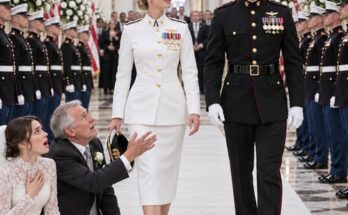
They Called Me a Stranger at My Sister’s Wedding. Then the Man With My Eyes Stood Up.
The cruelest thing my stepfather ever did wasn’t calling me poor.
It was making two hundred people watch while he decided I wasn’t family.
I knew going to Valerie’s wedding was a mistake before I ever left my apartment.
That afternoon, I stood beneath the flickering bathroom light in the cheapest apartment I could afford outside St. Louis, pulling at the zipper of a lavender clearance-rack dress.
The fabric was thin.
The lace around the collar wasn’t original. **I had sewn it on myself after work, one tiny stitch at a time**, because the dress looked too plain without it and professional alterations cost more than a week of groceries.
It wasn’t glamorous.
But it was clean.
It fit.
And it was mine.
My phone vibrated against the sink.
Mom.
I answered.
“Clara,” Monica said, skipping hello entirely, “today is about Valerie.”
I stared at myself in the scratched mirror.
“I know.”
“Gregory’s investors are attending. Valerie’s new family has connections. Please don’t embarrass us.”
“I wasn’t planning to.”
“If anyone asks what you do, don’t say you’re a cashier.”
My stomach tightened.
“I also do bookkeeping.”
“At a dry cleaner.”
“Yes, Mom.”
“Say financial administration.”
I almost laughed.
Not because it was funny.
Because after thirty-two years, she was still trying to edit me into someone she could tolerate.
“And don’t eat like you haven’t seen food in a week,” she continued.
I said nothing.
“Also, please tell me you found something decent to wear.”
I looked at the lavender dress.
“It’s fine.”
“Clara—”
“I have to go.”
For once, I hung up first.
I stood there trembling afterward.
My younger sister Valerie had always been beautiful in exactly the way my mother understood.
Blonde hair.
Perfect teeth.
Expensive clothes.
The ability to enter a room already convinced it belonged to her.
I was Monica’s daughter from before Gregory Bennett.
The mistake before the respectable marriage.
The reminder that my mother had once loved somebody else.
My biological father’s name was Daniel Caldwell.
According to Mom, Daniel had disappeared before I could remember him.
She said he had been charming, irresponsible, selfish.
Whenever I asked questions, her answers became shorter.
Eventually, I stopped asking.
I kept his last name anyway.
That always irritated Gregory.
“You’re living in my house,” he told me once when I was thirteen. “You should have my name.”
I refused.
I didn’t know why.
Maybe because **Caldwell was the only thing I had from a man whose face I had never seen.**
Gregory never forgave me.
When I was seventeen, I asked him for fifty dollars for a secondhand prom dress.
He laughed.
“Want money? Scrub the kitchen floor.”
Three days later, he handed twelve-year-old Valerie five hundred dollars for a school dance.
“She deserves to feel beautiful.”
Mom stood there.
Watching.
Silent.
She always watched.
She always stayed silent.
That hurt more than Gregory’s cruelty.
I drove to the Sterling Grand Ballroom in a Honda old enough to vote.
The venue rose behind wrought-iron gates like something built for royalty.
White marble.
Towering windows.
Valets in spotless uniforms.
Rows of luxury cars gleaming in the afternoon light.
My Honda rattled between a Bentley and a black Mercedes.
The valet looked at it, then at me.
His smile changed.
I handed him the keys anyway.
Inside, roses climbed twelve-foot columns beneath crystal chandeliers.
A string quartet played near a champagne fountain.
The room smelled like flowers, perfume, butter, and money.
I had taken three steps when a hostess approached.
“The service entrance is behind the building.”
I froze.
“I’m a guest.”
She blinked.
“I’m the bride’s sister.”
She checked her tablet.
“Name?”
“Clara Caldwell.”
Her finger stopped.
Something flickered across her expression.
Then she smiled too quickly.
“You are on the list.”
I almost missed the way she glanced toward a man standing across the foyer.
Older.
White hair.
Charcoal suit.
Silver-handled cane.
He was watching me.
When our eyes met, he looked startled.
I turned away before I could wonder why.
Mom found me near the reception entrance.
Her silver gown probably cost more than my car.
Gregory wore midnight blue and a gold watch thick enough to pay off my student loans.
“What are you wearing?” Mom whispered.
“My dress.”
Gregory looked me over.
“You look like a housekeeper on her afternoon off.”
The insult came easily to him.
Practice, I suppose.
“Stay away from my partners,” he said. “Don’t tell people about that cash register job.”
“I do financial records for Mr. Patel too.”
Gregory smirked.
“At a dry cleaner.”
Before I could answer, someone wrapped me in a hug.
“Clara.”
Lucas.
My half brother was twenty-seven and the only person in Gregory’s house who had ever behaved as though I belonged there.
He stepped back and smiled.
“You look beautiful.”
“Thank you.”
His eyes settled on the lace collar.
“You added that yourself?”
I nodded.
“It’s cool.”
Mom grabbed his elbow.
“Lucas, come with me. The CEO of Harrison Imports just arrived.”
The words meant nothing to me then.
Later, I would remember them perfectly.
During the ceremony, I was seated in the last row behind a marble pillar beside the kitchen entrance.
The bride’s sister.
Hidden like an electrical cord.
From there I watched Gregory walk Valerie down the aisle.
He cried when he kissed her cheek.
Actual tears.
I remembered being nine years old and waiting beside the stairs with a handmade Father’s Day card.
I had written DAD on the front.
Gregory opened it, looked at me, and said, “You have a father somewhere. I’m Valerie’s father.”
That night I tore the card into pieces beneath my blanket.
At Valerie’s wedding, I watched that same man cry because his real daughter was getting married.
I pressed my nails into my palm.
Afterward, everyone moved into the ballroom.
Dinner was served buffet-style.
Prime rib.
Salmon.
Lobster.
Roasted vegetables.
Warm bread glazed with butter.
My stomach cramped.
**I had not eaten since the previous afternoon.**
The last cash in my wallet had gone toward gas and a small crystal serving bowl from Valerie’s registry.
For almost an hour, I stayed near the wall with water.
Then hunger won.
I picked up a plate.
One roll, I thought.
Some salmon.
Nothing excessive.
My fingers had just touched the serving tongs when Gregory saw me.
His entire expression changed.
He crossed the ballroom fast.
Mom followed.
“Put the plate down.”
I turned.
“What?”
“You heard me.”
“Gregory, I’m hungry.”
He stepped closer.
“Put it down.”
Mom grabbed my arm.
“I told you not to make a spectacle.”
“I’m trying to eat.”
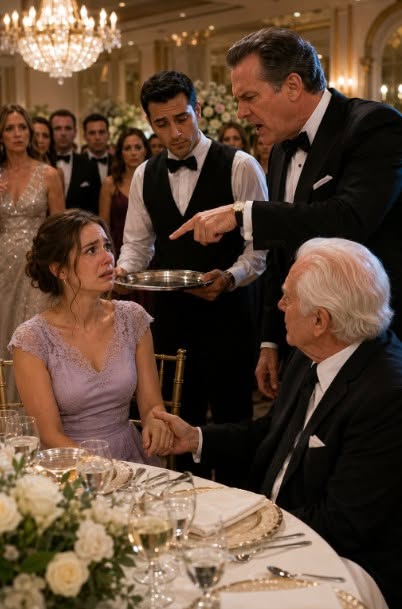
Gregory laughed loudly enough to draw attention.
“Of course you are.”
Conversations stopped.
“Gregory,” Mom whispered.
But he was enjoying himself now.
He pointed at me.
“You are not family.”
Silence spread across the ballroom.
“You showed up because you wanted a free meal,” he continued. “You’re too poor to buy yourself a decent dinner.”
The plate slipped from my hands.
Porcelain shattered.
The band stopped.
Two hundred people stared.
A waiter stepped forward.
“Sir, there’s more than enough—”
“Do not serve her.”
Gregory’s voice cracked across the room.
“If she touches anything on those tables, call security.”
My vision blurred.
Near the cake, Valerie covered her mouth.
Not in sympathy.
In horror that her perfect reception had been interrupted.
Lucas pushed toward us.
Two men tried to restrain him.
I turned toward the doors.
I wanted the parking lot.
My Honda.
My apartment.
Anywhere that wasn’t there.
Then somebody stepped into my path.
The white-haired gentleman from the foyer.
He carried the same silver-handled cane.
Up close, he was perhaps seventy-five.
Tall despite his age.
Sharp blue-gray eyes.
My eyes.
He held out his hand.
“Take my hand, Clara.”
I stared at him.
“Who are you?”
He did not answer me.
Not yet.
Instead, he turned toward Gregory.
Then toward the investors.
His voice carried without shouting.
“Good evening. My name is Harrison Caldwell.”
Gregory went white.
Behind him, my mother seemed to stop breathing.
Harrison took my trembling hand.
“There are several things everyone here needs to learn about this young woman before anyone ever dares call her unwanted again.”
Nobody spoke.
Then Harrison looked at me.
“Your father was my son.”
My knees weakened.
“What?”
“Daniel Caldwell.”
I stared at Mom.
She whispered, “Clara—”
“You told me he left.”
“He did.”
“No,” Harrison said.
His voice was calm.
That somehow made it worse.
“My son died eleven months after Clara was born.”
The room seemed to tilt.
Harrison reached into his jacket.
He removed an old photograph.
A young man stood beside a lake holding a baby wrapped in lavender.
He had dark hair.
A crooked smile.
My eyes.
On the back was handwriting faded by time.
**My Clara. My whole world.**
I stopped breathing.
“That’s me?”
“Yes.”
My fingers shook as I touched the photograph.
Mom’s eyes filled with tears.
“I was trying to protect you.”
“From what?”
She looked at Harrison.
“From them.”
Harrison’s jaw tightened.
“Daniel and Monica separated shortly before his death. She blamed the Caldwell family for interfering.”
“You threatened to take Clara,” Mom said.
“I offered help.”
“You hired attorneys.”
“Because you vanished with my granddaughter.”
Gregory stepped forward.
“This has gone far enough.”
Harrison slowly turned.
“No, Gregory. It hasn’t even started.”
A woman near the investors’ table rose.
Late sixties.
Silver hair.
Navy suit.
She carried a leather folder.
“This is Elaine Porter,” Harrison said. “My attorney.”
Gregory’s face changed again.
Not anger.
Fear.
Elaine opened the folder on a nearby table.
“Daniel Caldwell created a trust eleven days before his death,” she said.
I stared at her.
“A trust?”
“For you.”
I nearly laughed.
I lived in a one-bedroom apartment.
I counted quarters before laundry.
I sometimes skipped lunch before payday.
“What kind of trust?”
Elaine slid forward a document.
The number printed on it made no sense.
I read it twice.
Then a third time.
At the time Daniel died, the trust had contained **$2.4 million in company shares and investments.**
Today, properly managed, it should have been worth considerably more.
“Why didn’t I know?”
Elaine looked at my mother.
Because Monica had been appointed temporary guardian of the assets.
My chest tightened.
“What happened to the money?”
Nobody answered.
Then I understood why Gregory looked afraid.
Elaine placed bank statements beside the trust agreement.
Withdrawals.
Loans.
Transfers.
Shell companies.
My name appeared repeatedly.
Some transfers were dated when I was eight.
Ten.
Fourteen.
Eighteen.
“Mom?”
She started crying.
“I didn’t know what Gregory was doing at first.”
Gregory snapped, “Shut up.”
Every head turned.
I looked at him.
“What did you do?”
He said nothing.
Elaine answered.
“Your stepfather used assets from your trust as collateral when he launched Bennett Development.”
My stomach dropped.
Gregory’s luxury homes.
His cars.
The country club.
Valerie’s private college.
The vacations I watched through photographs while working holiday shifts.
“Bennett Development,” Elaine continued, “was funded primarily through assets belonging to Clara Caldwell.”
The ballroom erupted into whispers.
Gregory slammed his hand against the table.
“That is a lie.”
Harrison lifted his cane slightly.
“Is it?”
Elaine produced another document.
A signature.
Mine.
Except it wasn’t mine.
It supposedly authorized a transfer when I was nineteen.
I had never seen it.
“I didn’t sign this.”
“We know,” Elaine said.
Gregory laughed nervously.
“This is absurd.”
Then Lucas appeared beside me.
“I have something.”
His face was pale.
In his hand was a flash drive.
Gregory stared at him.
“Lucas.”
Lucas ignored him.
“I found copies of old financial records in Dad’s office six months ago.”
“Give me that.”
“No.”
Gregory lunged one step forward.
Harrison’s security man appeared instantly between them.
Lucas handed the drive to Elaine.
“I didn’t understand what I was seeing,” he said. “But Clara’s name kept appearing.”
I stared at my brother.
“Why didn’t you tell me?”
“I was trying to make sure before I blew up your life.”
Gregory shouted, “You ungrateful little—”
“Stop.”
The voice belonged to Valerie.
Everyone looked at the bride.
For the first time all evening, she wasn’t posing.
She was crying.
She walked toward us.
“Is my wedding being paid for with Clara’s money?”
Gregory said nothing.
Valerie’s expression changed.
“Dad?”
Mom sat down suddenly.
Her face had collapsed into both hands.
Harrison looked at me.
“There is something else.”
I almost didn’t want to hear it.
Elaine pulled out another page.
“When you turned thirty,” she said, “control of all remaining trust assets should legally have transferred directly to you.”
“I’m thirty-two.”
“Yes.”
“So why didn’t it?”
Elaine looked grim.
“Someone filed a petition claiming you were financially incompetent.”
I felt cold.
“What?”
A psychological evaluation had supposedly described me as unstable, irresponsible, and incapable of managing assets.
I had never met the doctor whose signature appeared on it.
Gregory had used it to extend control.
The humiliation at the wedding suddenly felt different.
Not random.
Not merely cruelty.
He had spent years making everyone believe I was pathetic.
Poor Clara.
Unsuccessful Clara.
Embarrassing Clara.
A woman who couldn’t manage money.
A woman who needed to be ignored.
**He had been building a story around me because that story protected his fortune.**
I looked at Mom.
“You knew?”
She cried harder.
That was my answer.
Something inside me broke.
But it didn’t break the way Gregory expected.
It didn’t make me smaller.
It made me quiet.
I turned to him.
“You called me a freeloader.”
He looked around, realizing the entire ballroom was watching.
“You said I came here for your food.”
“Clara—”
“How much of this wedding did I pay for?”
No answer.
“The flowers?”
Silence.
“The ballroom?”
His jaw clenched.
“Valerie’s dress?”
Valerie covered her mouth.
I looked toward the towering cake.
“The food you just told them not to serve me?”
Lucas gave a humorless laugh.
Gregory shouted, “I built everything you see!”
Harrison replied, “With stolen capital.”
That was when men in dark suits appeared at the ballroom entrance.
Not wedding security.
Federal investigators.
Elaine explained that Harrison’s attorneys had contacted authorities after tracing transfers through multiple companies.
Gregory stared at Harrison.
“You set this up.”
“No,” Harrison said.
“You did.”
Agents approached.
Gregory backed away.
Mom stood.
“Please.”
For a moment, I thought she was speaking to the agents.
Then she looked at me.
“Clara, please.”
I stared at the woman who had watched my childhood disappear one humiliation at a time.
“Why?”
Her voice broke.
“Because I was scared.”
“Of Gregory?”
“At first.”
“And later?”
She looked down.
That silence answered too.
Later, the money became easier.
The house became bigger.
The vacations became nicer.
Valerie needed tuition.
Lucas needed tuition.
There was always another reason to wait before telling me.
Always another reason to remain silent.
Gregory was escorted out through the same ballroom where he had ordered me removed.
Guests parted for him.
His investors wouldn’t look at him.
At the doorway, he twisted back toward me.
“You think these people care about you now because you have money?”
I stared at him.
“No.”
He smirked.
“Then you’re still stupid.”
“No,” I said. “I think they’re staring because they just watched a thief call his victim a freeloader.”
For the first time in my life, Gregory Bennett had nothing to say.
The doors closed behind him.
The wedding did not recover.
How could it?
Valerie disappeared into the bridal suite.
Guests left in waves.
Mom sat alone at a table.
Lucas stayed beside me.
And Harrison never released my hand until I finally asked him the question I had been avoiding.
“Why didn’t you find me?”
Pain moved across his face.
“We tried.”
“For thirty-two years?”
“For fourteen.”
He reached into his pocket.
This time he removed an envelope.
The paper was yellowed.
My name was written on it.
CLARA — AGE 5.
Inside was a birthday card.
Then another.
AGE 6.
AGE 7.
AGE 8.
There were photographs.
Letters.
Receipts from certified mail.
All returned.
Harrison had been writing to me.
Mom had sent everything back.
“I thought eventually you would contact us,” he said. “But your mother told our attorneys that you wanted nothing to do with the Caldwell family.”
“I was a child.”
“I know.”
His voice cracked.
“For years, I believed you had been taught to hate us.”
I opened one letter.
Inside Harrison had written about Daniel.
How he played terrible guitar.
How he hated olives.
How he once drove eight hours through a snowstorm because Monica had called and said baby Clara had a fever.
A father who abandoned me wouldn’t have done that.
I started crying.
Not quietly.
Thirty-two years of questions came apart at once.
Harrison pulled me into his arms.
And for the first time that day, I stopped caring who watched.
Three months later, Gregory was indicted on fraud, forgery, and financial crimes.
Mom accepted a plea agreement for cooperating.
I did not visit her.
Not then.
Maybe someday.
Valerie’s marriage survived the wedding, though barely. Her husband, Nathan, turned out to be far kinder than the family around him. Valerie returned nearly every wedding gift and sold several pieces of jewelry Gregory had bought her.
She gave the proceeds to the trust restitution fund.
When she came to my apartment, she stood outside for ten minutes before knocking.
“I knew Dad was cruel to you,” she said.
I waited.
“But I liked being the one he loved.”
That was the first honest thing she had ever said to me.
“I’m sorry.”
I didn’t forgive her that day.
But I let her sit down.
Sometimes that is where forgiveness starts.
Lucas joined Harrison Imports after graduation from his MBA program.
I didn’t.
Everyone assumed I would.
Instead, I stayed at the dry cleaner for another six months.
Mr. Patel nearly fainted when he learned I was technically wealthy.
“You’ve been fixing my payroll spreadsheets for fourteen dollars an hour?”
“Fifteen now.”
He laughed so hard he had to sit down.
Then something unexpected happened.
Harrison asked to see one of the spreadsheets.
I showed him the bookkeeping system I had built for Mr. Patel’s three stores.
He studied it.
Then he looked at me strangely.
“Daniel used to organize numbers exactly like this.”
My heart squeezed.
Eventually, I took courses in forensic accounting.
Not because I needed the money.
Because I wanted to understand how Gregory had hidden mine.
Within two years, I was working with a nonprofit that helped elderly people and low-income families recover assets lost through financial abuse.
I wore good clothes now.
But I kept the lavender dress.
I kept the old Honda too, until the transmission finally surrendered on Interstate 64.
Harrison cried harder at the junkyard than I did.
“I hate this car,” he said.
“You hate that it proves I survived without you.”
He smiled.
“That too.”
For my thirty-fifth birthday, Harrison invited me to dinner.
Nothing elaborate.
Just family.
Lucas.
Valerie.
Nathan.
Harrison.
And me.
Halfway through dessert, Harrison placed a small velvet box beside my plate.
“I’m not accepting diamonds.”
“It isn’t jewelry.”
Inside was the silver handle from his cane.
I stared at him.
“You broke your cane?”
“I never needed it.”
I looked up.
He smiled.
“I carried it because Daniel gave it to me.”
I turned the handle over.
There was an engraving beneath it.
Three initials.
D.C.C.
“Daniel Charles Caldwell,” I whispered.
Harrison shook his head.
“No.”
My breath stopped.
He pointed to the final C.
“Daniel had it engraved after you were born.”
I looked closer.
D.C.C.
Daniel.
Caldwell.
Clara.
Then I noticed something else.
The silver cap unscrewed.
Inside was a tiny rolled piece of paper.
My hands trembled as I opened it.
It was a handwritten note from my father.
If something happens to me, my father must know Monica is frightened of Gregory Bennett. Gregory has been lending her money. He keeps asking about Clara’s trust.
I looked up sharply.
“Gregory knew Mom before Dad died?”
Harrison’s expression changed.
“Yes.”
A chill ran through me.
That was the one detail nobody had explained.
Gregory had always claimed he met Mom two years after Daniel’s death.
He had lied.
I read the rest.
If I am gone, do not assume the accident was an accident.
The dining room became silent.
Lucas whispered, “What accident?”
Harrison’s face had turned white.
My father had died when his car went off a bridge during a storm.
The case had been ruled accidental.
But the original police report contained one strange detail Harrison had never understood.
**Daniel’s brake line had been replaced three days before the crash.**
The mechanic who replaced it?
A small garage partly owned by Gregory Bennett’s older brother.
Gregory’s fraud case had uncovered millions.
But financial investigators had also found an old payment.
Ten thousand dollars.
Transferred from Gregory to his brother forty-eight hours after Daniel died.
For thirty-four years, nobody had connected it.
Until now.
I stared at the silver cane handle.
The letters.
The returned birthday cards.
The trust documents.
All the clues that had been waiting for someone to put them together.
Gregory hadn’t entered my life after my father disappeared.
**Gregory had been there before my father died.**
And suddenly I understood something far darker.
He hadn’t spent my childhood punishing me because I wasn’t his daughter.
He had spent my childhood looking at the child whose inheritance had built his life—
the child of the man whose death had made that inheritance accessible.
The investigation into Daniel Caldwell’s death was reopened.
I wish I could say I felt triumphant.
I didn’t.
I felt hollow.
Some victories arrive too late to return what was stolen.
But Harrison sat beside me during every interview.
Lucas came to every hearing.
Valerie testified about documents she had seen Gregory burn years earlier without understanding what they were.
And Mom finally told the truth.
Gregory had been obsessed with Daniel’s company shares.
He had convinced Monica that Daniel’s family would take me away.
Then he convinced her to hide financial information.
Then he convinced her to sign papers.
By the time she understood how deep the fraud went, she was implicated.
Fear became silence.
Silence became comfort.
Comfort became complicity.
Years later, prosecutors charged Gregory in connection with Daniel’s death.
The final evidence came from the last person anyone expected.
Gregory’s brother.
Dying from cancer and facing his own charges, he confessed that Gregory had paid him to tamper with Daniel’s car.
The motive had never been jealousy.
It had been money.
My money.
At sentencing, Gregory looked older.
Smaller.
He saw me in the gallery and smiled bitterly.
“You got everything.”
I shook my head.
“No.”
He waited.
I looked at Harrison beside me.
At Lucas.
At Valerie.
At the photograph of my father tucked inside my purse.
“You took things money can’t replace.”
His smile disappeared.
“But you failed at the one thing you spent your whole life trying to prove.”
“What’s that?”
I stood.
“That I was unwanted.”
Outside the courthouse, Harrison offered me his arm.
I took it.
Not because I needed help walking.
Because family, I had learned, was not the person who controlled the seating chart.
It was not the person who shared your house.
It was not even always the person who shared your blood.
Family was the person who reached for your hand when everyone else wanted you to disappear.
Three years after Valerie’s wedding, the Sterling Grand invited Harrison to a charity gala.
He refused to attend unless I came.
This time, when I drove through the gates, I wasn’t in the Honda.
But I wore lavender.
Not because I had anything to prove.
Because I liked the color.
The same hostess from Valerie’s wedding stood near the entrance.
She recognized me immediately.
Her face went pale.
“Ms. Caldwell.”
I smiled.
“Hello.”
She glanced toward Harrison.
Then back at me.
“Welcome.”
Inside, waiters circulated with silver trays.
One young man approached carrying salmon crostini.
I recognized him.
He was the waiter who had tried to defend me at Valerie’s wedding.
He recognized me too.
For one awkward second, neither of us spoke.
Then he smiled.
“Ma’am?”
He offered me the tray.
I took one.
Then another.
Harrison raised an eyebrow.
“What?”
I said.
“There’s more than enough food.”
He laughed.
And beneath the same chandeliers where Gregory Bennett had once announced that I was not family, **I finally understood the truth he had spent decades trying to bury.**
I had never been the poor outsider who wandered into someone else’s world.
I was Clara Caldwell.
Daniel’s daughter.
Harrison’s granddaughter.
A sister.
A survivor.
And, in the end, the fortune Gregory stole was not the greatest thing I recovered.
**I recovered the truth about who loved me before he ever taught me to believe nobody did.**