Three days after we buried my father-in-law, I discovered that my husband had already decided what I would do with my inheritance.
I just hadn’t been included in the decision.
“The Gull Lake property passes to Claire Bennett individually.”
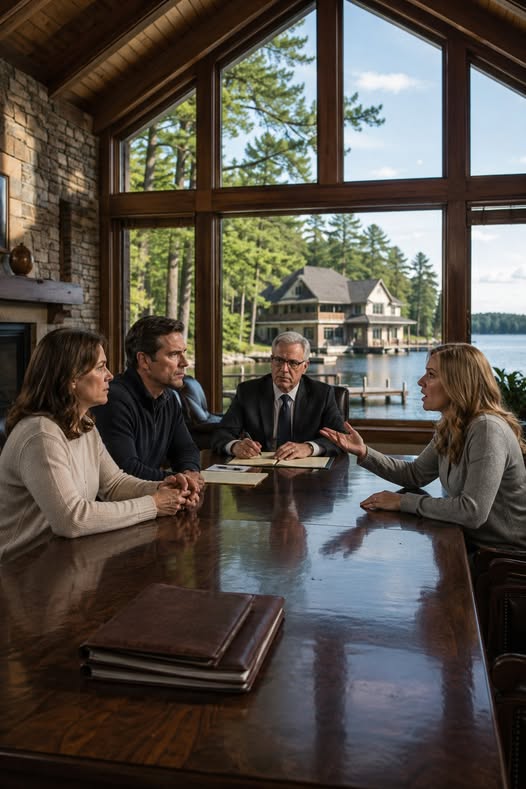
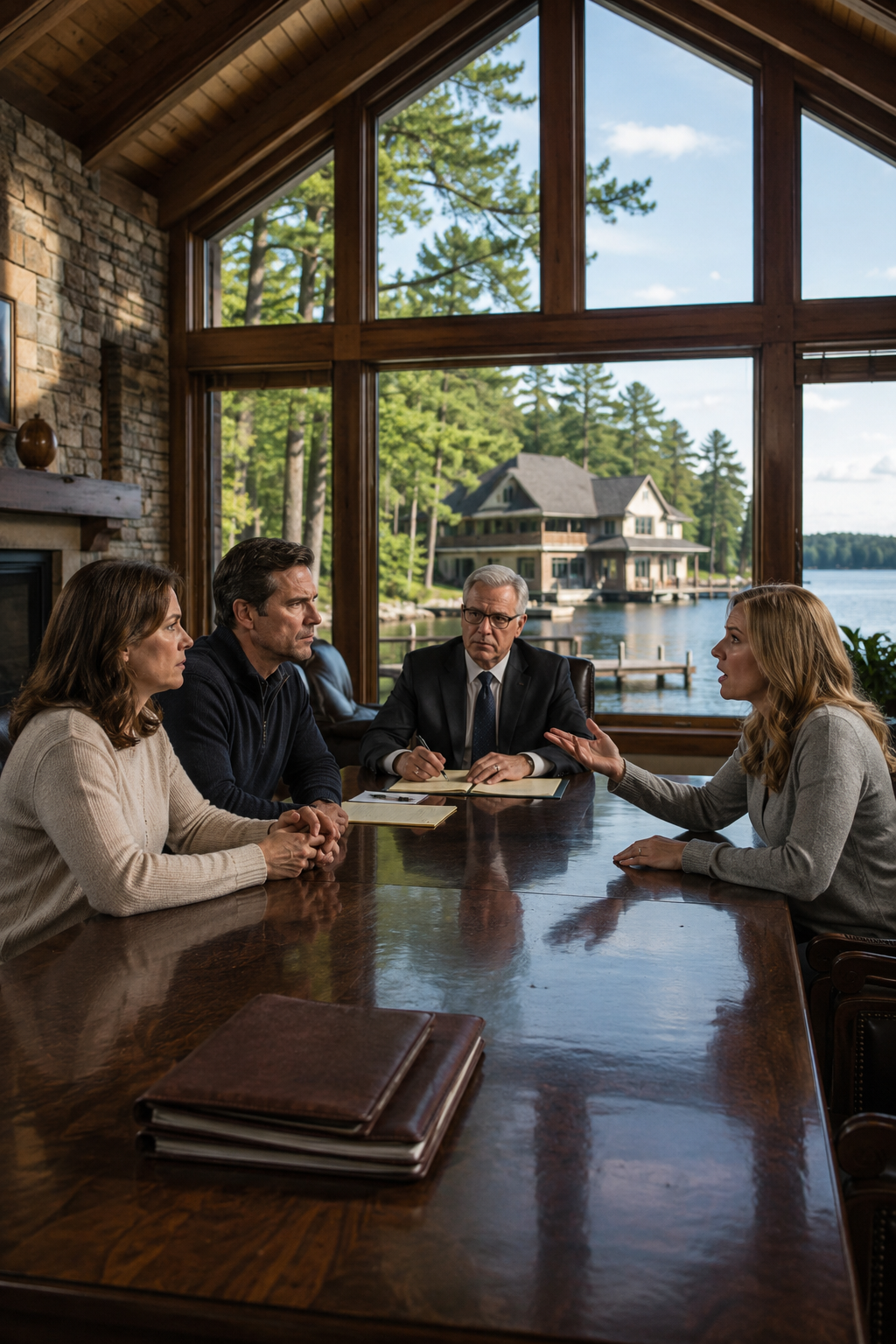
The attorney’s words settled over the conference room like smoke.
Nobody moved.
Nobody breathed.
For a moment, I honestly wondered whether grief had damaged my ability to understand English.
Claire Bennett.
That was me.
Gull Lake.
That was Frank’s house.
The lake house.
The cedar-sided home where Daniel and his sister Meredith had spent nearly every summer of their childhood. The place where our children had learned to swim. The house everybody in the Bennett family spoke about as if it were less a piece of property than a family member.
Beside me, my husband’s fingers tightened around mine.
Across the table, Meredith stared at estate attorney Charles Holloway.
Then she laughed.
A tiny, stunned sound.
“I’m sorry,” she said. “What?”
Charles adjusted the papers in front of him.
“The Gull Lake property is distributed to Claire individually.”
Meredith leaned forward.
“No. Daniel gets the lake house.”
Charles looked at her calmly.
“That is not what your father’s current trust says.”
“But Daniel is the oldest son.”
Charles said nothing.
Meredith turned sharply toward my husband.
“Daniel?”
Daniel was still holding my hand.
But his grip had changed.
It no longer felt comforting.
It felt possessive.
Then he leaned toward me and whispered something I would remember for the rest of my life.
“Don’t get confused by the wording. Dad’s house is still family property.”
I stared at him.
“What?”
“I heard what Charles said.”
“Then what are you talking about?”
His voice remained low.
“Dad probably put it in your name because you took care of him. Maybe he thought it would protect you somehow. We’ll sort it out.”
We’ll sort it out.
As if Frank had made a clerical error.
As if my name appearing in a legal trust was a temporary inconvenience.
Something cold moved through my chest.
Six days earlier, Frank Bennett had died at seventy-nine.
For the final three years of his life, I had gradually become the person who knew everything nobody else had time to know.
His medication schedule.
His cardiologist’s number.
His insurance password.
Which foods he could tolerate after pneumonia.
What time the hospice nurse came.
Where he kept his advance directive.
Which blanket he wanted when he was cold.
I was forty-six and had been married to Daniel for fourteen years.
When I first married into the Bennett family, Frank and I weren’t particularly close.
He was courteous but reserved—a traditional Midwestern man who expressed affection by asking whether your tires had enough tread for winter.
He rarely said, “I love you.”
He said things like, “That water heater sounds wrong.”
Or, “Interest rates are probably coming down.”
Or, “You should keep jumper cables in the trunk.”
Then his wife, Margaret, died.
Frank became quieter after that.
He lived through routines.
Tuesday breakfast at the same diner.
Thursday card night.
Sunday football.
And summers at Gull Lake.
The house sat a couple of hours north of Minneapolis, near Brainerd.
It wasn’t a mansion.
But it was beautiful.
Four bedrooms.
A screened porch.
An old wooden dock.
Tall pines.
A detached garage overflowing with fishing equipment nobody had properly organized since Bill Clinton was president.
The Bennett family never called it Frank’s lake house.
They simply called it the lake house.
I eventually learned that those two missing words—Frank’s house—explained almost everything.
My caregiving started after Frank slipped on ice and injured his hip.
Daniel traveled constantly for work. He was a regional vice president for an industrial building-supply company.
Meredith lived in Rochester and worked as a nurse administrator.
I worked hybrid as a contracts manager for an engineering firm, which meant my schedule was the easiest to rearrange.
So I drove Frank to one orthopedic appointment.
Then physical therapy.
Then the pharmacy.
Then cardiology.
Then another hospital visit.
Soon everyone had a reason why it made sense for me to handle things.
“Claire knows his medications.”
“Dad listens to Claire.”
“He’s calmer with her.”
Meredith’s favorite text was:
Let me know if you need anything.
Sometimes I actually asked.
Can you take him Thursday?
Her answer was usually some version of:
Wish I could. Crazy week.
So I went.
Again.
And again.
But I wasn’t a martyr.
I genuinely grew to love Frank.
We talked in doctors’ waiting rooms in ways we never had around Thanksgiving tables.
He told me about Margaret.
About the first time Daniel drove a car.
About nearly bankrupting themselves buying Gull Lake in the late eighties.
“Margaret bought that place,” he once told me.
“I thought you bought it together.”
“She found it.”
“That sounds more accurate.”
“She saw the dock and decided our children were going to grow up there.”
“Did you agree?”
“No.”
He gave me a dry smile.
“Then I paid for it for thirty years.”
That was Frank.
As his health declined, I drove him to the lake more often.
I opened windows in spring.
Changed sheets.
Bought groceries.
Called the dock company.
Replaced a broken water heater.
Once, while he sat watching the sunset from the screened porch, he said, “You do too much.”
I smiled.
“Your children inherited excellent delegation skills.”
Frank laughed until he coughed.
What I didn’t realize was that while I was helping Frank live in his house, the rest of the family had already begun planning life there without him.
It became obvious two Thanksgivings before his death.
Meredith was scrolling through her phone when she said casually, “Eventually we should redo that kitchen.”
Frank looked up.
“What kitchen?”
“The lake house.”
“Why?”
“The cabinets are ancient.”
“They work.”
Daniel joined in.
“The dock will need replacing first.”
Frank stared at him.
“I like my dock.”
Later, while I was loading the dishwasher, Frank came into the kitchen carrying a plate.
“They talk about that house like I’m already dead.”
“They don’t mean it that way.”
“Maybe.”
Then he looked at me.
“You don’t.”
“I don’t what?”
“Talk about it that way.”
I thought he meant I was being polite.
I had no idea how carefully he was watching all of us.
The following summer, Meredith brought a contractor friend to inspect a loose deck railing.
By dinner, they were talking about knocking down a kitchen wall.
Afterward, Frank sat beside me on the porch.
“I asked him to look at a railing.”
“I know.”
“Nobody wants to fix what I have.”
His voice was almost a whisper.
“They want to plan what comes after me.”
I told Daniel later.
He rolled his eyes.
“Dad gets territorial.”
“It’s his house.”
“Of course it is.”
“Then why is everybody renovating it in their heads?”
Daniel shrugged.
“Eventually somebody has to deal with it.”
Everybody knew who somebody meant.
Daniel.
The eldest son.
The assumed heir.
Even I believed the lake house would eventually belong to him.
Frank never told me otherwise.
Not once.
During the final six weeks of his life, he insisted on staying at Gull Lake.
Daniel thought he should remain closer to Minneapolis.
Frank refused.
“I’m going home.”
He meant the lake.
So I rearranged everything.
Three or four nights a week, I stayed there.
Daniel came when he could.
And I want to be fair about that.
Daniel loved his father.
He sat beside him.
He spoke to hospice workers.
Once, I found him crying alone in the garage because he didn’t want Frank to see.
This story would be simpler if my husband had always been cruel.
He wasn’t.
But his work was always considered immovable.
Mine moved.
Meredith came most weekends.
Yet even when everybody was present, they still asked me the questions.
Did Dad take his medication?
When did he eat?
Where are the insurance papers?
When is the nurse coming?
Frank died Tuesday morning.
Daniel and I were beside him.
Meredith arrived forty minutes later.
Frank had been dead less than three hours when Meredith stepped onto the screened porch and said, “We’ll need to decide what furniture stays.”
I remember staring at her.
She didn’t even seem to understand why.
Then came the funeral.
Flowers.
Church.
Photographs.
Casseroles nobody ate.
And finally Charles Holloway’s conference room.
After revealing that the lake house belonged to me, Charles allowed Meredith to argue for several minutes.
“Dad always said Daniel would get it.”
“I can only tell you what Frank executed,” Charles replied.
Meredith turned toward me.
“Did he discuss this with you?”
“No.”
“Never?”
“Never.”
She studied my face as if searching for evidence of a conspiracy.
Daniel spoke.
“She didn’t know.”
For one second, I felt grateful.
Then he added:
“We’ll figure it out.”
There was that we again.
Charles slowly removed his glasses.
“Before anyone figures anything out,” he said, “there is another matter.”
Meredith shifted.
It was barely noticeable.
But I noticed.
Charles opened another folder.
“Can someone explain why a real estate agent requested access to Gull Lake before Frank’s funeral?”
Meredith’s face drained.
Daniel released my hand.
“What realtor?”
Charles looked at Meredith.
“A woman named Rebecca Shaw contacted my office four days before Frank died. She claimed she’d been asked to prepare a preliminary valuation.”
Meredith crossed her arms.
“That proves nothing.”
“She gave your name.”
Daniel turned to his sister.
“Meredith?”
She shook her head.
“I was gathering information.”
“While Dad was dying?”
“Don’t make it sound disgusting.”
“How should I make it sound?”
“We all knew decisions were coming.”
I finally spoke.
“Frank was still alive.”
Her eyes snapped toward me.
“And you don’t understand what it costs to maintain that property.”
“I know exactly what it costs. I paid half the service bills for the last six weeks because nobody else remembered them.”
Meredith flushed.
Charles interrupted.
“There’s more.”
He removed a sealed envelope.
Frank’s handwriting was on the front.
CLAIRE ONLY.
My pulse hammered.
Charles slid it toward me.
“I was instructed to give this to you only after the family learned about the property.”
Daniel stared at the envelope.
“What does it say?”
“I haven’t opened it.”
He reached for it.
I pulled it away.
For the first time in fourteen years, I saw genuine anger flash through my husband’s eyes because I had denied him something.
“Claire.”
“It has my name on it.”
“I’m your husband.”
“That doesn’t make it yours.”
The silence that followed felt enormous.
I opened the envelope.
Inside was a single sheet.
Frank’s handwriting shook slightly.
Claire,
If Charles has given you this letter, then I am gone, the house is yours, and somebody has probably already told you that you don’t understand what that means.
My throat tightened.
Daniel looked away.
I continued.
You understand perfectly.
Do not sign anything.
Do not transfer the house.
Do not let grief convince you to surrender what I deliberately gave you.
Then came the sentence that made my hands start trembling.
“And before you trust Daniel, go to Gull Lake and open the red tackle box beneath my workbench.”
I stopped reading.
Daniel stood.
“What the hell?”
Meredith looked at him.
Not surprised.
Afraid.
I looked from one to the other.
“What’s in the tackle box?”
Daniel laughed without humor.
“Dad was medicated. You know how confused he got.”
“He wrote this before hospice,” Charles said quietly.
Daniel froze.
“How do you know?”
“Because I witnessed it.”
The room changed.
I folded Frank’s letter.
Daniel reached for my arm.
“Claire, listen to me.”
I pulled away.
“No.”
His expression hardened.
“After everything we’ve been through, you’re going to trust a dead man’s paranoia?”
I stared at him.
“Apparently he knew someone was calling realtors before he was buried.”
Daniel looked at Meredith.
And that was when I understood.
He wasn’t shocked about the realtor.
He was angry she had been caught.
I drove to Gull Lake the next morning.
Alone.
Daniel called seventeen times.
Meredith called nine.
I answered neither.
The house looked exactly as it had the week Frank died.
His coffee mug still sat beside the sink.
His reading glasses rested on a small table near the porch.
For a few minutes, I couldn’t move.
I simply stood there and cried.
Then I went to the garage.
Frank’s workbench was against the back wall.
Beneath it sat three tackle boxes.
Black.
Green.
Red.
My hands shook as I pulled the red one toward me.
Inside were fishing lures.
Old photographs.
A screwdriver.
And beneath the removable tray—
a flash drive.
A key.
And another envelope.
On it Frank had written:
YOU WERE NEVER SUPPOSED TO NEED THIS.
The key opened a metal lockbox hidden behind a cabinet.
Inside were documents.
Emails.
Bank statements.
And a printed purchase proposal from a development company.
My stomach dropped when I saw the proposed price.
$2.4 million.
The buyer wanted to demolish the lake house and divide the shoreline into three luxury lots.
The proposal was dated three months before Frank died.
And beneath it were emails.
From Daniel.
To Meredith.
At first I couldn’t process them.
Then I started reading.
Once Dad is gone, Claire won’t fight us.
Another:
She’ll sign whatever I put in front of her. She hates conflict.
And another:
Rebecca can have the valuation ready before probate so we don’t lose the buyer.
My knees went weak.
I sat on the concrete floor.
There was more.
Daniel had accumulated enormous losses through a failed private investment with two colleagues.
Nearly $680,000.
He had never told me.
He had taken loans against accounts I didn’t know existed.
He had promised part of the eventual lake-house proceeds to cover the debt.
That was why he had always spoken about the house as if it already belonged to him.
It wasn’t sentiment.
It was collateral in a future he had quietly built around Frank’s death.
Then I found the email that destroyed what remained of my marriage.
It was from Daniel to a divorce attorney.
Sent five months earlier.
Assuming she signs the deed transfer first, how long should I wait before filing?
I read the sentence three times.
The room blurred.
He hadn’t simply planned to take the house.
He had planned to use me to obtain it, transfer it out of my name, and then leave me.
My phone vibrated.
Daniel.
This time I answered.
“Claire.”
His voice sounded exhausted.
“Where are you?”
“You know where I am.”
Silence.
“You opened the box.”
“Yes.”
“Dad had no right to interfere in our marriage.”
I actually laughed.
It came out broken.
“Our marriage?”
“You don’t understand the financial pressure I was under.”
“I understand the email to the divorce attorney.”
Silence.
Then:
“That wasn’t final.”
“You asked how long to wait after I signed over the house.”
“I was angry when I wrote that.”
“For five months?”
“Claire—”
“You told Meredith I’d sign anything because I hate conflict.”
He exhaled.
“Please come home.”
I looked through the garage window at the lake.
“No.”
“Don’t destroy fourteen years because of something Dad manipulated.”
“You destroyed it.”
Then another voice came through the phone.
Meredith.
“Daniel, hang up.”
They were together.
Of course they were.
I ended the call.
But Frank’s lockbox still contained one final envelope.
It was thicker than the others.
Inside was a letter addressed to Charles.
And beneath it, one addressed to me.
I opened mine.
Claire,
Now you know enough to be angry.
Before you decide what kind of man I was for keeping this from you, you deserve to know that I almost did nothing.
Daniel is my son.
I loved him before he could walk.
I still loved him after I learned what he was planning.
That is the terrible thing about loving your children. Sometimes love makes you want to protect them from consequences they have earned.
I wiped tears from my face.
But Margaret made me promise something before she died.
I stopped.
Margaret?
I kept reading.
Go to the bottom of the box. There is a blue envelope.
I found it.
The handwriting wasn’t Frank’s.
It was Margaret’s.
She had written it eight years earlier, weeks before her death.
Frank,
If you are reading this because Daniel has once again treated Gull Lake as something he is owed, please remember what we agreed.
The house should belong to the person who understands that a home is not valuable because of what someone will pay for the land.
Then came the line I never expected.
“If Claire is still in this family, give it to her.”
I covered my mouth.
Margaret had written the letter when I had been married to Daniel only six years.
She continued:
I watch her at the lake.
She washes towels nobody asks her to wash. She makes beds she didn’t sleep in. She notices when you need help without humiliating you by announcing it.
Daniel sees inheritance.
Meredith sees tradition.
Claire sees people.
I was crying so hard I could barely read.
But the final paragraph changed everything again.
There is something I never told the children.
Gull Lake was never purchased with Frank’s money.
I frowned.
Frank had always joked that Margaret found the house and he spent thirty years paying for it.
But according to her letter, that wasn’t true.
The original down payment—and nearly the entire mortgage payoff—had come from Margaret’s inheritance from her mother.
She had deliberately kept the property titled jointly because she believed marriage meant sharing everything.
But before she died, she and Frank signed a private estate agreement.
If either Daniel or Meredith attempted to sell the property before Frank’s death, pressure him to transfer it, or arrange a sale in anticipation of inheriting it, Frank was to remove the lake house from their inheritance completely.
It wasn’t revenge.
It was Margaret’s final condition.
And Frank had honored it.
I thought that was the final twist.
I was wrong.
Three days later, we returned to Charles’s office.
Daniel brought an attorney.
Meredith did too.
Daniel looked terrible.
He barely acknowledged me.
His lawyer spoke first.
“My client believes Frank may have been subject to undue influence during his final months.”
Charles nodded.
“You’re entitled to raise that claim.”
Daniel glanced at me, almost relieved.
Then Charles continued.
“However, before you do, there is a provision you should understand.”
He opened Frank’s trust.
“Frank anticipated a challenge.”
Daniel’s lawyer stiffened.
Charles read the clause.
Any beneficiary who challenged the distribution of Gull Lake—or pressured Claire to transfer ownership—would immediately forfeit their remaining inheritance.
Meredith went pale.
Daniel stared at Charles.
“How much?”
Charles folded his hands.
“For you? Approximately nine hundred thousand dollars.”
Daniel’s attorney whispered something urgently.
But Charles wasn’t finished.
“There is also the issue of the property valuation.”
Meredith sank backward.
“The request made to Rebecca Shaw satisfied one of Margaret Bennett’s conditions.”
Daniel frowned.
“What conditions?”
Charles slid copies of Margaret’s letter across the table.
For the first time, my husband looked truly broken.
He read his mother’s words.
His lips moved silently.
Then he looked at me.
“She chose you?”
“Apparently.”
“My own mother?”
There was no anger in his voice now.
Only disbelief.
Charles said gently, “Your mother chose whoever proved they understood what the house meant.”
Daniel stared at the table.
For a moment I almost felt sorry for him.
Almost.
Then Charles reached for one final folder.
“I’m afraid there is one more matter.”
Meredith groaned.
“What now?”
Charles looked directly at me.
“Claire, Frank asked me not to disclose this unless Daniel contested the trust or attempted to pressure you into transferring the house.”
Daniel’s head lifted.
Charles slid a document toward me.
I looked down.
It was a deed.
Not a trust amendment.
Not a will.
A deed.
My name appeared under Grantee.
The date was six months before Frank died.
I looked up.
“I don’t understand.”
Charles smiled faintly.
“Frank transferred Gull Lake to you six months ago.”
Daniel jumped to his feet.
“What?”
“The deed was recorded.”
“But today you said she inherited it!”
“No,” Charles replied.
“I said the trust distributed any remaining interest in Gull Lake to Claire. That statement was legally accurate.”
My heart pounded.
Charles turned to me.
“The house has actually been yours for six months.”
I stared at him.
“How could I own property without knowing?”
“Frank retained a lifetime estate and instructed me not to tell you. He was afraid you would refuse.”
I couldn’t speak.
Then Charles said the words that delivered Frank’s final move.
“And because the house had already legally transferred before Rebecca Shaw was contacted, Daniel and Meredith were attempting to arrange the sale of property neither of them—and not even Frank—still owned.”
Meredith whispered, “Oh my God.”
Daniel slowly sat down.
Every plan.
Every email.
Every whispered assumption.
Every renovation they had imagined.
Every dollar Daniel had mentally spent—
had been built around a house that was already mine.
Charles handed me one final note.
Only four lines.
Frank’s handwriting.
Claire,
You once joked that my children inherited delegation skills.
So I delegated one last job to you.
Take care of the house. And this time, take care of yourself too.
I sold nothing.
I transferred nothing.
Daniel moved out two weeks later.
Our divorce took eleven months.
Meredith didn’t speak to me for nearly a year.
Eventually, she did.
The first thing she said when I answered the phone was:
“I was horrible.”
I didn’t disagree.
We never became close.
But she apologized.
Really apologized.
Daniel lost a large portion of his inheritance paying his debts. He eventually admitted the marriage had been failing in his mind long before Frank became sick.
I told him that was the part he should have told me.
Not after the house.
Before it.
The following summer, I drove north with my children.
When Gull Lake appeared through the trees, I nearly turned around.
Everything about the place hurt.
Frank’s chair.
Margaret’s old dishes.
The dock everyone had wanted to replace.
I walked onto the screened porch and stood where Frank used to sit.
My daughter came beside me.
“Are we keeping it?”
I looked across the water.
For years, everyone had asked the wrong question.
Who gets the house?
Daniel?
Meredith?
The children?
The cousins?
Me?
But standing there, I finally understood what Margaret and Frank had understood long before any of us.
A family home isn’t preserved because the right person owns it.
It survives because somebody keeps showing up.
Somebody opens the windows.
Somebody fixes the railing instead of planning the renovation.
Somebody changes the sheets.
Somebody remembers which chair an old man liked facing the lake.
Somebody takes care of what already exists before dreaming about what it could become.
I looked at my daughter.
“Yes,” I said.
“We’re keeping it.”
That afternoon, we found Frank’s old fishing rods in the garage.
The dock was still crooked.
The kitchen cabinets were still ancient.
The wall Meredith wanted removed was still standing.
I repaired the loose railing.
Nothing more.
And when the sun began setting behind the pines, turning the lake gold, I carried Frank’s old chair onto the porch.
Underneath the cushion was something hard.
Another envelope.
For one terrible second, I thought there was one more secret.
Instead, inside was a photograph.
Frank and Margaret stood on the unfinished dock in 1989.
Young.
Laughing.
Behind them was the tiny original lake house.
On the back, Margaret had written:
“We spent everything we had because we wanted a place our family would always come back to.”
Below it, in much newer ink, Frank had added one sentence.
“Turns out the house was never the inheritance.”
I stared at those words for a long time.
Then I looked through the screen door.
My children were laughing on the dock.
The same dock Daniel had wanted to replace.
The same water where he and Meredith had once learned to swim.
The same place Margaret had chosen decades earlier because she imagined children growing up there.
And suddenly I understood.
Frank had never really been deciding who deserved a piece of real estate.
He had been deciding who could be trusted with the memory of a family after the family itself had forgotten what mattered.
Daniel thought his father had left me a house.
Meredith thought Margaret had chosen me over her own children.
For a while, even I believed the inheritance was a reward for three years of caregiving.
But none of us had understood the truth.
Frank didn’t leave me Gull Lake because I had taken care of him.
He left it to me because, long before anybody knew there would be an inheritance to fight over, I had already been taking care of the one thing everyone else believed they owned.
And that was the secret Margaret had seen first.
The lake house had never needed an heir.
It needed a guardian.